
Slider Beef Burgers
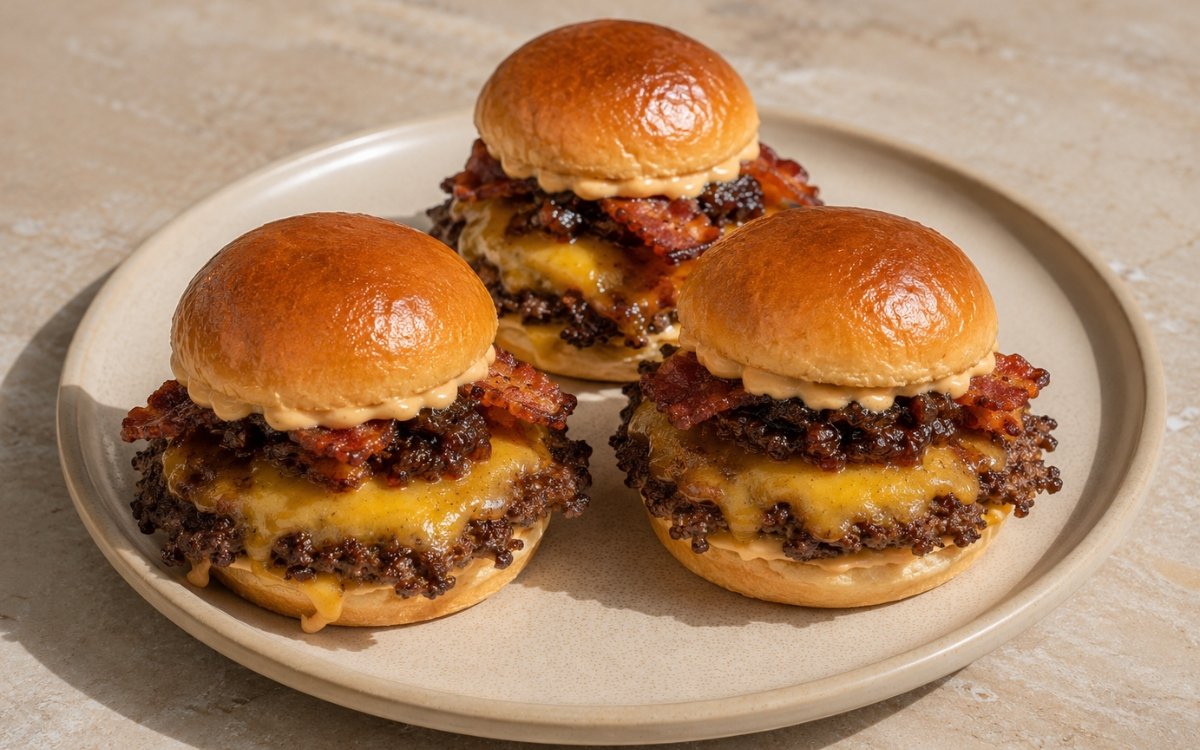
Mini smash-burger sliders on soft toasted brioche slider buns, each stacked with a thin crispy-edged 85/15 beef patty, melted American cheese, crisp bacon, dark glossy bacon-onion jam, and hot mayo. Smashing the beef hard against a screaming-hot griddle the instant it hits the surface is the technique this whole slider depends on — that violent initial contact is what produces the lacy, deeply browned crust, the same hard-and-immediate smash principle used elsewhere in this collection whenever a thin patty needs maximum surface contact for real char. Leaving the beef balls loosely packed rather than compressed protects the patty’s texture from the inside, since overworked beef turns dense and bouncy rather than staying tender once smashed thin. Reducing the bacon-onion jam until genuinely sticky, not merely soft, is what keeps it from running down the bun and destabilising the whole slider. The payoff is a stack of miniature burgers with real structural and textural range — a lacy, crisp-edged patty, melted cheese, crackling bacon, and dark, glossy jam, all held together by a properly toasted bun.
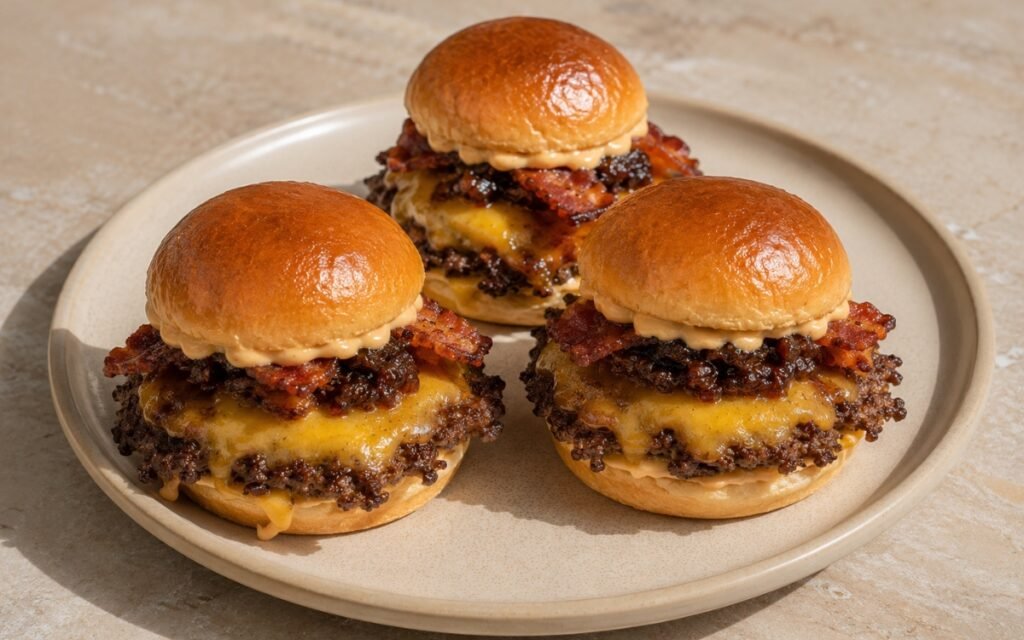
Prep Time : 30 min
Cook Time : 45 min
Servings : 12 Sliders
30 min
45 min
12 Sliders
Ingredients
For the Slider Buns
• 12 brioche slider buns, store-bought or homemade — use Brioche Burger Buns with the Mini Slider Buns variation if making your own
• 30g unsalted butter, softened, for toasting — this one on Amazon
For the Smash Burger Patties
• 960g ground beef, 85/15, divided into 12 x 80g balls
• 10g kosher salt
• 4g freshly cracked black pepper
• Neutral oil, only if needed for the griddle
For the Cheese
• 12 slices American cheese
For the Crispy Bacon
• 24 thin bacon half-strips or 12 full thin slices cut in half — use 2 half-strips per slider
For the Bacon-Onion Jam
• 200g bacon, finely chopped
• 350g yellow onion, finely diced
• 20g unsalted butter, only if needed
• 40g light brown sugar — this one on Amazon
• 45ml apple cider vinegar
• 30ml maple syrup — this one on Amazon
• 15ml balsamic vinegar — this one on Amazon
• 10g Dijon mustard — this one on Amazon
• 2g smoked paprika — this one on Amazon
• 1g freshly cracked black pepper
• Pinch of kosher salt, only if needed
For the Hot Mayo
• 180g mayonnaise
• 35g hot sauce
• 15g ketchup
• 10g Dijon mustard
• 10ml pickle brine or fresh lemon juice
• 2g smoked paprika
• 1g garlic powder
• Pinch of kosher salt
This post may contain affiliate links. As an Amazon Associate I earn from qualifying purchases, at no additional cost to you.
Directions
- Make the Bacon-Onion Jam
Add the finely chopped bacon to a cold skillet. Cook over medium heat for 8–10 minutes, stirring often, until the fat renders and the bacon becomes browned and crisp. Remove about one-third of the crisp bacon pieces and reserve them for texture. Leave 25–30ml bacon fat in the pan. Add the diced onion and cook over medium-low heat for 15–18 minutes, stirring often, until soft, golden, and deeply sweet. Add the brown sugar, apple cider vinegar, maple syrup, balsamic vinegar, Dijon mustard, smoked paprika, black pepper, and the reserved crisp bacon. Cook for another 8–10 minutes until dark, sticky, glossy, and spoonable. The jam should be thick enough to sit on the slider without running down the bun. If it is watery, keep reducing. Wet jam will wreck the bun. Starting the bacon in a cold pan rather than a hot one lets its fat render out gradually as the pan heats, producing evenly crisp bacon rather than pieces that scorch on the outside before their fat has fully released. - Make the Hot Mayo
Mix the mayonnaise, hot sauce, ketchup, Dijon mustard, pickle brine or lemon juice, smoked paprika, garlic powder, and salt until smooth. The sauce should be creamy, lightly spicy, and thick enough to spread. Do not make it runny. Keeping this sauce genuinely spreadable rather than pourable matters specifically for a slider’s small scale — a looser sauce would run off the tiny bun before the rest of the toppings even go on. - Cook the Crispy Bacon
Cook the bacon half-strips in a skillet over medium heat until deeply golden and crisp, about 6–8 minutes. Transfer to a rack or paper towel-lined plate. Do not burn it. You want crisp bacon that still bends slightly, not dry black shards. Bacon that still has a slight bend to it, rather than being cooked to complete rigidity, is easier to fold and fit neatly onto a small slider bun without cracking or splintering apart. - Prepare the Beef
Divide the beef into 12 loose balls, 80g each. Do not compress them tightly. Keep chilled until just before cooking. Season the outside with salt and black pepper right before smashing. Keeping the beef loosely balled rather than packed tightly is what preserves a tender bite once the patty is smashed thin — overworked, tightly compacted beef develops a denser protein structure that turns noticeably bouncier and tougher under heat. - Preheat the Griddle
Heat a cast-iron skillet, flat-top griddle, or heavy steel pan over high heat until extremely hot. The surface should be just beginning to smoke. This is the main turning point. A lukewarm pan gives grey mini burgers. Smash sliders need violent heat for crispy edges. This intensity of heat is what allows the thin, smashed patty to develop a real, deeply browned crust within the very short cook time a slider-sized patty actually needs — anything less produces pale, steamed beef rather than the lacy crust this style depends on. - Toast the Buns
Butter the cut sides of the slider buns. Toast them cut-side down on a skillet or griddle for 1–2 minutes until golden and lightly crisp. Set aside. Toasting matters because these buns have to hold mayo, jam, bacon, cheese, and beef fat. A lightly crisped interior surface gives the small, soft brioche bun meaningfully more resistance against the combined moisture and fat from every topping stacked on top of it. - Smash the Patties
Place a few beef balls on the hot griddle, leaving space between them. Immediately smash each ball hard with a stiff spatula or burger press into a thin patty. Hold the press down for about 8–10 seconds so the beef makes full contact with the surface. Cook undisturbed for 60–90 seconds until the edges are deeply browned, lacy, and crisp. Do not move the patties early. If you mess with them before the crust forms, you lose the whole point of a smash burger. Holding the press down for those first several seconds is what forces the ball to spread thin and maintain full, sustained contact with the hot surface — releasing pressure too early lets the patty spring back thicker in places, producing uneven browning across its surface. - Flip and Cheese
Scrape under each patty firmly to preserve the crust, then flip. Add one slice of American cheese immediately. Cook for another 45–60 seconds until the cheese melts and the patty is cooked through. Work in batches so the griddle stays hot. Crowding makes steam, and steamed sliders are pathetic. Scraping firmly rather than gently is deliberate — a light touch risks leaving the hard-earned crust stuck to the griddle instead of attached to the patty, undoing the entire point of the initial smash. - Assemble the Sliders
Spread hot mayo on the bottom buns. Add one cheese-covered smash patty to each bun. Add 2 crispy bacon half-strips. Spoon bacon-onion jam over the bacon and cheese. Add a little more hot mayo to the top bun if desired, then close the sliders. Building in this specific order — sauce, patty, bacon, jam — keeps the wettest component, the jam, positioned on top rather than sandwiched directly against the bottom bun, where it would have the most direct and prolonged contact with the bread. - Serve
Serve immediately while the patties are hot, the cheese is melted, the bacon is crisp, and the jam is glossy. Sliders are tiny, so they lose heat quickly and the buns soften quickly. Their small scale means less thermal mass than a full-sized burger, so both the temperature and the crisp textures fade noticeably faster — serving without delay matters even more here than it would for a standard burger.
*Notes :
- The cold-start technique for the bacon-onion jam’s bacon component is worth understanding as more than a minor procedural detail. Bacon added to an already-hot pan tends to seize and brown unevenly on the outside before its interior fat has had time to properly render out. Starting it cold and letting the pan’s temperature climb gradually alongside it produces bacon that renders more completely and crisps more evenly across every piece.
- Keeping the beef loosely balled rather than compacted addresses a texture concern that becomes especially pronounced once the beef is smashed thin. A tightly packed ball of ground beef has already begun developing a denser, more cohesive protein structure before it ever reaches the griddle — smashing that same dense structure into a thin patty tends to produce something noticeably tougher and springier than beef that started loose and only came together under the force of the smash itself.
- The griddle’s extreme heat is non-negotiable specifically because of how little time a slider-sized smash patty actually spends cooking. A full-sized smash burger has more mass and more time on the heat to develop its crust; a slider patty, being considerably smaller and thinner, needs to build that same lacy, deeply browned exterior within a much shorter window, which is only achievable with genuinely aggressive starting heat.
- The bacon-onion jam’s reduction to a genuinely sticky, spoonable consistency — rather than merely soft and jammy — is worth pushing further than might initially feel necessary. A jam that’s soft but still somewhat loose will begin running the moment it’s spooned onto a warm slider, and given how small and delicate a slider bun is compared to a standard bun, even a modest amount of runny jam is enough to compromise its structure.
Why This Recipe Works
This recipe works because every component is scaled and handled specifically for a slider’s small format: the beef stays loosely balled so it doesn’t toughen once smashed, the griddle runs genuinely hot to build real crust in the short time a thin patty needs, and the bacon-onion jam is reduced to a properly sticky consistency that won’t run down the small bun.
Toasting the buns gives them real structural resistance against the combined moisture and fat of every topping, and assembling in a deliberate order — sauce, patty, bacon, jam — keeps the wettest component away from prolonged contact with the bread.
Ingredient Breakdown
Loosely Balled 85/15 Beef
The patty base — kept unpacked to avoid toughening once smashed thin, with enough fat for flavour without becoming greasy.
Extremely Hot Griddle
The critical cooking surface — genuinely aggressive heat is what allows a thin, small patty to develop real crust within its short cook time.
Cold-Started Bacon-Onion Jam
The condiment — bacon rendered gradually from a cold pan for even crisping, reduced fully to a sticky, spreadable consistency.
American Cheese
The specified melting cheese — chosen specifically because it melts cleanly and drapes evenly over a small patty in a way sharper, firmer cheeses don’t.
Toasted Brioche Slider Buns
The structural base — lightly crisped for real resistance against hot mayo, patty fat, bacon, and jam all stacked in a small space.
Flavor Structure Explained
This slider follows a layered balance model:
- Crisp savoury foundation (smashed, lacy-edged beef patty)
- Rich melted centre (American cheese)
- Smoky crunchy accent (crispy bacon)
- Sweet-tangy depth (bacon-onion jam)
- Sharp spiced finish (hot mayo)
The smashed beef patty defines each bite with deep, well-browned savouriness and a genuinely crisp, lacy edge. Melted American cheese adds a rich, clean, binding layer directly against the beef. Crispy bacon contributes smoky crunch that plays against the softer patty and cheese. The bacon-onion jam layers in sweet, tangy, deeply reduced depth that ties the whole slider together. Hot mayo finishes everything with sharp, spiced creaminess that cuts through the richness of the beef, cheese, and jam.
Common Mistakes to Avoid
- Compacting the Beef Before Smashing – This produces dense, tough patties once smashed thin. Always keep the beef loosely balled.
- Using a Pan That’s Not Hot Enough – This gives pale, grey patties instead of a deeply browned, lacy crust. Always let the griddle reach smoking-hot before adding the beef.
- Moving the Patties Too Early – Disturbing the beef before a crust forms loses the entire point of a smash burger. Always leave it undisturbed for the full initial cook time.
- Leaving the Bacon-Onion Jam Too Loose – Watery jam runs off the tiny bun and destabilises the whole slider. Always reduce it until genuinely thick and sticky.
- Skipping the Bun Toasting Step – An untoasted bun collapses quickly under hot mayo, beef fat, and jam. Always toast the buns before assembling.
Variations
Spicier Version
Increase the hot sauce in the hot mayo and add a few thin slices of pickled jalapeño to each slider for a sharper heat throughout.
With Caramelised Mushrooms
Add a spoonful of finely chopped, well-caramelised mushrooms alongside the bacon-onion jam for extra umami depth.
Double-Stacked Sliders
Use two smaller 50–55g patties per slider instead of one 80g patty for an even lacier, more crust-forward bite.
Cheddar Version
Substitute sharp cheddar for the American cheese for a more assertive, tangier flavour, accepting a slightly less clean melt.
Storage & Make-Ahead
The bacon-onion jam can be made 2–3 days ahead and refrigerated in a sealed container; rewarm gently before using. The hot mayo can be made ahead and refrigerated for up to 5 days.
Raw beef can be portioned into balls and refrigerated for a few hours before cooking; smash fresh for the best crust.
Cooked, unassembled patties and bacon can be refrigerated for up to 2 days; reheat gently in a hot skillet before assembling.
Fully assembled sliders are not suitable for storage — assemble and serve only what will be eaten immediately.
Frequently Asked Questions
Why does the beef need to stay loosely balled rather than packed tightly?
Tightly packed beef develops a denser protein structure before it even reaches the griddle. Smashing that dense structure into a thin patty produces something noticeably tougher and more bouncy than beef that starts loose and only comes together under the force of the smash itself.
Why does the griddle need to be so aggressively hot for sliders specifically?
A slider patty is considerably smaller and thinner than a standard burger patty, giving it far less time on the heat before it’s fully cooked. Building a real, lacy crust within that short window requires genuinely intense starting heat — anything more moderate produces pale, steamed beef instead.
Why is the bacon started in a cold pan rather than added to an already-hot one?
Bacon added to a hot pan tends to seize and brown unevenly on the outside before its fat has fully rendered. Starting it cold and letting the pan heat gradually alongside it produces more evenly rendered, evenly crisped bacon.
Why does the bacon-onion jam need to be reduced until genuinely sticky rather than just soft?
A softer, looser jam will begin running the moment it’s spooned onto a warm slider bun. Given how small and delicate a slider bun is, even a modest amount of runny jam is enough to compromise the whole sandwich’s structure.
Are there other griddled beef sandwiches worth trying?
Patty Melt is worth exploring if you enjoy this style of smashed, griddled beef — a full-sized patty griddled with caramelised onion and melted cheese between brioche bread rather than stacked on a slider bun. For a larger-format version of the same smash technique used here, the Double Smash Burger applies the identical hard, immediate smashing method to full-sized patties.
Nutrition Facts
( per serving )
Calories
~325 kcal
Protein
16 g
Fat
22 g
Carbs
16 g
Calories
~325 kcal
Protein
16 g
Fat
22 g
Carbs
16 g
Related Recipes
Related Recipes

Crispiest Fried Chicken
Buttermilk-brined chicken with a thick, craggy double-dredged crust built using a cold-water rehydration dip, then double-fried until aggressively crunchy.
Birria Tacos with Consommé (Quesabirria)
Three-cut beef braised into a deep chile consommé, shredded, stuffed into small tortillas with Oaxaca cheese, and fried in birria fat until crisp and red-orange.
Classic Cold Brew Iced Black Tea
Black tea cold brewed 6–12 hours in cold filtered water — honey loosened in warm water before adding, lemon peel infused cold 10–15 minutes. Ultra-smooth and mellow.

You might also like
You might also like
Pho Soup / Vietnamese Beef Pho
A clear, deeply aromatic beef broth built from blanched bones, charred onion and ginger, and toasted spices, served over rice noodles with rare beef and brisket.
Beef Stroganoff
Tender seared beef, properly browned mushrooms, and a rich, glossy sour cream sauce over buttery egg noodles.
Crispy Lemon Garlic Chicken Wings
Oven-baked wings with crackling, deeply golden skin, tossed hot in a rich lemon-garlic butter sauce built mostly on zest.
Slider Beef Burgers
Ingredients
Method
- Add the finely chopped bacon to a cold skillet. Cook over medium heat for 8–10 minutes, stirring often, until the fat renders and the bacon becomes browned and crisp. Remove about one-third of the crisp bacon pieces and reserve them for texture. Leave 25–30ml bacon fat in the pan. Add the diced onion and cook over medium-low heat for 15–18 minutes, stirring often, until soft, golden, and deeply sweet. Add the brown sugar, apple cider vinegar, maple syrup, balsamic vinegar, Dijon mustard, smoked paprika, black pepper, and the reserved crisp bacon. Cook for another 8–10 minutes until dark, sticky, glossy, and spoonable. The jam should be thick enough to sit on the slider without running down the bun. If it is watery, keep reducing. Wet jam will wreck the bun. Starting the bacon in a cold pan rather than a hot one lets its fat render out gradually as the pan heats, producing evenly crisp bacon rather than pieces that scorch on the outside before their fat has fully released.
- Mix the mayonnaise, hot sauce, ketchup, Dijon mustard, pickle brine or lemon juice, smoked paprika, garlic powder, and salt until smooth. The sauce should be creamy, lightly spicy, and thick enough to spread. Do not make it runny. Keeping this sauce genuinely spreadable rather than pourable matters specifically for a slider’s small scale — a looser sauce would run off the tiny bun before the rest of the toppings even go on.
- Cook the bacon half-strips in a skillet over medium heat until deeply golden and crisp, about 6–8 minutes. Transfer to a rack or paper towel-lined plate. Do not burn it. You want crisp bacon that still bends slightly, not dry black shards. Bacon that still has a slight bend to it, rather than being cooked to complete rigidity, is easier to fold and fit neatly onto a small slider bun without cracking or splintering apart.
- Divide the beef into 12 loose balls, 80g each. Do not compress them tightly. Keep chilled until just before cooking. Season the outside with salt and black pepper right before smashing. Keeping the beef loosely balled rather than packed tightly is what preserves a tender bite once the patty is smashed thin — overworked, tightly compacted beef develops a denser protein structure that turns noticeably bouncier and tougher under heat.
- Heat a cast-iron skillet, flat-top griddle, or heavy steel pan over high heat until extremely hot. The surface should be just beginning to smoke. This is the main turning point. A lukewarm pan gives grey mini burgers. Smash sliders need violent heat for crispy edges. This intensity of heat is what allows the thin, smashed patty to develop a real, deeply browned crust within the very short cook time a slider-sized patty actually needs — anything less produces pale, steamed beef rather than the lacy crust this style depends on.
- Butter the cut sides of the slider buns. Toast them cut-side down on a skillet or griddle for 1–2 minutes until golden and lightly crisp. Set aside. Toasting matters because these buns have to hold mayo, jam, bacon, cheese, and beef fat. A lightly crisped interior surface gives the small, soft brioche bun meaningfully more resistance against the combined moisture and fat from every topping stacked on top of it.
- Place a few beef balls on the hot griddle, leaving space between them. Immediately smash each ball hard with a stiff spatula or burger press into a thin patty. Hold the press down for about 8–10 seconds so the beef makes full contact with the surface. Cook undisturbed for 60–90 seconds until the edges are deeply browned, lacy, and crisp. Do not move the patties early. If you mess with them before the crust forms, you lose the whole point of a smash burger. Holding the press down for those first several seconds is what forces the ball to spread thin and maintain full, sustained contact with the hot surface — releasing pressure too early lets the patty spring back thicker in places, producing uneven browning across its surface.
- Scrape under each patty firmly to preserve the crust, then flip. Add one slice of American cheese immediately. Cook for another 45–60 seconds until the cheese melts and the patty is cooked through. Work in batches so the griddle stays hot. Crowding makes steam, and steamed sliders are pathetic. Scraping firmly rather than gently is deliberate — a light touch risks leaving the hard-earned crust stuck to the griddle instead of attached to the patty, undoing the entire point of the initial smash.
- Spread hot mayo on the bottom buns. Add one cheese-covered smash patty to each bun. Add 2 crispy bacon half-strips. Spoon bacon-onion jam over the bacon and cheese. Add a little more hot mayo to the top bun if desired, then close the sliders. Building in this specific order — sauce, patty, bacon, jam — keeps the wettest component, the jam, positioned on top rather than sandwiched directly against the bottom bun, where it would have the most direct and prolonged contact with the bread.
- Serve immediately while the patties are hot, the cheese is melted, the bacon is crisp, and the jam is glossy. Sliders are tiny, so they lose heat quickly and the buns soften quickly. Their small scale means less thermal mass than a full-sized burger, so both the temperature and the crisp textures fade noticeably faster — serving without delay matters even more here than it would for a standard burger.