Ingredients
Method
Make the Bacon-Onion Jam
- Add the finely chopped bacon to a cold skillet. Cook over medium heat for 8–10 minutes, stirring often, until the fat renders and the bacon becomes browned and crisp. Remove about one-third of the crisp bacon pieces and reserve them for texture. Leave 25–30ml bacon fat in the pan. Add the diced onion and cook over medium-low heat for 15–18 minutes, stirring often, until soft, golden, and deeply sweet. Add the brown sugar, apple cider vinegar, maple syrup, balsamic vinegar, Dijon mustard, smoked paprika, black pepper, and the reserved crisp bacon. Cook for another 8–10 minutes until dark, sticky, glossy, and spoonable. The jam should be thick enough to sit on the slider without running down the bun. If it is watery, keep reducing. Wet jam will wreck the bun. Starting the bacon in a cold pan rather than a hot one lets its fat render out gradually as the pan heats, producing evenly crisp bacon rather than pieces that scorch on the outside before their fat has fully released.
Make the Hot Mayo
- Mix the mayonnaise, hot sauce, ketchup, Dijon mustard, pickle brine or lemon juice, smoked paprika, garlic powder, and salt until smooth. The sauce should be creamy, lightly spicy, and thick enough to spread. Do not make it runny. Keeping this sauce genuinely spreadable rather than pourable matters specifically for a slider's small scale — a looser sauce would run off the tiny bun before the rest of the toppings even go on.
Cook the Crispy Bacon
- Cook the bacon half-strips in a skillet over medium heat until deeply golden and crisp, about 6–8 minutes. Transfer to a rack or paper towel-lined plate. Do not burn it. You want crisp bacon that still bends slightly, not dry black shards. Bacon that still has a slight bend to it, rather than being cooked to complete rigidity, is easier to fold and fit neatly onto a small slider bun without cracking or splintering apart.
Prepare the Beef
- Divide the beef into 12 loose balls, 80g each. Do not compress them tightly. Keep chilled until just before cooking. Season the outside with salt and black pepper right before smashing. Keeping the beef loosely balled rather than packed tightly is what preserves a tender bite once the patty is smashed thin — overworked, tightly compacted beef develops a denser protein structure that turns noticeably bouncier and tougher under heat.
Preheat the Griddle
- Heat a cast-iron skillet, flat-top griddle, or heavy steel pan over high heat until extremely hot. The surface should be just beginning to smoke. This is the main turning point. A lukewarm pan gives grey mini burgers. Smash sliders need violent heat for crispy edges. This intensity of heat is what allows the thin, smashed patty to develop a real, deeply browned crust within the very short cook time a slider-sized patty actually needs — anything less produces pale, steamed beef rather than the lacy crust this style depends on.
Toast the Buns
- Butter the cut sides of the slider buns. Toast them cut-side down on a skillet or griddle for 1–2 minutes until golden and lightly crisp. Set aside. Toasting matters because these buns have to hold mayo, jam, bacon, cheese, and beef fat. A lightly crisped interior surface gives the small, soft brioche bun meaningfully more resistance against the combined moisture and fat from every topping stacked on top of it.
Smash the Patties
- Place a few beef balls on the hot griddle, leaving space between them. Immediately smash each ball hard with a stiff spatula or burger press into a thin patty. Hold the press down for about 8–10 seconds so the beef makes full contact with the surface. Cook undisturbed for 60–90 seconds until the edges are deeply browned, lacy, and crisp. Do not move the patties early. If you mess with them before the crust forms, you lose the whole point of a smash burger. Holding the press down for those first several seconds is what forces the ball to spread thin and maintain full, sustained contact with the hot surface — releasing pressure too early lets the patty spring back thicker in places, producing uneven browning across its surface.
Flip and Cheese
- Scrape under each patty firmly to preserve the crust, then flip. Add one slice of American cheese immediately. Cook for another 45–60 seconds until the cheese melts and the patty is cooked through. Work in batches so the griddle stays hot. Crowding makes steam, and steamed sliders are pathetic. Scraping firmly rather than gently is deliberate — a light touch risks leaving the hard-earned crust stuck to the griddle instead of attached to the patty, undoing the entire point of the initial smash.
Assemble the Sliders
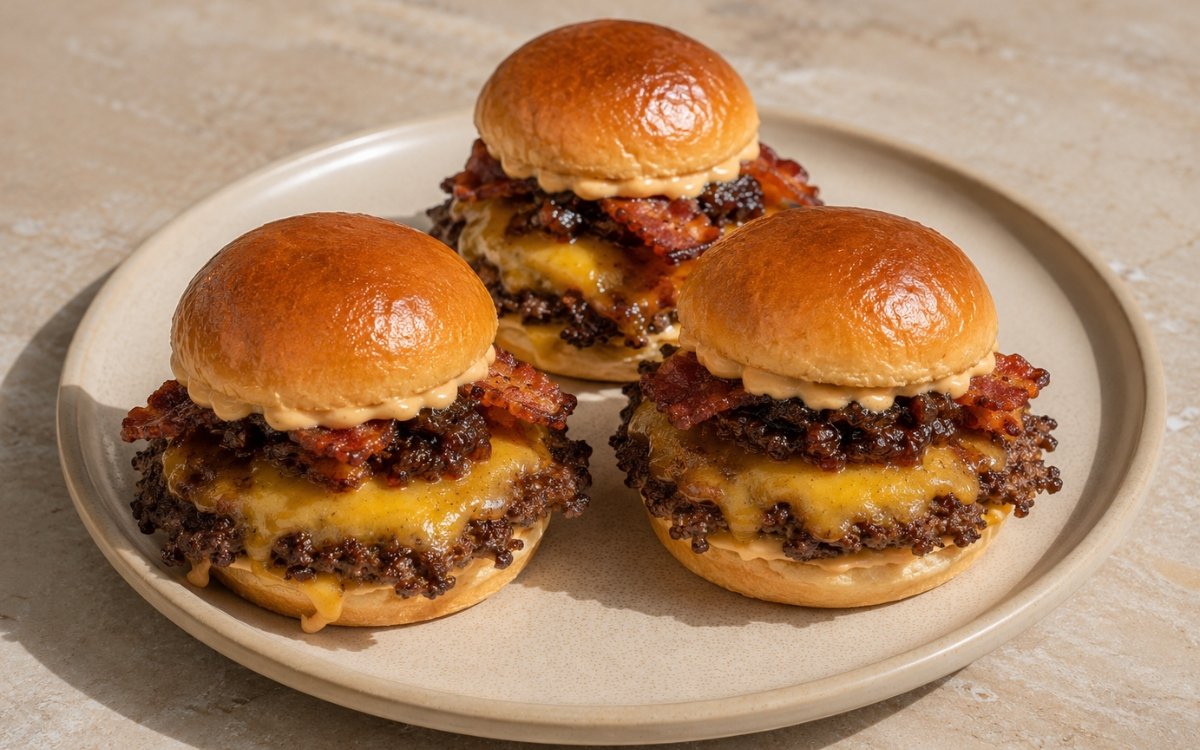
- Spread hot mayo on the bottom buns. Add one cheese-covered smash patty to each bun. Add 2 crispy bacon half-strips. Spoon bacon-onion jam over the bacon and cheese. Add a little more hot mayo to the top bun if desired, then close the sliders. Building in this specific order — sauce, patty, bacon, jam — keeps the wettest component, the jam, positioned on top rather than sandwiched directly against the bottom bun, where it would have the most direct and prolonged contact with the bread.
Serve
- Serve immediately while the patties are hot, the cheese is melted, the bacon is crisp, and the jam is glossy. Sliders are tiny, so they lose heat quickly and the buns soften quickly. Their small scale means less thermal mass than a full-sized burger, so both the temperature and the crisp textures fade noticeably faster — serving without delay matters even more here than it would for a standard burger.
Notes
The cold-start technique for the bacon-onion jam's bacon component is worth understanding as more than a minor procedural detail. Bacon added to an already-hot pan tends to seize and brown unevenly on the outside before its interior fat has had time to properly render out. Starting it cold and letting the pan's temperature climb gradually alongside it produces bacon that renders more completely and crisps more evenly across every piece.
Keeping the beef loosely balled rather than compacted addresses a texture concern that becomes especially pronounced once the beef is smashed thin. A tightly packed ball of ground beef has already begun developing a denser, more cohesive protein structure before it ever reaches the griddle — smashing that same dense structure into a thin patty tends to produce something noticeably tougher and springier than beef that started loose and only came together under the force of the smash itself.
The griddle's extreme heat is non-negotiable specifically because of how little time a slider-sized smash patty actually spends cooking. A full-sized smash burger has more mass and more time on the heat to develop its crust; a slider patty, being considerably smaller and thinner, needs to build that same lacy, deeply browned exterior within a much shorter window, which is only achievable with genuinely aggressive starting heat.
The bacon-onion jam's reduction to a genuinely sticky, spoonable consistency — rather than merely soft and jammy — is worth pushing further than might initially feel necessary. A jam that's soft but still somewhat loose will begin running the moment it's spooned onto a warm slider, and given how small and delicate a slider bun is compared to a standard bun, even a modest amount of runny jam is enough to compromise its structure.