
Double Smash Burger
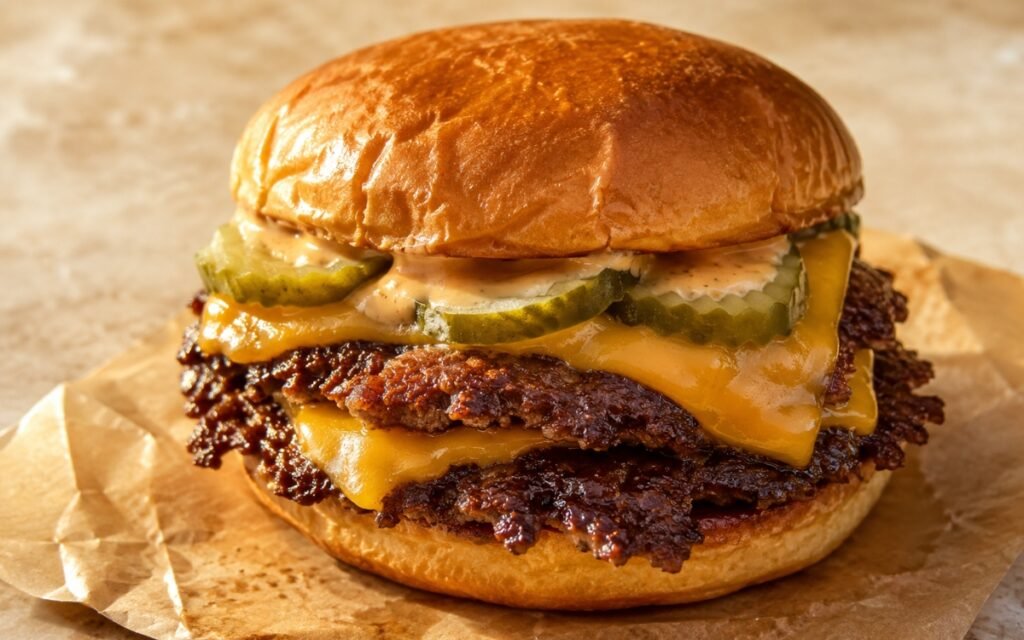
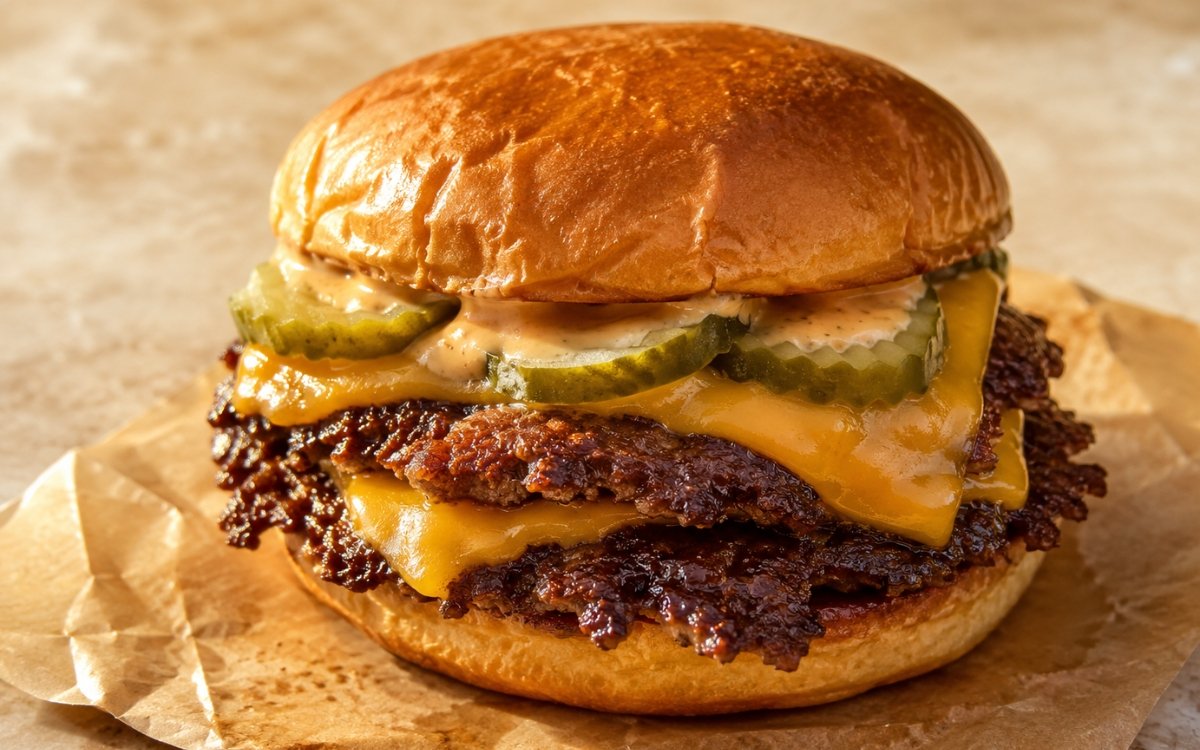
A diner-style double cheeseburger of two thin 85g patties of 75/25 beef smashed onto smoking-hot cast iron, layered with American cheese, tangy-sweet burger sauce and dill pickle planks on a butter-toasted bun, the key being a deeply caramelised, lacy crust on every patty. Smashing a loose ball of beef flat within its first 5 seconds on smoking-hot cast iron, rather than shaping a thick patty and pressing it later, is the technique this whole burger depends on for its crust — the beef spreads into a thin, craggy disc with its whole surface touching the iron, so it browns in under 2 minutes, the same maximum-contact-sear principle used elsewhere in this collection whenever thin meat has to brown before it overcooks. Seasoning each patty with fine sea salt and black pepper only after smashing, and again after the flip, is what keeps the surface dry enough to sear rather than steam. Toasting the buns in 20g of butter and the rendered beef fat is what carries the crust’s savoury flavour into the bread and stops it turning soggy. The payoff is a double cheeseburger with real, diner-style character — crisp, lacy beef edges, a juicy centre, molten cheese, a tangy-sweet smoky sauce, sharp cold pickles and a golden, buttery bun.
Prep Time : 20 min
Cook Time : 20 min
Servings : 4 burgers
20 min
20 min
4 burgers
Ingredients
For the Burgers
• 680g ground beef, 75/25 fat ratio
• Fine sea salt, to taste
• Black pepper, to taste
• 8 slices American cheese, 2 per burger
• 4 hamburger buns
• 4 dill pickles, sliced lengthwise into thin planks
• 20g unsalted butter, for toasting the buns — this one on Amazon
For the Burger Sauce
• 60g mayonnaise
• 60g ketchup
• 60g yellow mustard
• 5g Worcestershire sauce, about 1 tsp — this one on Amazon
• 1 tsp smoked paprika — this one on Amazon
• ½ dill pickle, finely diced
• ¼ small sweet onion, finely diced
• ½ garlic clove, finely grated
• Kosher salt, to taste
• Freshly ground black pepper, to taste
If you’re looking for the perfect burger buns, try both versions — our Brioche Burger Buns for a rich, buttery, soft texture, or our Classic Burger Buns for a lighter, more structured roll that holds up to juicy burgers.
This post may contain affiliate links. As an Amazon Associate I earn from qualifying purchases, at no additional cost to you.
Directions
- Make the Burger Sauce
In a small bowl, combine the 60g mayonnaise, 60g ketchup, 60g yellow mustard, 5g Worcestershire sauce, 1 tsp smoked paprika, the finely diced ½ dill pickle, the finely diced ¼ sweet onion and the finely grated ½ garlic clove. Stir firmly until the sauce is completely uniform and an even orange-pink, with no streaks of mustard or ketchup left. Season with a small pinch of kosher salt and freshly ground black pepper, tasting as you go, since the pickle and mustard are already salty. Cover and refrigerate while you portion and cook the beef, which gives the raw onion time to soften and the garlic time to mellow. That short chill is what turns three separate condiments into one cohesive, rounded sauce. - Portion the Beef
Divide the 680g ground beef into 8 equal portions of about 85g each, two patties per burger. Keep the beef cold and handle it as little as possible, rolling each portion into a very loose ball without packing it; the surface should look rough and craggy rather than smooth. Do not flatten the balls into patties, and do not season them yet. Set them on a parchment-lined tray in the fridge until the pan is hot, and cut 8 squares of parchment about 15cm wide for smashing. Slice the 4 dill pickles lengthwise into thin planks and pat them dry. That loose, unseasoned ball is what smashes easily into thin, ragged edges and keeps its surface dry for the sear. - Preheat the Cast Iron
Heat the oven to 90°C and set a wire rack on a baking tray inside to hold the finished stacks. Place a large cast iron skillet, ideally 30cm, over medium-high to high heat with no oil and leave it for a full 3–4 minutes, until faint wisps of smoke rise from the dry surface. If a drop of water skitters and vanishes in under a second, the pan is ready; if it sits and simmers, keep heating. Plan on 4 batches of 2 balls each, letting the pan recover for 60–90 seconds between batches if it stops smoking. That stored heat in heavy cast iron is what keeps the surface hot enough to sear when cold beef lands on it. - Smash and Season the Patties
Place 1 beef ball in the hot skillet and immediately lay a parchment square over it. Within 5 seconds, press straight down as hard as you can with a heavy, wide, flat metal spatula or burger press, using your other hand on top for extra force, and hold for 10–15 seconds until the ball spreads into a thin patty about 12–14cm across with ragged edges, then peel away the parchment. Immediately season the exposed side of each patty with fine sea salt and black pepper. Add a second ball to the other side of the pan and smash and season it the same way. Do not press either patty again. That single fast, hard smash is what puts the entire surface of the soft beef against the iron before its proteins set. - Let the Crust Develop
Leave the patties completely undisturbed for 90 seconds to 2 minutes, without lifting, checking or pressing them. Watch the edges: they should turn deep brown and lacy, and the raw top should start to turn pale around the rim. Slide a thin, sharp-edged spatula under one edge; if it releases cleanly, the crust is ready, and if it sticks, give it another 20–30 seconds. Then scrape firmly under the whole patty in one decisive motion, keeping the blade flat against the iron rather than lifting tentatively. That uninterrupted contact and confident scrape are what keep the caramelised crust attached to the beef instead of left behind on the pan. - Flip, Season and Stack
Flip each patty once, then immediately season the newly exposed side with fine sea salt and black pepper. Lay 1 slice of American cheese on each patty straight away and cook for 60 seconds more, just until the second side is set and the cheese has slumped and turned glossy. Lift one patty onto the other, both cheese-side up, to make a double stack, then move the stack to the rack in the 90°C oven. Repeat the smashing, crust and flip steps with the remaining balls, letting the pan recover between batches, until you have 4 stacks. That brief second side is what melts the cheese and finishes the thin patty without drying it out. - Toast the Buns
Without cleaning the pan, reduce the heat slightly and add the 20g of unsalted butter directly into the rendered beef fat remaining in the skillet. Once it foams, place the buns cut-side down in the buttered fat, working in 2 batches if they do not all fit, and press gently with the spatula. Toast for 60–90 seconds, until the cut surfaces are golden, slightly crisp and glossy with fat. Watch closely, since the sugar in the bun can scorch quickly at this heat; if the fat starts to smoke hard, lower the heat further. That toast in butter and beef fat is what seals the crumb against the sauce and carries the crust’s savoury flavour into the bread. - Assemble and Rest
Spread a quarter of the burger sauce, about 60g, over the cut side of each bottom bun. Set a double stack on each sauced base, lay the pickle planks over the top layer of cheese so they cover as much of the patty as possible, and close with the top bun. Let each burger rest for 60–90 seconds, just until the cheese has fully melted and the beef juices begin to run into the sauce. Serve straight away while the edges are still audibly crisp. That short rest is what lets the juices and sauce merge into one layer without giving the bun time to turn soggy.
*Notes :
- The single smash deserves genuine recognition as the technique most directly responsible for whether this burger has a real crust or just a grey surface. The recipe’s own rule to “Smash once, immediately, and with maximum force” reflects the physics — a soft ball flattens fully before its proteins set, while a second press after the crust forms only squeezes juice out through the sides and leaves the patty drier.
- The 75/25 beef deserves the same attention this technique receives throughout this collection’s other high-heat beef dishes, because its fat does three jobs at once. As it renders, it fries the outside of each patty for a lacquered crust, keeps the thin interior juicy through a fierce sear and leaves flavourful fat in the pan for the buns — leaner 80/20 beef browns less and eats noticeably drier.
- Seasoning after the smash deserves genuine respect as the detail most directly responsible for keeping the sear dry and fast. Salt that sits on raw beef draws moisture to the surface within minutes, and that water turns to steam the moment it meets the iron, so salting each side just after it is exposed lets the seasoning stick without slowing the browning at all.
- The crust’s clean release deserves attention as a genuine, checkable readiness cue rather than a loose approximation. When the edges are deep brown and lacy and a thin spatula slides under without resistance, the crust is set, while a patty that clings needs another 20–30 seconds — forcing it early tears the crust away and leaves the best part stuck to the pan.
Why This Recipe Works
This recipe works because every step protects the crust that defines a smash burger. Loose, unseasoned balls of 75/25 beef land on smoking cast iron and are smashed once within seconds, so the whole surface browns in under 2 minutes while the fat keeps the thin centre juicy.
Salt goes on only after each side is exposed, which keeps the sear dry. A slice of American cheese per patty melts during the 60-second finish, and the buns toast in butter and rendered beef fat. Finally, the tangy sauce and cold pickle planks cut through the richness in every bite.
Ingredient Breakdown
Loose, Unseasoned Beef Balls (85g Each)
The critical technique — lightly rolled, unpacked balls smash easily into thin patties with ragged edges that brown deeply.
Single Hard Smash (Within 5 Seconds)
The critical technique — flattening the beef before its proteins set puts the whole surface on the iron for maximum crust.
75/25 Ground Beef
The critical ingredient choice — its higher fat content bastes the crust, keeps thin patties juicy and leaves flavourful fat for the buns.
American Cheese
The structural choice — its emulsified texture melts smoothly from the patty’s own heat in 60 seconds without separating or turning greasy.
Butter and Beef Fat Bun Toast
The finishing technique — 20g of butter in the rendered fat crisps the cut sides and seals the crumb against the sauce.
Burger Sauce with Pickle Planks
The finishing touch — mayonnaise, ketchup, mustard and smoked paprika bring tangy sweetness, while cold dill planks add sharp acidity.
Flavor Structure Explained
This double smash burger follows a layered balance model:
- Deeply caramelised centrepiece (two smashed 75/25 beef patties)
- Creamy, salty layer (melted American cheese)
- Tangy, sweet, smoky richness (mayonnaise, ketchup, mustard, smoked paprika)
- Sharp, cold contrast (dill pickle planks)
- Soft, buttery base (bun toasted in butter and beef fat)
The two smashed patties form the deeply caramelised centrepiece, beefy and slightly bitter at their lacy edges. Melted American cheese softens that intensity with a creamy, salty layer that keeps the crust from tasting harsh. The burger sauce builds a tangy, sweet and gently smoky richness beneath the beef, while the cold dill planks cut through with sharp, briny acidity. The buttery toasted bun then holds every layer in place as the soft, savoury base that ties this burger together.
Common Mistakes to Avoid
- Under-Heating the Pan – This leaves the beef grey and steamed, with no crust however hard it is smashed. Always preheat the dry cast iron for 3–4 minutes until it just begins to smoke.
- Smashing Too Late – This lets the proteins set first, so the beef resists flattening and stays thick in the centre. Always smash each ball within 5 seconds of it hitting the pan.
- Pressing the Patty Again – This squeezes juice and melted fat out through the sides and leaves a drier burger. Always smash once, hard, then leave the patty untouched until it releases.
- Seasoning the Beef in Advance – This draws moisture to the surface, which steams on contact and slows the browning. Always season each side only once it is exposed, after smashing and after flipping.
- Using Lean Beef – This produces a drier, paler patty with less crust and less flavourful fat left for the buns. Always use 75/25 ground beef for this technique.
- Skipping the Bun Toast – This leaves the soft crumb to soak up sauce and juices until it collapses within minutes. Always toast the cut sides in the butter and rendered beef fat.
Variations
Animal-Style Version
Pile 30g of slow-cooked, deeply golden caramelised onions over the cheese on each burger before closing the bun, adding a sweeter, jammy layer that rounds out the sauce’s sharp tang.
Bacon Smash Version
Add 2 strips of crisp thin-cut bacon per burger between the double stack and the pickle planks, bringing extra salt, smoke and crunch without changing the smash technique at all.
Spicy Jalapeño Version
Stir 10g of finely diced pickled jalapeños into the burger sauce and finish each assembled burger with a drizzle of hot sauce for a sharper, heat-forward bite.
Truffle Gruyère Version
Add 5ml of truffle oil to the sauce and swap the American cheese for Gruyère, melting it under a lid with a splash of water, since residual heat alone will not melt it.
Storage & Make-Ahead
The burger sauce can be made up to 3 days ahead and kept in an airtight container in the fridge, and it tastes better after the first 24 hours as the onion softens and the garlic mellows.
The beef can be portioned into loose balls up to 4 hours ahead and kept uncovered on a parchment-lined tray on the bottom shelf of the fridge, but leave them unseasoned so the surface stays dry for the sear.
Slice the pickle planks and cut the parchment squares up to a day ahead, keeping the pickles in a little of their brine in the fridge and patting them dry just before assembling.
Cooked patties are best eaten straight from the pan, because smash burgers do not reheat well and the thin, lacy crust softens almost at once in a microwave, oven or covered pan.
Hold finished stacks uncovered on the rack in the 90°C oven for no more than 10–15 minutes, then assemble each burger just before serving, since a pre-built smash burger softens the bun within about 5 minutes.
Frequently Asked Questions
Why does this burger need 75/25 beef rather than a leaner mix?
The 25% fat renders against the hot iron and fries the outside of each patty in its own fat, giving a lacquered crust while keeping the thin centre juicy. Leaner 80/20 beef works, but it browns less and eats noticeably drier.
Why is cast iron used instead of a non-stick pan?
Heavy cast iron holds enough heat to keep searing when cold beef lands on it, so the crust forms in under 2 minutes. Non-stick pans should not be heated to smoking point and give little crust, so a heavy stainless steel pan is the best substitute.
Why is the salt added after smashing rather than mixed into the beef?
Salt added early pulls moisture to the surface and, when mixed in, firms the meat, so the patty steams and smashes less evenly. Seasoning each side right after it is exposed keeps the sear dry and puts the seasoning directly on the crust.
Why is American cheese used instead of cheddar?
American cheese contains emulsifying salts that let it melt smoothly from the patty’s own heat in about 60 seconds. Cheddar needs more heat and tends to split into oil and stringy protein before it covers the craggy crust evenly.
Are there other classic burger, slider, or homemade bun dishes worth trying?
Cuban Frita Burger offers another classic burger direction worth exploring. Slider Beef Burgers and Grilled Halloumi Burger with Roasted Peppers are also worth trying for other bite-size and grilled burger directions, and Classic Burger Buns and Brioche Burger Buns offer other homemade bun recipes worth exploring.
Nutrition Facts
( Per Serving — 1 burger )
Calories
~840 kcal
Protein
41 g
Fat
59 g
Carbs
34 g
Calories
~840 kcal
Protein
41 g
Fat
59 g
Carbs
34 g
Related Recipes
Related Recipes

Fluffy Butter Rice
Rice rinsed clear, toasted in foaming butter until lightly golden, simmered covered undisturbed until fluffy, rested and fluffed. Rich and buttery.
Pulled Pork Sandwich
Slow-braised pork shoulder shredded and tossed in a reduced, glossy barbecue glaze, piled onto toasted brioche buns with fresh coleslaw.
Loaded Nachos
Sturdy tortilla chips layered with melted Mexican cheese blend, hard-browned seasoned ground beef, drained pico de gallo, guacamole, and sour cream.
You might also like
You might also like
Cuban Sandwich (Cubano)
Citrus-marinated pork roasted in its own mojo marinade, layered with ham, Swiss cheese, and pickles on homemade Cuban bread, pressed until crisp and golden.
Loaded Nachos
Sturdy tortilla chips layered with melted Mexican cheese blend, hard-browned seasoned ground beef, drained pico de gallo, guacamole, and sour cream.
Nashville Hot Chicken Sandwich
Double-dredged, cold-water-rehydrated fried chicken coated in a fiery Nashville hot glaze, served on toasted brioche with mayonnaise and dill pickles.
Double Smash Burger
Ingredients
Method
- In a small bowl, combine the 60g mayonnaise, 60g ketchup, 60g yellow mustard, 5g Worcestershire sauce, 1 tsp smoked paprika, the finely diced ½ dill pickle, the finely diced ¼ sweet onion and the finely grated ½ garlic clove. Stir firmly until the sauce is completely uniform and an even orange-pink, with no streaks of mustard or ketchup left. Season with a small pinch of kosher salt and freshly ground black pepper, tasting as you go, since the pickle and mustard are already salty. Cover and refrigerate while you portion and cook the beef, which gives the raw onion time to soften and the garlic time to mellow. That short chill is what turns three separate condiments into one cohesive, rounded sauce.
- Divide the 680g ground beef into 8 equal portions of about 85g each, two patties per burger. Keep the beef cold and handle it as little as possible, rolling each portion into a very loose ball without packing it; the surface should look rough and craggy rather than smooth. Do not flatten the balls into patties, and do not season them yet. Set them on a parchment-lined tray in the fridge until the pan is hot, and cut 8 squares of parchment about 15cm wide for smashing. Slice the 4 dill pickles lengthwise into thin planks and pat them dry. That loose, unseasoned ball is what smashes easily into thin, ragged edges and keeps its surface dry for the sear.
- Heat the oven to 90°C and set a wire rack on a baking tray inside to hold the finished stacks. Place a large cast iron skillet, ideally 30cm, over medium-high to high heat with no oil and leave it for a full 3–4 minutes, until faint wisps of smoke rise from the dry surface. If a drop of water skitters and vanishes in under a second, the pan is ready; if it sits and simmers, keep heating. Plan on 4 batches of 2 balls each, letting the pan recover for 60–90 seconds between batches if it stops smoking. That stored heat in heavy cast iron is what keeps the surface hot enough to sear when cold beef lands on it.
- Place 1 beef ball in the hot skillet and immediately lay a parchment square over it. Within 5 seconds, press straight down as hard as you can with a heavy, wide, flat metal spatula or burger press, using your other hand on top for extra force, and hold for 10–15 seconds until the ball spreads into a thin patty about 12–14cm across with ragged edges, then peel away the parchment. Immediately season the exposed side of each patty with fine sea salt and black pepper. Add a second ball to the other side of the pan and smash and season it the same way. Do not press either patty again. That single fast, hard smash is what puts the entire surface of the soft beef against the iron before its proteins set.
- Leave the patties completely undisturbed for 90 seconds to 2 minutes, without lifting, checking or pressing them. Watch the edges: they should turn deep brown and lacy, and the raw top should start to turn pale around the rim. Slide a thin, sharp-edged spatula under one edge; if it releases cleanly, the crust is ready, and if it sticks, give it another 20–30 seconds. Then scrape firmly under the whole patty in one decisive motion, keeping the blade flat against the iron rather than lifting tentatively. That uninterrupted contact and confident scrape are what keep the caramelised crust attached to the beef instead of left behind on the pan.
- Flip each patty once, then immediately season the newly exposed side with fine sea salt and black pepper. Lay 1 slice of American cheese on each patty straight away and cook for 60 seconds more, just until the second side is set and the cheese has slumped and turned glossy. Lift one patty onto the other, both cheese-side up, to make a double stack, then move the stack to the rack in the 90°C oven. Repeat the smashing, crust and flip steps with the remaining balls, letting the pan recover between batches, until you have 4 stacks. That brief second side is what melts the cheese and finishes the thin patty without drying it out.
- Without cleaning the pan, reduce the heat slightly and add the 20g of unsalted butter directly into the rendered beef fat remaining in the skillet. Once it foams, place the buns cut-side down in the buttered fat, working in 2 batches if they do not all fit, and press gently with the spatula. Toast for 60–90 seconds, until the cut surfaces are golden, slightly crisp and glossy with fat. Watch closely, since the sugar in the bun can scorch quickly at this heat; if the fat starts to smoke hard, lower the heat further. That toast in butter and beef fat is what seals the crumb against the sauce and carries the crust’s savoury flavour into the bread.
- Spread a quarter of the burger sauce, about 60g, over the cut side of each bottom bun. Set a double stack on each sauced base, lay the pickle planks over the top layer of cheese so they cover as much of the patty as possible, and close with the top bun. Let each burger rest for 60–90 seconds, just until the cheese has fully melted and the beef juices begin to run into the sauce. Serve straight away while the edges are still audibly crisp. That short rest is what lets the juices and sauce merge into one layer without giving the bun time to turn soggy.