
Lemon Chicken Cutlet Orzo
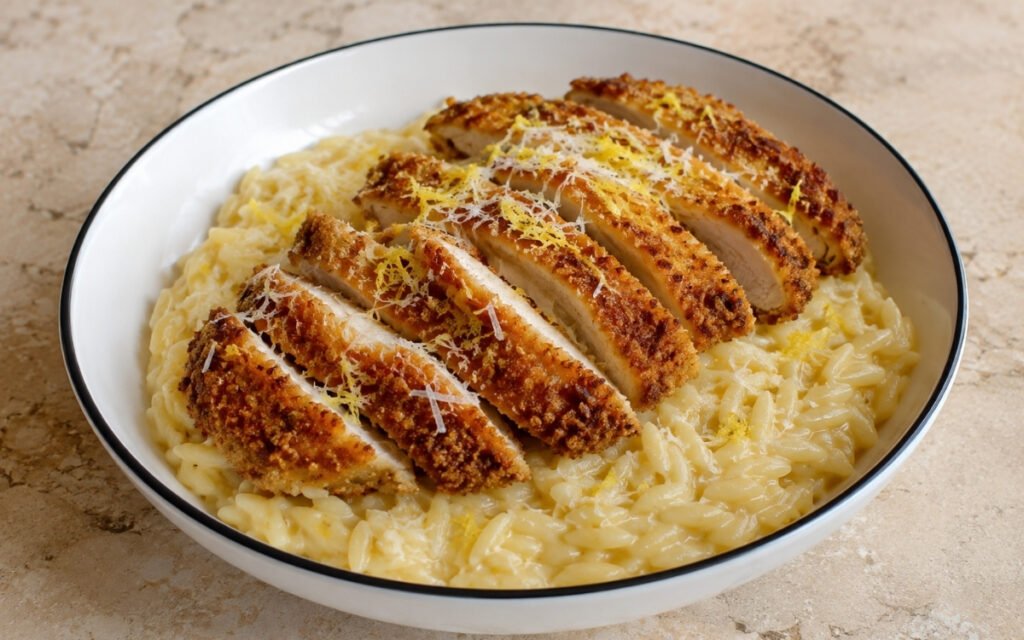
Crispy fried chicken cutlets laid over creamy lemon orzo — the combination that makes both components better than they are separately. The orzo is coated in a blended sauce of caramelised sweet onion, garlic, lemon zest, ricotta, and Parmesan that is bright, rich, and deeply citrus-forward. The cutlets are the same Parmesan-and-oregano-breaded, fried-golden preparation as the Italian Fried Chicken Cutlets — served here sliced into strips over the warm, creamy orzo rather than as a standalone plate. One dish, two textures, one extremely satisfying bowl.
Prep Time : 25 min
Cook Time : 30 min
Servings : 4
25 min
30 min
4
Ingredients
For the Lemon Orzo
• 300g orzo pasta — this one on Amazon
• Chicken stock, approximately 800ml–1L for cooking the orzo
• 45ml fresh lemon juice
• Zest of 2 lemons
• 3 garlic cloves, roughly chopped
• 2 medium sweet white onions, finely chopped
• 2 tbsp extra-virgin olive oil — this one on Amazon
• 60g ricotta cheese — this one on Amazon
• 60g Parmesan cheese, finely grated, plus extra for serving — this one on Amazon
• Fine sea salt to taste
• Freshly ground black pepper to taste
For the Fried Chicken Cutlets
• 900g boneless, skinless chicken breasts, about 4 medium
• 100g all-purpose flour
• 8g fine sea salt, plus extra for finishing
• Freshly ground black pepper
• 3 large eggs
• 150g Italian-style breadcrumbs— this one on Amazon
• 50g Parmesan cheese, finely grated
• 3g dried oregano
• Vegetable oil, for frying — approximately 100ml per batch
This post may contain affiliate links. As an Amazon Associate I earn from qualifying purchases, at no additional cost to you.
Directions
- Butterfly and Bread the Chicken Cutlets
Begin with the chicken because the breading requires the most time and the cutlets can rest briefly on a wire rack before frying while the orzo and sauce components are being prepared. Butterfly each breast by slicing horizontally through the thickest part almost all the way through, then opening it flat. Pound between two sheets of plastic wrap to a uniform thickness of just under 1cm throughout. Set up the three-station breading: the first dish with flour, salt, and pepper; the second with three beaten eggs; the third with Italian breadcrumbs, 50g Parmesan, oregano, and a pinch of salt and pepper. Bread each cutlet through flour, egg, and breadcrumbs in sequence, pressing firmly at the final stage. For the complete technique in detail — the wet hand, dry hand method, the pressing motion, and the reasoning behind each step — refer to the Italian Fried Chicken Cutlets recipe. Place the breaded cutlets on a clean plate and set aside — they will fry while the orzo sauce base is cooking. - Start the Orzo in Stock
While the breaded cutlets rest, bring the chicken stock to a simmer in a large high-sided sauté pan or saucepan. Add the orzo and cook over low heat, stirring occasionally to prevent sticking, for 8–9 minutes until just al dente with a small amount of stock remaining in the pan. Do not drain — the residual starchy stock is what allows the blended sauce to coat every grain of orzo when combined. Cut the heat when the orzo reaches al dente and cover the pan to keep warm. - Build the Lemon Sauce Base
While the orzo cooks, heat the olive oil in a wide skillet over medium heat. Add the finely chopped sweet onions. Cook, stirring occasionally, for 6–8 minutes until the onions are soft, glossy, and showing light golden colour at the edges — sweet white onions have a higher sugar content than standard white onions and caramelise more quickly, producing a deeply sweet, mellow flavour that is the backbone of the sauce. Do not rush this stage — under-cooked onion blended into the sauce produces a sharp, slightly raw flavour that competes with the lemon. Once the onions are properly softened and golden, reduce the heat to low. Add the roughly chopped garlic and the lemon zest of both lemons. Cook on this very low heat for 3–4 minutes, stirring occasionally — the heat is low enough to gently bloom the lemon zest’s aromatic oils and the garlic’s aromatic compounds into the surrounding onion and oil without frying them. At this temperature, the garlic becomes fragrant and sweet rather than sharp and bitter. The lemon zest opens up and releases its volatile citrus oils into the pan, infusing the onion mixture with a bright, aromatic lemon character that is more complex than lemon juice alone would produce. Transfer the entire contents of the pan — caramelised onion, garlic, and lemon zest, plus all the oil — to a food processor or standing blender. Add the ricotta, 60g of Parmesan, lemon juice, a generous pinch of fine sea salt, and several grinds of black pepper. Blend on high speed for 60–90 seconds until completely smooth. Taste the blended sauce — it should be bright, creamy, and deeply lemony with a clear savoury Parmesan depth. Adjust salt if needed. Set aside. - Fry the Chicken Cutlets
With the orzo resting and the sauce blended, fry the cutlets. Heat approximately 100ml of vegetable oil in a large heavy-bottomed skillet over medium-high heat to 175°C. Fry two cutlets at a time — never more — for 3 minutes per side until deeply golden brown and cooked to 74°C internal temperature. Transfer to a wire rack and sprinkle immediately with a small pinch of fine salt. Allow the oil to recover to 175°C before adding the next batch. Keep finished cutlets warm in a 95°C oven on the wire rack while frying the remaining batches. Once all cutlets are fried, allow to rest for 3–4 minutes before slicing. - Fold the Sauce into the Orzo
With all components ready — resting orzo, blended sauce, and fried cutlets — bring everything together. Pour the blended lemon sauce over the orzo in the pan and fold together with a spatula using slow, thorough strokes. The residual heat of the orzo and the warmth of the sauce are sufficient to bring everything to serving temperature without needing additional heat — do not return the pan to the burner, which would continue cooking the orzo past al dente and risk breaking the sauce. Add a generous amount of additional freshly cracked black pepper and fold through. Taste and adjust salt if needed. - Slice the Cutlets and Serve
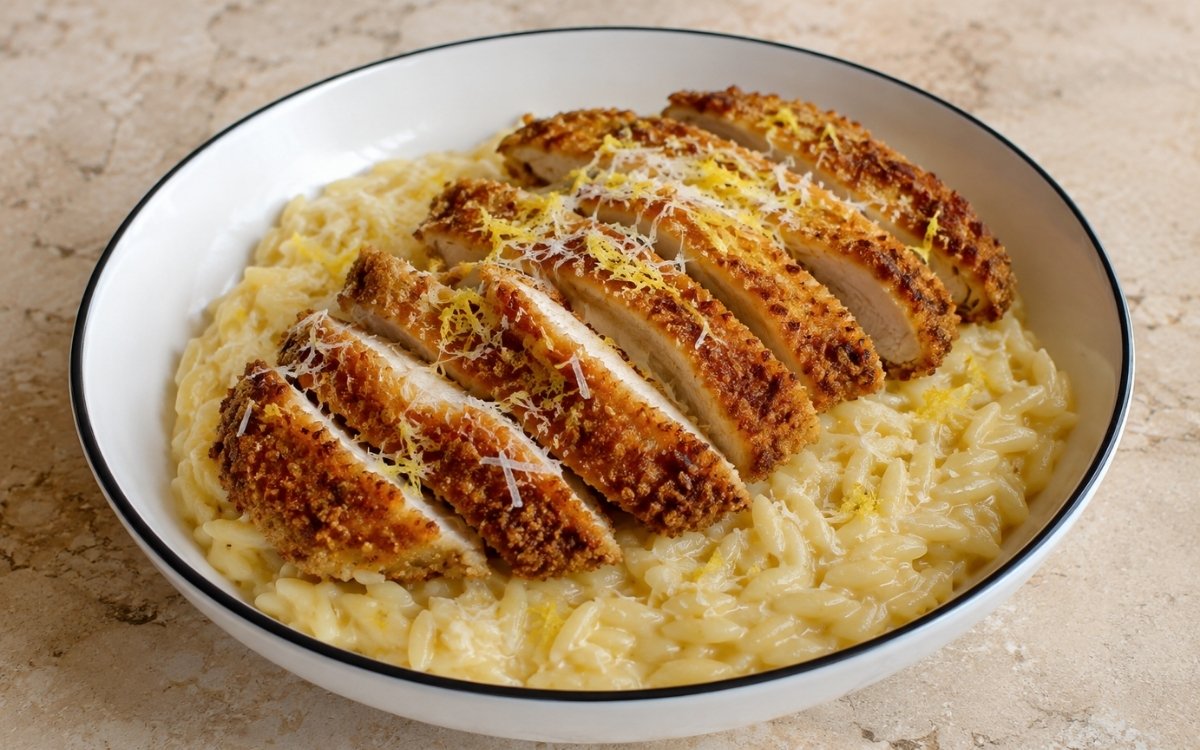
Slice each rested cutlet on the cutting board into thin strips — approximately 1cm wide, cutting at a slight diagonal for a cleaner presentation. The diagonal cut is both visual and functional: it produces longer, more elegant strips and slightly shortens the chicken fibres at the cut surface, making each piece more tender to bite. Divide the creamy lemon orzo among four wide, warm bowls. Lay the sliced cutlet strips from one cutlet over each portion of orzo — fanning them slightly over the surface so the golden crust is visible above the orzo rather than buried in it. The presentation should show the contrast between the crispy, golden-breaded surface and the creamy, lemon-yellow orzo beneath. Scatter additional finely grated Parmesan over each bowl. Add a pinch of lemon zest over the top for the aromatic freshness and visual brightness it provides. Optionally, add the smallest amount of lime zest alongside the lemon zest — the lime’s slightly greener, more tropical citrus colour provides a visual contrast against the yellow lemon zest that makes the garnish more striking without contributing a detectable lime flavour at this small quantity.
*Notes :
- The lemon zest of two lemons is a substantial quantity for a sauce made for 4 portions, and it is the correct amount. The double-zest application — zest cooked into the onion base during the blooming step and the blended sauce — produces a lemon character that is deeply aromatic and complex rather than simply acidic. Zest’s volatile oils are released most fully when gently heated in fat, which is why the 3–4 minute low-heat blooming step with the caramelised onion is so important. The lemon juice adds the acid dimension; the bloomed zest adds the aromatic dimension. Together they produce a dish that tastes consistently, fully, and warmly of lemon rather than simply sour.
- The sweet white onion rather than standard white onion is a specific ingredient choice for this recipe. Sweet onions — Walla Walla, Vidalia, or any mild, high-sugar variety — have a lower sulfur content and higher sugar content than standard white onions. They caramelise faster, produce a sweeter, more complex base when cooked to golden, and their mild character allows the lemon’s brightness to remain the dominant flavour of the sauce rather than competing with a sharp raw-onion note. Standard white onions can be substituted but should be cooked for 2–3 additional minutes to fully caramelise and mellow.
- The cutlet presentation — sliced into strips over the orzo rather than served whole alongside it — is the specific detail that makes this a bowl dish rather than a plate dish. Sliced cutlet strips provide more surface area for the orzo to coat, the golden crust is visible throughout the bowl rather than being a single piece set to one side, and the contrast of textures in every forkful — creamy orzo, crunchy crust, juicy chicken — is what defines the eating experience.
Why This Recipe Works
This recipe works because the lemon sauce is built through a technique that develops its citrus character at two levels simultaneously — the aromatic oils of the zest bloomed in fat during cooking, and the bright acidity of the juice blended in at the finish. The caramelised sweet onion provides the sweet, mellow base that prevents the lemon from tasting sharp rather than bright.
The ricotta and Parmesan provide the creamy, savoury depth that gives the sauce body and makes the orzo feel genuinely rich. And the fried cutlet’s crispy crust provides the textural contrast that makes a creamy pasta dish feel like a complete, interesting meal rather than simply a sauce with starch.
Ingredient Breakdown
Sweet White Onions (Caramelised)
The sweet, mellow backbone of the sauce — their high sugar content produces a deeper, rounder caramelisation than standard white onions and allows the lemon to be the dominant flavour.
Lemon Zest (Bloomed in Oil with Garlic) and Lemon Juice (Blended in)
The dual-application citrus strategy — zest provides aromatic, complex lemon depth when bloomed; juice provides clean acid brightness when blended. Together they produce a fully, warmly lemon-flavoured sauce.
Ricotta
The creamy base without cream — smooth, mild, and fatty enough to produce the sauce’s coating body without overpowering the lemon character.
Parmesan (In Sauce and at Serving)
Deep savoury, umami richness that grounds the brightness of the lemon and prevents the sauce from tasting one-dimensionally citrusy.
Orzo in Stock
Small pasta cooked in seasoned stock that retains its cooking liquid as the sauce medium — every grain is flavoured throughout rather than only on the surface.
Fried Chicken Cutlets (Sliced Over Orzo)
The textural anchor — crispy, golden, Parmesan-and-oregano-scented crust that provides contrast to the creamy orzo in every forkful.
Flavor Structure Explained
This dish follows a layered balance model:
- Bright citrus core (lemon juice, zest)
- Creamy savory depth (ricotta, Parmesan, onion, olive oil)
- Crispy textural contrast (Parmesan cutlet crust)
- Sweet aromatic base (caramelised onion)
- Integrated richness (combined layers)
Lemon defines the dominant character with vivid acidity and aromatic intensity that runs through every bite. The ricotta–Parmesan base builds a creamy, savory layer that softens and balances that brightness. Caramelised onion adds subtle sweetness, rounding the profile. The crispy cutlet introduces contrast, delivering crunch and concentrated savory flavor against the soft orzo. Olive oil ties everything together, creating a cohesive, rich structure where brightness, creaminess, and texture all hit at once.
Common Mistakes to Avoid
- Not Blooming the Lemon Zest on Low Heat – High heat burns the zest’s volatile oils and produces a bitter result. The 3–4 minutes on very low heat is specifically designed for aromatic release rather than cooking.
- Rushing the Onion Caramelisation – Under-cooked onion blended into the sauce produces a sharp, raw character that competes with the lemon. Take the full 6–8 minutes until golden.
- Draining the Orzo – The residual starchy stock is the liquid that allows the sauce to coat every grain. Always cut the heat at al dente with stock remaining rather than draining.
- Placing the Whole Cutlet Rather Than Slicing – A whole cutlet over a bowl of orzo is difficult to eat and the crust-to-orzo contrast is limited to the first few bites. Slicing into strips distributes the crust throughout the bowl.
- Overcrowding the Frying Pan – Two cutlets at a time maximum — more drops the oil temperature and produces pale, greasy crust.
- Not Tasting the Sauce Before Adding to the Orzo – The blended sauce’s seasoning sets the seasoning of the entire dish. Correct at the blending stage when adjustment is easiest.
Variations
Lemon Herb Version
Add 15g of fresh flat-leaf parsley and 5g of fresh tarragon to the blender alongside the orzo sauce for a herb-forward variation where the anise note of tarragon bridges the lemon and the Parmesan.
Shrimp Version
Replace the fried chicken cutlet with 400g of large shrimp seared for 90 seconds per side in 1 tbsp of butter and lemon juice. Lay the seared shrimp over the orzo in place of the sliced cutlet for a lighter, more delicate version of the same dish.
Extra Caper Version
Fold 2 tablespoons of rinsed capers into the finished orzo alongside the sauce for a briny, salty note that amplifies the lemon’s brightness and adds a specifically Italian flavour dimension.
Baked Cutlet Version
For a lighter alternative to frying, bake the breaded cutlets at 220°C on a wire rack over a baking sheet, drizzled with olive oil, for 15–18 minutes until golden. The crust will be less dramatically crispy than the fried version but the lemon orzo combination works equally well.
Storage & Make-Ahead
The completed orzo dish can be refrigerated for up to 3 days, although the orzo will absorb the sauce during storage and thicken quite a bit. To reheat it, add a splash of chicken stock, cover, and warm it gently over low heat, stirring carefully until the creamy consistency returns. The fried cutlets should be stored separately from the orzo. Reheat them on a wire rack in a 200°C oven for about 8 minutes, then slice and serve them over the freshly reheated orzo.
The lemon sauce on its own can be refrigerated for up to 3 days or frozen for up to 2 months. The most efficient make-ahead method is to prepare the sauce in advance and cook the orzo fresh when needed.
Breaded uncooked cutlets can be prepared up to 2 hours ahead and refrigerated uncovered on a wire rack before frying.
Frequently Asked Questions
Can I use regular white onion instead of sweet white onion?
Yes — cook for 2–3 additional minutes to fully caramelise and mellow the sharper sulphur compounds. The result will be slightly less sweet and slightly more savoury in the sauce but still excellent.
How much lemon is too much?
The double-zest application produces an assertively lemon-forward sauce designed for people who want the lemon to be the primary flavour event. For a more subtle citrus note, reduce to the zest of one lemon in the blooming step and use 30ml of lemon juice in the blender rather than 45ml.
Can I make the orzo sauce without a blender?
Mash the caramelised onion and garlic with a fork or potato masher, stir in the ricotta, Parmesan, lemon juice, and zest vigorously, and fold into the orzo. The sauce will be chunkier and less uniformly creamy but the flavour is identical.
What drinks pair well with this dish?
The lemon orzo’s bright, citrus-forward character pairs naturally with drinks in the same register. A Blood Orange Lemonade provides a sweeter, more complex citrus pairing that echoes the lemon in the sauce. A Limoncello Spritz Mocktail specifically amplifies the lemon character of the dish and is the most natural pairing. A Classic Fresh Lemonade works beautifully for a simple, complementary summer combination — the same citrus in the glass and on the plate.
Why slice the chicken over the orzo rather than serve it whole?
Sliced strips distribute the crust contrast throughout the bowl so every forkful contains a combination of creamy orzo and crispy chicken. A whole cutlet served on top is visually impressive but limits the textural interaction to the first few bites before the crust sections are separated from the orzo.
Nutrition Facts
( per serving )
Calories
~905 kcal
Protein
69 g
Fat
28 g
Carbs
86 g
Calories
~905 kcal
Protein
69 g
Fat
28 g
Carbs
86 g
Related Recipes
Related Recipes

Creamy Mushroom Garlic Pasta
Seared mushrooms for texture and a concentrated mushroom paste for invisible depth — cream sauce over pappardelle, 35 minutes.
Lasagne alla Bolognese
Beef and veal Bolognese slow-braised 3 hours on pancetta fat and soffritto — layered with ricotta, mozzarella, and Parmesan, baked golden. The weekend lasagne worth every hour.
Spaghetti alle Vongole
Fresh clams in a light olive-oil, white wine, and garlic emulsion with parsley and lemon zest, tossed with al dente spaghetti.
You might also like
You might also like
Pan-Seared Chicken Breast (Skin on)
Chicken breast pounded even, dried thoroughly, seared skin-side down undisturbed — finished with garlic thyme butter basting. Crispy skin, juicy meat.
Chinese Five-Spice Chicken Thighs
Chicken thighs scored and marinated in five-spice, soy, ginger, and garlic — seared undisturbed, roasted until crispy, rested. Warm, aromatic, crispy-skinned.
Flautas de Pollo
Spiced shredded chicken thighs rolled tightly in corn tortillas and fried until golden and crisp, served with chunky guacamole and bright salsa roja.

Lemon Chicken Cutlet Orzo
Ingredients
Method
- Begin with the chicken because the breading requires the most time and the cutlets can rest briefly on a wire rack before frying while the orzo and sauce components are being prepared. Butterfly each breast by slicing horizontally through the thickest part almost all the way through, then opening it flat. Pound between two sheets of plastic wrap to a uniform thickness of just under 1cm throughout. Set up the three-station breading: the first dish with flour, salt, and pepper; the second with three beaten eggs; the third with Italian breadcrumbs, 50g Parmesan, oregano, and a pinch of salt and pepper. Bread each cutlet through flour, egg, and breadcrumbs in sequence, pressing firmly at the final stage. For the complete technique in detail — the wet hand, dry hand method, the pressing motion, and the reasoning behind each step — refer to the Italian Fried Chicken Cutlets recipe. Place the breaded cutlets on a clean plate and set aside — they will fry while the orzo sauce base is cooking.
- While the breaded cutlets rest, bring the chicken stock to a simmer in a large high-sided sauté pan or saucepan. Add the orzo and cook over low heat, stirring occasionally to prevent sticking, for 8–9 minutes until just al dente with a small amount of stock remaining in the pan. Do not drain — the residual starchy stock is what allows the blended sauce to coat every grain of orzo when combined. Cut the heat when the orzo reaches al dente and cover the pan to keep warm.
- While the orzo cooks, heat the olive oil in a wide skillet over medium heat. Add the finely chopped sweet onions. Cook, stirring occasionally, for 6–8 minutes until the onions are soft, glossy, and showing light golden colour at the edges — sweet white onions have a higher sugar content than standard white onions and caramelise more quickly, producing a deeply sweet, mellow flavour that is the backbone of the sauce. Do not rush this stage — under-cooked onion blended into the sauce produces a sharp, slightly raw flavour that competes with the lemon. Once the onions are properly softened and golden, reduce the heat to low. Add the roughly chopped garlic and the lemon zest of both lemons. Cook on this very low heat for 3–4 minutes, stirring occasionally — the heat is low enough to gently bloom the lemon zest’s aromatic oils and the garlic’s aromatic compounds into the surrounding onion and oil without frying them. At this temperature, the garlic becomes fragrant and sweet rather than sharp and bitter. The lemon zest opens up and releases its volatile citrus oils into the pan, infusing the onion mixture with a bright, aromatic lemon character that is more complex than lemon juice alone would produce. Transfer the entire contents of the pan — caramelised onion, garlic, and lemon zest, plus all the oil — to a food processor or standing blender. Add the ricotta, 60g of Parmesan, lemon juice, a generous pinch of fine sea salt, and several grinds of black pepper. Blend on high speed for 60–90 seconds until completely smooth. Taste the blended sauce — it should be bright, creamy, and deeply lemony with a clear savoury Parmesan depth. Adjust salt if needed. Set aside.
- With the orzo resting and the sauce blended, fry the cutlets. Heat approximately 100ml of vegetable oil in a large heavy-bottomed skillet over medium-high heat to 175°C. Fry two cutlets at a time — never more — for 3 minutes per side until deeply golden brown and cooked to 74°C internal temperature. Transfer to a wire rack and sprinkle immediately with a small pinch of fine salt. Allow the oil to recover to 175°C before adding the next batch. Keep finished cutlets warm in a 95°C oven on the wire rack while frying the remaining batches. Once all cutlets are fried, allow to rest for 3–4 minutes before slicing.
- With all components ready — resting orzo, blended sauce, and fried cutlets — bring everything together. Pour the blended lemon sauce over the orzo in the pan and fold together with a spatula using slow, thorough strokes. The residual heat of the orzo and the warmth of the sauce are sufficient to bring everything to serving temperature without needing additional heat — do not return the pan to the burner, which would continue cooking the orzo past al dente and risk breaking the sauce. Add a generous amount of additional freshly cracked black pepper and fold through. Taste and adjust salt if needed.
- Slice each rested cutlet on the cutting board into thin strips — approximately 1cm wide, cutting at a slight diagonal for a cleaner presentation. The diagonal cut is both visual and functional: it produces longer, more elegant strips and slightly shortens the chicken fibres at the cut surface, making each piece more tender to bite. Divide the creamy lemon orzo among four wide, warm bowls. Lay the sliced cutlet strips from one cutlet over each portion of orzo — fanning them slightly over the surface so the golden crust is visible above the orzo rather than buried in it. The presentation should show the contrast between the crispy, golden-breaded surface and the creamy, lemon-yellow orzo beneath. Scatter additional finely grated Parmesan over each bowl. Add a pinch of lemon zest over the top for the aromatic freshness and visual brightness it provides. Optionally, add the smallest amount of lime zest alongside the lemon zest — the lime’s slightly greener, more tropical citrus colour provides a visual contrast against the yellow lemon zest that makes the garnish more striking without contributing a detectable lime flavour at this small quantity.