Ingredients
Method
Butterfly and Bread the Chicken Cutlets
- Begin with the chicken because the breading requires the most time and the cutlets can rest briefly on a wire rack before frying while the orzo and sauce components are being prepared. Butterfly each breast by slicing horizontally through the thickest part almost all the way through, then opening it flat. Pound between two sheets of plastic wrap to a uniform thickness of just under 1cm throughout. Set up the three-station breading: the first dish with flour, salt, and pepper; the second with three beaten eggs; the third with Italian breadcrumbs, 50g Parmesan, oregano, and a pinch of salt and pepper. Bread each cutlet through flour, egg, and breadcrumbs in sequence, pressing firmly at the final stage. For the complete technique in detail — the wet hand, dry hand method, the pressing motion, and the reasoning behind each step — refer to the Italian Fried Chicken Cutlets recipe. Place the breaded cutlets on a clean plate and set aside — they will fry while the orzo sauce base is cooking.
Start the Orzo in Stock
- While the breaded cutlets rest, bring the chicken stock to a simmer in a large high-sided sauté pan or saucepan. Add the orzo and cook over low heat, stirring occasionally to prevent sticking, for 8–9 minutes until just al dente with a small amount of stock remaining in the pan. Do not drain — the residual starchy stock is what allows the blended sauce to coat every grain of orzo when combined. Cut the heat when the orzo reaches al dente and cover the pan to keep warm.
Build the Lemon Sauce Base
- While the orzo cooks, heat the olive oil in a wide skillet over medium heat. Add the finely chopped sweet onions. Cook, stirring occasionally, for 6–8 minutes until the onions are soft, glossy, and showing light golden colour at the edges — sweet white onions have a higher sugar content than standard white onions and caramelise more quickly, producing a deeply sweet, mellow flavour that is the backbone of the sauce. Do not rush this stage — under-cooked onion blended into the sauce produces a sharp, slightly raw flavour that competes with the lemon. Once the onions are properly softened and golden, reduce the heat to low. Add the roughly chopped garlic and the lemon zest of both lemons. Cook on this very low heat for 3–4 minutes, stirring occasionally — the heat is low enough to gently bloom the lemon zest's aromatic oils and the garlic's aromatic compounds into the surrounding onion and oil without frying them. At this temperature, the garlic becomes fragrant and sweet rather than sharp and bitter. The lemon zest opens up and releases its volatile citrus oils into the pan, infusing the onion mixture with a bright, aromatic lemon character that is more complex than lemon juice alone would produce. Transfer the entire contents of the pan — caramelised onion, garlic, and lemon zest, plus all the oil — to a food processor or standing blender. Add the ricotta, 60g of Parmesan, lemon juice, a generous pinch of fine sea salt, and several grinds of black pepper. Blend on high speed for 60–90 seconds until completely smooth. Taste the blended sauce — it should be bright, creamy, and deeply lemony with a clear savoury Parmesan depth. Adjust salt if needed. Set aside.
Fry the Chicken Cutlets
- With the orzo resting and the sauce blended, fry the cutlets. Heat approximately 100ml of vegetable oil in a large heavy-bottomed skillet over medium-high heat to 175°C. Fry two cutlets at a time — never more — for 3 minutes per side until deeply golden brown and cooked to 74°C internal temperature. Transfer to a wire rack and sprinkle immediately with a small pinch of fine salt. Allow the oil to recover to 175°C before adding the next batch. Keep finished cutlets warm in a 95°C oven on the wire rack while frying the remaining batches. Once all cutlets are fried, allow to rest for 3–4 minutes before slicing.
Fold the Sauce into the Orzo
- With all components ready — resting orzo, blended sauce, and fried cutlets — bring everything together. Pour the blended lemon sauce over the orzo in the pan and fold together with a spatula using slow, thorough strokes. The residual heat of the orzo and the warmth of the sauce are sufficient to bring everything to serving temperature without needing additional heat — do not return the pan to the burner, which would continue cooking the orzo past al dente and risk breaking the sauce. Add a generous amount of additional freshly cracked black pepper and fold through. Taste and adjust salt if needed.
Slice the Cutlets and Serve
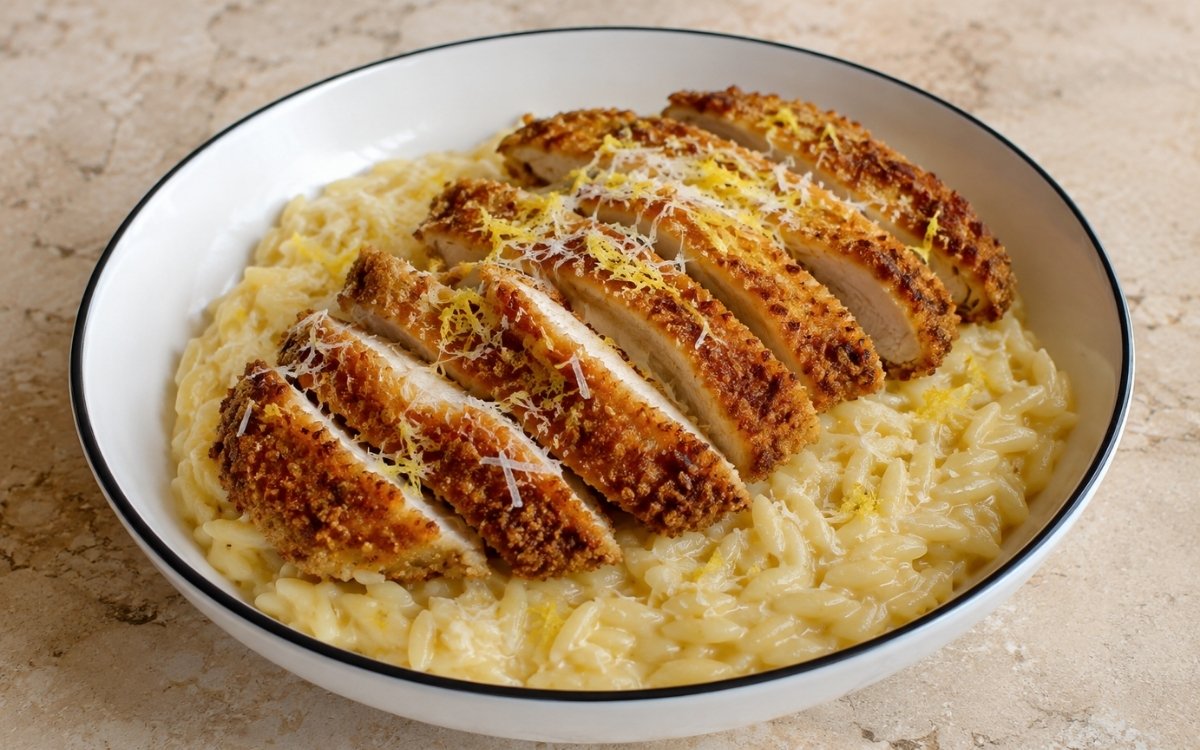
- Slice each rested cutlet on the cutting board into thin strips — approximately 1cm wide, cutting at a slight diagonal for a cleaner presentation. The diagonal cut is both visual and functional: it produces longer, more elegant strips and slightly shortens the chicken fibres at the cut surface, making each piece more tender to bite. Divide the creamy lemon orzo among four wide, warm bowls. Lay the sliced cutlet strips from one cutlet over each portion of orzo — fanning them slightly over the surface so the golden crust is visible above the orzo rather than buried in it. The presentation should show the contrast between the crispy, golden-breaded surface and the creamy, lemon-yellow orzo beneath. Scatter additional finely grated Parmesan over each bowl. Add a pinch of lemon zest over the top for the aromatic freshness and visual brightness it provides. Optionally, add the smallest amount of lime zest alongside the lemon zest — the lime's slightly greener, more tropical citrus colour provides a visual contrast against the yellow lemon zest that makes the garnish more striking without contributing a detectable lime flavour at this small quantity.
Notes
The lemon zest of two lemons is a substantial quantity for a sauce made for 4 portions, and it is the correct amount. The double-zest application — zest cooked into the onion base during the blooming step and the blended sauce — produces a lemon character that is deeply aromatic and complex rather than simply acidic. Zest's volatile oils are released most fully when gently heated in fat, which is why the 3–4 minute low-heat blooming step with the caramelised onion is so important. The lemon juice adds the acid dimension; the bloomed zest adds the aromatic dimension. Together they produce a dish that tastes consistently, fully, and warmly of lemon rather than simply sour.
The sweet white onion rather than standard white onion is a specific ingredient choice for this recipe. Sweet onions — Walla Walla, Vidalia, or any mild, high-sugar variety — have a lower sulfur content and higher sugar content than standard white onions. They caramelise faster, produce a sweeter, more complex base when cooked to golden, and their mild character allows the lemon's brightness to remain the dominant flavour of the sauce rather than competing with a sharp raw-onion note. Standard white onions can be substituted but should be cooked for 2–3 additional minutes to fully caramelise and mellow.
The cutlet presentation — sliced into strips over the orzo rather than served whole alongside it — is the specific detail that makes this a bowl dish rather than a plate dish. Sliced cutlet strips provide more surface area for the orzo to coat, the golden crust is visible throughout the bowl rather than being a single piece set to one side, and the contrast of textures in every forkful — creamy orzo, crunchy crust, juicy chicken — is what defines the eating experience.