
Blackberry Lime Infused Water
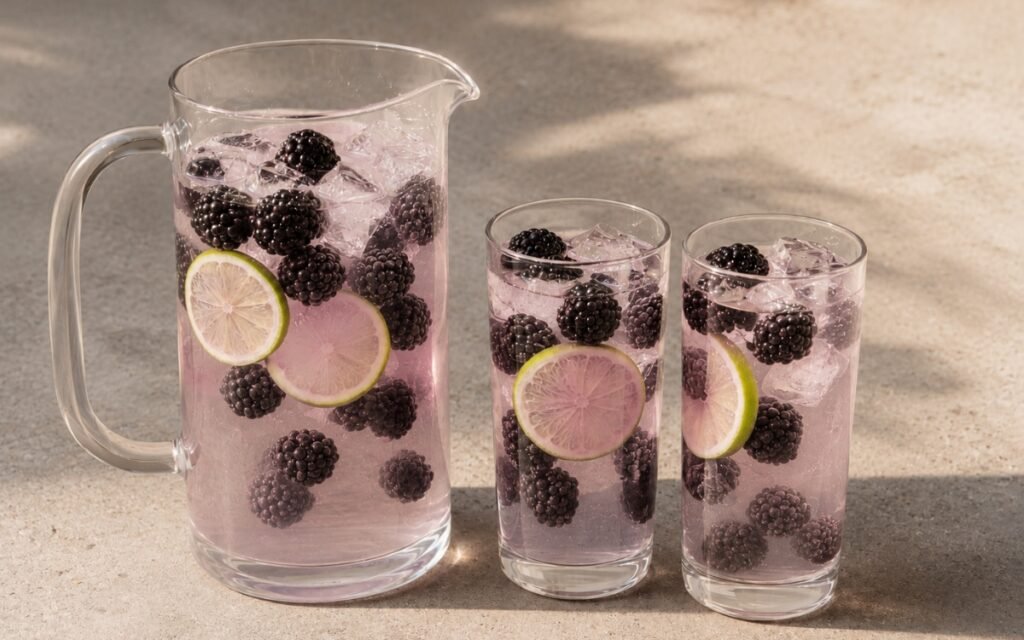
Blackberry lime infused water sits between the vivid blue-purple of the blueberry lemon version and the lighter coral-pink of the raspberry orange — blackberry’s deeply pigmented anthocyanins producing the most specifically inky, dark, vivid colour of any berry infused water preparation, while lime’s sharp, tropical citrus brightness provides a specifically complementary contrast to blackberry’s deeper, more complex, more wine-adjacent character. The tannin management concern from the blackberry lemonade applies here as well — blackberry’s higher tannin content than raspberry means the mashing approach must be specifically light, avoiding the seeds in particular. While raspberry seeds release bitterness under pressure at any meaningful level, blackberry’s larger seeds contain a comparable tannin-rich fraction that under aggressive crushing produces an astringent, somewhat harsh note that is detectable even at the low concentration of an infused water. The lightly mashed approach — pressing enough to crack the outer skin and release the vivid juice from the berry flesh without crushing the seeds — produces the correct dark, vivid, aromatic result. The lime’s peel bitterness extraction timeline is the same as in the strawberry lime and watermelon lime preparations: faster than lemon due to lime’s thinner skin and higher limonoid concentration, making the 4-hour removal specifically important.
Prep Time : 10 min
Infusion Time : 1–4 hr
Servings : 16
10 min
1–4 hr
16
Ingredients
For the Infusion Base
• 1 cup fresh blackberries — approximately 150g
• 30–45ml fresh lime juice — optional
• 15–30g honey — optional; must be pre-dissolved — this one on Amazon
• 1–2 small pinches fine sea salt — optional
For the Final Build
• 3 litres ice-cold water
• 1 cup fresh blackberries — approximately 150g; left whole
• 2 limes — thinly sliced
This post may contain affiliate links. As an Amazon Associate I earn from qualifying purchases, at no additional cost to you.
Directions
- Lightly Mash the Blackberry Base
Add the first cup of blackberries to the large pitcher. Using the back of a spoon, press on each berry with specific attention to the technique: firm enough to crack the outer skin and release the vivid, inky juice from the berry flesh, without applying sustained pressure that crushes the seeds against the spoon or pitcher surface. The blackberry’s skin requires deliberate pressure to crack — firmer than the barely-there press for raspberries — but the moment the skin splits and juice releases, the press should stop rather than continuing to the seed. Blackberry seeds are larger and more specifically tannin-rich than raspberry seeds, and their tannin fraction is more astringent in cold water under pressure than raspberry’s equivalent. The seed-avoidance technique specifically produces a clean, vivid, specifically aromatic result; aggressive seed crushing produces a detectable astringent quality in the finished water. At the correct mashing level, a few seeds will inevitably be present in the mashed base — this is normal and does not produce any meaningful tannin contribution without physical crushing. - Optional Additions
Pre-dissolve any honey in warm water. Add to the pitcher with optional lime juice (30–45ml in 3 litres — barely perceptible brightness) and the optional 1–2 small pinches of fine sea salt. The salt is specifically optional in this preparation — blackberry’s deeper, more complex aromatic character is pleasant without the amplification that salt provides for more delicate aromatics like watermelon or peach. - Build and Infuse
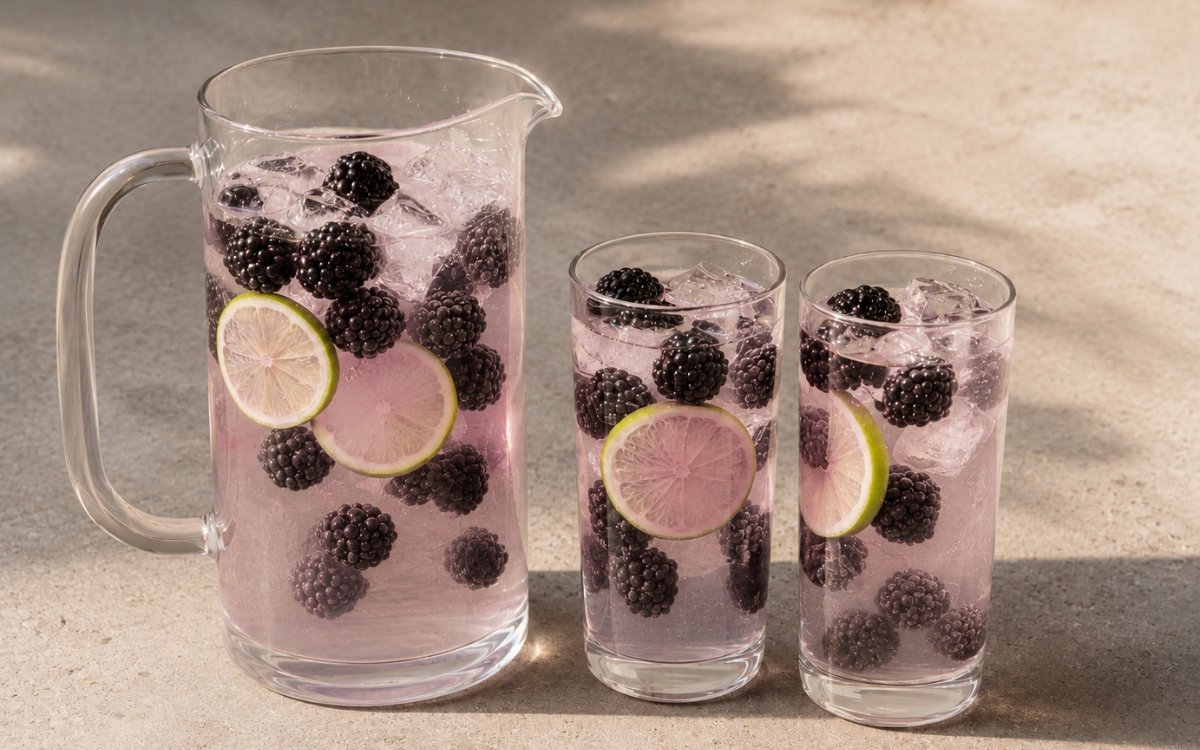
Pour the 3 litres of ice-cold water into the pitcher. Add the whole blackberries — their intact skins providing both visual presence as dark, vivid spheres throughout the water and a progressive surface aromatic release. Add the thinly sliced lime rounds. Stir gently once or twice. The colour development is the most dramatically dark of any infused water preparation: blackberry’s deeply concentrated anthocyanin pigments — primarily cyanidin-3-glucoside and delphinidin-3-glucoside — infuse into the cold water rapidly from the mashed base, producing a vivid, inky purple-black progression from almost the first minutes of infusion. By 2 hours the water is a specifically vivid dark purple; by 4 hours it is at its most vivid. The pH sensitivity of the anthocyanins applies as in the blueberry preparation but more dramatically: in plain neutral water the colour is deep purple-black; with lime juice added the acidity shifts the anthocyanins toward vivid magenta-purple. Cover and refrigerate for 1–4 hours. At 1 hour: vivid colour with subtle blackberry depth. At 4 hours: maximum aromatic presence. After 4 hours, remove all lime slices and blackberries. Lime’s limonoid bitterness and blackberry’s dull, waterlogged, seedy character both develop progressively beyond this point.
*Notes :
- Frozen blackberries are an excellent substitute for fresh — the freezing pre-ruptures the cell walls, producing immediate, vivid colour release without requiring any mashing. Add frozen blackberries directly to the pitcher; the natural thawing in the cold water provides the required cell disruption. The pre-ruptured cells also produce a slightly faster infusion — check at 2–3 hours rather than the full 4 hours if using frozen berries.
- The vivid dark colour of blackberry infused water makes it specifically impressive for visual presentation at tables, events, or parties — the inky purple-to-magenta colour range is arguably the most visually striking of any infused water in this collection.
Why This Recipe Works
This recipe works because the blackberry mashing technique specifically avoids the seeds while cracking the outer skin for vivid colour and aromatic release. The tannin management from the lemonade preparation applies here at the infused-water level.
Lime’s sharp, tropical brightness specifically complements blackberry’s deeper character. And the 4-hour removal prevents both lime peel bitterness and blackberry’s waterlogged deterioration.
Ingredient Breakdown
Blackberry Mashed Without Seed Crushing
The tannin-prevention technique — skin-crack only for vivid colour and aromatic release; seeds avoided for the clean, astringency-free result.
Two-Stage Blackberry (Mashed + Whole)
The colour and aromatic optimisation — mashed base for immediate vivid release; whole berries for visual presence and progressive contribution.
Lime as the Citrus Component
The specifically complementary brightness — lime’s tropical sharpness matching blackberry’s own complexity more specifically than lemon’s cleaner citrus.
4-Hour Maximum (Lime and Blackberry Both Deteriorate)
The dual quality limit — lime peel bitterness and blackberry’s seedy waterlogging both developing progressively.
Flavor Structure Explained
This Blackberry lime infused water follows a minimalist balance model:
- Deep berry core (blackberry)
- Bright citrus lift (lime)
- Complex fruit aromatics (dark berry character)
- Hydration-focused structure (cold water)
- Visual appeal through natural color extraction (blackberry pigments)
Blackberry defines the foundation with rich berry aromatics, subtle earthiness, and a deeper, more wine-like fruit character than lighter berries such as strawberry or raspberry. Even at infusion strength, it lends the water a sense of complexity and depth that feels more mature and layered. Lime contributes a faint tropical-citrus brightness that lifts the darker berry notes and keeps the profile feeling fresh and refreshing rather than heavy. The primary experience remains the clean refreshment of cold water, with the fruit acting as an aromatic enhancement rather than a dominant flavor source. A defining feature of the drink is its striking purple-to-magenta hue, which provides an immediate visual impression that mirrors the blackberry’s depth and character.
Common Mistakes to Avoid
- Aggressively Crushing the Blackberry Seeds – Blackberry seeds’ tannin fraction produces astringency under pressure. Always stop pressing when the skin cracks.
- Leaving Lime Rounds Beyond 4 Hours – Same bitterness urgency as strawberry lime and watermelon lime preparations. Always remove at 4 hours.
- Adding Too Much Lime Juice – Beyond 45ml in 3 litres the lime’s flavour becomes specifically perceptible as limeade rather than bright water. Always the conservative quantity.
- Not Pre-Dissolving Honey – Always pre-dissolve.
Variations
With Mint
Add 12 lightly clapped fresh mint leaves — mint’s cool freshness alongside blackberry’s deep character produces a specifically cooling contrast.
With Vanilla
Add a split vanilla bean — vanilla’s warm sweetness alongside blackberry’s complexity is the most indulgent, most specifically fragrant version.
With Orange
Add 1 thinly sliced orange alongside the lime rounds — orange’s warm sweetness moderates lime’s sharpness and adds another dimension against blackberry’s depth.
With Thyme
Add 2 fresh thyme sprigs alongside the blackberries — thyme’s warm herbal character specifically resonates with blackberry’s wine-adjacent complexity.
Storage & Make-Ahead
Once the ingredients have been removed, the infused water can be refrigerated in a sealed pitcher for up to 24 hours. Its deep color remains vibrant throughout the storage period.
Infused water should not be stored with the ingredients still present for longer than 4 hours. For the best flavor and appearance, remove the ingredients once the infusion period is complete.
Frequently Asked Questions
Why is the seed-crushing warning more prominent for blackberry than for other berries?
Blackberry seeds are larger and contain a higher tannin concentration per seed than raspberry seeds, and blackberry’s baseline tannin character is already higher than raspberry’s. The combination of larger seeds and more concentrated tannin means that even moderate seed crushing produces a more perceptibly astringent result in the finished water than the equivalent raspberry seed crushing would.
Why does the colour shift from dark purple to magenta with lime juice?
Blackberry’s primary anthocyanin pigments — cyanidin-3-glucoside and delphinidin-3-glucoside — are pH-sensitive. At neutral water pH they produce deep purple-black light absorption. At lower pH (with lime juice’s citric acid) they shift toward shorter wavelengths, producing the magenta-red visible colour. The shift is more dramatic than blueberry’s equivalent because blackberry’s anthocyanin concentration is higher.
Why is salt specifically optional in this preparation?
Blackberry’s deeper, more complex, more wine-adjacent aromatic character is specifically present enough without the sub-threshold amplification that salt provides for more delicate aromatics like watermelon or peach. The salt is available as a fine-tuning option rather than a necessary step.
What other berry and citrus infused waters share this direction?
The Strawberry Lime Infused Water shares the lime as the citrus component with strawberry’s warmer, lighter, more specifically sweet fruitiness — the most directly comparable in a softer berry direction. The Blueberry Lemon Infused Water shares the dark berry anthocyanin colour and the dramatic visual quality — lemon rather than lime alongside a gentler, less wine-adjacent berry character. The Raspberry Orange Infused Water shares the berry infusion with raspberry’s brighter, more immediately vivid fruitiness and orange’s warm, sweet citrus rather than lime’s sharpness.
Nutrition Facts
( per serving )
Calories
~8 kcal
Protein
0 g
Fat
0 g
Carbs
2 g
Calories
~8 kcal
Protein
0 g
Fat
0 g
Carbs
2 g
Related Recipes
Related Recipes

Black Tea Orange Pitcher
Ceylon tea at 90–95°C for 3 minutes, dual citrus zest off heat — 750ml orange juice for warm rounded body, cold water, chilled. Tea-forward with orange lift.
White Tea Strawberry Pitcher
White tea at 70–75°C for 3–4 minutes, strawberries gently infused 8–10 minutes — fully strained, cold water only (no juice), chilled. Pale, delicate, and refined.
Passion Fruit Lime Pitcher Drink
Gently mashed passion fruit pulp combined with fresh lime juice and sliced limes for a bright golden, tropical, double-lime pitcher drink.
You might also like
You might also like
Blueberry Black Iced Tea
Black tea at 90–95°C for 2½–3 minutes, lemon peel infused cold, blueberries gently fork-mashed and lightly strained — added gradually, chilled. Bright and tea-forward.
Thyme Lemon Orange Green Tea Cooler
Green tea at 75–80°C for 2–3 minutes, thyme clapped and infused cold — orange juice for softness, lemon juice for sharpness, honey, chilled. Bright and lightly herbal.
Light Raspberry Mint Iced Tea
White tea at 75–80°C, raspberries blended with lemon and water — honey while warm, mint cold-infused 10–15 minutes, chilled. Pale blush-pink and clean.
Blackberry Lime Infused Water
Ingredients
Method
- Add the first cup of blackberries to the large pitcher. Using the back of a spoon, press on each berry with specific attention to the technique: firm enough to crack the outer skin and release the vivid, inky juice from the berry flesh, without applying sustained pressure that crushes the seeds against the spoon or pitcher surface. The blackberry’s skin requires deliberate pressure to crack — firmer than the barely-there press for raspberries — but the moment the skin splits and juice releases, the press should stop rather than continuing to the seed. Blackberry seeds are larger and more specifically tannin-rich than raspberry seeds, and their tannin fraction is more astringent in cold water under pressure than raspberry’s equivalent. The seed-avoidance technique specifically produces a clean, vivid, specifically aromatic result; aggressive seed crushing produces a detectable astringent quality in the finished water. At the correct mashing level, a few seeds will inevitably be present in the mashed base — this is normal and does not produce any meaningful tannin contribution without physical crushing.
- Pre-dissolve any honey in warm water. Add to the pitcher with optional lime juice (30–45ml in 3 litres — barely perceptible brightness) and the optional 1–2 small pinches of fine sea salt. The salt is specifically optional in this preparation — blackberry’s deeper, more complex aromatic character is pleasant without the amplification that salt provides for more delicate aromatics like watermelon or peach.
- Pour the 3 litres of ice-cold water into the pitcher. Add the whole blackberries — their intact skins providing both visual presence as dark, vivid spheres throughout the water and a progressive surface aromatic release. Add the thinly sliced lime rounds. Stir gently once or twice. The colour development is the most dramatically dark of any infused water preparation: blackberry’s deeply concentrated anthocyanin pigments — primarily cyanidin-3-glucoside and delphinidin-3-glucoside — infuse into the cold water rapidly from the mashed base, producing a vivid, inky purple-black progression from almost the first minutes of infusion. By 2 hours the water is a specifically vivid dark purple; by 4 hours it is at its most vivid. The pH sensitivity of the anthocyanins applies as in the blueberry preparation but more dramatically: in plain neutral water the colour is deep purple-black; with lime juice added the acidity shifts the anthocyanins toward vivid magenta-purple. Cover and refrigerate for 1–4 hours. At 1 hour: vivid colour with subtle blackberry depth. At 4 hours: maximum aromatic presence. After 4 hours, remove all lime slices and blackberries. Lime’s limonoid bitterness and blackberry’s dull, waterlogged, seedy character both develop progressively beyond this point.