Ingredients
Method
Lightly Mash the Blackberry Base
- Add the first cup of blackberries to the large pitcher. Using the back of a spoon, press on each berry with specific attention to the technique: firm enough to crack the outer skin and release the vivid, inky juice from the berry flesh, without applying sustained pressure that crushes the seeds against the spoon or pitcher surface. The blackberry's skin requires deliberate pressure to crack — firmer than the barely-there press for raspberries — but the moment the skin splits and juice releases, the press should stop rather than continuing to the seed. Blackberry seeds are larger and more specifically tannin-rich than raspberry seeds, and their tannin fraction is more astringent in cold water under pressure than raspberry's equivalent. The seed-avoidance technique specifically produces a clean, vivid, specifically aromatic result; aggressive seed crushing produces a detectable astringent quality in the finished water. At the correct mashing level, a few seeds will inevitably be present in the mashed base — this is normal and does not produce any meaningful tannin contribution without physical crushing.
Optional Additions
- Pre-dissolve any honey in warm water. Add to the pitcher with optional lime juice (30–45ml in 3 litres — barely perceptible brightness) and the optional 1–2 small pinches of fine sea salt. The salt is specifically optional in this preparation — blackberry's deeper, more complex aromatic character is pleasant without the amplification that salt provides for more delicate aromatics like watermelon or peach.
Build and Infuse
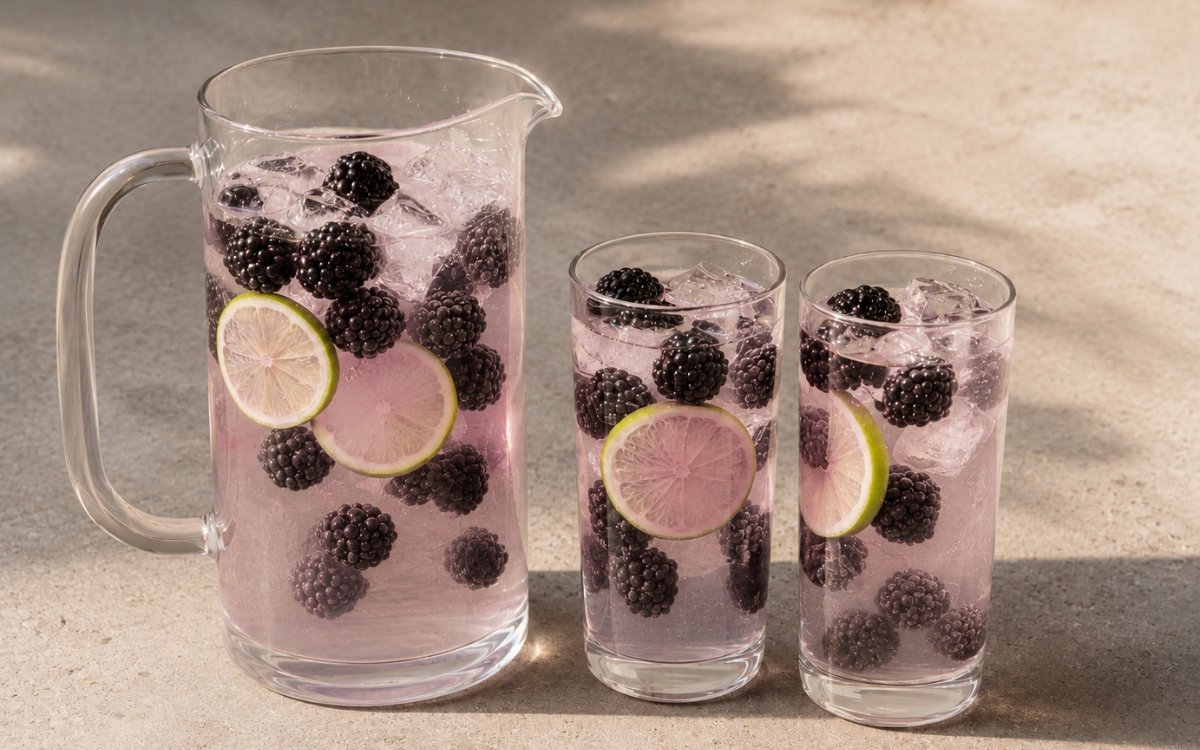
- Pour the 3 litres of ice-cold water into the pitcher. Add the whole blackberries — their intact skins providing both visual presence as dark, vivid spheres throughout the water and a progressive surface aromatic release. Add the thinly sliced lime rounds. Stir gently once or twice. The colour development is the most dramatically dark of any infused water preparation: blackberry's deeply concentrated anthocyanin pigments — primarily cyanidin-3-glucoside and delphinidin-3-glucoside — infuse into the cold water rapidly from the mashed base, producing a vivid, inky purple-black progression from almost the first minutes of infusion. By 2 hours the water is a specifically vivid dark purple; by 4 hours it is at its most vivid. The pH sensitivity of the anthocyanins applies as in the blueberry preparation but more dramatically: in plain neutral water the colour is deep purple-black; with lime juice added the acidity shifts the anthocyanins toward vivid magenta-purple. Cover and refrigerate for 1–4 hours. At 1 hour: vivid colour with subtle blackberry depth. At 4 hours: maximum aromatic presence. After 4 hours, remove all lime slices and blackberries. Lime's limonoid bitterness and blackberry's dull, waterlogged, seedy character both develop progressively beyond this point.
Notes
Frozen blackberries are an excellent substitute for fresh — the freezing pre-ruptures the cell walls, producing immediate, vivid colour release without requiring any mashing. Add frozen blackberries directly to the pitcher; the natural thawing in the cold water provides the required cell disruption. The pre-ruptured cells also produce a slightly faster infusion — check at 2–3 hours rather than the full 4 hours if using frozen berries.
The vivid dark colour of blackberry infused water makes it specifically impressive for visual presentation at tables, events, or parties — the inky purple-to-magenta colour range is arguably the most visually striking of any infused water in this collection.