
Watermelon Lime Infused Water
Watermelon infused water is the most paradoxical preparation in this collection — a fruit that is 92% water itself producing an infused water that tastes specifically more of the fruit than the water in the pitcher despite the fruit being approximately the same composition as the medium it is infusing into. The paradox resolves when you understand that the 8% non-water fraction of watermelon includes the volatile aromatic compounds — particularly (Z,Z)-3,6-nonadienal and various other aldehydes — responsible for watermelon’s characteristically fresh, vivid, specifically watermelon aroma that gives cold water its specifically cool, refreshing quality when watermelon is added to it. These compounds infuse into the surrounding cold water even without any mechanical disruption; the lightly crushed chunks release them from disrupted cells faster and at higher concentration. The same principle from the fresh watermelon lemonade recipe applies with even more force here: blending or over-processing watermelon produces a juice immediately rather than an infused water, and the subtlety that makes watermelon infused water specifically refreshing rather than simply watermelon-flavoured is lost entirely with aggressive processing. Lime rather than lemon as the citrus component — lime’s sharper, more tropical character is specifically complementary to watermelon’s cool, fresh register in the same way it is in the Watermelon Mint Fizz Mocktail — and the same 4-hour limit applies with lime’s faster peel-bitterness extraction.
Prep Time : 10 min
Infusion Time : 1–4 hr
Servings : 16
10 min
1–4 hr
16
Ingredients
For the Infusion Base
• 2 cups watermelon — approximately 300g; deseeded and cut into chunks
• 30–45ml fresh lime juice — optional
• 15–30g honey — optional; must be pre-dissolved — this one on Amazon
• 1–2 small pinches fine sea salt
For the Final Build
• 3 litres ice-cold water
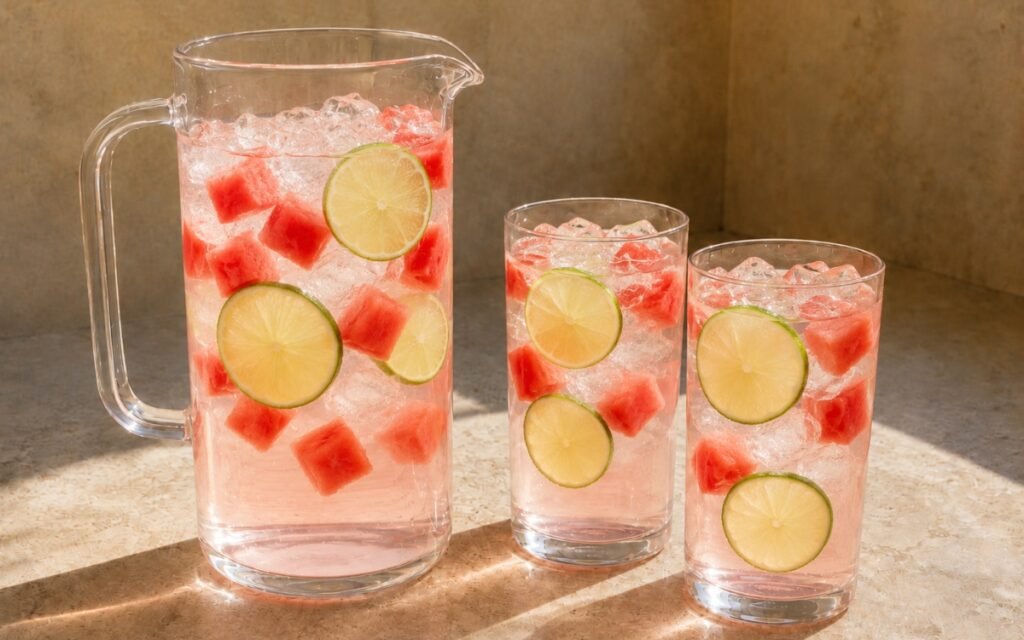
• Additional watermelon — slices or small chunks; for visual presence
• 2–3 limes — thinly sliced
This post may contain affiliate links. As an Amazon Associate I earn from qualifying purchases, at no additional cost to you.
Directions
- Lightly Crush the Watermelon Chunks
Add the 2 cups of deseeded, chunked watermelon to the large pitcher. Using the back of a large spoon or a muddler, press the watermelon chunks with a gentle but firm single press — enough to crack each chunk and release visible juice without reducing them to a pulp or liquid. The correct visual outcome: watermelon pieces with visible splits, releasing juice, with their structural integrity largely preserved rather than dissolved into a pink liquid mass. Watermelon’s very high water content makes the fine line between infused water and watermelon juice particularly sharp in this preparation. A single firm press cracks the cells and releases the aromatic compounds from the disrupted outer layers into the pitcher; a continued or aggressive press extracts the full juice content and produces a pink, fruity liquid that is specifically juice territory regardless of subsequent dilution. Stop pressing as soon as each chunk has visibly cracked. The larger quantity — 2 cups rather than the 1 cup base used for berries — is calibrated for watermelon’s specifically low aromatic compound concentration per gram compared to raspberries or blueberries. Watermelon’s pleasant aromatic compounds are present at lower absolute concentrations than most berry fruits; more fruit mass in the base provides sufficient aromatic compound release for the infusion. - Optional Honey and Lime Juice
Pre-dissolve any honey in warm water. Add to the pitcher with optional lime juice (30–45ml in 3 litres — barely perceptible citrus brightness) and the 1–2 small pinches of fine sea salt. The salt’s sub-threshold function is specifically valuable in watermelon water — watermelon’s aromatic compounds respond to sodium’s amplifying effect in the same way noted in the fresh watermelon lemonade preparation, making the watermelon’s delicate character taste more specifically of itself. - Build and Infuse
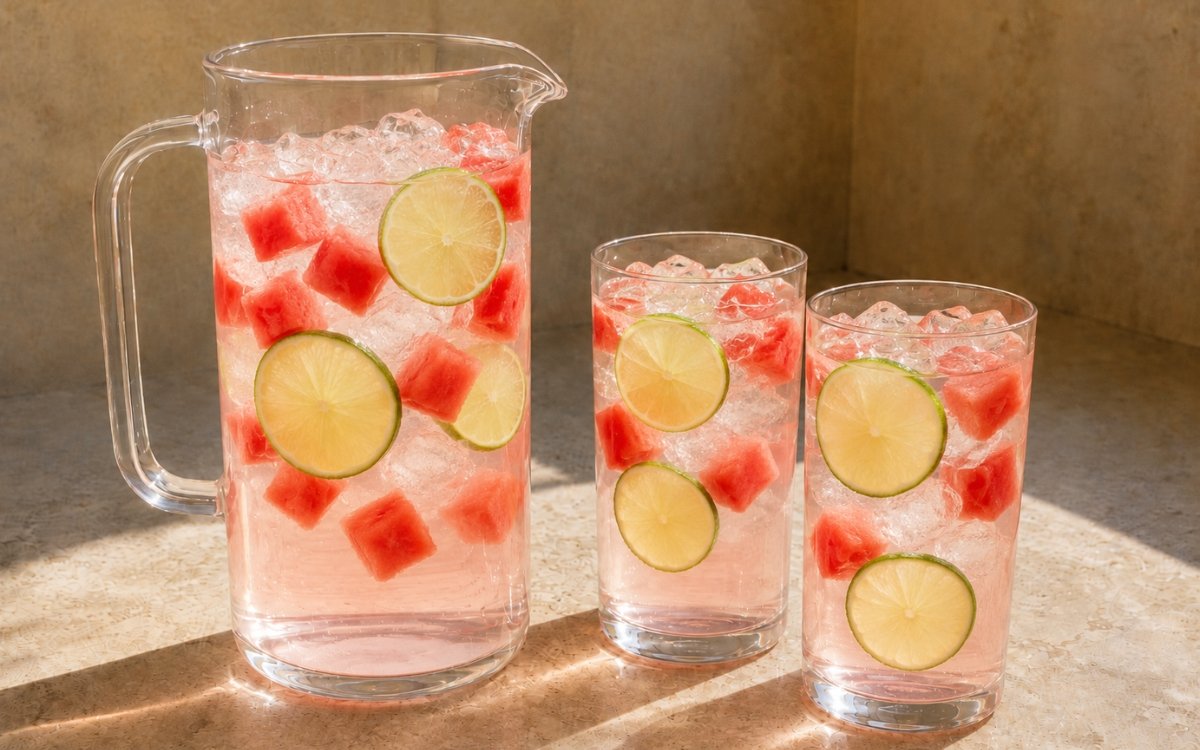
Pour the 3 litres of ice-cold water into the pitcher. Add the visual watermelon pieces — slices or additional chunks arranged for visual appeal — and the thinly sliced lime rounds. Stir gently once or twice. Cover and refrigerate for 1–4 hours. Watermelon’s volatile aromatic compounds infuse progressively into the cold water: at 1 hour a subtle, specifically clean, cool watermelon freshness is present; at 4 hours it is at the maximum of the pleasant infused-water range. The water’s colour shifts from clear toward a very pale, barely visible pink from the watermelon’s lycopene and anthocyanin pigments — a much lighter colour development than blueberry or raspberry infusions because the watermelon’s pigments are primarily carotenoid-based and less soluble in water than anthocyanins. After 4 hours, remove all lime slices and watermelon pieces. The lime rounds’ limonoid bitterness extraction timeline applies with the same urgency as in the strawberry lime preparation. The watermelon pieces become visibly paler, softer, and less aromatic as the infusion period extends — their pleasant volatile compounds progressively depleted into the water, leaving less flavourful fruit in the pitcher. - Serve
Serve well chilled directly from the pitcher, or over ice. Add fresh watermelon triangles and lime rounds to the pitcher or individual glasses at the time of serving for visual freshness. Stir gently before serving as watermelon’s natural larger-molecule compounds separate slightly during storage in the same way observed in the fresh watermelon lemonade.
*Notes :
- Seedless watermelon varieties — the standard in most markets — are specifically convenient for this preparation as they eliminate the seed-removal step in the chunking preparation. Any seedless variety produces excellent results; for varieties with seeds, remove all visible seeds before adding to the pitcher. Seeds in infused water do not present the same bitterness risk as raspberry seeds (watermelon seeds are neutral in flavour) but produce an untidy visual and are generally removed for presentation reasons.
- The optional lime juice addition in this preparation is specifically lime rather than lemon because lime’s sharper, more tropical citrus acidity is the more specifically complementary pairing for watermelon’s cool, summer-fruit character. The same pairing instinct drives the Watermelon Mint Fizz Mocktail‘s lime rather than lemon choice.
Why This Recipe Works
This recipe works because the light crush releases volatile aromatic compounds from disrupted cells without extracting the full juice content that would shift the preparation from infused water to diluted juice. The 2-cup base quantity compensates for watermelon’s lower aromatic concentration per gram.
The salt specifically amplifies watermelon’s delicate aromatic character. And lime’s tropical-fresh citrus sharpness is specifically complementary to watermelon’s cool summer-fruit register.
Ingredient Breakdown
2 Cups Watermelon (Larger Base Than Berries)
The aromatic concentration calibration — watermelon’s lower volatile compound concentration per gram requires more fruit mass for equivalent infusion impact.
Light Single Press (Not Aggressive Crushing)
The infused-water vs juice boundary — the fine line between cracking cells for aromatic release and extracting full juice; always the minimal press.
Lime Rather Than Lemon
The tonally appropriate citrus — lime’s tropical sharpness complementing watermelon’s cool summer-fruit register.
Sub-Threshold Salt
The watermelon aromatic amplifier — specifically effective at making watermelon’s delicate volatile compounds taste more vivid.
4-Hour Maximum With Lime Priority Removal
The lime peel bitterness management — same urgency as strawberry lime preparation.
Flavor Structure Explained
This Watermelon lime infused water follows a minimalist balance model:
- Cool fruit core (watermelon)
- Subtle citrus brightness (lime)
- Clean refreshing aromatics (light infusion)
- Hydration-focused structure (cold water)
- Crisp cooling finish (shared freshness profile)
Watermelon defines the foundation with delicate sweetness and a clean, refreshing fruit character that naturally aligns with the sensation of cold water. Unlike stronger fruit infusions, its contribution is subtle, acting more as an enhancement of freshness than as a distinct fruit flavor. Lime adds a faint tropical-citrus sharpness that brings focus and clarity to the watermelon’s gentle profile, making it feel more vivid without overwhelming it. Because both ingredients occupy a similarly fresh and cooling aromatic space, they work together seamlessly. The result is an infused water centered on hydration, clarity, and effortless refreshment.
Common Mistakes to Avoid
- Blending Rather Than Crushing – Blending produces juice immediately, eliminating the infused-water character entirely. Always a single gentle press only.
- Using Too Little Watermelon – Watermelon’s low aromatic concentration per gram requires sufficient fruit mass. Always the full 2 cups for the base.
- Leaving Lime Rounds Beyond 4 Hours – Same bitterness extraction urgency as the strawberry lime preparation. Always remove at the 4-hour maximum.
- Not Adding Salt – Watermelon’s delicate aromatic compounds are specifically amplified by sub-threshold sodium. Always include the pinch.
- Forgetting to Stir Before Serving – Watermelon’s larger-molecule compounds separate during storage. Always stir gently before pouring.
Variations
With Mint
Add 12 lightly clapped fresh mint leaves alongside the watermelon and lime — the Watermelon Mint Fizz Mocktail‘s flavour combination in infused water format.
With Basil
Add 8 lightly clapped fresh basil leaves — basil’s warm, anise-adjacent aromatic character alongside watermelon’s cool freshness is a specifically unexpected, specifically beautiful combination.
With Cucumber
Add 8–10 thin cucumber slices alongside the watermelon — both share the same cool, fresh aromatic register, and the combination produces a specifically more complex, more layered cool freshness.
With Jalapeño
Add 2–3 thin jalapeño slices — the jalapeño’s building heat alongside watermelon’s cool sweetness is a specifically contrasting, specifically interesting infused water direction.
Storage & Make-Ahead
Once the ingredients have been removed, the infused water can be refrigerated in a sealed pitcher for up to 24 hours. Stir gently before serving to redistribute the flavors evenly.
Infused water should not be stored with the ingredients still present for longer than 4 hours. For the best flavor and clarity, remove the ingredients once the infusion period is complete.
Frequently Asked Questions
Why does watermelon infuse cold water so effectively when it is itself mostly water?
Watermelon’s 8% non-water fraction includes the volatile aromatic compounds — particularly (Z,Z)-3,6-nonadienal and related aldehydes — responsible for its characteristic fresh, cool aroma. These compounds infuse readily into the surrounding cold water and are the same compounds that make cold watermelon taste specifically refreshing. The fruit adds its specific aromatic quality to water without significantly changing the water’s composition.
Why 2 cups of watermelon in the base rather than 1 cup as used for berries?
Watermelon contains its pleasant volatile aromatic compounds at lower absolute concentration per gram than berry fruits. A 1-cup base would produce an infusion that is too light to be specifically present as watermelon character. The 2-cup quantity provides sufficient aromatic compound release for the full 3-litre volume.
Why not blend the watermelon for maximum aromatic release?
Blending fully extracts the watermelon’s juice and produces a pink, visibly fruited liquid that is juice territory regardless of subsequent water dilution. The preparation’s specific appeal — clean, subtly watermelon-flavoured water that is unmistakably more refreshing than plain water — depends on the volatile aromatic compounds infusing gradually rather than the full juice content being released immediately.
What other infused waters share this cool, fresh direction?
The Cucumber Lemon Infused Water shares the same cool, clean, fresh aromatic register — cucumber’s hexanal compounds occupying a similar sensory space to watermelon’s own cool aldehydes. The Strawberry Lime Infused Water shares the lime as the citrus component and the same berry-fruit-and-lime combination philosophy in a warmer, more specifically berry-fruity direction. The Blackberry Lime Infused Water shares the lime alongside a berry fruit for a darker, more complex infused water character.
Nutrition Facts
( per serving )
Calories
~8 kcal
Protein
0 g
Fat
0 g
Carbs
2 g
Calories
~8 kcal
Protein
0 g
Fat
0 g
Carbs
2 g
Related Recipes
Related Recipes

Pineapple Orange Pitcher Drink
Dual orange and lemon zest steeped in light brown sugar syrup — combined with pineapple juice, orange juice, lemon for brightness, salt, cold water, chilled. Tropical and vivid.
Cherry Limeade Pitcher Drink
Macerated, strained cherry-lime base combined with fresh lime juice and a second infusion of whole cherries and lime slices for a vivid red limeade.
Apple Cinnamon Infused Water
Apples skin-on and lightly mashed with 1–2 cinnamon sticks cold-infused in 3L water — removed after 4 hours before cinnamon escalates. Crisp and warm-spiced.
You might also like
You might also like
Pear Lemonade
Ripe pears at low heat with honey, lemon zest off heat — 150ml lemon only so pear leads, salt, cold water, chilled. Pale, delicate, and pear-forward.
White Tea Lemonade
Silver Needle at 70–75°C for 3–4 minutes, bags not squeezed — honey-lemon syrup, 180ml lemon so tea’s whisper remains, chilled. Pale, floral, and delicate.
Rosemary Peach White Iced Tea
White tea at 75–80°C for 3–4 minutes, peach rosemary syrup made separately and strained — stirred in with restraint, chilled. Delicate, floral, and quietly fruity.
Watermelon Lime Infused Water
Ingredients
Method
- Add the 2 cups of deseeded, chunked watermelon to the large pitcher. Using the back of a large spoon or a muddler, press the watermelon chunks with a gentle but firm single press — enough to crack each chunk and release visible juice without reducing them to a pulp or liquid. The correct visual outcome: watermelon pieces with visible splits, releasing juice, with their structural integrity largely preserved rather than dissolved into a pink liquid mass. Watermelon’s very high water content makes the fine line between infused water and watermelon juice particularly sharp in this preparation. A single firm press cracks the cells and releases the aromatic compounds from the disrupted outer layers into the pitcher; a continued or aggressive press extracts the full juice content and produces a pink, fruity liquid that is specifically juice territory regardless of subsequent dilution. Stop pressing as soon as each chunk has visibly cracked. The larger quantity — 2 cups rather than the 1 cup base used for berries — is calibrated for watermelon’s specifically low aromatic compound concentration per gram compared to raspberries or blueberries. Watermelon’s pleasant aromatic compounds are present at lower absolute concentrations than most berry fruits; more fruit mass in the base provides sufficient aromatic compound release for the infusion.
- Pre-dissolve any honey in warm water. Add to the pitcher with optional lime juice (30–45ml in 3 litres — barely perceptible citrus brightness) and the 1–2 small pinches of fine sea salt. The salt’s sub-threshold function is specifically valuable in watermelon water — watermelon’s aromatic compounds respond to sodium’s amplifying effect in the same way noted in the fresh watermelon lemonade preparation, making the watermelon’s delicate character taste more specifically of itself.
- Pour the 3 litres of ice-cold water into the pitcher. Add the visual watermelon pieces — slices or additional chunks arranged for visual appeal — and the thinly sliced lime rounds. Stir gently once or twice. Cover and refrigerate for 1–4 hours. Watermelon’s volatile aromatic compounds infuse progressively into the cold water: at 1 hour a subtle, specifically clean, cool watermelon freshness is present; at 4 hours it is at the maximum of the pleasant infused-water range. The water’s colour shifts from clear toward a very pale, barely visible pink from the watermelon’s lycopene and anthocyanin pigments — a much lighter colour development than blueberry or raspberry infusions because the watermelon’s pigments are primarily carotenoid-based and less soluble in water than anthocyanins. After 4 hours, remove all lime slices and watermelon pieces. The lime rounds’ limonoid bitterness extraction timeline applies with the same urgency as in the strawberry lime preparation. The watermelon pieces become visibly paler, softer, and less aromatic as the infusion period extends — their pleasant volatile compounds progressively depleted into the water, leaving less flavourful fruit in the pitcher.
- Serve well chilled directly from the pitcher, or over ice. Add fresh watermelon triangles and lime rounds to the pitcher or individual glasses at the time of serving for visual freshness. Stir gently before serving as watermelon’s natural larger-molecule compounds separate slightly during storage in the same way observed in the fresh watermelon lemonade.