Ingredients
Method
Lightly Crush the Watermelon Chunks
- Add the 2 cups of deseeded, chunked watermelon to the large pitcher. Using the back of a large spoon or a muddler, press the watermelon chunks with a gentle but firm single press — enough to crack each chunk and release visible juice without reducing them to a pulp or liquid. The correct visual outcome: watermelon pieces with visible splits, releasing juice, with their structural integrity largely preserved rather than dissolved into a pink liquid mass. Watermelon's very high water content makes the fine line between infused water and watermelon juice particularly sharp in this preparation. A single firm press cracks the cells and releases the aromatic compounds from the disrupted outer layers into the pitcher; a continued or aggressive press extracts the full juice content and produces a pink, fruity liquid that is specifically juice territory regardless of subsequent dilution. Stop pressing as soon as each chunk has visibly cracked. The larger quantity — 2 cups rather than the 1 cup base used for berries — is calibrated for watermelon's specifically low aromatic compound concentration per gram compared to raspberries or blueberries. Watermelon's pleasant aromatic compounds are present at lower absolute concentrations than most berry fruits; more fruit mass in the base provides sufficient aromatic compound release for the infusion.
Optional Honey and Lime Juice
- Pre-dissolve any honey in warm water. Add to the pitcher with optional lime juice (30–45ml in 3 litres — barely perceptible citrus brightness) and the 1–2 small pinches of fine sea salt. The salt's sub-threshold function is specifically valuable in watermelon water — watermelon's aromatic compounds respond to sodium's amplifying effect in the same way noted in the fresh watermelon lemonade preparation, making the watermelon's delicate character taste more specifically of itself.
Build and Infuse
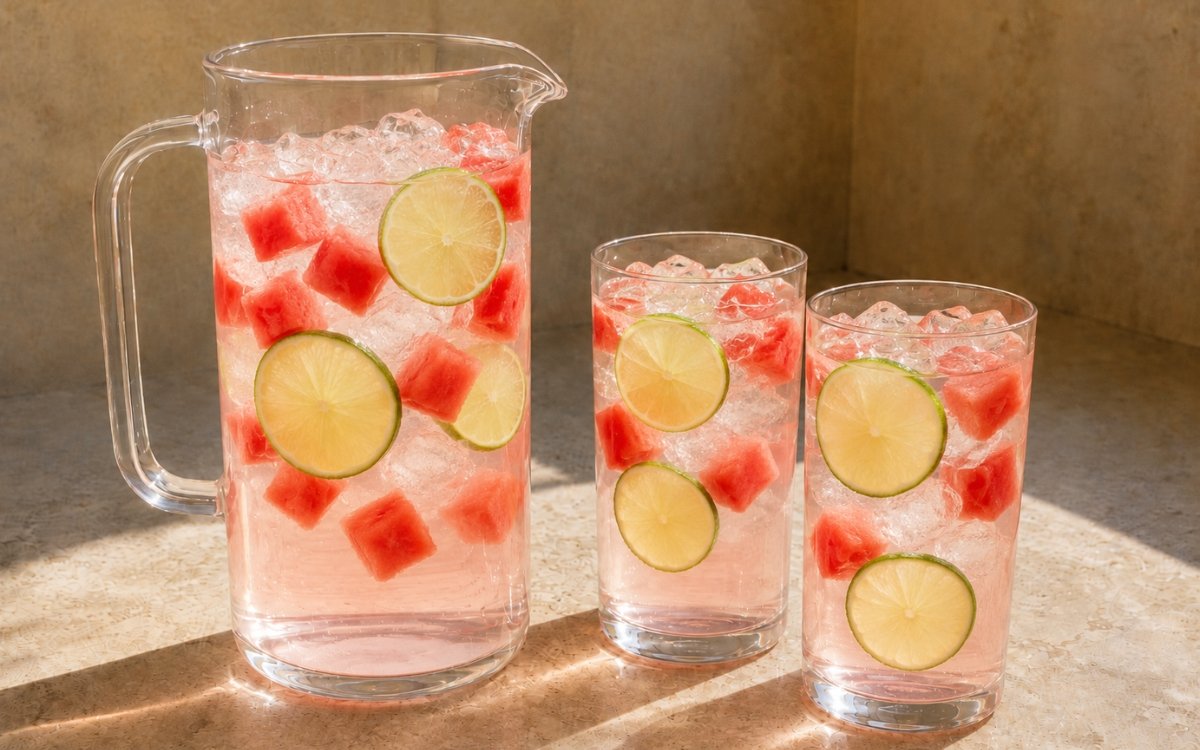
- Pour the 3 litres of ice-cold water into the pitcher. Add the visual watermelon pieces — slices or additional chunks arranged for visual appeal — and the thinly sliced lime rounds. Stir gently once or twice. Cover and refrigerate for 1–4 hours. Watermelon's volatile aromatic compounds infuse progressively into the cold water: at 1 hour a subtle, specifically clean, cool watermelon freshness is present; at 4 hours it is at the maximum of the pleasant infused-water range. The water's colour shifts from clear toward a very pale, barely visible pink from the watermelon's lycopene and anthocyanin pigments — a much lighter colour development than blueberry or raspberry infusions because the watermelon's pigments are primarily carotenoid-based and less soluble in water than anthocyanins. After 4 hours, remove all lime slices and watermelon pieces. The lime rounds' limonoid bitterness extraction timeline applies with the same urgency as in the strawberry lime preparation. The watermelon pieces become visibly paler, softer, and less aromatic as the infusion period extends — their pleasant volatile compounds progressively depleted into the water, leaving less flavourful fruit in the pitcher.
Serve
- Serve well chilled directly from the pitcher, or over ice. Add fresh watermelon triangles and lime rounds to the pitcher or individual glasses at the time of serving for visual freshness. Stir gently before serving as watermelon's natural larger-molecule compounds separate slightly during storage in the same way observed in the fresh watermelon lemonade.
Notes
Seedless watermelon varieties — the standard in most markets — are specifically convenient for this preparation as they eliminate the seed-removal step in the chunking preparation. Any seedless variety produces excellent results; for varieties with seeds, remove all visible seeds before adding to the pitcher. Seeds in infused water do not present the same bitterness risk as raspberry seeds (watermelon seeds are neutral in flavour) but produce an untidy visual and are generally removed for presentation reasons.
The optional lime juice addition in this preparation is specifically lime rather than lemon because lime's sharper, more tropical citrus acidity is the more specifically complementary pairing for watermelon's cool, summer-fruit character. The same pairing instinct drives the Watermelon Mint Fizz Mocktail's lime rather than lemon choice.