
Raspberry Lemonade Pitcher — For a Crowd
Raspberry lemonade at crowd scale introduces the same dual-extraction approach as the single-batch version but at doubled quantities and with specific attention to the crowd-serving considerations that are different at 16 servings from the 8-serving format. The extraction rationale is the same: raspberry’s volatile ester aromatic compounds — the bright, vivid, floral-fruity fractions responsible for fresh raspberry’s characteristically immediate, specifically aromatic freshness — are heat-sensitive and evaporate during even gentle cooking, while the heat-stable compounds that provide warm, concentrated, deeper raspberry flavour extract efficiently at low heat into the honey syrup. Two stages: cooked honey syrup for depth, raw cold-strained juice for volatile brightness. Both fully strained — the specific instruction that crowd format makes more important than at smaller scales. The specific note that lemon juice is structural at this preparation’s scale addresses a dilution issue specific to crowd lemonade: when raspberry lemonade is poured over ice and consumed across a serving period, the ice melts progressively and dilutes each subsequent glass. A preparation with insufficient lemon acid backbone at full concentration will become specifically flat-tasting, thin, and berry-water-adjacent by the second or third glass as the ice dilution compounds the water ratio. The 300ml of lemon juice specifically provides the structural acid backbone that survives progressive ice dilution throughout the service period.
Prep Time : 20 min
Cook Time : 8–10 min
Servings : 16
20 min
8–10 min
16
Ingredients
For the Lemon-Raspberry Base
• Clean pulp or segments from 2–3 lemons — seeds and tough membranes removed; no white pith
For the Honey-Raspberry Syrup
• 300g fresh raspberries
• 140–160g mild honey — start with 140g — this one on Amazon
• 240ml water
• Zest of 2 lemons — yellow part only; added off heat
For the Fresh Raspberry Juice
• 300g fresh raspberries — kept raw; lightly mashed and cold-strained
For the Final Build
• 300ml fresh lemon juice — approximately 6–7 lemons
• 2–2.5 litres ice-cold water — start with 2 litres; adjust after tasting
• 2 pinches fine sea salt
For Serving
• Ice cubes
• Lemon slices
• Fresh raspberries
This post may contain affiliate links. As an Amazon Associate I earn from qualifying purchases, at no additional cost to you.
Directions
- Make the Honey-Raspberry Syrup
Combine the 300g of raspberries, 140g of honey, and 240ml of water in a saucepan over low to medium-low heat. Stir gently until the honey completely dissolves and the raspberries begin releasing their vivid juice. Simmer for 8–10 minutes — the same extraction-not-reduction principle at crowd scale. The liquid must remain vividly coloured, fluid, and aromatic throughout; any visible thickening or darkening signals too much heat. Remove from the heat. Add the zest of 2 lemons and cover. Steep for 5–8 minutes — double the single-batch’s zest quantity for the proportionate volume. The lemon zest’s aromatic oils integrate into the warm raspberry-honey medium during the steep, providing the specifically unified raspberry-citrus aromatic depth in the syrup itself that bridges the two primary flavours at the finished pitcher’s scale. Strain through a fine-mesh sieve, pressing gently but firmly on the cooked raspberry solids. The pressing at this preparation specifically needs care — cooked raspberry seeds at 300g of berries are more numerous than the single-batch equivalent and can force through a poor-quality or over-pressed sieve into the syrup. Always press with deliberate pressure against the mesh rather than aggressive grinding. Cool completely. - Extract the Fresh Raspberry Juice
Place the 300g of fresh raw raspberries in a bowl. Mash lightly with a fork — a fraction less pressure than the cooked berry pressing of Step 1, specifically because raw raspberry seeds release tannins under pressure at higher concentration than cooked seeds. The goal is cracked berries with released juice pooling around them, not a fully uniform mash. Strain through a fine-mesh sieve, pressing lightly on the mashed berries. The 300g of raw raspberries yields approximately 150–180ml of vivid, volatile-compound-rich raw raspberry juice at light pressing pressure. The colour is specifically more vivid, more immediately aromatic, and more noticeably fresh than the cooked syrup’s deeper, warmer result. - Build the Pitcher
Add the lemon pulp from 2–3 lemons (seeds, membranes, and pith removed; clean pulp) to the large pitcher. Muddle gently. Add the 300ml of fresh lemon juice, the cooled honey-raspberry syrup, all of the fresh strained raspberry juice, 2 litres of ice-cold water, and the 2 pinches of fine sea salt. Stir thoroughly. The lemon juice’s structural function at this scale is specifically more important than in smaller preparations. At 16 servings served over ice across a party period of 1–2 hours, each glass experiences progressive additional dilution from ice melt beyond the initial water ratio. A preparation with 300ml of lemon juice maintains its acid backbone across this dilution curve; a preparation with insufficient lemon juice tastes specifically flat, specifically thin, and specifically non-lemonade after the first 2–3 glasses. The 300ml quantity is the minimum for structural integrity at crowd scale. Taste with the crowd-format assessment: vivid raspberry character, clearly lemonade (not berry water), and sufficient acid presence to hold up against ice dilution. If the raspberry is specifically dominant to the exclusion of the lemon’s structural function — more lemon juice sharpens the balance. If it is specifically too intense for the gathering — additional cold water up to 2.5 litres. - Chill, Stir Before Service, and Serve
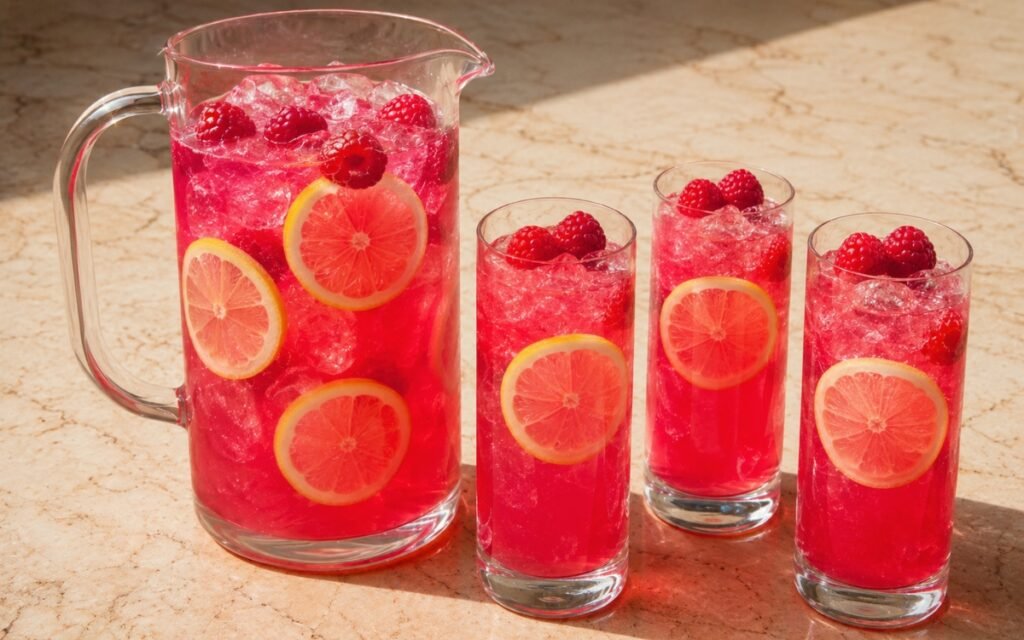
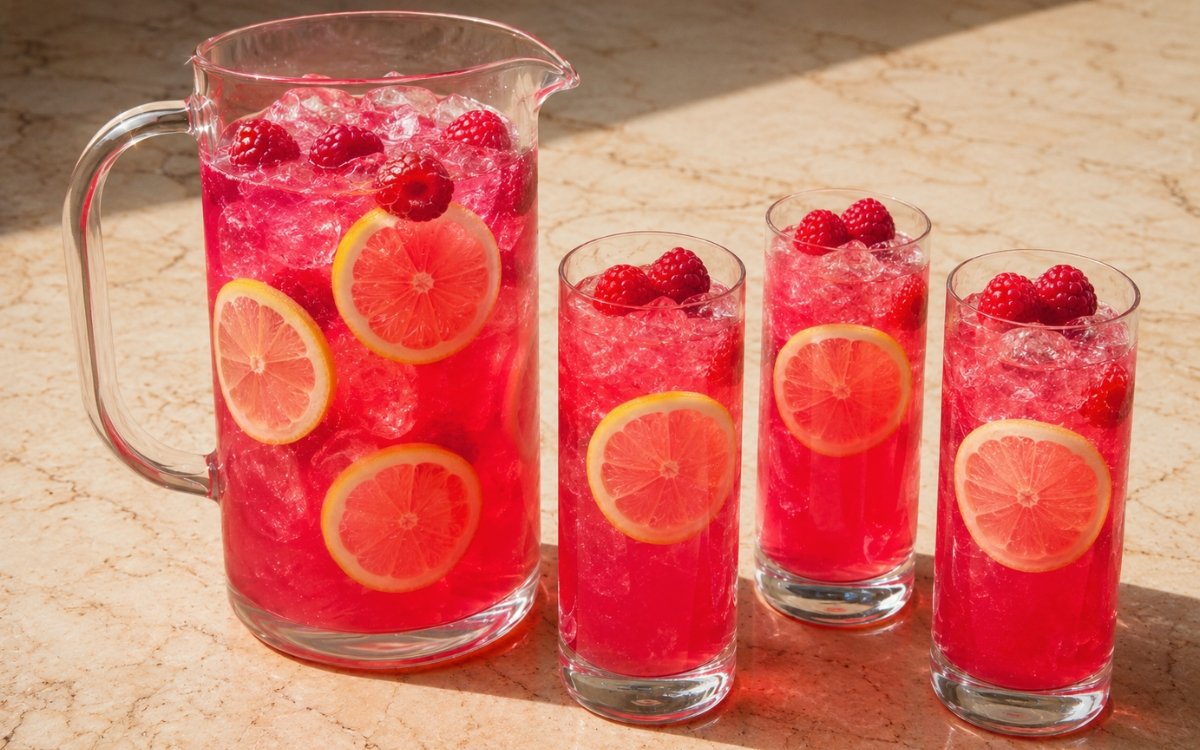
Cover and refrigerate for 1–2 hours. Before serving, stir the pitcher once — natural settling of the denser raspberry components during the refrigerator rest produces a slightly uneven distribution; a single stir before the first pour redistributes. Fill glasses with ice. Pour over the chilled raspberry lemonade. Garnish each glass with a lemon slice and 2–3 fresh raspberries on the rim or resting in the ice. Serve immediately.
*Notes :
- For self-serve party formats, a ladle or large spoon placed in the pitcher helps guests serve themselves without tilting the pitcher — and a brief stir of the pitcher before each self-serve encourages redistribution of any settling during the service period.
- Frozen raspberries are a specifically effective substitute for fresh at the crowd scale — the pre-ruptured cell walls from freezing produce a more immediately vivid colour in the cooked syrup and a faster cold-pressed juice from the raw extraction, often with more vivid colour than fresh. Always thaw before using in either stage.
Why This Recipe Works
This recipe works because the dual-extraction captures both the heat-stable concentrated depth from the honey syrup and the volatile aromatic brightness from the cold-strained raw juice — providing the layered flavour that crowd-scale lemonade specifically requires to hold up across ice dilution and extended service.
The complete straining of both components ensures visual clarity throughout service. The 300ml lemon juice specifically provides the structural acid backbone that survives progressive ice melting. And the mild honey avoids competing with raspberry’s vivid aromatic character at scale.
Ingredient Breakdown
Dual-Raspberry Extraction (300g Cooked + 300g Raw)
The two-temperature approach at crowd scale — cooked honey syrup for warm concentrated depth; raw cold-strained juice for vivid volatile brightness.
300ml Lemon Juice (Structural Acid at Scale)
The backbone calibration — sufficient acid to maintain lemonade identity through progressive ice dilution across a full service period.
Light Raw-Berry Pressing
The crowd-specific tannin management — raw raspberry seeds release tannin at higher concentration than cooked; always light pressing for the cold-strained component.
Full Straining Both Stages
The crowd-clarity requirement — seeds and pulp settling in a crowd pitcher produce visual degradation and inconsistent flavour.
Stir Before Service
The natural-settling correction — denser raspberry components redistribute with a single stir.
Flavor Structure Explained
This Raspberry lemonade follows a layered balance model:
- Multi-layered raspberry core (cooked and fresh raspberry)
- Bright citrus backbone (lemon juice)
- Warm rounded sweetness (syrup)
- Structured crowd-scale acidity (lemon architecture)
- Vivid refreshing finish (fruit-acid balance)
Raspberry defines the foundation through two complementary forms. The cooked raspberry syrup contributes concentrated berry depth and warmth, while the fresh juice adds vivid aromatics and bright fruit freshness. Together they create a complete raspberry expression that is more layered and expressive than either alone. Lemon juice provides the structural backbone, maintaining a clear lemonade identity even when served over ice and diluted in a large-format preparation. Sweetness softens the acidity without obscuring the fruit, allowing the raspberry to remain the dominant flavor. The result is a lemonade that is intensely berry-forward, brightly refreshing, and visually striking while retaining the clean balance expected from classic lemonade.
Common Mistakes to Avoid
- Leaving Seeds and Pulp in the Pitcher – At crowd scale, settling seeds and pulp produce visual degradation progressively through service. Always fully strain.
- Insufficient Lemon Juice – Raspberry lemonade without sufficient structural acid becomes berry water after ice dilution. Always 300ml minimum at this scale.
- Strong Honey at This Quantity – 140–160g of a strongly flavoured honey in a 3.3-litre pitcher is specifically perceptible as competing. Always mild honey.
- Not Stirring Before Service – Natural settling during the refrigerator rest produces uneven distribution. Always stir once before the first pour.
- Pressing the Raw Raspberry Seeds Firmly – Raw tannin extraction under firm pressing. Always light pressure for the cold-strained component.
Variations
Sparkling Raspberry Lemonade Pitcher
Build without water; refrigerate; add ice-cold sparkling water right before serving at the same total volume.
With Mint
Add 20 lightly clapped fresh mint leaves to the completed pitcher before chilling — steep cold for 20 minutes then remove. Mint and raspberry at crowd scale is a specifically refreshing, specifically summery combination.
With Rose
Add 1½ tsp of food-grade dried rose petals to the honey-raspberry syrup during the off-heat steep alongside the lemon zest — rose and raspberry’s shared geraniol aromatic connection producing the most specifically elegant crowd version.
With Lime
Replace 100ml of the lemon juice with lime juice — the Raspberry Basil Limeade direction in crowd format.
Storage & Make-Ahead
Honey-raspberry syrup can be refrigerated for up to 4 days, making it an excellent component to prepare well in advance for parties or gatherings.
Raw raspberry juice is best used within 4 to 6 hours of pressing to preserve its freshest aromatic qualities. Alternatively, it can be pressed on the day of serving and refrigerated until it is ready to be combined with the other ingredients.
Once assembled, the pitcher can be refrigerated for up to 2 days. If serving on the second day, stir well before pouring to ensure the flavors are evenly distributed.
Frequently Asked Questions
Why is the lemon juice specifically described as structural?
Raspberry lemonade served over ice in a crowd setting experiences progressive ice-melt dilution with each pour and across each glass during consumption. A preparation with sufficient lemon juice (300ml) maintains its acid backbone and lemonade identity through this dilution. A preparation with insufficient lemon juice is correctly balanced at the moment of building but becomes flat, thin, and specifically non-lemonade after the first 2–3 pours as the lemon’s contribution is diluted below the threshold of structural function.
Why is the raw raspberry pressing lighter than the cooked syrup pressing?
Raw raspberry seeds release tannin compounds under pressure at higher concentration than cooked raspberry seeds — cooking’s heat partially denatures or softens the tannin-containing structures. The light press for the raw extraction specifically avoids the astringency that firm pressing would introduce.
Why stir before service after chilling?
The honey-raspberry syrup’s denser components settle slightly during the refrigerator rest, producing a pitcher where the first glass may be lighter and the last glass more concentrated. A single stir before the first pour redistributes everything for consistent flavour throughout service.
What other crowd-format and raspberry preparations share this direction?
The Strawberry Lemonade Pitcher Drink shares the crowd-format dual-extraction berry lemonade structure with strawberry’s warmer, sweeter fruitiness — the most directly structurally comparable preparation. The Raspberry Orange Infused Water shares raspberry at the most restrained, most water-like end of the spectrum. The Raspberry Iced Tea Pitcher shares raspberry at crowd scale in a tea-based format.
Nutrition Facts
( per serving )
Calories
~75 kcal
Protein
0 g
Fat
0 g
Carbs
20 g
Calories
~75 kcal
Protein
0 g
Fat
0 g
Carbs
20 g
Related Recipes
Related Recipes

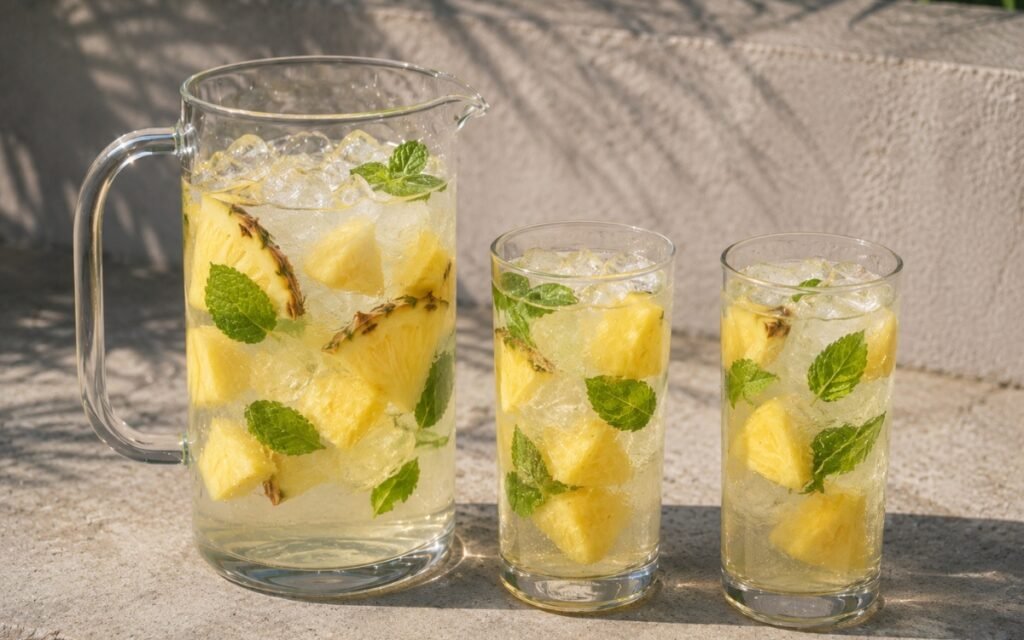
Pineapple Mint Infused Water
Pineapple lightly pressed and clapped mint leaves cold-infused in 3L water — removed after 4 hours before fermentation develops. Tropical warmth and mint coolness.
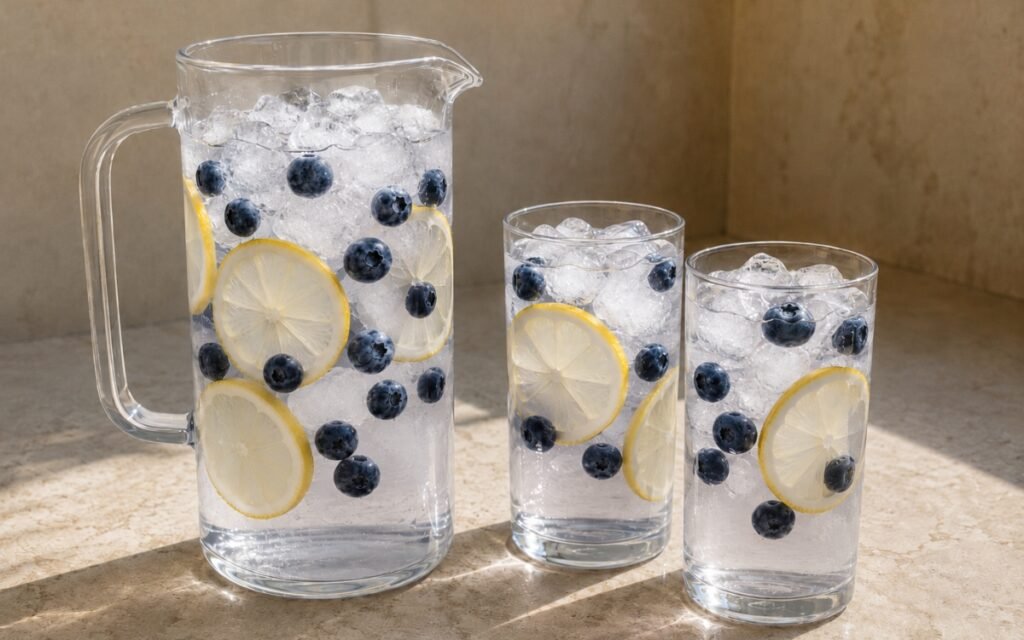
Blueberry Lemon Infused Water
Blueberries mashed for vivid colour, whole blueberries and lemon slices cold-infused in 3L water — removed after 4 hours. Vivid blue-purple to lavender and hydrating.
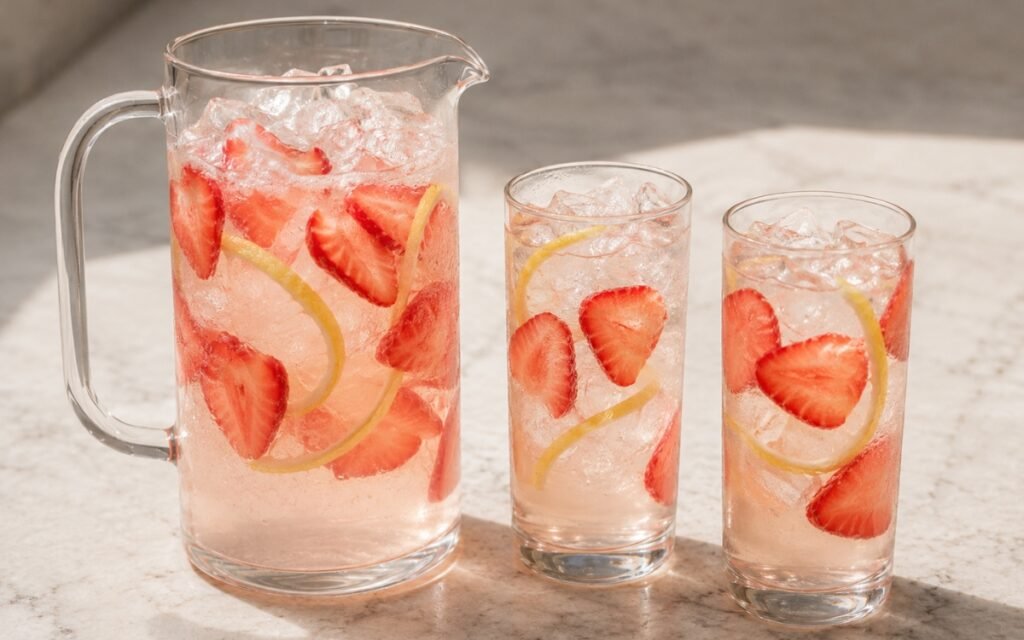
White Tea Strawberry Pitcher
White tea at 70–75°C for 3–4 minutes, strawberries gently infused 8–10 minutes — fully strained, cold water only (no juice), chilled. Pale, delicate, and refined.
You might also like
You might also like
Mango Iced Green Tea
Green tea at 75–80°C for 2–3 minutes, mango simmered into a light unreduced syrup, deseeded chili infused cold 3–5 minutes — chilled. Bright, tropical, gently edged.
Fresh Pink Lemonade
Cranberries simmered for extraction, not reduction — vivid fluid syrup combined with fresh lemon juice and salt. Naturally pink, tart, and crisp.
Orange Cold Brew Iced Tea
Black tea cold brewed 8–12 hours in cold filtered water — orange peel infused 10–12 minutes, fresh orange juice. Ultra-smooth and gently citrusy.

Raspberry Lemonade Pitcher for a Crowd
Ingredients
Method
- Combine the 300g of raspberries, 140g of honey, and 240ml of water in a saucepan over low to medium-low heat. Stir gently until the honey completely dissolves and the raspberries begin releasing their vivid juice. Simmer for 8–10 minutes — the same extraction-not-reduction principle at crowd scale. The liquid must remain vividly coloured, fluid, and aromatic throughout; any visible thickening or darkening signals too much heat. Remove from the heat. Add the zest of 2 lemons and cover. Steep for 5–8 minutes — double the single-batch’s zest quantity for the proportionate volume. The lemon zest’s aromatic oils integrate into the warm raspberry-honey medium during the steep, providing the specifically unified raspberry-citrus aromatic depth in the syrup itself that bridges the two primary flavours at the finished pitcher’s scale. Strain through a fine-mesh sieve, pressing gently but firmly on the cooked raspberry solids. The pressing at this preparation specifically needs care — cooked raspberry seeds at 300g of berries are more numerous than the single-batch equivalent and can force through a poor-quality or over-pressed sieve into the syrup. Always press with deliberate pressure against the mesh rather than aggressive grinding. Cool completely.
- Place the 300g of fresh raw raspberries in a bowl. Mash lightly with a fork — a fraction less pressure than the cooked berry pressing of Step 1, specifically because raw raspberry seeds release tannins under pressure at higher concentration than cooked seeds. The goal is cracked berries with released juice pooling around them, not a fully uniform mash. Strain through a fine-mesh sieve, pressing lightly on the mashed berries. The 300g of raw raspberries yields approximately 150–180ml of vivid, volatile-compound-rich raw raspberry juice at light pressing pressure. The colour is specifically more vivid, more immediately aromatic, and more noticeably fresh than the cooked syrup’s deeper, warmer result.
- Add the lemon pulp from 2–3 lemons (seeds, membranes, and pith removed; clean pulp) to the large pitcher. Muddle gently. Add the 300ml of fresh lemon juice, the cooled honey-raspberry syrup, all of the fresh strained raspberry juice, 2 litres of ice-cold water, and the 2 pinches of fine sea salt. Stir thoroughly. The lemon juice’s structural function at this scale is specifically more important than in smaller preparations. At 16 servings served over ice across a party period of 1–2 hours, each glass experiences progressive additional dilution from ice melt beyond the initial water ratio. A preparation with 300ml of lemon juice maintains its acid backbone across this dilution curve; a preparation with insufficient lemon juice tastes specifically flat, specifically thin, and specifically non-lemonade after the first 2–3 glasses. The 300ml quantity is the minimum for structural integrity at crowd scale. Taste with the crowd-format assessment: vivid raspberry character, clearly lemonade (not berry water), and sufficient acid presence to hold up against ice dilution. If the raspberry is specifically dominant to the exclusion of the lemon’s structural function — more lemon juice sharpens the balance. If it is specifically too intense for the gathering — additional cold water up to 2.5 litres.
- Cover and refrigerate for 1–2 hours. Before serving, stir the pitcher once — natural settling of the denser raspberry components during the refrigerator rest produces a slightly uneven distribution; a single stir before the first pour redistributes. Fill glasses with ice. Pour over the chilled raspberry lemonade. Garnish each glass with a lemon slice and 2–3 fresh raspberries on the rim or resting in the ice. Serve immediately.