Ingredients
Method
Make the Honey-Raspberry Syrup
- Combine the 300g of raspberries, 140g of honey, and 240ml of water in a saucepan over low to medium-low heat. Stir gently until the honey completely dissolves and the raspberries begin releasing their vivid juice. Simmer for 8–10 minutes — the same extraction-not-reduction principle at crowd scale. The liquid must remain vividly coloured, fluid, and aromatic throughout; any visible thickening or darkening signals too much heat. Remove from the heat. Add the zest of 2 lemons and cover. Steep for 5–8 minutes — double the single-batch's zest quantity for the proportionate volume. The lemon zest's aromatic oils integrate into the warm raspberry-honey medium during the steep, providing the specifically unified raspberry-citrus aromatic depth in the syrup itself that bridges the two primary flavours at the finished pitcher's scale. Strain through a fine-mesh sieve, pressing gently but firmly on the cooked raspberry solids. The pressing at this preparation specifically needs care — cooked raspberry seeds at 300g of berries are more numerous than the single-batch equivalent and can force through a poor-quality or over-pressed sieve into the syrup. Always press with deliberate pressure against the mesh rather than aggressive grinding. Cool completely.
Extract the Fresh Raspberry Juice
- Place the 300g of fresh raw raspberries in a bowl. Mash lightly with a fork — a fraction less pressure than the cooked berry pressing of Step 1, specifically because raw raspberry seeds release tannins under pressure at higher concentration than cooked seeds. The goal is cracked berries with released juice pooling around them, not a fully uniform mash. Strain through a fine-mesh sieve, pressing lightly on the mashed berries. The 300g of raw raspberries yields approximately 150–180ml of vivid, volatile-compound-rich raw raspberry juice at light pressing pressure. The colour is specifically more vivid, more immediately aromatic, and more noticeably fresh than the cooked syrup's deeper, warmer result.
Build the Pitcher
- Add the lemon pulp from 2–3 lemons (seeds, membranes, and pith removed; clean pulp) to the large pitcher. Muddle gently. Add the 300ml of fresh lemon juice, the cooled honey-raspberry syrup, all of the fresh strained raspberry juice, 2 litres of ice-cold water, and the 2 pinches of fine sea salt. Stir thoroughly. The lemon juice's structural function at this scale is specifically more important than in smaller preparations. At 16 servings served over ice across a party period of 1–2 hours, each glass experiences progressive additional dilution from ice melt beyond the initial water ratio. A preparation with 300ml of lemon juice maintains its acid backbone across this dilution curve; a preparation with insufficient lemon juice tastes specifically flat, specifically thin, and specifically non-lemonade after the first 2–3 glasses. The 300ml quantity is the minimum for structural integrity at crowd scale. Taste with the crowd-format assessment: vivid raspberry character, clearly lemonade (not berry water), and sufficient acid presence to hold up against ice dilution. If the raspberry is specifically dominant to the exclusion of the lemon's structural function — more lemon juice sharpens the balance. If it is specifically too intense for the gathering — additional cold water up to 2.5 litres.
Chill, Stir Before Service, and Serve
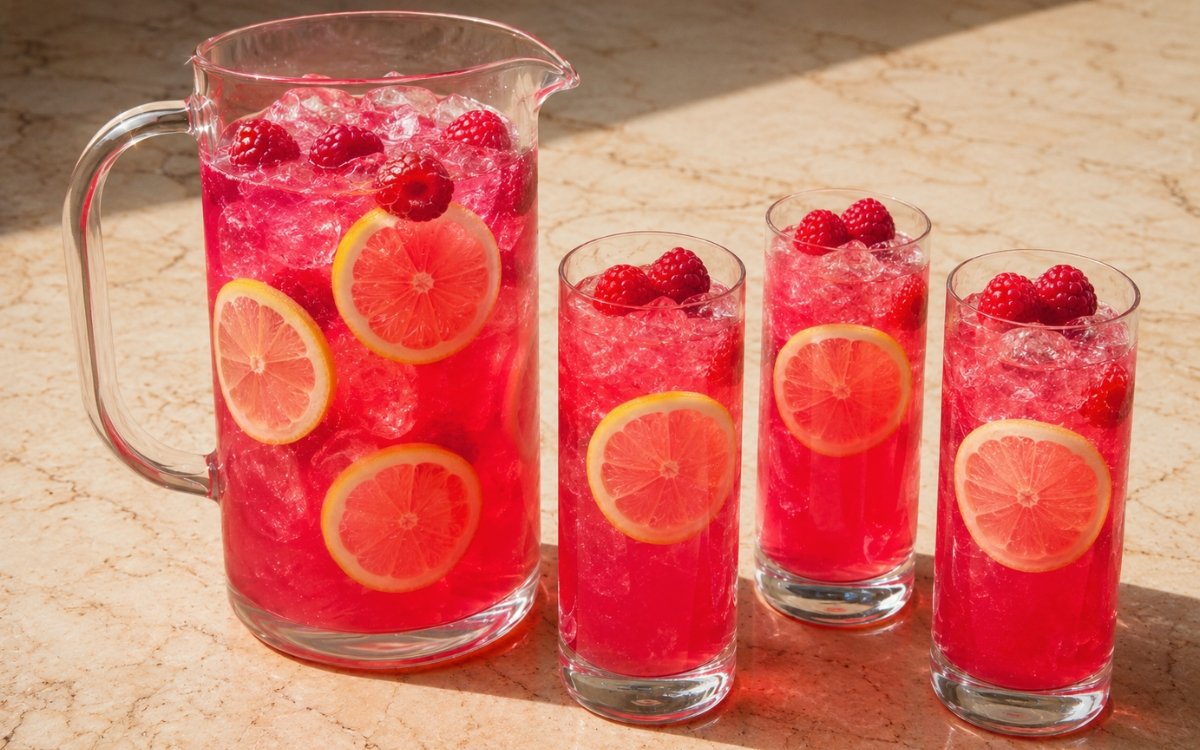
- Cover and refrigerate for 1–2 hours. Before serving, stir the pitcher once — natural settling of the denser raspberry components during the refrigerator rest produces a slightly uneven distribution; a single stir before the first pour redistributes. Fill glasses with ice. Pour over the chilled raspberry lemonade. Garnish each glass with a lemon slice and 2–3 fresh raspberries on the rim or resting in the ice. Serve immediately.
Notes
For self-serve party formats, a ladle or large spoon placed in the pitcher helps guests serve themselves without tilting the pitcher — and a brief stir of the pitcher before each self-serve encourages redistribution of any settling during the service period.
Frozen raspberries are a specifically effective substitute for fresh at the crowd scale — the pre-ruptured cell walls from freezing produce a more immediately vivid colour in the cooked syrup and a faster cold-pressed juice from the raw extraction, often with more vivid colour than fresh. Always thaw before using in either stage.