
Korean Beef Bulgogi Rice Bowl
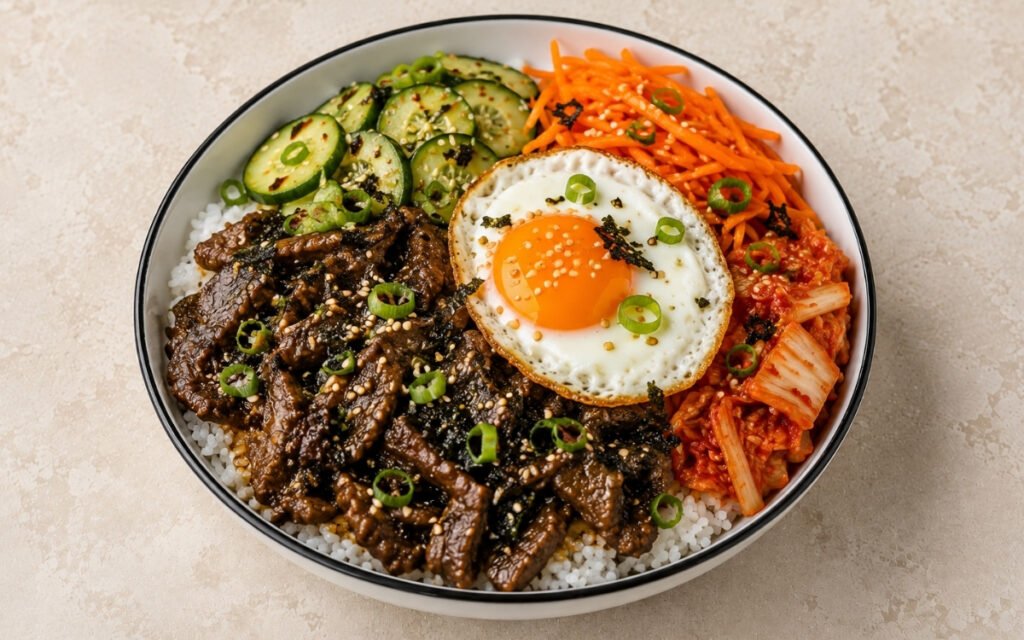
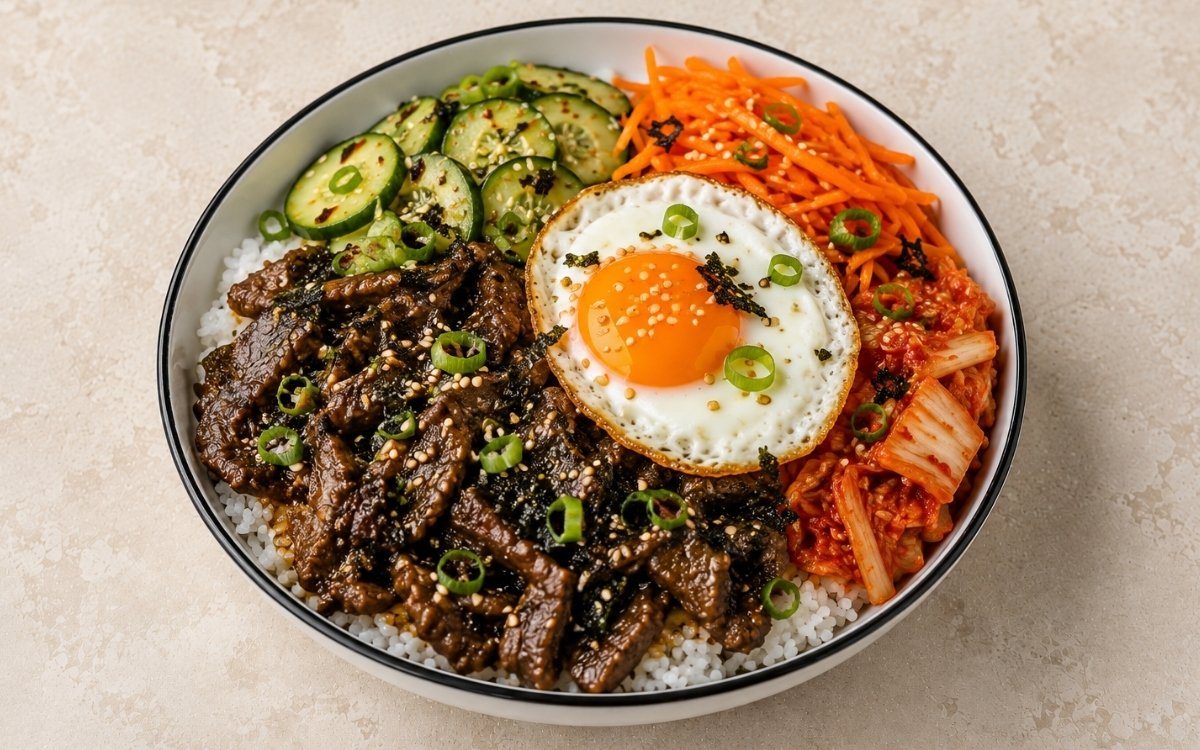
Ribeye sliced paper-thin against the grain and marinated in soy, brown sugar, sesame oil, grated Asian pear, gochugaru, and fresh ginger — the Asian pear’s natural enzymes tenderising the meat simultaneously while its juice adds subtle sweetness to the marinade. Cooked in a smoking-hot cast iron skillet in two batches, each half left undisturbed for 2 minutes before stirring, so the marinade’s sugar caramelises into the specific dark, slightly sticky bulgogi crust rather than steaming pale. Quick-pickled cucumbers made while the beef marinates, kimchi alongside, a runny-yolk fried egg on top, and torn nori scattered over. The Korean barbecue bowl that earns its reputation at home.
Prep Time : 20 min
Cook Time : 15 min
Servings : 4
20 min
15 min
4
Ingredients
For the Bulgogi Marinade
• 60ml soy sauce
• 40g brown sugar
• 30ml sesame oil — this one on Amazon
• 20g garlic, minced
• 15g fresh ginger, grated
• 60g Asian pear, grated
• 10g gochugaru, Korean red pepper flakes — this one on Amazon
• 2g black pepper
For the Beef Bulgogi Rice Bowl
• 600g ribeye steak
• 240g short-grain white rice, uncooked
• 400ml water
• 200g cucumber, thinly sliced
• 30g rice vinegar
• 15g sugar
• 3g salt
• 100g carrots, julienned
• 60g kimchi
• 4 large eggs
• 40g neutral oil, divided
• 20g green onions, sliced
• 10g toasted sesame seeds — this one on Amazon
• 5g nori sheets, torn
This post may contain affiliate links. As an Amazon Associate I earn from qualifying purchases, at no additional cost to you.
Directions
- Prepare the Bulgogi Marinade
In a large bowl, whisk together the 60ml of soy sauce, 40g of brown sugar, 30ml of toasted sesame oil, 20g of minced garlic, 15g of grated fresh ginger, 60g of grated Asian pear, 10g of gochugaru, and 2g of black pepper. Whisk continuously until the brown sugar has completely dissolved and the mixture is uniform — undissolved sugar settling at the bottom of the marinade produces uneven seasoning on the beef’s surface. The marinade’s components are each specifically chosen: soy provides the primary salt and umami; brown sugar provides the caramelisable sweetness that produces the characteristic bulgogi crust during high-heat cooking; sesame oil provides the specifically Korean aromatic richness; gochugaru provides the fruity, building heat that prevents the sweet-savoury combination from tasting cloying. The Asian pear deserves specific attention — it contains proteolytic enzymes, primarily actinidin, that break down muscle protein fibres in the beef’s outer surface during the marinating period, producing a notably more tender texture than the same beef marinated without it. The pear also contributes a mild, clean fruitiness to the marinade’s flavour. If unavailable, 15g of kiwi fruit provides the same enzyme activity at a smaller quantity — kiwi’s actinidin is more concentrated and requires no more than 15g for 30 minutes, as longer exposure or larger quantities will overtenderise and affect the beef’s texture negatively. - Slice and Marinate the Beef
Place the 600g of ribeye in the freezer for 30 minutes before slicing if time allows — partially frozen beef is significantly firmer than fully thawed beef and can be sliced to the required 3mm thinness much more consistently with a sharp knife. At room temperature, even a sharp knife produces slightly uneven slices when working against the grain of the muscle fibres. If the freezer step is skipped, work slowly with a very sharp knife. Slice the ribeye against the grain — cutting perpendicular to the muscle fibres’ direction — into strips approximately 3mm thick and 4–5cm in length. Cutting against the grain shortens each individual muscle fibre so it snaps cleanly when bitten rather than requiring tearing through long, intact fibres. The paper-thin slices also provide maximum marinade penetration surface area and maximum caramelised surface area during the high-heat cooking step. Add the sliced beef to the marinade and toss thoroughly to coat every surface. Cover and refrigerate for a minimum of 30 minutes — sufficient for the pear’s enzymes to tenderise the outer surface and the marinade’s flavours to penetrate. Up to 4 hours produces deeper flavour penetration; beyond 4 hours the pear’s enzymatic activity can make the outer surface slightly mushy. - Quick-Pickle the Cucumbers
While the beef marinates, prepare the quick-pickled cucumbers. In a medium bowl, combine the 200g of thinly sliced cucumber with the 30ml of rice vinegar, 15g of sugar, and 3g of salt. Toss to coat and allow to sit at room temperature for the duration of the marinating period, tossing occasionally. In 30 minutes the cucumber slices will have released some of their moisture into the surrounding pickling liquid, absorbing the vinegar’s clean acidity and the sugar’s mild sweetness in return — softening slightly at their surface while retaining crisp structure in their centre. The quick-pickled cucumber is the acid element that cuts through the bulgogi’s sweet-savoury richness, the fried egg’s creaminess, and the rice’s neutrality — its presence in the bowl provides the brightness that makes all the other components feel more vivid. - Cook the Short-Grain White Rice
Rinse the 240g of short-grain white rice under cold running water in a fine-mesh sieve, working the grains gently with your fingers until the water running through them is completely clear. Short-grain rice has a higher surface starch content than jasmine rice — rinsing is more important here, not less, because the residual starch on unrinsed short-grain produces a gluey, over-sticky result rather than the correctly slightly sticky, distinct grains that make a proper Korean rice bowl base. Combine the rinsed rice with 400ml of cold water in a medium saucepan. Bring to a full rolling boil over high heat — wait for a genuine boil, not the first sign of simmering. Reduce immediately to the lowest possible heat setting, cover tightly with a well-fitting lid, and simmer for 15 minutes. Do not lift the lid at any point during this 15-minute period — the trapped steam inside the covered pot is the primary cooking medium, and any escape disrupts the water absorption ratio and produces unevenly cooked grains. After 15 minutes, remove from heat completely. Leave completely covered and undisturbed for a further 10 minutes — do not open the lid during this resting period either. The residual steam inside the covered pot continues cooking the uppermost layers of rice gently and evenly during this rest, while the bottom grains firm slightly away from the pan. Only after the full 10-minute rest, remove the lid and fluff gently with a fork using a light lifting motion. The rice should be fully cooked throughout, slightly sticky, and hold its shape when pressed — the correct short-grain texture for a Korean rice bowl. - Cook the Bulgogi Beef in Two Batches
This step requires a very specific technique — the difference between genuinely caramelised bulgogi and pale, steamed beef. Heat a large cast iron skillet or heavy wok over the absolute highest available heat for 2–3 full minutes until smoking. Add 15ml of neutral oil and immediately add half the marinated beef in a single layer. Leave completely undisturbed for 2 minutes — the sustained direct contact between the marinade-coated beef and the smoking surface is what caramelises the marinade’s brown sugar into the characteristic dark, sticky, slightly charred bulgogi crust. Any movement during this 2 minutes breaks the contact and prevents the caramelisation. After 2 minutes, stir-fry for a further 1–2 minutes until the beef is cooked through. Transfer immediately to a serving plate — all accumulated sauce and caramelised drippings included. Allow the pan to return to smoking temperature before proceeding. Add the remaining 15ml of oil and cook the second batch identically. Cooking both batches simultaneously would crowd the pan, dropping the temperature dramatically and causing the beef and its marinade to steam in the shared liquid rather than caramelise at the pan surface — producing pale, wet beef entirely lacking the crust that defines this dish. - Fry the Eggs
In a smaller non-stick skillet, heat the remaining 10ml of neutral oil over medium-high heat until shimmering. Crack the 4 eggs carefully into the pan with space between each. Fry for 2–3 minutes — the whites should be fully set with a clearly opaque, firm exterior while the yolk remains completely liquid and moves freely when the pan is gently tilted. The runny yolk is the specific finishing element of the bulgogi bowl — broken over the assembled bowl at the table, it runs into the rice and distributes a creamy, rich yolk over the surrounding components, seasoning every element it contacts and providing the specific richness that makes the bowl feel complete rather than simply assembled. Cook fully set eggs only if strongly preferred — the liquid yolk is worth attempting. - Assemble and Serve
Divide the 720g of cooked short-grain white rice among four wide bowls — short-grain white rice is specified because its slightly sticky character holds the bowl’s components in place rather than the grains rolling loosely, and its mild flavour provides the correct neutral base for the assertively flavoured bulgogi. Top each bowl with a generous portion of the caramelised bulgogi beef — arranging it so the dark, caramelised surfaces are visible rather than buried. Arrange the components distinctly: drain the quick-pickled cucumbers and place alongside the beef; add 25g of julienned carrots per bowl; place 15g of kimchi per bowl. The kimchi provides the fermented, spiced, acidic complexity that the pickled cucumber’s clean simplicity does not — they serve different acid and flavour roles simultaneously. Place one fried egg on top of each assembled bowl. Drizzle any remaining pan sauce — the concentrated, caramelised bulgogi drippings from the plate — over each bowl. Scatter the sliced green onions, toasted sesame seeds, and torn nori pieces across each bowl. The nori provides a specifically Japanese-Korean flavour element — its umami-rich, slightly oceanic character amplifies the sesame oil and soy’s savoury depth in each bite it is present. Serve immediately — the fried egg is broken by the person eating, the yolk releasing into the bowl at the table.
*Notes :
- The Asian pear enzyme tenderisation is a technique specific to Korean cuisine that distinguishes authentic bulgogi from its simplified imitations. Most marinade tenderisation in Western cooking relies on acid alone — wine, citrus, or vinegar — which denatures surface proteins but does not break down the muscle fibres’ peptide bonds. The proteolytic enzymes in Asian pear (and kiwi, papaya, and pineapple) directly cleave the peptide bonds in the myosin fibres, producing a more fundamental tenderisation at the molecular level. The result is beef that is noticeably more tender than acid-only marinated beef at the same thickness — producing the specific melt-in-the-mouth, slightly silky texture that characterises properly prepared bulgogi.
- The two-batch cooking approach is non-negotiable for the correct result and bears repeating in the notes context. A full 600g of marinated beef in a single batch in a 28–30cm skillet produces approximately 6–8mm average depth of beef — sufficient to trap steam between pieces and between the beef and pan surface. The marinade’s sugar in a steaming environment dissolves into liquid rather than caramelising, producing grey, wet beef swimming in liquid sauce. Two batches at half the quantity each, spread to a single layer in a smoking-hot pan, produce the correct caramelised, slightly charred result that is the textural and flavour signature of authentic bulgogi.
Why This Recipe Works
This recipe works because it treats the two critical technique requirements of bulgogi — the enzyme tenderisation during marinating and the single-layer, undisturbed caramelisation during cooking — as non-negotiable rather than optional. The Asian pear’s enzymes produce the specific tenderness; the undisturbed 2-minute contact produces the specific crust.
Both together produce the result that makes bulgogi worth making rather than simply ordering. The bowl components — quick-pickled cucumber for acid, kimchi for fermented complexity, runny egg for richness — each provide a dimension the others do not.
Ingredient Breakdown
Ribeye (Sliced Paper-Thin Against Grain)
The correct bulgogi cut — sufficient fat marbling for the caramelised crust, against-grain slicing for tenderness, paper-thin for maximum caramelised surface area.
Asian Pear (60g, Grated)
The enzyme tenderiser — proteolytic enzymes break down muscle fibre peptide bonds during marinating, producing the silky tenderness specific to authentic bulgogi.
Brown Sugar (In Marinade)
The caramelisation source — Maillard-reacts with the beef’s surface proteins at the smoking-hot pan contact, producing the dark, sticky bulgogi crust.
Gochugaru
The Korean heat element — fruity, building warmth that prevents the sweet-savoury marinade from tasting flat.
Two-Batch, Undisturbed Sear
The technique decision that makes or breaks the dish — the 2-minute undisturbed contact produces caramelisation; a crowded, moved batch produces steaming.
Runny-Yolk Fried Egg
The finishing richness — broken over the assembled bowl at the table, the liquid yolk distributes through the components as a creamy seasoning layer.
Kimchi and Quick-Pickled Cucumber
The dual-acid elements — kimchi for fermented complexity, pickled cucumber for clean, fresh brightness; serving different roles simultaneously.
Flavor Structure Explained
This Korean beef bulgogi bowl follows a layered balance model:
- Sweet-savory umami core (soy sauce, brown sugar, sesame oil)
- Fruity warming heat (gochugaru)
- Bright fermented contrast (pickled cucumber, kimchi)
- Creamy rich layer (sesame oil, egg yolk)
- Umami aromatic finish (nori, sesame seeds)
The bulgogi marinade defines the foundation with caramelised sweetness, soy-driven umami, and sesame richness coating every piece of beef. Gochugaru adds a slow-building warmth that keeps the sweetness active rather than flat. Pickled cucumber and kimchi cut through the richness with acidity and fermentation, adding brightness and complexity. Sesame oil and egg yolk create a smooth, coating richness that ties the bowl together. Nori and sesame seeds finish with nutty umami and aromatic depth, completing the structure with layered contrast and balance.
Common Mistakes to Avoid
- Not Slicing Thin Enough – Thicker beef slices require longer cooking to cook through, during which the exterior caramelises to burning rather than the correct crust. Paper-thin slices cook through in the same 2–3 minutes that produce the correct crust.
- Skipping the Freezer Step – Room-temperature ribeye produces uneven slice thickness that affects both marinade penetration and cooking time consistency. 30 minutes in the freezer before slicing produces consistent 3mm slices.
- Marinating More Than 4 Hours – The Asian pear’s enzymes continue working beyond the flavour benefit — beyond 4 hours the outer surface of the beef becomes noticeably mushy rather than tender.
- Cooking Both Batches Together – The most consequential error. Always cook in two single-layer batches at smoking heat.
- Moving the Beef in the First 2 Minutes – The caramelisation requires sustained contact. Any movement during the first 2 minutes breaks the contact and prevents the crust.
- Cooking the Yolk Through – The runny yolk is the finishing element that seasons the whole bowl at the table. Cook only until the whites are set and the yolk is fully liquid.
Variations
With Chicken Thighs
Replace the ribeye with 600g of boneless, skinless chicken thighs sliced thinly — the same marinade and technique apply, with cooking time adjusted to 3–4 minutes per batch to ensure the chicken is fully cooked through.
Extra Spicy Version
Double the gochugaru to 20g and add 30g of gochujang paste to the marinade for a version where the heat is a primary note rather than a warm background — the gochujang adds fermented chili complexity alongside the flakes’ heat.
With Bibimbap Vegetables
Add sautéed spinach, sautéed mushrooms, and blanched bean sprouts alongside the existing bowl components for a more complete bibimbap-style bowl — each vegetable prepared separately and arranged in distinct sections.
Without Egg
The bowl is complete without the fried egg — increase the kimchi to 80g per bowl for additional richness and flavour to compensate for the absent yolk.
Storage & Make-Ahead
Cooked bulgogi beef can be refrigerated for up to 3 days. Although the caramelized crust will soften during storage, the flavor will still be excellent. To bring back some of the caramelization, reheat it briefly in a hot, dry skillet for 60 to 90 seconds.
Marinated raw beef can be kept in the refrigerator for up to 4 hours before cooking. After that, the enzyme activity in the marinade may begin to over-tenderize the surface.
Quick-pickled cucumbers can be refrigerated for up to 2 days. The pickling flavor will deepen overnight, although the cucumbers will continue to soften the longer they sit. They will still remain pleasant to eat.
For meal prep, it is best to store all of the components separately. This makes for an excellent 4-day meal prep option. Cook the eggs fresh when serving, and add the nori only right before eating.
Frequently Asked Questions
What is the purpose of Asian pear in bulgogi?
Asian pear contains proteolytic enzymes that break down muscle fibre peptide bonds in the beef’s surface, producing measurably more tender meat than acid-only marinades. The pear also contributes a clean, mild fruitiness to the marinade. It is a traditional ingredient in Korean bulgogi that distinguishes authentic preparations from simplified versions.
What is gochugaru and can I substitute it?
Gochugaru is Korean coarse red pepper flakes — fruity, moderately spiced, and slightly sweet, providing building warmth rather than sharp immediate heat. Generic red pepper flakes provide comparable heat without the specific fruity character. Cayenne provides heat with a different, more aggressive profile. Neither is an exact substitute for gochugaru’s specific flavour.
Why short-grain rice rather than jasmine?
Short-grain white rice’s slightly sticky character holds the bowl’s components in place rather than rolling loosely, and its mild, slightly sweet flavour is specifically suited to the assertive bulgogi and kimchi. It is the traditional Korean rice for this application.
Can I grill the bulgogi instead of pan-searing?
Yes — very high heat grill, very thin slices, and very brief cooking (60–90 seconds per side) produce excellent grilled bulgogi with additional char character from the grill grate. The marinade’s sugar burns quickly on a direct flame, so watch carefully.
Why is two-batch cooking so important?
A full batch of 600g of thin marinated beef in a single layer fills even a large skillet beyond capacity, trapping the released moisture and creating a steaming environment. The sugar in the marinade dissolves into liquid rather than caramelising, producing wet, grey beef. Two batches at half quantity each, with the pan brought back to smoking between batches, produce the caramelised, slightly charred crust that defines the dish.
Nutrition Facts
( per serving )
Calories
~890 kcal
Protein
46 g
Fat
44 g
Carbs
77 g
Calories
~890 kcal
Protein
46 g
Fat
44 g
Carbs
77 g
Related Recipes
Related Recipes

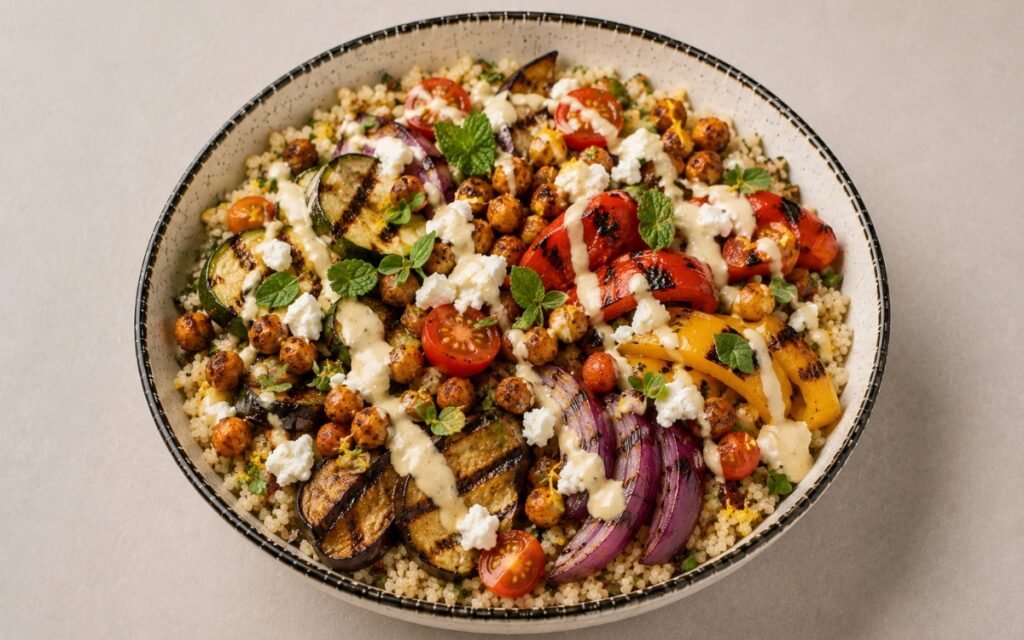
Grilled Mediterranean Veggie Bowl
Smoky grilled vegetables with lemon-herb quinoa, crispy chickpeas & creamy tahini-yogurt sauce.
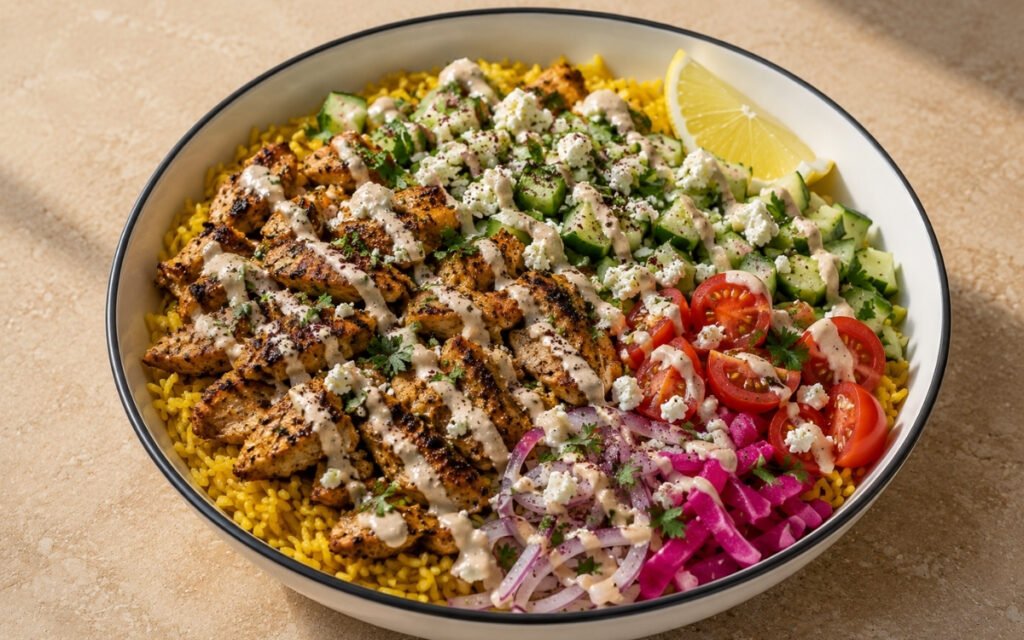
Lebanese Chicken Shawarma Rice Bowl
Chicken thighs marinated in yogurt and seven Lebanese spices, charred undisturbed in cast iron — over turmeric rice with cold-whisked tahini sauce and pickled turnips. 45 minutes.
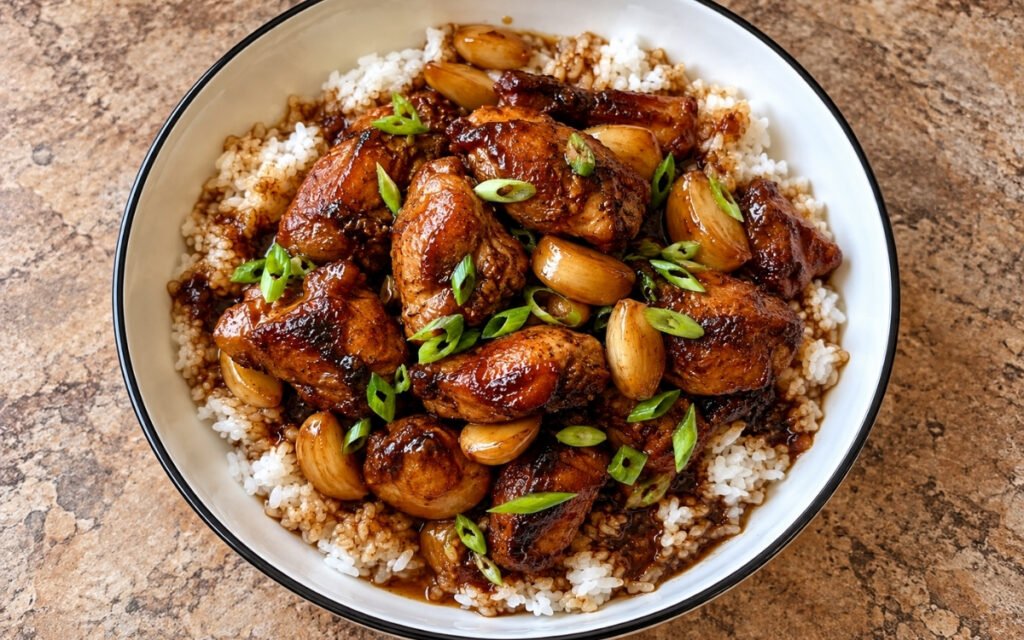
Chicken Adobo Rice Bowl
Boneless chicken thighs braised in soy sauce, vinegar, garlic, bay leaf and black pepper until deeply savory and glossy, spooned over rice.
You might also like
You might also like
Pho Sandwich
Slow-braised beef in a fragrant, charred pho-style spice base, sliced and glazed, piled into a crusty baguette with fresh herbs and crispy shallots.
Steak Tacos with Salsa Verde
Dry-brined, hard-seared steak, rested and sliced thin against the grain, in warm homemade corn tortillas with salsa verde, onion, and avocado.
Loaded Nachos
Sturdy tortilla chips layered with melted Mexican cheese blend, hard-browned seasoned ground beef, drained pico de gallo, guacamole, and sour cream.
Korean Beef Bulgogi Bowl
Ingredients
Method
- In a large bowl, whisk together the 60ml of soy sauce, 40g of brown sugar, 30ml of toasted sesame oil, 20g of minced garlic, 15g of grated fresh ginger, 60g of grated Asian pear, 10g of gochugaru, and 2g of black pepper. Whisk continuously until the brown sugar has completely dissolved and the mixture is uniform — undissolved sugar settling at the bottom of the marinade produces uneven seasoning on the beef’s surface. The marinade’s components are each specifically chosen: soy provides the primary salt and umami; brown sugar provides the caramelisable sweetness that produces the characteristic bulgogi crust during high-heat cooking; sesame oil provides the specifically Korean aromatic richness; gochugaru provides the fruity, building heat that prevents the sweet-savoury combination from tasting cloying. The Asian pear deserves specific attention — it contains proteolytic enzymes, primarily actinidin, that break down muscle protein fibres in the beef’s outer surface during the marinating period, producing a notably more tender texture than the same beef marinated without it. The pear also contributes a mild, clean fruitiness to the marinade’s flavour. If unavailable, 15g of kiwi fruit provides the same enzyme activity at a smaller quantity — kiwi’s actinidin is more concentrated and requires no more than 15g for 30 minutes, as longer exposure or larger quantities will overtenderise and affect the beef’s texture negatively.
- Place the 600g of ribeye in the freezer for 30 minutes before slicing if time allows — partially frozen beef is significantly firmer than fully thawed beef and can be sliced to the required 3mm thinness much more consistently with a sharp knife. At room temperature, even a sharp knife produces slightly uneven slices when working against the grain of the muscle fibres. If the freezer step is skipped, work slowly with a very sharp knife. Slice the ribeye against the grain — cutting perpendicular to the muscle fibres’ direction — into strips approximately 3mm thick and 4–5cm in length. Cutting against the grain shortens each individual muscle fibre so it snaps cleanly when bitten rather than requiring tearing through long, intact fibres. The paper-thin slices also provide maximum marinade penetration surface area and maximum caramelised surface area during the high-heat cooking step. Add the sliced beef to the marinade and toss thoroughly to coat every surface. Cover and refrigerate for a minimum of 30 minutes — sufficient for the pear’s enzymes to tenderise the outer surface and the marinade’s flavours to penetrate. Up to 4 hours produces deeper flavour penetration; beyond 4 hours the pear’s enzymatic activity can make the outer surface slightly mushy.
- While the beef marinates, prepare the quick-pickled cucumbers. In a medium bowl, combine the 200g of thinly sliced cucumber with the 30ml of rice vinegar, 15g of sugar, and 3g of salt. Toss to coat and allow to sit at room temperature for the duration of the marinating period, tossing occasionally. In 30 minutes the cucumber slices will have released some of their moisture into the surrounding pickling liquid, absorbing the vinegar’s clean acidity and the sugar’s mild sweetness in return — softening slightly at their surface while retaining crisp structure in their centre. The quick-pickled cucumber is the acid element that cuts through the bulgogi’s sweet-savoury richness, the fried egg’s creaminess, and the rice’s neutrality — its presence in the bowl provides the brightness that makes all the other components feel more vivid.
- Rinse the 240g of short-grain white rice under cold running water in a fine-mesh sieve, working the grains gently with your fingers until the water running through them is completely clear. Short-grain rice has a higher surface starch content than jasmine rice — rinsing is more important here, not less, because the residual starch on unrinsed short-grain produces a gluey, over-sticky result rather than the correctly slightly sticky, distinct grains that make a proper Korean rice bowl base. Combine the rinsed rice with 400ml of cold water in a medium saucepan. Bring to a full rolling boil over high heat — wait for a genuine boil, not the first sign of simmering. Reduce immediately to the lowest possible heat setting, cover tightly with a well-fitting lid, and simmer for 15 minutes. Do not lift the lid at any point during this 15-minute period — the trapped steam inside the covered pot is the primary cooking medium, and any escape disrupts the water absorption ratio and produces unevenly cooked grains. After 15 minutes, remove from heat completely. Leave completely covered and undisturbed for a further 10 minutes — do not open the lid during this resting period either. The residual steam inside the covered pot continues cooking the uppermost layers of rice gently and evenly during this rest, while the bottom grains firm slightly away from the pan. Only after the full 10-minute rest, remove the lid and fluff gently with a fork using a light lifting motion. The rice should be fully cooked throughout, slightly sticky, and hold its shape when pressed — the correct short-grain texture for a Korean rice bowl.
- This step requires a very specific technique — the difference between genuinely caramelised bulgogi and pale, steamed beef. Heat a large cast iron skillet or heavy wok over the absolute highest available heat for 2–3 full minutes until smoking. Add 15ml of neutral oil and immediately add half the marinated beef in a single layer. Leave completely undisturbed for 2 minutes — the sustained direct contact between the marinade-coated beef and the smoking surface is what caramelises the marinade’s brown sugar into the characteristic dark, sticky, slightly charred bulgogi crust. Any movement during this 2 minutes breaks the contact and prevents the caramelisation. After 2 minutes, stir-fry for a further 1–2 minutes until the beef is cooked through. Transfer immediately to a serving plate — all accumulated sauce and caramelised drippings included. Allow the pan to return to smoking temperature before proceeding. Add the remaining 15ml of oil and cook the second batch identically. Cooking both batches simultaneously would crowd the pan, dropping the temperature dramatically and causing the beef and its marinade to steam in the shared liquid rather than caramelise at the pan surface — producing pale, wet beef entirely lacking the crust that defines this dish.
- In a smaller non-stick skillet, heat the remaining 10ml of neutral oil over medium-high heat until shimmering. Crack the 4 eggs carefully into the pan with space between each. Fry for 2–3 minutes — the whites should be fully set with a clearly opaque, firm exterior while the yolk remains completely liquid and moves freely when the pan is gently tilted. The runny yolk is the specific finishing element of the bulgogi bowl — broken over the assembled bowl at the table, it runs into the rice and distributes a creamy, rich yolk over the surrounding components, seasoning every element it contacts and providing the specific richness that makes the bowl feel complete rather than simply assembled. Cook fully set eggs only if strongly preferred — the liquid yolk is worth attempting.
- Divide the 720g of cooked short-grain white rice among four wide bowls — short-grain white rice is specified because its slightly sticky character holds the bowl’s components in place rather than the grains rolling loosely, and its mild flavour provides the correct neutral base for the assertively flavoured bulgogi. Top each bowl with a generous portion of the caramelised bulgogi beef — arranging it so the dark, caramelised surfaces are visible rather than buried. Arrange the components distinctly: drain the quick-pickled cucumbers and place alongside the beef; add 25g of julienned carrots per bowl; place 15g of kimchi per bowl. The kimchi provides the fermented, spiced, acidic complexity that the pickled cucumber’s clean simplicity does not — they serve different acid and flavour roles simultaneously. Place one fried egg on top of each assembled bowl. Drizzle any remaining pan sauce — the concentrated, caramelised bulgogi drippings from the plate — over each bowl. Scatter the sliced green onions, toasted sesame seeds, and torn nori pieces across each bowl. The nori provides a specifically Japanese-Korean flavour element — its umami-rich, slightly oceanic character amplifies the sesame oil and soy’s savoury depth in each bite it is present. Serve immediately — the fried egg is broken by the person eating, the yolk releasing into the bowl at the table.