Ingredients
Method
Prepare the Bulgogi Marinade
- In a large bowl, whisk together the 60ml of soy sauce, 40g of brown sugar, 30ml of toasted sesame oil, 20g of minced garlic, 15g of grated fresh ginger, 60g of grated Asian pear, 10g of gochugaru, and 2g of black pepper. Whisk continuously until the brown sugar has completely dissolved and the mixture is uniform — undissolved sugar settling at the bottom of the marinade produces uneven seasoning on the beef's surface. The marinade's components are each specifically chosen: soy provides the primary salt and umami; brown sugar provides the caramelisable sweetness that produces the characteristic bulgogi crust during high-heat cooking; sesame oil provides the specifically Korean aromatic richness; gochugaru provides the fruity, building heat that prevents the sweet-savoury combination from tasting cloying. The Asian pear deserves specific attention — it contains proteolytic enzymes, primarily actinidin, that break down muscle protein fibres in the beef's outer surface during the marinating period, producing a notably more tender texture than the same beef marinated without it. The pear also contributes a mild, clean fruitiness to the marinade's flavour. If unavailable, 15g of kiwi fruit provides the same enzyme activity at a smaller quantity — kiwi's actinidin is more concentrated and requires no more than 15g for 30 minutes, as longer exposure or larger quantities will overtenderise and affect the beef's texture negatively.
Slice and Marinate the Beef
- Place the 600g of ribeye in the freezer for 30 minutes before slicing if time allows — partially frozen beef is significantly firmer than fully thawed beef and can be sliced to the required 3mm thinness much more consistently with a sharp knife. At room temperature, even a sharp knife produces slightly uneven slices when working against the grain of the muscle fibres. If the freezer step is skipped, work slowly with a very sharp knife. Slice the ribeye against the grain — cutting perpendicular to the muscle fibres' direction — into strips approximately 3mm thick and 4–5cm in length. Cutting against the grain shortens each individual muscle fibre so it snaps cleanly when bitten rather than requiring tearing through long, intact fibres. The paper-thin slices also provide maximum marinade penetration surface area and maximum caramelised surface area during the high-heat cooking step. Add the sliced beef to the marinade and toss thoroughly to coat every surface. Cover and refrigerate for a minimum of 30 minutes — sufficient for the pear's enzymes to tenderise the outer surface and the marinade's flavours to penetrate. Up to 4 hours produces deeper flavour penetration; beyond 4 hours the pear's enzymatic activity can make the outer surface slightly mushy.
Quick-Pickle the Cucumbers
- While the beef marinates, prepare the quick-pickled cucumbers. In a medium bowl, combine the 200g of thinly sliced cucumber with the 30ml of rice vinegar, 15g of sugar, and 3g of salt. Toss to coat and allow to sit at room temperature for the duration of the marinating period, tossing occasionally. In 30 minutes the cucumber slices will have released some of their moisture into the surrounding pickling liquid, absorbing the vinegar's clean acidity and the sugar's mild sweetness in return — softening slightly at their surface while retaining crisp structure in their centre. The quick-pickled cucumber is the acid element that cuts through the bulgogi's sweet-savoury richness, the fried egg's creaminess, and the rice's neutrality — its presence in the bowl provides the brightness that makes all the other components feel more vivid.
Cook the Short-Grain White Rice
- Rinse the 240g of short-grain white rice under cold running water in a fine-mesh sieve, working the grains gently with your fingers until the water running through them is completely clear. Short-grain rice has a higher surface starch content than jasmine rice — rinsing is more important here, not less, because the residual starch on unrinsed short-grain produces a gluey, over-sticky result rather than the correctly slightly sticky, distinct grains that make a proper Korean rice bowl base. Combine the rinsed rice with 400ml of cold water in a medium saucepan. Bring to a full rolling boil over high heat — wait for a genuine boil, not the first sign of simmering. Reduce immediately to the lowest possible heat setting, cover tightly with a well-fitting lid, and simmer for 15 minutes. Do not lift the lid at any point during this 15-minute period — the trapped steam inside the covered pot is the primary cooking medium, and any escape disrupts the water absorption ratio and produces unevenly cooked grains. After 15 minutes, remove from heat completely. Leave completely covered and undisturbed for a further 10 minutes — do not open the lid during this resting period either. The residual steam inside the covered pot continues cooking the uppermost layers of rice gently and evenly during this rest, while the bottom grains firm slightly away from the pan. Only after the full 10-minute rest, remove the lid and fluff gently with a fork using a light lifting motion. The rice should be fully cooked throughout, slightly sticky, and hold its shape when pressed — the correct short-grain texture for a Korean rice bowl.
Cook the Bulgogi Beef in Two Batches
- This step requires a very specific technique — the difference between genuinely caramelised bulgogi and pale, steamed beef. Heat a large cast iron skillet or heavy wok over the absolute highest available heat for 2–3 full minutes until smoking. Add 15ml of neutral oil and immediately add half the marinated beef in a single layer. Leave completely undisturbed for 2 minutes — the sustained direct contact between the marinade-coated beef and the smoking surface is what caramelises the marinade's brown sugar into the characteristic dark, sticky, slightly charred bulgogi crust. Any movement during this 2 minutes breaks the contact and prevents the caramelisation. After 2 minutes, stir-fry for a further 1–2 minutes until the beef is cooked through. Transfer immediately to a serving plate — all accumulated sauce and caramelised drippings included. Allow the pan to return to smoking temperature before proceeding. Add the remaining 15ml of oil and cook the second batch identically. Cooking both batches simultaneously would crowd the pan, dropping the temperature dramatically and causing the beef and its marinade to steam in the shared liquid rather than caramelise at the pan surface — producing pale, wet beef entirely lacking the crust that defines this dish.
Fry the Eggs
- In a smaller non-stick skillet, heat the remaining 10ml of neutral oil over medium-high heat until shimmering. Crack the 4 eggs carefully into the pan with space between each. Fry for 2–3 minutes — the whites should be fully set with a clearly opaque, firm exterior while the yolk remains completely liquid and moves freely when the pan is gently tilted. The runny yolk is the specific finishing element of the bulgogi bowl — broken over the assembled bowl at the table, it runs into the rice and distributes a creamy, rich yolk over the surrounding components, seasoning every element it contacts and providing the specific richness that makes the bowl feel complete rather than simply assembled. Cook fully set eggs only if strongly preferred — the liquid yolk is worth attempting.
Assemble and Serve
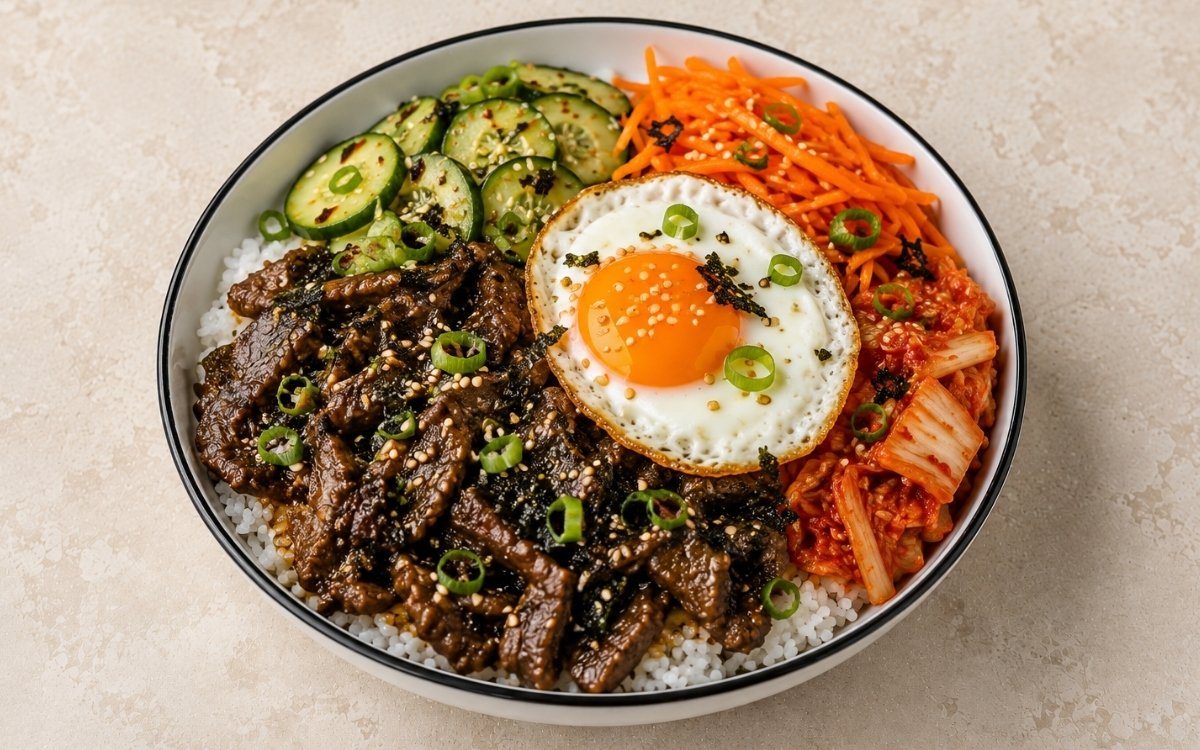
- Divide the 720g of cooked short-grain white rice among four wide bowls — short-grain white rice is specified because its slightly sticky character holds the bowl's components in place rather than the grains rolling loosely, and its mild flavour provides the correct neutral base for the assertively flavoured bulgogi. Top each bowl with a generous portion of the caramelised bulgogi beef — arranging it so the dark, caramelised surfaces are visible rather than buried. Arrange the components distinctly: drain the quick-pickled cucumbers and place alongside the beef; add 25g of julienned carrots per bowl; place 15g of kimchi per bowl. The kimchi provides the fermented, spiced, acidic complexity that the pickled cucumber's clean simplicity does not — they serve different acid and flavour roles simultaneously. Place one fried egg on top of each assembled bowl. Drizzle any remaining pan sauce — the concentrated, caramelised bulgogi drippings from the plate — over each bowl. Scatter the sliced green onions, toasted sesame seeds, and torn nori pieces across each bowl. The nori provides a specifically Japanese-Korean flavour element — its umami-rich, slightly oceanic character amplifies the sesame oil and soy's savoury depth in each bite it is present. Serve immediately — the fried egg is broken by the person eating, the yolk releasing into the bowl at the table.
Notes
The Asian pear enzyme tenderisation is a technique specific to Korean cuisine that distinguishes authentic bulgogi from its simplified imitations. Most marinade tenderisation in Western cooking relies on acid alone — wine, citrus, or vinegar — which denatures surface proteins but does not break down the muscle fibres' peptide bonds. The proteolytic enzymes in Asian pear (and kiwi, papaya, and pineapple) directly cleave the peptide bonds in the myosin fibres, producing a more fundamental tenderisation at the molecular level. The result is beef that is noticeably more tender than acid-only marinated beef at the same thickness — producing the specific melt-in-the-mouth, slightly silky texture that characterises properly prepared bulgogi.
The two-batch cooking approach is non-negotiable for the correct result and bears repeating in the notes context. A full 600g of marinated beef in a single batch in a 28–30cm skillet produces approximately 6–8mm average depth of beef — sufficient to trap steam between pieces and between the beef and pan surface. The marinade's sugar in a steaming environment dissolves into liquid rather than caramelising, producing grey, wet beef swimming in liquid sauce. Two batches at half the quantity each, spread to a single layer in a smoking-hot pan, produce the correct caramelised, slightly charred result that is the textural and flavour signature of authentic bulgogi.