
Argentine Milanesa Napolitana
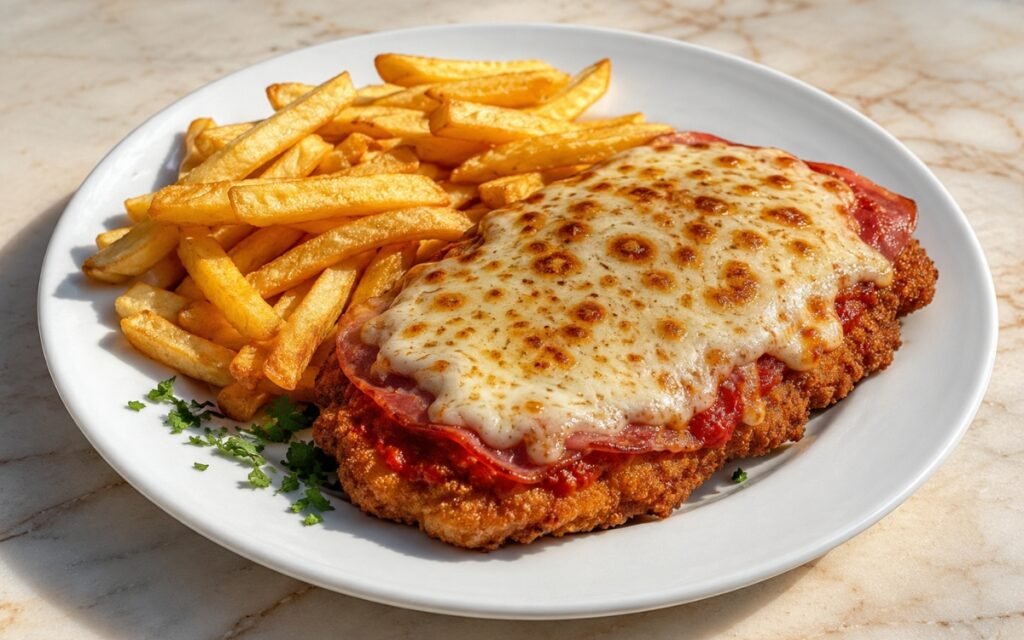
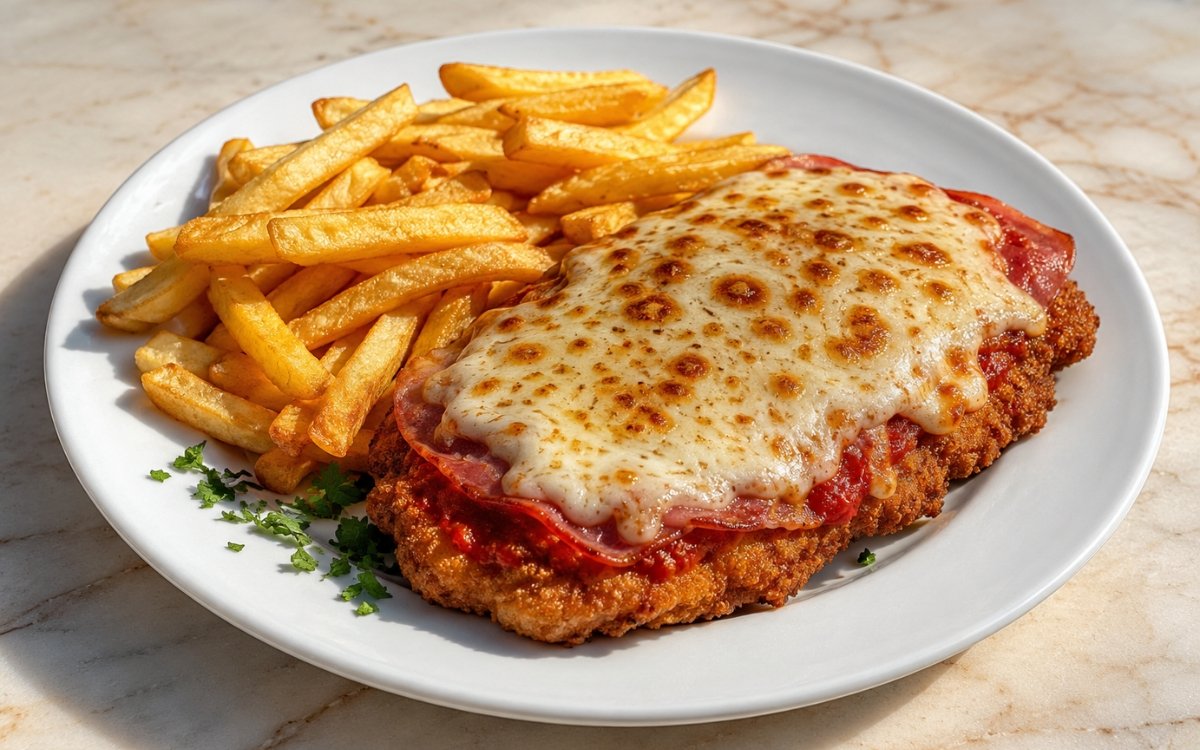
One large golden-brown breaded chicken cutlet per serving, topped with tomato sauce, smoked ham, and melted mozzarella, served with double-fried French fries and fresh parsley. Resting the breaded cutlets for 10–15 minutes before frying is the technique that keeps the crust intact through the whole cook — freshly breaded coating sheds crumbs readily in hot oil, while a brief rest lets the egg wash and breadcrumbs properly adhere, the same rest-before-fry principle used elsewhere in this collection whenever a breaded item needs to survive frying without shedding its coating. Keeping the tomato sauce on top restrained rather than generous protects the crisp breadcrumb crust from the inside out, since too much sauce soaks straight through and softens exactly the texture the frying stage worked to build. Frying the fries twice, at two distinct temperatures, follows the same structural logic used throughout this collection for fries that need to hold their crispness beside a saucy, cheese-topped main. The payoff is a cutlet with a genuinely crisp, visible breadcrumb edge beneath melted cheese and ham, served immediately beside rigid, golden fries.
Prep Time : 35 min
Cook Time : 55 min
Servings : 4
35 min
55 min
4
Ingredients
For the Chicken Milanesa
• 800g chicken breast cutlets, about 200g per serving
• 8g fine sea salt
• 3g freshly cracked black pepper
• 2g garlic powder
• 2g dried oregano
• 80g all-purpose flour
• 3 large eggs
• 20ml milk
• 10g Dijon mustard, optional — this one on Amazon
• 180g fine dry breadcrumbs
• 40g grated Parmesan, optional — this one on Amazon
• Neutral oil, for shallow frying
For the Tomato Sauce
• 1 can San Marzano or good-quality crushed tomatoes, 400g — this one on Amazon
• 20ml olive oil — this one on Amazon
• 2 garlic cloves, minced
• 2g dried oregano — this one on Amazon
• 4g fine sea salt, plus more to taste
• Freshly cracked black pepper, to taste
• 4–6 fresh basil leaves, ribboned and added off heat
• 2–4g sugar, only if the tomatoes taste too acidic
For the Napolitana Topping
• 8 slices smoked ham, 2 slices per cutlet
• 200g low-moisture mozzarella, 50g per cutlet, sliced or shredded
For the Double-Fried Fries
• 800g potatoes, peeled and cut into fries
• 2 litres ice-cold water, for soaking
• Neutral oil, for frying
• Fine sea salt, for salting while hot
For Garnishing and Serving
• 10g fresh parsley, finely chopped
This post may contain affiliate links. As an Amazon Associate I earn from qualifying purchases, at no additional cost to you.
Directions
- Prepare the Fries
Place the cut potatoes in ice-cold water and soak for 30 minutes. Drain, rinse, and dry extremely well with towels. The potatoes must be dry before frying. Wet potatoes spit oil and fry badly. The cold soak draws out excess surface starch that would otherwise cause the fries to stick together and brown unevenly across the two separate fries this recipe calls for. - Make the Tomato Sauce
Heat the olive oil in a saucepan over medium-low heat. Add the minced garlic and cook for 30–45 seconds, just until fragrant. Do not brown it. Add the crushed tomatoes, dried oregano, salt, and black pepper. Simmer uncovered for 15–20 minutes, stirring occasionally, until slightly thickened and no longer watery. Taste. Add a small amount of sugar only if the tomatoes are too sharp. Turn off the heat and stir in the ribboned basil. The sauce should be bright, red, and spoonable, not thick like paste. Adding the basil only once the heat is off preserves its bright, fresh aromatic quality — basil cooked directly in a simmering sauce tends to darken and lose much of that fresh character. - Prepare the Chicken Cutlets
If the chicken breasts are uneven, slice and pound them into wide cutlets about 6–8mm thick. Season both sides with salt, black pepper, garlic powder, and oregano. Do not leave the cutlets thick. Thick chicken burns outside before cooking through and makes a clumsy milanesa. Pounding to an even thickness matters more here than in many other preparations, since this cutlet fries relatively quickly at a fairly high temperature — any thick sections simply won’t have caught up to doneness by the time the breading outside is properly golden. - Bread the Cutlets
Set up three shallow dishes: flour in the first, eggs mixed with milk and Dijon mustard if using in the second, and breadcrumbs mixed with Parmesan if using in the third. Coat each cutlet lightly in flour, shaking off excess. Dip into the egg mixture, then press firmly into the breadcrumbs until fully coated on both sides. Rest the breaded cutlets on a rack or tray for 10–15 minutes. This helps the coating hydrate and stick during frying. The standard three-stage breading sequence works because each layer gives the next something to grip — a light flour dusting first gives the wet egg something to cling to, and that egg layer in turn is what the dry breadcrumbs adhere to; skipping or shortchanging any one stage weakens the whole coating’s hold on the chicken. - First Fry the Potatoes
Heat neutral oil to 150°C. Fry the potatoes in batches for 5–6 minutes, until cooked through and pale blond but not browned. Transfer to a rack and let cool for at least 10 minutes. This lower-temperature first fry is calibrated to cook the potato’s interior through gently, without the surface browning and setting a crust too early — that crust-building is deliberately saved for the second, hotter fry. - Fry the Milanesa
Heat 1–1.5cm neutral oil in a wide skillet to 170–175°C. Fry the breaded cutlets in batches for 2–3 minutes per side, until deeply golden-brown and crisp. Transfer to a rack. The chicken should reach 74°C internally. Do not stack the cutlets or the crust will steam and soften. A single, uncrowded layer on the rack is just as important as the frying stage itself — stacked cutlets trap steam released from the hot chicken beneath the crust above, softening exactly the texture the frying just built. - Top the Milanesa Napolitana
Place the fried cutlets on a baking tray. Spoon tomato sauce over each cutlet, leaving some crispy breadcrumb edges visible. Add 2 slices of smoked ham per cutlet, then top each with 50g mozzarella. Broil or bake at 220°C for 4–6 minutes, until the mozzarella is melted, bubbling, and lightly browned in spots. Do not overload with sauce. Too much sauce turns the breadcrumb coating soggy. Leaving some breadcrumb edges deliberately uncovered by sauce is a genuine protective measure, not just a visual choice — those exposed edges stay crisp throughout the broiling stage, giving the finished cutlet a textural contrast between crisp border and softer, sauced centre. - Second Fry the Potatoes
Increase the oil to 185°C. Fry the potatoes again in batches for 2–4 minutes, until golden, crisp, and firm at the edges. Transfer to a rack and salt immediately while hot. This second, hotter fry is what builds the genuinely rigid, crisp exterior the fries need to hold up on the plate beside a sauced, cheese-topped cutlet. - Serve
Place one Milanesa Napolitana on each plate with a generous pile of fries beside it. Scatter fresh parsley over the cheese and fries. Serve immediately while the cutlet is crisp at the edges, the cheese is melted, and the fries are hot. This dish has essentially no holding window once assembled — steam from the hot sauce and melted cheese continues softening the breading underneath even after it comes out of the broiler, so serving without delay is what preserves the crisp edges as long as possible.
*Notes :
- Resting the breaded cutlets before they ever meet the hot oil is a step that’s easy to skip when short on time, but doing so has a real, visible cost. Freshly applied breadcrumbs haven’t had time to properly adhere to the wet egg layer beneath them, and cutlets fried immediately after breading tend to shed noticeable amounts of coating into the oil, leaving patchy, thin spots on the finished crust. The 10–15 minute rest gives the coating time to set and hydrate against the cutlet’s surface, producing a crust that stays intact through frying.
- The relationship between the tomato sauce and the breadcrumb crust underneath it is worth understanding as a genuine trade-off rather than simply “more sauce is better.” Every bit of sauce spooned over the cutlet is liquid sitting in direct contact with a crisp coating that took real effort to develop — restraint here, leaving some breadcrumb edges visibly bare, is what keeps at least part of the cutlet’s texture crisp through the final broiling stage and the short window before it’s served.
- Using low-moisture mozzarella rather than fresh mozzarella for the topping follows the same reasoning that governs this cheese choice throughout the collection. Fresh mozzarella releases meaningful water as it melts, and that moisture sitting directly on top of the sauce and breadcrumb layers accelerates exactly the softening this recipe is trying to avoid. Low-moisture mozzarella melts with considerably less released liquid, protecting the crust below it.
- This dish shares its double-fried potato technique with several others in this collection, and the underlying logic is identical each time it appears: a cooler first fry cooks the potato through without colour, and a hotter second fry builds a rigid, crisp exterior strong enough to hold its own on a plate next to a warm, saucy main course. Skipping the second fry, or only frying once at a single temperature, produces fries that soften noticeably faster once served beside the sauced cutlet.
Why This Recipe Works
This recipe works because the breaded cutlet is built and handled specifically to protect its crisp coating at every stage: a proper three-stage bread, a rest period before frying so the crumbs adhere, and a restrained amount of tomato sauce that leaves some breadcrumb edges bare rather than fully submerging the cutlet.
Low-moisture mozzarella limits excess moisture from the topping itself, and the double-fried potatoes hold their own rigid structure beside the sauced main. Serving immediately protects all of that careful texture work through to the table.
Ingredient Breakdown
Evenly Pounded Chicken Cutlets
The base protein — pounded to a consistent 6–8mm thickness so the interior cooks through in the same window the crust turns golden.
Three-Stage Breading (Flour, Egg, Breadcrumbs)
The coating technique — each layer gives the next something to adhere to, building a crust that survives frying intact.
Rested Breaded Cutlets
The critical pre-fry step — a 10–15 minute rest lets the breadcrumbs properly set and hydrate before hitting hot oil.
Restrained Tomato Sauce
The topping balance — spooned to leave some breadcrumb edges visible and crisp rather than fully sauced.
Double-Fried Potatoes
The structural side — a cooler first fry for the interior, a hotter second fry for a rigid crust that holds up beside the saucy cutlet.
Flavor Structure Explained
This milanesa napolitana follows a layered balance model:
- Crisp savoury foundation (breaded, fried chicken cutlet)
- Bright tangy centre (simmered tomato sauce)
- Rich smoky depth (smoked ham)
- Melted creamy topping (mozzarella)
- Fresh herbal finish (parsley, basil)
The crisp, golden breaded cutlet provides a savoury, crunchy foundation beneath everything else. Bright, herb-flecked tomato sauce layers in tangy acidity that cuts through the richness of the fried coating. Smoked ham adds a savoury, slightly smoky depth between the sauce and cheese. Melted mozzarella contributes a rich, gooey topping that binds the whole dish together. Fresh basil folded into the sauce and a final scatter of parsley finish the plate with clean, herbal brightness that keeps the heavier components balanced.
Common Mistakes to Avoid
- Frying the Cutlets Immediately After Breading – Freshly applied breadcrumbs haven’t had time to set and shed easily in the oil. Always rest breaded cutlets for 10–15 minutes before frying.
- Leaving the Chicken Cutlets Too Thick – Uneven or overly thick cutlets burn outside before the centre cooks through. Always pound to an even 6–8mm thickness.
- Overloading the Cutlet with Tomato Sauce – Excess sauce soaks into and softens the crisp breadcrumb crust. Always spoon it on with restraint, leaving some edges bare.
- Using Fresh Mozzarella Instead of Low-Moisture – Fresh mozzarella releases significant water as it melts, accelerating the crust’s softening. Always use low-moisture mozzarella for the topping.
- Skipping the Double Fry on the Potatoes – Single-fried potatoes soften quickly beside a sauced, cheese-topped main. Always fry twice, at two different temperatures.
Variations
Beef Milanesa Napolitana
Substitute thin beef cutlets at the same total weight for the chicken, following the identical breading, frying, and topping method — the more traditional version of this dish.
Spicier Version
Add a pinch of red chili flakes to the tomato sauce while it simmers for a subtle background heat throughout.
Extra-Cheesy Version
Increase the mozzarella to 65g per cutlet and add a scattering of grated Parmesan over the top before broiling for a richer, more pronounced cheese layer.
Baked Instead of Fried
After breading, place the cutlets on a wire rack over a baking sheet, spray lightly with oil, and bake at 220°C for 18–22 minutes, flipping once, for a lighter version with less crisp but still golden results.
Storage & Make-Ahead
Breaded, unfried cutlets can be refrigerated on a tray for up to 24 hours before frying. The tomato sauce can be refrigerated in a sealed container for up to 5 days, or frozen for up to 3 months.
Fried, unsauced cutlets can be refrigerated for up to 2 days; reheat in a hot oven before topping and broiling.
Twice-fried potatoes are best made fresh close to serving and do not hold or reheat well once fully cooked.
The fully topped, broiled dish is best eaten immediately; reheating tends to soften the breadcrumb crust considerably.
Frequently Asked Questions
Why does the cutlet need to rest after breading and before frying?
Freshly applied breadcrumbs haven’t had time to properly adhere to the wet egg layer underneath. A cutlet fried immediately after breading sheds noticeable amounts of coating into the oil, while a 10–15 minute rest lets the crust set and hydrate, staying intact through frying.
Why is the tomato sauce applied with restraint rather than generously covering the whole cutlet?
Every bit of sauce sitting on the crisp breadcrumb crust works to soften it. Leaving some edges visibly bare keeps at least part of the cutlet crisp through the broiling stage and the short window before serving, rather than fully saturating the coating.
Why use low-moisture mozzarella instead of fresh mozzarella for the topping?
Fresh mozzarella releases considerable water as it melts, and that moisture sitting directly on the sauce and breadcrumb layers accelerates the crust’s softening. Low-moisture mozzarella melts with far less released liquid, protecting the crisp coating beneath it.
Why does the chicken need to be pounded to an even thickness before breading?
This cutlet fries at a fairly high temperature for a relatively short time. Uneven thickness means thin sections risk overcooking and burning while thicker sections haven’t caught up to doneness by the time the breading is properly golden.
Are there other similar breaded, cheese-topped recipes worth trying?
Chicken Parmigiana follows a very similar technique and structure — a breaded, fried chicken cutlet topped with tomato sauce and melted cheese — making it a close cousin to this Argentine version, worth comparing if you enjoy this style of dish.
Nutrition Facts
( per serving )
Calories
~920 kcal
Protein
58 g
Fat
44 g
Carbs
68 g
Calories
~920 kcal
Protein
58 g
Fat
44 g
Carbs
68 g
Related Recipes
Related Recipes

Easy Ground Beef Patties
Ground beef portioned gently, indented, seasoned late — seared undisturbed, butter-basted, and rested. Caramelized crust, juicy interior.
Lemon Butter Baked Cod
Cod fillets baked snugly in garlicky lemon butter, topped with lemon slices until flaky, finished with pan juices and parsley. Elegant and effortless.
Elote-Style Chicken Wings
Oven-baked wings with crackling skin, tossed hot in a creamy mayo-crema elote sauce, then topped with crumbled cotija and chili powder.
You might also like
You might also like
Classic British Fish and Chips
Beer-battered cod fried until crisp and puffed, served with fluffy double-fried chips, rustic mushy peas, and sharp tartar sauce.
Chicken Fajita Rice Bowl
Charred chicken and peppers over cilantro-lime rice with black beans and fresh toppings.
Baked Chicken Thighs with Cheesy Spaghetti
Smoked paprika crispy chicken thighs, cacio e pepe spaghetti with tempered cheese paste, and charred broccolini — one bowl, Parmesan over everything, 55 minutes.
Argentine Milanesa Napolitana
Ingredients
Method
- Place the cut potatoes in ice-cold water and soak for 30 minutes. Drain, rinse, and dry extremely well with towels. The potatoes must be dry before frying. Wet potatoes spit oil and fry badly. The cold soak draws out excess surface starch that would otherwise cause the fries to stick together and brown unevenly across the two separate fries this recipe calls for.
- Heat the olive oil in a saucepan over medium-low heat. Add the minced garlic and cook for 30–45 seconds, just until fragrant. Do not brown it. Add the crushed tomatoes, dried oregano, salt, and black pepper. Simmer uncovered for 15–20 minutes, stirring occasionally, until slightly thickened and no longer watery. Taste. Add a small amount of sugar only if the tomatoes are too sharp. Turn off the heat and stir in the ribboned basil. The sauce should be bright, red, and spoonable, not thick like paste. Adding the basil only once the heat is off preserves its bright, fresh aromatic quality — basil cooked directly in a simmering sauce tends to darken and lose much of that fresh character.
- If the chicken breasts are uneven, slice and pound them into wide cutlets about 6–8mm thick. Season both sides with salt, black pepper, garlic powder, and oregano. Do not leave the cutlets thick. Thick chicken burns outside before cooking through and makes a clumsy milanesa. Pounding to an even thickness matters more here than in many other preparations, since this cutlet fries relatively quickly at a fairly high temperature — any thick sections simply won’t have caught up to doneness by the time the breading outside is properly golden.
- Set up three shallow dishes: flour in the first, eggs mixed with milk and Dijon mustard if using in the second, and breadcrumbs mixed with Parmesan if using in the third. Coat each cutlet lightly in flour, shaking off excess. Dip into the egg mixture, then press firmly into the breadcrumbs until fully coated on both sides. Rest the breaded cutlets on a rack or tray for 10–15 minutes. This helps the coating hydrate and stick during frying. The standard three-stage breading sequence works because each layer gives the next something to grip — a light flour dusting first gives the wet egg something to cling to, and that egg layer in turn is what the dry breadcrumbs adhere to; skipping or shortchanging any one stage weakens the whole coating’s hold on the chicken.
- Heat neutral oil to 150°C. Fry the potatoes in batches for 5–6 minutes, until cooked through and pale blond but not browned. Transfer to a rack and let cool for at least 10 minutes. This lower-temperature first fry is calibrated to cook the potato’s interior through gently, without the surface browning and setting a crust too early — that crust-building is deliberately saved for the second, hotter fry.
- Heat 1–1.5cm neutral oil in a wide skillet to 170–175°C. Fry the breaded cutlets in batches for 2–3 minutes per side, until deeply golden-brown and crisp. Transfer to a rack. The chicken should reach 74°C internally. Do not stack the cutlets or the crust will steam and soften. A single, uncrowded layer on the rack is just as important as the frying stage itself — stacked cutlets trap steam released from the hot chicken beneath the crust above, softening exactly the texture the frying just built.
- Place the fried cutlets on a baking tray. Spoon tomato sauce over each cutlet, leaving some crispy breadcrumb edges visible. Add 2 slices of smoked ham per cutlet, then top each with 50g mozzarella. Broil or bake at 220°C for 4–6 minutes, until the mozzarella is melted, bubbling, and lightly browned in spots. Do not overload with sauce. Too much sauce turns the breadcrumb coating soggy. Leaving some breadcrumb edges deliberately uncovered by sauce is a genuine protective measure, not just a visual choice — those exposed edges stay crisp throughout the broiling stage, giving the finished cutlet a textural contrast between crisp border and softer, sauced centre.
- Increase the oil to 185°C. Fry the potatoes again in batches for 2–4 minutes, until golden, crisp, and firm at the edges. Transfer to a rack and salt immediately while hot. This second, hotter fry is what builds the genuinely rigid, crisp exterior the fries need to hold up on the plate beside a sauced, cheese-topped cutlet.
- Place one Milanesa Napolitana on each plate with a generous pile of fries beside it. Scatter fresh parsley over the cheese and fries. Serve immediately while the cutlet is crisp at the edges, the cheese is melted, and the fries are hot. This dish has essentially no holding window once assembled — steam from the hot sauce and melted cheese continues softening the breading underneath even after it comes out of the broiler, so serving without delay is what preserves the crisp edges as long as possible.