Ingredients
Method
Prepare the Fries
- Place the cut potatoes in ice-cold water and soak for 30 minutes. Drain, rinse, and dry extremely well with towels. The potatoes must be dry before frying. Wet potatoes spit oil and fry badly. The cold soak draws out excess surface starch that would otherwise cause the fries to stick together and brown unevenly across the two separate fries this recipe calls for.
Make the Tomato Sauce
- Heat the olive oil in a saucepan over medium-low heat. Add the minced garlic and cook for 30–45 seconds, just until fragrant. Do not brown it. Add the crushed tomatoes, dried oregano, salt, and black pepper. Simmer uncovered for 15–20 minutes, stirring occasionally, until slightly thickened and no longer watery. Taste. Add a small amount of sugar only if the tomatoes are too sharp. Turn off the heat and stir in the ribboned basil. The sauce should be bright, red, and spoonable, not thick like paste. Adding the basil only once the heat is off preserves its bright, fresh aromatic quality — basil cooked directly in a simmering sauce tends to darken and lose much of that fresh character.
Prepare the Chicken Cutlets
- If the chicken breasts are uneven, slice and pound them into wide cutlets about 6–8mm thick. Season both sides with salt, black pepper, garlic powder, and oregano. Do not leave the cutlets thick. Thick chicken burns outside before cooking through and makes a clumsy milanesa. Pounding to an even thickness matters more here than in many other preparations, since this cutlet fries relatively quickly at a fairly high temperature — any thick sections simply won't have caught up to doneness by the time the breading outside is properly golden.
Bread the Cutlets
- Set up three shallow dishes: flour in the first, eggs mixed with milk and Dijon mustard if using in the second, and breadcrumbs mixed with Parmesan if using in the third. Coat each cutlet lightly in flour, shaking off excess. Dip into the egg mixture, then press firmly into the breadcrumbs until fully coated on both sides. Rest the breaded cutlets on a rack or tray for 10–15 minutes. This helps the coating hydrate and stick during frying. The standard three-stage breading sequence works because each layer gives the next something to grip — a light flour dusting first gives the wet egg something to cling to, and that egg layer in turn is what the dry breadcrumbs adhere to; skipping or shortchanging any one stage weakens the whole coating's hold on the chicken.
First Fry the Potatoes
- Heat neutral oil to 150°C. Fry the potatoes in batches for 5–6 minutes, until cooked through and pale blond but not browned. Transfer to a rack and let cool for at least 10 minutes. This lower-temperature first fry is calibrated to cook the potato's interior through gently, without the surface browning and setting a crust too early — that crust-building is deliberately saved for the second, hotter fry.
Fry the Milanesa
- Heat 1–1.5cm neutral oil in a wide skillet to 170–175°C. Fry the breaded cutlets in batches for 2–3 minutes per side, until deeply golden-brown and crisp. Transfer to a rack. The chicken should reach 74°C internally. Do not stack the cutlets or the crust will steam and soften. A single, uncrowded layer on the rack is just as important as the frying stage itself — stacked cutlets trap steam released from the hot chicken beneath the crust above, softening exactly the texture the frying just built.
Top the Milanesa Napolitana
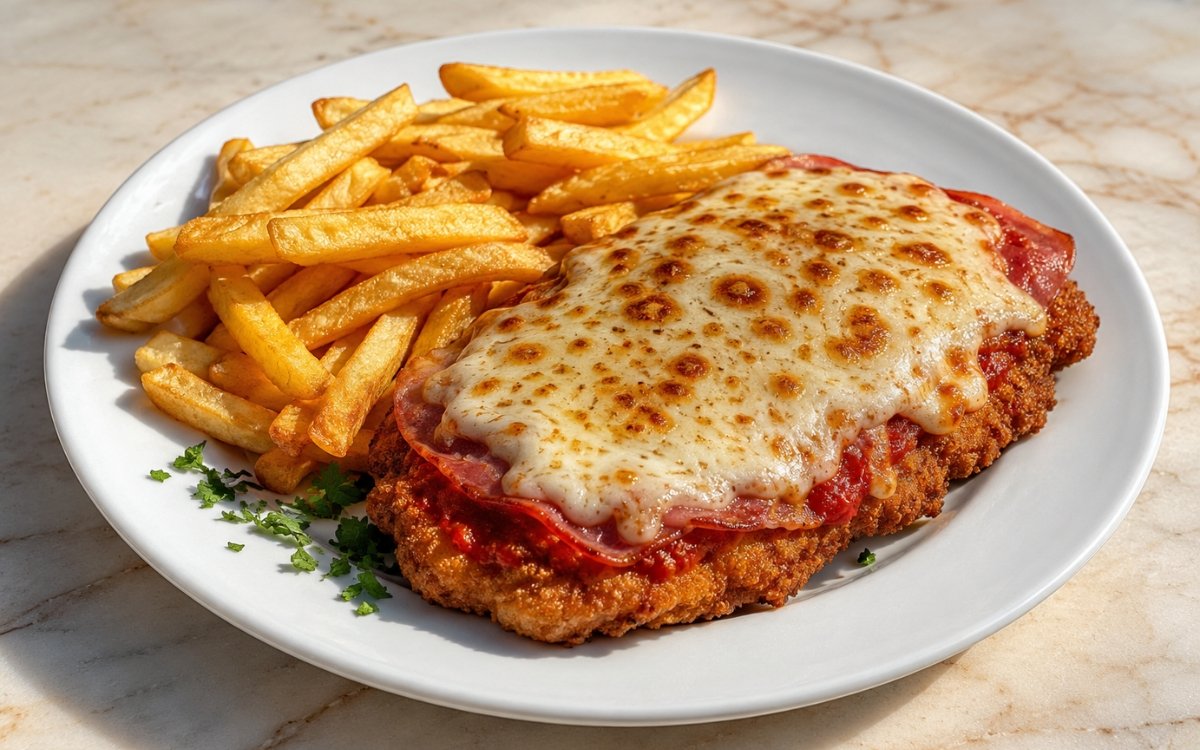
- Place the fried cutlets on a baking tray. Spoon tomato sauce over each cutlet, leaving some crispy breadcrumb edges visible. Add 2 slices of smoked ham per cutlet, then top each with 50g mozzarella. Broil or bake at 220°C for 4–6 minutes, until the mozzarella is melted, bubbling, and lightly browned in spots. Do not overload with sauce. Too much sauce turns the breadcrumb coating soggy. Leaving some breadcrumb edges deliberately uncovered by sauce is a genuine protective measure, not just a visual choice — those exposed edges stay crisp throughout the broiling stage, giving the finished cutlet a textural contrast between crisp border and softer, sauced centre.
Second Fry the Potatoes
- Increase the oil to 185°C. Fry the potatoes again in batches for 2–4 minutes, until golden, crisp, and firm at the edges. Transfer to a rack and salt immediately while hot. This second, hotter fry is what builds the genuinely rigid, crisp exterior the fries need to hold up on the plate beside a sauced, cheese-topped cutlet.
Serve
- Place one Milanesa Napolitana on each plate with a generous pile of fries beside it. Scatter fresh parsley over the cheese and fries. Serve immediately while the cutlet is crisp at the edges, the cheese is melted, and the fries are hot. This dish has essentially no holding window once assembled — steam from the hot sauce and melted cheese continues softening the breading underneath even after it comes out of the broiler, so serving without delay is what preserves the crisp edges as long as possible.
Notes
Resting the breaded cutlets before they ever meet the hot oil is a step that's easy to skip when short on time, but doing so has a real, visible cost. Freshly applied breadcrumbs haven't had time to properly adhere to the wet egg layer beneath them, and cutlets fried immediately after breading tend to shed noticeable amounts of coating into the oil, leaving patchy, thin spots on the finished crust. The 10–15 minute rest gives the coating time to set and hydrate against the cutlet's surface, producing a crust that stays intact through frying.
The relationship between the tomato sauce and the breadcrumb crust underneath it is worth understanding as a genuine trade-off rather than simply "more sauce is better." Every bit of sauce spooned over the cutlet is liquid sitting in direct contact with a crisp coating that took real effort to develop — restraint here, leaving some breadcrumb edges visibly bare, is what keeps at least part of the cutlet's texture crisp through the final broiling stage and the short window before it's served.
Using low-moisture mozzarella rather than fresh mozzarella for the topping follows the same reasoning that governs this cheese choice throughout the collection. Fresh mozzarella releases meaningful water as it melts, and that moisture sitting directly on top of the sauce and breadcrumb layers accelerates exactly the softening this recipe is trying to avoid. Low-moisture mozzarella melts with considerably less released liquid, protecting the crust below it.
This dish shares its double-fried potato technique with several others in this collection, and the underlying logic is identical each time it appears: a cooler first fry cooks the potato through without colour, and a hotter second fry builds a rigid, crisp exterior strong enough to hold its own on a plate next to a warm, saucy main course. Skipping the second fry, or only frying once at a single temperature, produces fries that soften noticeably faster once served beside the sauced cutlet.