
Crispy Potato Galette with Smoked Salmon & Crème Fraîche
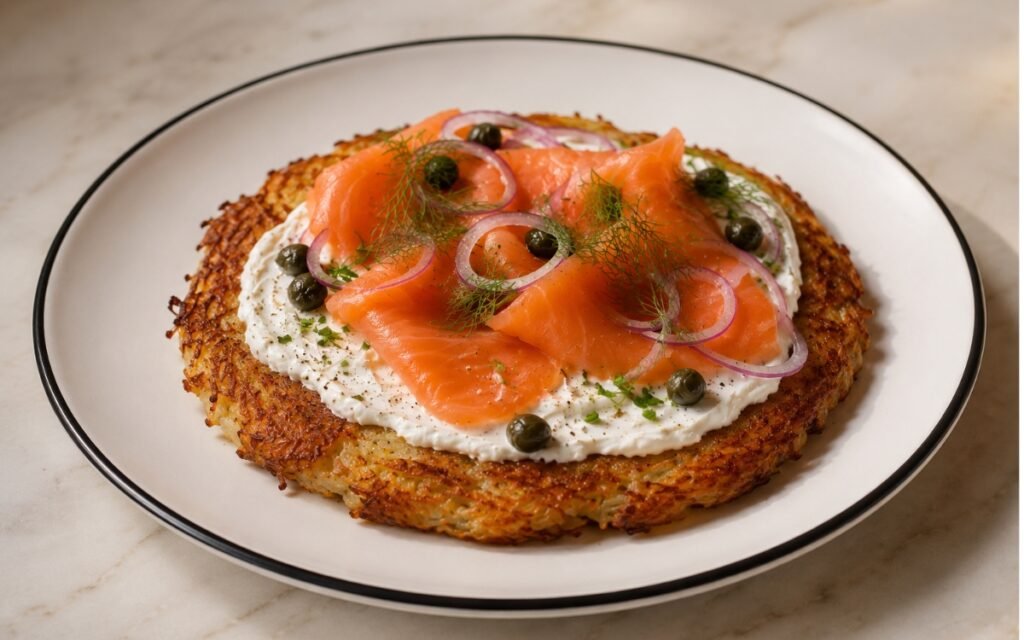
The lox and cream cheese bagel reimagined as a crispy potato galette — all the same components in a completely different format, richer, more elegant, and entirely gluten-free. Whole Yukon Gold potatoes boiled until completely tender and then pressed in a hot cast iron with butter and neutral oil — the smashed surface immediately developing the specific deeply golden, large-surface-area crust that diced or grated potato preparations cannot produce, because the whole pressed potato’s flesh spreads into a single uninterrupted contact layer across the full surface of the pan. The red onion soaked in ice water for 20 minutes to remove the aggressive sulfur compounds while preserving the crisp texture — producing the sweet, mild raw onion that complements the smoked salmon in the way that full-pungency raw onion cannot. Crème fraîche rather than cream cheese — cooler, more pourable, more specifically French in character and specifically suited to being spread across a warm potato without immediately melting away. Smoked salmon in loose folds rather than flat — the folds creating height, delicacy, and the visual presence that makes this plate feel assembled with intention.
Prep Time : 15 min
Cook Time : 40–50 min
Servings : 4
15 min
40–50 min
4
Ingredients
For the Potato Galettes
• 4 large Yukon Gold potatoes — approximately 900–1000g total
• 40g unsalted butter — this one on Amazon
• 1 tbsp neutral oil
• Fine sea salt
• Freshly cracked black pepper
For the Toppings
• 200g smoked salmon — approximately 50g per serving — this one on Amazon
• 240g crème fraîche — this one on Amazon
• 60g red onion, sliced paper-thin
• 2 tbsp capers, drained
• Fresh dill sprigs
• Freshly cracked black pepper
This post may contain affiliate links. As an Amazon Associate I earn from qualifying purchases, at no additional cost to you.
Directions
- Boil the Potatoes Whole
Place the 4 Yukon Gold potatoes — unpeeled, whole — into a large pot of cold, generously salted water. Bring to a gentle boil over high heat, then reduce to a steady simmer. Cook for 25–35 minutes depending on size until completely tender throughout — a thin knife or skewer should slide through the thickest part of each potato with almost no resistance. The complete tenderness throughout is specifically required: any firm zone in the potato’s centre will resist the pressing step and produce an uneven galette that tears rather than spreading into a single, uniform flat disc. The cold-water start ensures the potatoes cook evenly from outside to centre rather than the surface becoming mushy before the centre is cooked. Yukon Gold potatoes are specifically the correct variety for this preparation — their buttery, slightly creamy flesh produces a galette with a rich, soft interior that contrasts specifically well with the shatteringly crunchy exterior. Starchier potatoes like Russets produce a drier, less creamy interior. Drain the potatoes and allow to stand in the empty pot with the lid off for 3–5 minutes, letting the residual heat evaporate the surface moisture. The drier the potato’s surface at the pressing stage, the more immediate and more even the crust that forms on contact with the hot butter. - Soak the Red Onion
While the potatoes boil, slice the 60g of red onion as paper-thin as possible — a mandoline produces consistent translucent slices; a very sharp knife produces equivalent results with patience. Place the sliced onion into a bowl of ice-cold water — as cold as possible, with ice cubes if available. Allow to soak for at least 20 minutes. The ice-cold water draws out the allicin and sulfur compounds responsible for raw onion’s sharp, aggressive pungency through osmosis, while the cold temperature keeps the onion crisp rather than wilting. After 20 minutes, drain the onion thoroughly and press between paper towels to remove as much water as possible — wet onion placed on the crème fraîche will dilute it. - Press and Sear the Potato Galettes
Heat a large cast iron skillet or heavy stainless steel pan over medium heat until genuinely hot — the butter and oil should sizzle immediately on contact. Add the 40g of butter and 1 tbsp of neutral oil. The combination of butter and neutral oil is the same principle applied throughout this collection — butter for rich flavour and the golden colour that its milk solids contribute; neutral oil to raise the effective smoke point and prevent the butter from burning during the 5–7 minute sustained contact. When the butter foam has subsided and the pan is hot, place one whole boiled potato in the pan — not sliced, not halved, whole. Using a flat-bottomed bowl, the bottom of a smaller skillet, or a sturdy wide spatula, press down firmly on the potato — applying steady, even pressure until the potato spreads into a rough circle approximately 1.5–2cm thick. For a more refined, restaurant-style presentation: place a ring mold or large cookie cutter on the pan surface before placing the potato, then press within the mold for a cleanly circular galette. Season the pressed surface generously with fine sea salt and freshly cracked black pepper — the seasoning pressing into the flattened surface at this stage adheres directly to the crust-forming face rather than sitting on top. Leave the potato completely undisturbed for 5–7 minutes. The pressed flesh in direct contact with the hot butter develops the deeply golden, cohesive crust that gives the galette its large, uninterrupted crisp surface. Any movement before the crust is set disrupts the contact and produces patchy, uneven colouring. After 5–7 minutes the galette should release naturally from the pan surface — if it sticks, it needs more time. Flip carefully using a wide spatula and cook the second side for 4–6 minutes until equally golden and crisp. Transfer to a plate. Repeat with the remaining three potatoes, adding additional butter and oil between batches as needed. - Assemble the Galettes
Working quickly while the galettes are still warm and the crust is at its crispest, assemble each one on its serving plate. Spread approximately 60g of crème fraîche over each warm galette, leaving a small uncovered border around the edge — the visual border frames the assembly and prevents the crème fraîche from running over the crispy edges, which softens them on contact. Season the crème fraîche lightly with freshly cracked black pepper. Crème fraîche is specified rather than sour cream or cream cheese for its specific properties in this application: it is thick enough to spread without running, cool enough to contrast with the warm potato, and has a specifically mild, slightly tangy, slightly nutty character from its culture that does not compete with the smoked salmon’s delicacy the way sharper dairy products would. Arrange 50g of smoked salmon in loose, soft folds over the centre of each galette. Fold rather than lay flat — lifting each slice and allowing it to fall naturally into soft peaks and folds rather than pressing it flat against the crème fraîche. The folds create height, visual dimensionality, and allow the salmon to rest lightly on the surface rather than being compressed into a flat sheet that merges with the crème fraîche beneath it. Scatter the drained, pressed capers around the salmon — their small, round briny presence is visible against the white crème fraîche and the pale salmon. Distribute the soaked, drained red onion lightly over the top. Finish with generous fresh dill sprigs — placed rather than scattered, with the small feathery fronds visible against the salmon. A final crack of black pepper over the entire assembly. Serve immediately.
*Notes :
- This preparation is described accurately in the recipe’s descriptor: it is the lox and cream cheese bagel’s specific flavour combination — smoked salmon, dairy spread, capers, red onion, and dill — transferred to a crispy potato base. The potato’s role is specifically equivalent to the bagel’s — a warm, slightly chewy, structurally cohesive base that carries the toppings — but its flavour contribution is richer, more buttery, and more savoury from the cast-iron crust than any bagel provides. The preparation is also entirely gluten-free, which the bagel version is not.
- Crème fraîche’s behaviour when spread on a warm potato is specifically different from cream cheese — it softens very slightly from the heat, becoming more spreadable and slightly more pourable at the edges, while maintaining enough body to support the salmon folds. Cream cheese at cold temperature would resist spreading; at room temperature it would spread but pool rather than holding the salmon in place. Crème fraîche’s natural fat content and the bacterial culture’s slight stabilising effect produce the correct intermediate consistency.
Why This Recipe Works
This recipe works because the whole-potato boiling-and-pressing technique produces the single largest uninterrupted crust surface of any potato preparation — the entire pressed surface area developing a cohesive golden crust rather than the multiple smaller surfaces of diced or grated potato.
The ice-water red onion soak produces the specific mild, crisp raw onion that complements rather than overwhelms the smoked salmon. And the smoked salmon in folds rather than flat provides the visual height and the delicacy of texture that makes the assembly feel composed rather than simply topped.
Ingredient Breakdown
Whole Boiled Yukon Gold Potatoes
The specific preparation — whole boiling then pressing produces the maximum uninterrupted crust surface; Yukon Gold’s creamy flesh produces the correct interior contrast.
Butter and Neutral Oil Combined
The crust-development fat — butter for colour and flavour, neutral oil for smoke point; together producing the deeply golden, sustained crust over 5–7 undisturbed minutes.
Ice-Water Red Onion Soak (20 Minutes)
The sulphur-removal technique — ice-cold water drawing out aggressive pungency while preserving crisp texture; mild, sweet onion complementing rather than overwhelming the salmon.
Crème Fraîche (Rather Than Cream Cheese)
The specific dairy — thick enough to spread, mild enough not to compete, and specifically tangy-nutty in character; contrasting the warm potato without melting away.
Smoked Salmon in Folds (Not Flat)
The presentation and texture technique — folds create visual height and allow the salmon to rest lightly and delicately rather than being compressed flat.
Flavor Structure Explained
This Crispy potato galette with smoked salmon follows a layered balance model:
- Buttery crisp foundation (potato galette)
- Cool tangy contrast (crème fraîche)
- Smoky savory centerpiece (smoked salmon)
- Sharp briny accents (capers)
- Fresh herbal finish (dill, red onion)
The potato galette defines the foundation with deep golden crispness, buttery richness, and savory warmth. Crème fraîche provides cooling acidity that contrasts the hot potato while creating a smooth backdrop for the toppings. Smoked salmon delivers the central flavor with delicate smokiness, gentle sweetness, and rich marine character. Capers punctuate the richness with bursts of briny acidity that sharpen and amplify the salmon. Dill and red onion finish the composition with fresh herbal aroma and mild sharpness, creating a balance of warm and cool, rich and bright, crisp and creamy in every bite.
Common Mistakes to Avoid
- Over-muddling citrus — releases bitter pith compounds that dominate Not Boiling the Potatoes to Complete Tenderness – Any firm zone in the centre produces a galette that tears rather than pressing evenly. Always cook until a knife slides through with no resistance.
- Moving the Potato Before the Crust Sets – The 5–7 minute undisturbed contact is what produces the cohesive crust. Any movement before it forms completely produces patchy, uneven colouring.
- Not Soaking the Red Onion – Un-soaked raw red onion on smoked salmon produces the aggressive, eye-watering pungency that dominates every other flavour. Always soak for the full 20 minutes.
- Using Cold Crème Fraîche Straight from the Refrigerator – Very cold crème fraîche spreads too thickly and stiffly. Allow to sit at room temperature for 10–15 minutes before spreading for the correct consistency.
- Laying Salmon Flat Rather Than Folding – Flat-pressed salmon compresses against the crème fraîche and loses the delicate visual and textural quality that makes the assembly feel composed.
- Not Serving Immediately – The crème fraîche begins softening the crispy galette edge on contact within minutes. Always assemble and serve immediately.
Variations
With Labneh Instead of Crème Fraîche
Replace the crème fraîche with Authentic Labneh — the strained yogurt cheese’s tangier, denser character produces a more assertively acidic base that contrasts specifically interestingly with the smoked salmon’s mildness. Spread slightly thinner than the crème fraîche due to the denser consistency.
With Lemon Zest
Add the finely grated zest of ½ lemon folded through the crème fraîche before spreading — the citrus aromatic compounds amplify the dill and complement the salmon’s smokiness in the same way that the lemon wedge at the Lox Bagel adds brightness.
With Horseradish
Stir 1–2 tsp of prepared horseradish into the crème fraîche before spreading — the horseradish’s sharp, sinus-clearing heat provides a specifically Scandinavian character that is traditionally paired with smoked salmon.
With Cucumber
Add thin cucumber slices alongside the salmon — the cool, slightly bitter freshness amplifying the dill and providing additional textural variety.
Storage & Make-Ahead
Boiled potatoes can be refrigerated for up to 2 days before being pressed and seared. For easier and more even pressing, allow them to return to room temperature before shaping.
Soaked red onion can be refrigerated for up to 2 days in a sealed container filled with ice water.
Assembled galettes are not suitable for storage and should be served immediately after assembly for the best texture and presentation.
If you have cooked the galettes without the toppings, they can be re-crisped before serving. Warm them in a 200°C oven for about 5 minutes or in a hot cast-iron pan for 2 minutes per side, then assemble and serve.
Frequently Asked Questions
Why boil the potatoes whole rather than slicing and frying?
Whole boiling then pressing produces the maximum single uninterrupted crust surface — the entire flattened potato face in direct contact with the hot pan simultaneously. Sliced or grated potato preparations have multiple smaller surfaces with gaps between them. The whole-press galette also retains its creamy interior texture from the boiling, producing the specific crispy-outside-creamy-inside contrast.
Why Yukon Gold rather than Russet?
Yukon Gold’s higher moisture and fat content produce a creamier, more buttery interior — the specific soft, rich centre that contrasts with the crunchy exterior. Russets produce a drier, flakier interior that is less specifically satisfying against the crème fraîche and salmon.
Why soak the red onion in ice-cold water?
The allicin and sulfur compounds responsible for raw onion’s aggressive pungency are water-soluble and leach out of the sliced onion during soaking. Ice-cold water — the coldest possible — draws these compounds out most effectively while keeping the onion crisp. The result is raw onion with mild sweetness and crisp texture but without the sharp, eye-watering bite of un-soaked raw onion.
Why crème fraîche rather than cream cheese or sour cream?
Crème fraîche has a thick but slightly spreadable consistency at room temperature, a mild tangy-nutty character from its culture, and a fat content that allows it to spread smoothly without either the stiffness of cold cream cheese or the runniness of standard sour cream. It is specifically suited to being spread over a warm potato surface without immediately melting away.
Why fold the salmon rather than lay it flat?
Folded salmon creates visual height and dimensionality — the folds also allow the salmon to rest lightly on the crème fraîche surface without being compressed flat, preserving the delicate texture and the visual impression of something carefully composed rather than simply laid on.
Nutrition Facts
( per serving )
Calories
~480 kcal
Protein
22 g
Fat
26 g
Carbs
42 g
Calories
~480 kcal
Protein
22 g
Fat
26 g
Carbs
42 g
Related Recipes
Related Recipes

Light Raspberry Mint Iced Tea
White tea at 75–80°C, raspberries blended with lemon and water — honey while warm, mint cold-infused 10–15 minutes, chilled. Pale blush-pink and clean.
Light Strawberry Rosemary Iced White Tea
White tea at 75–80°C, strawberries blended with tea and strained — rosemary syrup added gradually to taste, chilled 2–4 hours. Pale pink and botanical.
Apricot Vanilla Sparkling Mocktail
Ripe apricots cooked below 40°C with honey and vanilla over club soda — warm and golden.



You might also like
You might also like
Turkish Börek — Spinach and Feta Borek
Pressed spinach and feta layered between phyllo sheets with a light milk-yogurt coating — pre-cut before baking, sesame and nigella seeds over egg wash, baked deeply golden. Crisp outside, soft custardy inside.
Enfrijoladas
Soft corn tortillas lightly fried, dipped in glossy black bean sauce, folded around queso fresco, and finished with more cheese, crema, onion, and avocado.
Classic French Toast
Three eggs and three yolks whisked with cream, cinnamon, and nutmeg — briefly soaking thick brioche and cooking 3 minutes per side in foaming butter until deeply golden. 30 minutes.

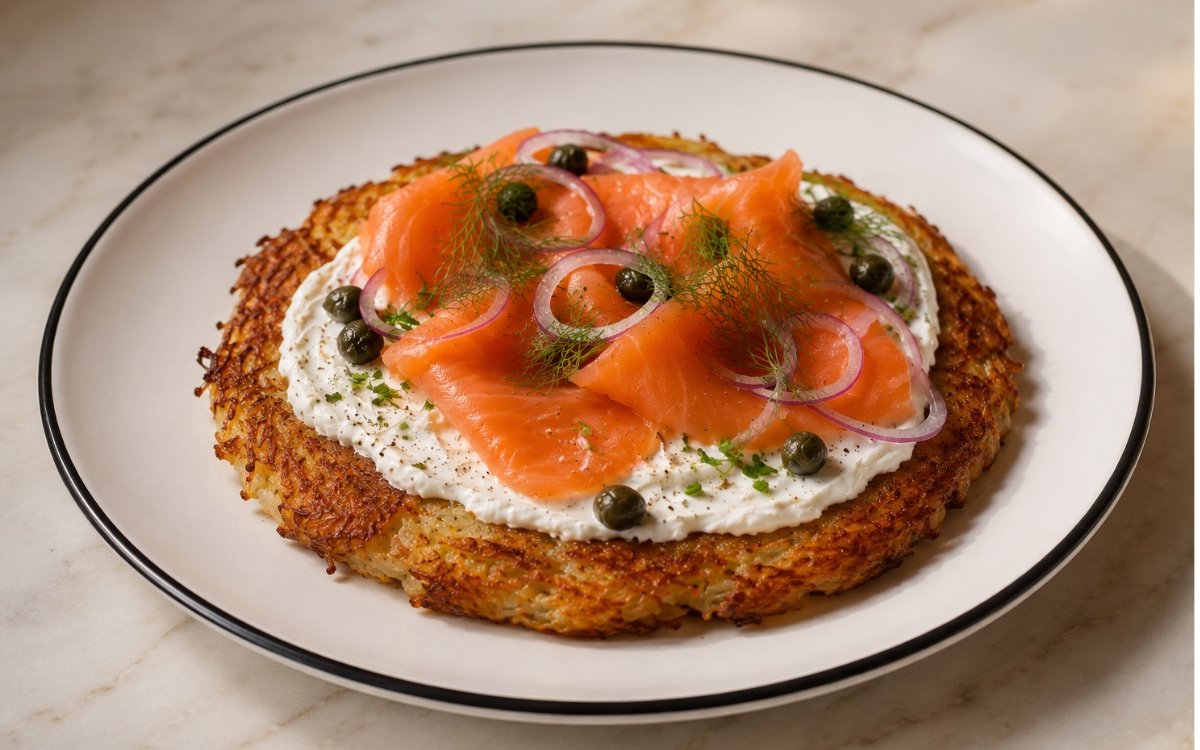
Crispy Potato Galette with Smoked Salmon & Crème Fraîche
Ingredients
Method
- Place the 4 Yukon Gold potatoes — unpeeled, whole — into a large pot of cold, generously salted water. Bring to a gentle boil over high heat, then reduce to a steady simmer. Cook for 25–35 minutes depending on size until completely tender throughout — a thin knife or skewer should slide through the thickest part of each potato with almost no resistance. The complete tenderness throughout is specifically required: any firm zone in the potato’s centre will resist the pressing step and produce an uneven galette that tears rather than spreading into a single, uniform flat disc. The cold-water start ensures the potatoes cook evenly from outside to centre rather than the surface becoming mushy before the centre is cooked. Yukon Gold potatoes are specifically the correct variety for this preparation — their buttery, slightly creamy flesh produces a galette with a rich, soft interior that contrasts specifically well with the shatteringly crunchy exterior. Starchier potatoes like Russets produce a drier, less creamy interior. Drain the potatoes and allow to stand in the empty pot with the lid off for 3–5 minutes, letting the residual heat evaporate the surface moisture. The drier the potato’s surface at the pressing stage, the more immediate and more even the crust that forms on contact with the hot butter.
- While the potatoes boil, slice the 60g of red onion as paper-thin as possible — a mandoline produces consistent translucent slices; a very sharp knife produces equivalent results with patience. Place the sliced onion into a bowl of ice-cold water — as cold as possible, with ice cubes if available. Allow to soak for at least 20 minutes. The ice-cold water draws out the allicin and sulfur compounds responsible for raw onion’s sharp, aggressive pungency through osmosis, while the cold temperature keeps the onion crisp rather than wilting. After 20 minutes, drain the onion thoroughly and press between paper towels to remove as much water as possible — wet onion placed on the crème fraîche will dilute it.
- Heat a large cast iron skillet or heavy stainless steel pan over medium heat until genuinely hot — the butter and oil should sizzle immediately on contact. Add the 40g of butter and 1 tbsp of neutral oil. The combination of butter and neutral oil is the same principle applied throughout this collection — butter for rich flavour and the golden colour that its milk solids contribute; neutral oil to raise the effective smoke point and prevent the butter from burning during the 5–7 minute sustained contact. When the butter foam has subsided and the pan is hot, place one whole boiled potato in the pan — not sliced, not halved, whole. Using a flat-bottomed bowl, the bottom of a smaller skillet, or a sturdy wide spatula, press down firmly on the potato — applying steady, even pressure until the potato spreads into a rough circle approximately 1.5–2cm thick. For a more refined, restaurant-style presentation: place a ring mold or large cookie cutter on the pan surface before placing the potato, then press within the mold for a cleanly circular galette. Season the pressed surface generously with fine sea salt and freshly cracked black pepper — the seasoning pressing into the flattened surface at this stage adheres directly to the crust-forming face rather than sitting on top. Leave the potato completely undisturbed for 5–7 minutes. The pressed flesh in direct contact with the hot butter develops the deeply golden, cohesive crust that gives the galette its large, uninterrupted crisp surface. Any movement before the crust is set disrupts the contact and produces patchy, uneven colouring. After 5–7 minutes the galette should release naturally from the pan surface — if it sticks, it needs more time. Flip carefully using a wide spatula and cook the second side for 4–6 minutes until equally golden and crisp. Transfer to a plate. Repeat with the remaining three potatoes, adding additional butter and oil between batches as needed.
- Working quickly while the galettes are still warm and the crust is at its crispest, assemble each one on its serving plate. Spread approximately 60g of crème fraîche over each warm galette, leaving a small uncovered border around the edge — the visual border frames the assembly and prevents the crème fraîche from running over the crispy edges, which softens them on contact. Season the crème fraîche lightly with freshly cracked black pepper. Crème fraîche is specified rather than sour cream or cream cheese for its specific properties in this application: it is thick enough to spread without running, cool enough to contrast with the warm potato, and has a specifically mild, slightly tangy, slightly nutty character from its culture that does not compete with the smoked salmon’s delicacy the way sharper dairy products would. Arrange 50g of smoked salmon in loose, soft folds over the centre of each galette. Fold rather than lay flat — lifting each slice and allowing it to fall naturally into soft peaks and folds rather than pressing it flat against the crème fraîche. The folds create height, visual dimensionality, and allow the salmon to rest lightly on the surface rather than being compressed into a flat sheet that merges with the crème fraîche beneath it. Scatter the drained, pressed capers around the salmon — their small, round briny presence is visible against the white crème fraîche and the pale salmon. Distribute the soaked, drained red onion lightly over the top. Finish with generous fresh dill sprigs — placed rather than scattered, with the small feathery fronds visible against the salmon. A final crack of black pepper over the entire assembly. Serve immediately.