Ingredients
Method
Boil the Potatoes Whole
- Place the 4 Yukon Gold potatoes — unpeeled, whole — into a large pot of cold, generously salted water. Bring to a gentle boil over high heat, then reduce to a steady simmer. Cook for 25–35 minutes depending on size until completely tender throughout — a thin knife or skewer should slide through the thickest part of each potato with almost no resistance. The complete tenderness throughout is specifically required: any firm zone in the potato's centre will resist the pressing step and produce an uneven galette that tears rather than spreading into a single, uniform flat disc. The cold-water start ensures the potatoes cook evenly from outside to centre rather than the surface becoming mushy before the centre is cooked. Yukon Gold potatoes are specifically the correct variety for this preparation — their buttery, slightly creamy flesh produces a galette with a rich, soft interior that contrasts specifically well with the shatteringly crunchy exterior. Starchier potatoes like Russets produce a drier, less creamy interior. Drain the potatoes and allow to stand in the empty pot with the lid off for 3–5 minutes, letting the residual heat evaporate the surface moisture. The drier the potato's surface at the pressing stage, the more immediate and more even the crust that forms on contact with the hot butter.
Soak the Red Onion
- While the potatoes boil, slice the 60g of red onion as paper-thin as possible — a mandoline produces consistent translucent slices; a very sharp knife produces equivalent results with patience. Place the sliced onion into a bowl of ice-cold water — as cold as possible, with ice cubes if available. Allow to soak for at least 20 minutes. The ice-cold water draws out the allicin and sulfur compounds responsible for raw onion's sharp, aggressive pungency through osmosis, while the cold temperature keeps the onion crisp rather than wilting. After 20 minutes, drain the onion thoroughly and press between paper towels to remove as much water as possible — wet onion placed on the crème fraîche will dilute it.
Press and Sear the Potato Galettes
- Heat a large cast iron skillet or heavy stainless steel pan over medium heat until genuinely hot — the butter and oil should sizzle immediately on contact. Add the 40g of butter and 1 tbsp of neutral oil. The combination of butter and neutral oil is the same principle applied throughout this collection — butter for rich flavour and the golden colour that its milk solids contribute; neutral oil to raise the effective smoke point and prevent the butter from burning during the 5–7 minute sustained contact. When the butter foam has subsided and the pan is hot, place one whole boiled potato in the pan — not sliced, not halved, whole. Using a flat-bottomed bowl, the bottom of a smaller skillet, or a sturdy wide spatula, press down firmly on the potato — applying steady, even pressure until the potato spreads into a rough circle approximately 1.5–2cm thick. For a more refined, restaurant-style presentation: place a ring mold or large cookie cutter on the pan surface before placing the potato, then press within the mold for a cleanly circular galette. Season the pressed surface generously with fine sea salt and freshly cracked black pepper — the seasoning pressing into the flattened surface at this stage adheres directly to the crust-forming face rather than sitting on top. Leave the potato completely undisturbed for 5–7 minutes. The pressed flesh in direct contact with the hot butter develops the deeply golden, cohesive crust that gives the galette its large, uninterrupted crisp surface. Any movement before the crust is set disrupts the contact and produces patchy, uneven colouring. After 5–7 minutes the galette should release naturally from the pan surface — if it sticks, it needs more time. Flip carefully using a wide spatula and cook the second side for 4–6 minutes until equally golden and crisp. Transfer to a plate. Repeat with the remaining three potatoes, adding additional butter and oil between batches as needed.
Assemble the Galettes
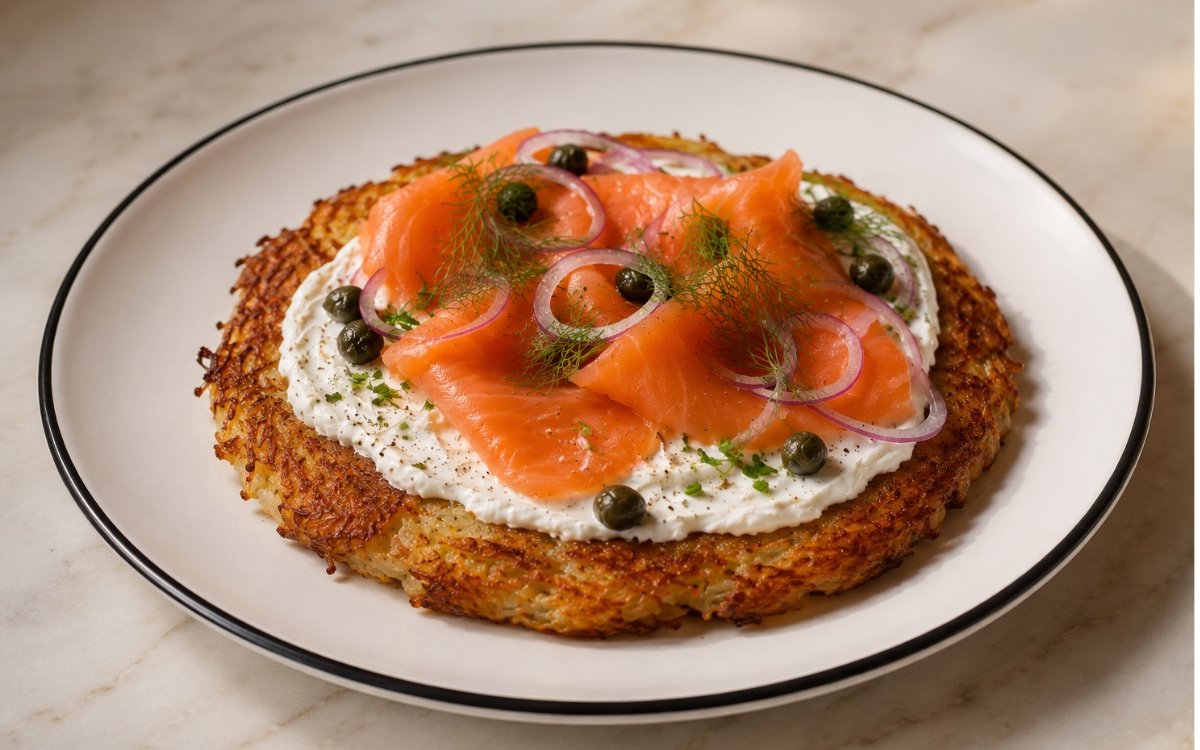
- Working quickly while the galettes are still warm and the crust is at its crispest, assemble each one on its serving plate. Spread approximately 60g of crème fraîche over each warm galette, leaving a small uncovered border around the edge — the visual border frames the assembly and prevents the crème fraîche from running over the crispy edges, which softens them on contact. Season the crème fraîche lightly with freshly cracked black pepper. Crème fraîche is specified rather than sour cream or cream cheese for its specific properties in this application: it is thick enough to spread without running, cool enough to contrast with the warm potato, and has a specifically mild, slightly tangy, slightly nutty character from its culture that does not compete with the smoked salmon's delicacy the way sharper dairy products would. Arrange 50g of smoked salmon in loose, soft folds over the centre of each galette. Fold rather than lay flat — lifting each slice and allowing it to fall naturally into soft peaks and folds rather than pressing it flat against the crème fraîche. The folds create height, visual dimensionality, and allow the salmon to rest lightly on the surface rather than being compressed into a flat sheet that merges with the crème fraîche beneath it. Scatter the drained, pressed capers around the salmon — their small, round briny presence is visible against the white crème fraîche and the pale salmon. Distribute the soaked, drained red onion lightly over the top. Finish with generous fresh dill sprigs — placed rather than scattered, with the small feathery fronds visible against the salmon. A final crack of black pepper over the entire assembly. Serve immediately.
Notes
This preparation is described accurately in the recipe's descriptor: it is the lox and cream cheese bagel's specific flavour combination — smoked salmon, dairy spread, capers, red onion, and dill — transferred to a crispy potato base. The potato's role is specifically equivalent to the bagel's — a warm, slightly chewy, structurally cohesive base that carries the toppings — but its flavour contribution is richer, more buttery, and more savoury from the cast-iron crust than any bagel provides. The preparation is also entirely gluten-free, which the bagel version is not.
Crème fraîche's behaviour when spread on a warm potato is specifically different from cream cheese — it softens very slightly from the heat, becoming more spreadable and slightly more pourable at the edges, while maintaining enough body to support the salmon folds. Cream cheese at cold temperature would resist spreading; at room temperature it would spread but pool rather than holding the salmon in place. Crème fraîche's natural fat content and the bacterial culture's slight stabilising effect produce the correct intermediate consistency.