
Watermelon Feta Salad
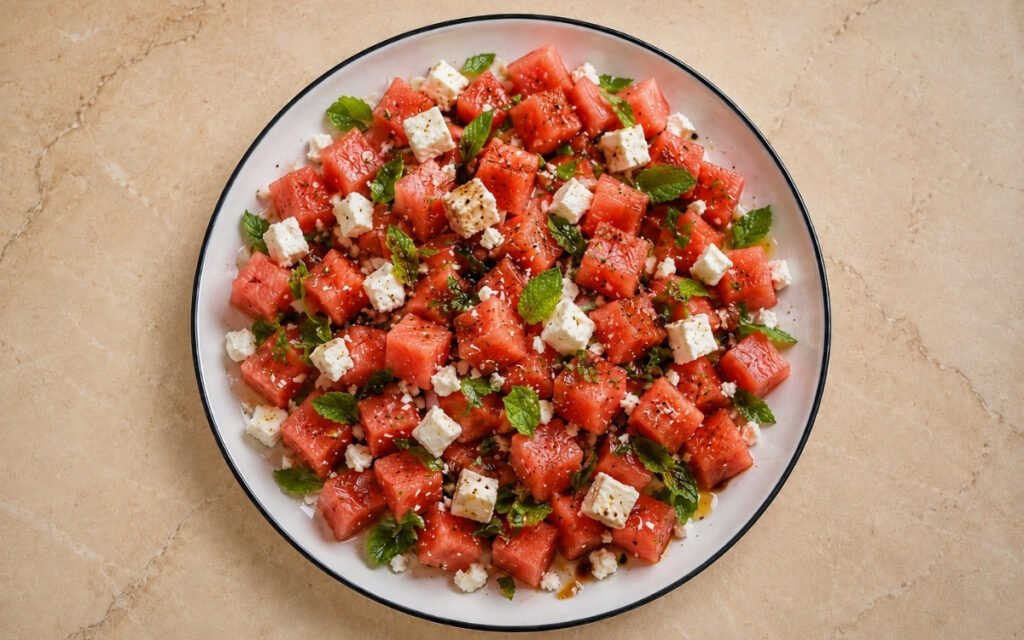
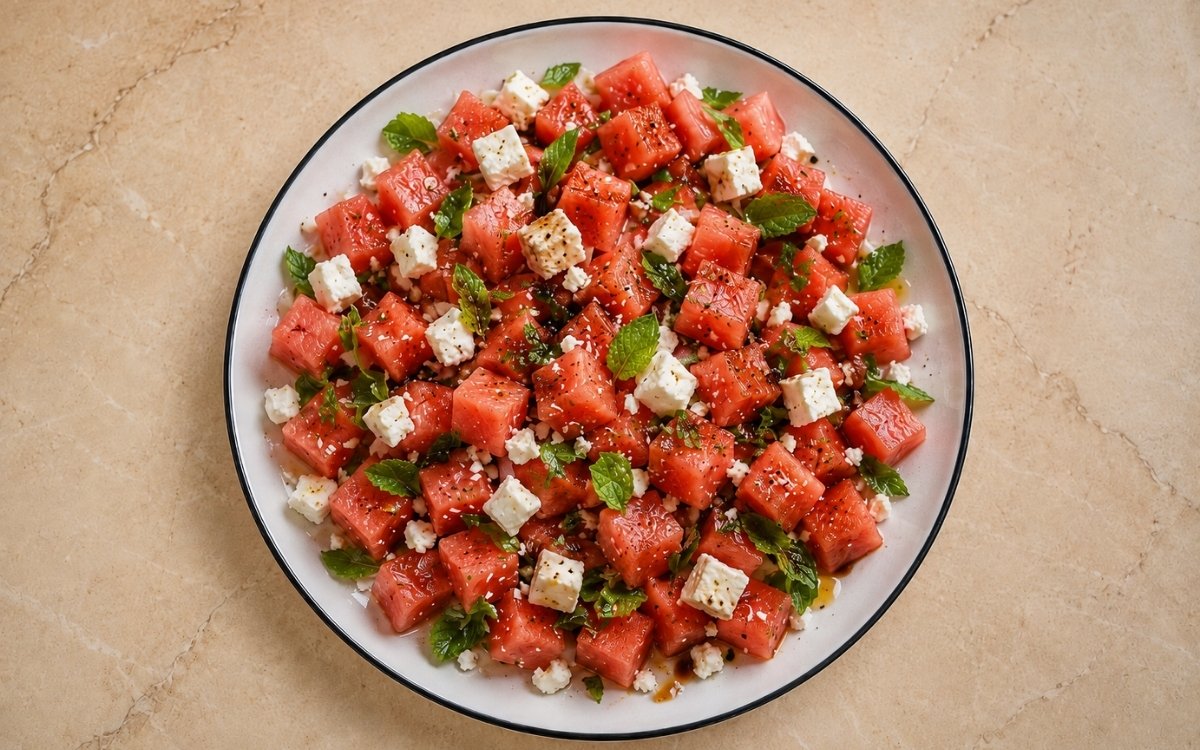
Sweet, salty, bright, and deeply refreshing — this watermelon feta salad is built on contrast and delivers the freshest summer experience of any dish in this collection. Thick cubes of cold watermelon tossed in a honey-lime-balsamic dressing, topped with crumbled feta and torn fresh mint. Everything about it works because nothing in the bowl agrees with anything else: sweet against salty, cold against creamy, acidic against rich. It comes together in ten minutes and tastes like it took considerably more thought than that.
Prep Time : 10 min
Cook Time : 0 min
Servings : 8
10 min
0 min
8
Ingredients
For The Watermelon Feta Salad
• 1 small watermelon or half of a large one, about 2–2.5kg flesh
• 200g feta cheese in brine, drained and crumbled
• 30 fresh mint leaves, plus extra whole leaves for garnish
• 3 tbsp balsamic vinegar, divided — 1 tbsp in the dressing, 2 tbsp for drizzling — this one on Amazon
• 2 tbsp extra-virgin olive oil — this one on Amazon
• Juice of 1 lime
• Zest of half a lime
• 2 tbsp honey — this one on Amazon
• Salt to taste
• Freshly ground black pepper to taste
This post may contain affiliate links. As an Amazon Associate I earn from qualifying purchases, at no additional cost to you.
Directions
- Prepare the Watermelon
Cut the watermelon into thick slices and remove the rind completely, cutting generously to remove the pale green-white flesh closest to the skin that is watery and flavourless rather than the deep red, sweet flesh at the centre. Cut the flesh into 1-inch cubes — approximately 2.5cm per side. The thickness of the cube matters for this salad’s texture and eating experience. Thin, small pieces of watermelon become lost in the dressing and break down quickly, producing a watery, indistinct result. Large 1-inch cubes hold their shape through tossing, provide a satisfying, substantial bite, and remain structurally distinct from the crumbled feta around them — the visual contrast of the red watermelon cubes against the white feta is part of the salad’s visual identity. Transfer the cubed watermelon to a large bowl. If time permits, refrigerate the cut watermelon for 20–30 minutes before assembling — cold watermelon in contact with the dressing produces a more refreshing, vivid result than room-temperature watermelon. - Prepare the Mint
Stack all 30 mint leaves on top of each other in a neat pile, with the largest leaf on the bottom and progressively smaller leaves on top. Roll the stack tightly lengthwise into a compact cylinder — this technique is called a chiffonade preparation. Using a sharp knife, slice through the entire rolled stack in thin, uniform cuts perpendicular to the roll, producing fine, ribbon-like mint strips. This single-pass slicing through the entire stack cuts every leaf simultaneously with a clean edge, which preserves the mint’s volatile aromatic compounds at the cut surface. Tearing mint by hand is an alternative method that some preparations prefer for rustic salads — tearing ruptures the cells along natural lines and releases aromatic oils differently from cutting. For this dressing, where the mint is incorporated into the liquid, the chiffonade cut is slightly preferred as the thin strips distribute more evenly throughout the dressing and release their flavour into the honey-lime base more readily than larger torn pieces. Add the sliced mint to the dressing bowl. - Make the Honey-Lime Dressing
In a small bowl, combine the honey, lime juice, lime zest, 1 tablespoon of balsamic vinegar, olive oil, a generous pinch of salt, and freshly ground black pepper. Whisk together until the honey is fully dissolved — honey’s viscosity means it takes 20–30 seconds of firm whisking to fully incorporate into the lime juice and olive oil rather than sitting as a separate layer at the bottom. The dressing is a deliberately simple four-component formula: honey provides sweetness that amplifies the watermelon’s natural sugar; lime juice and zest provide the bright, multi-layered citrus acidity that cuts through both the honey and the feta’s creaminess; balsamic vinegar adds a deeper, slightly tannic secondary acid with a sweet-sour complexity that lime alone cannot provide; and olive oil provides the smooth fat medium that carries all aromatic compounds — particularly the mint and lime zest — evenly across every piece of watermelon. Add the sliced mint to the dressing and stir to combine. Allow to sit for 2–3 minutes so the mint begins to infuse the honey and lime with its aromatic character. - Dress the Watermelon
Pour the honey-lime-mint dressing over the cubed watermelon in the large bowl. Toss gently using two large spoons or your hands, lifting from the bottom and turning the watermelon cubes through the dressing in slow, deliberate motions. The watermelon at this stage is the most fragile component — its cells are fully hydrated and its flesh is soft and yielding. Aggressive tossing breaks the cubes into smaller, irregular pieces, releases their juice into the bowl, and produces a watery, structurally collapsed salad rather than one with distinct, individually-dressed pieces. Toss only until every cube is lightly coated in the dressing — 6–8 gentle turns is usually sufficient. - Add the Feta and Final Toss
Crumble the drained feta cheese directly over the dressed watermelon, breaking it into irregular pieces of varying sizes — some chunks, some smaller crumbles. The irregularity is intentional: different sizes provide different textural experiences throughout the salad and ensure the feta looks naturally scattered rather than uniformly processed. Fold the feta through the salad using the same slow, lifting motion — 3–4 gentle turns at most. The goal is to distribute the feta throughout the watermelon without mashing it into a creamy smear that coats the fruit. Properly handled feta in this salad should retain distinct, recognisable pieces that provide their own salty, slightly tangy, creamy bite alongside the sweet watermelon rather than dissolving into the dressing. Feta from a tub packed in brine has a higher moisture content and more delicate structure than drier, vacuum-packed feta — it crumbles easily but also smears easily under aggressive handling. Treat it gently. - Garnish and Serve
Transfer to a large, shallow serving platter or serve directly from the bowl. Scatter a generous handful of whole fresh mint leaves across the surface — these are not a garnish in the decorative sense but a flavour element that provides the most concentrated mint character in the dish. A whole mint leaf eaten with a piece of watermelon and a crumble of feta produces the full combination the salad is designed around. Drizzle the remaining 2 tablespoons of balsamic vinegar over the entire surface of the salad from a height, allowing it to fall in thin, uneven lines across the watermelon, feta, and mint. The finishing balsamic drizzle serves a different purpose from the balsamic in the dressing — the dressing’s balsamic was whisked into the honey-lime and distributed evenly as a background flavour throughout the dish, while the finishing drizzle sits on the surface as visible, concentrated lines of sweet-acidic balsamic that add dramatic visual appeal and allow tasters to experience the balsamic as a distinct flavour note in individual bites. Serve immediately — this salad is at its absolute best within the first 15–20 minutes of assembly.
*Notes :
- The quality of the watermelon is the entire foundation of this dish and cannot be compensated for by any technique or additional ingredient. A perfect watermelon for this salad is deeply red, very sweet, firm-fleshed enough to hold cube shapes through tossing, and cold throughout. The easiest field indicator for watermelon sweetness and ripeness is the yellow field spot — the patch of yellow or orange discoloration on the underside where the watermelon rested on the ground during growth. A deep, creamy yellow spot indicates extended time on the vine and higher sugar development. A white or pale yellow spot indicates harvesting before full ripeness. A second indicator is weight relative to size — a ripe watermelon contains more water and feels heavy for its dimensions.
- Feta cheese packed in brine is specified over dry, crumbly vacuum-packed feta for reasons of both flavour and texture. Brine-packed feta retains more moisture, making it creamier and more pliable — it crumbles into the irregular, varied-size pieces that look natural and distribute well through the salad. More importantly, the brine maintains the active culture and complex, tangy flavour that distinguishes quality feta from cheaper versions. Drain the feta well before using — the brine itself is too salty to add to the bowl, but the cheese that was packed in it has absorbed enough brine to be properly seasoned throughout rather than only on the surface.
- Balsamic vinegar performs two distinct roles in this recipe — as an ingredient in the dressing and as a finishing drizzle — and understanding why it cannot simply be doubled in one application explains the structure of the recipe. Balsamic whisked into the dressing becomes homogeneously distributed and contributes as a background flavour throughout every bite. Balsamic drizzled on the surface after assembly sits as concentrated, visible threads that add a visual element and allow the balsamic’s specific character — sweet, thick, slightly tannic — to be tasted as a distinct note in the bites it touches. The two applications create a layered balsamic presence rather than a single-dimensional one.
Why This Recipe Works
This summer salad works entirely through contrast — and every pairing in the bowl is a deliberate opposition. Sweet watermelon against salty feta. Cold fruit against creamy cheese. Sharp lime acidity against honey sweetness. Tannic balsamic against juicy watermelon. Fresh mint’s cooling, aromatic quality against the richness of the olive oil and feta.
No two adjacent components agree with each other, and this perpetual contrast is what makes every bite of the salad more interesting than any single component eaten alone. The honey-lime-balsamic dressing bridges all the contrasts, providing enough cohesion to make the salad feel unified rather than simply a collection of opposing ingredients.
Ingredient Breakdown
Watermelon
he dominant component — sweet, cold, juicy, and the visual and structural foundation of the dish. Quality and ripeness are non-negotiable.
Feta in Brine
The salty, creamy contrast element — its sharp, tangy saltiness is the single most important counterpoint to the watermelon’s sweetness.
Fresh Mint
The aromatic bridge — cooling, slightly sweet, and the flavour that connects the watermelon’s freshness to the feta’s richness.
Honey
Amplifies the watermelon’s natural sweetness in the dressing and provides the viscous body that holds the dressing together.
Lime Juice and Zest
The bright acid layer — juice provides clean sharpness, zest provides aromatic citrus oils for a more complex, layered lime character.
Balsamic Vinegar
Dual-role ingredient — background depth in the dressing, visual drama and concentrated flavour as the finishing drizzle.
Extra-Virgin Olive Oil
Fat carrier — distributes aromatic compounds from the mint and lime zest evenly across every watermelon cube.
Flavor Structure Explained
This summer salad follows a layered balance model:
- Sweet juicy base (watermelon, honey)
- Salty contrast (feta)
- Bright acidity (lime, balsamic)
- Cooling aromatic lift (mint)
- Dynamic contrast (opposing flavors)
Watermelon and honey establish the sweet, juicy foundation that defines the first impression. Feta cuts through with sharp saltiness, creating immediate contrast. Lime and balsamic add acidity that sharpens and lifts the sweetness, preventing it from feeling flat. Mint delivers a cooling, aromatic layer that refreshes the palate and lightens the composition. The structure relies on tension — each element intensifies the others, creating a vivid, high-contrast profile that feels clean, bright, and instantly refreshing.
Common Mistakes to Avoid
- Over-tossing the Salad – Aggressive tossing breaks the watermelon into pieces, releases excess juice, and smears the feta into a creamy coating. Toss with restraint — 6–8 gentle turns for the watermelon, 3–4 for the feta.
- Using Unripe Watermelon – A pale, undersweet watermelon cannot be improved by any amount of honey or dressing. The sweetness of the fruit is the foundation — check the field spot and buy the ripest available.
- Not Draining the Feta – Brine added to the bowl makes the dressing unpleasantly salty and dilutes the honey-lime balance. Drain thoroughly before crumbling.
- Serving at Room Temperature – This salad needs cold watermelon to deliver its most refreshing quality. Refrigerate the cut watermelon before assembling if possible.
- Skipping the Finishing Balsamic Drizzle – The drizzle provides visual drama and allows the balsamic to be tasted as a distinct note. The tablespoon in the dressing alone produces a different, less interesting result.
- Making Too Far Ahead – Watermelon releases significant juice over time and the salad becomes watery. Assemble within 15–20 minutes of serving.
Variations
Za’atar Mediterranean Watermelon Salad
Replace the balsamic vinegar entirely with an additional squeeze of lemon juice, omit the honey, and scatter 2 tablespoons of za’atar seasoning over the assembled salad before the finishing drizzle. The za’atar’s dried thyme, sumac tartness, and sesame nuttiness give the salad a distinctly Eastern Mediterranean character — earthy, herby, and slightly less sweet. Particularly well-suited to serving alongside grilled halloumi, mezze spreads, and Middle Eastern-inspired dishes.
Mexican Tajín Watermelon Salad
Replace the balsamic and honey entirely. Toss the watermelon cubes with lime juice, olive oil, and a generous dusting of Tajín seasoning — the Mexican chili-lime-salt blend whose combination of dried chili, citric acid, and salt transforms fruit in a way that is specifically and irreplaceably its own. The result is spicy, tangy, umami-forward, and intensely addictive — a completely different flavor palette that leans into heat and chili-lime rather than sweet and salty contrast. Finish with additional Tajín sprinkled over the feta and extra lime wedges for squeezing.
Cucumber Watermelon Salad
Add 300g of thinly sliced or chunked English cucumber to the base recipe for additional freshness, crunch, and volume — a natural pairing with both watermelon and feta that extends the salad without changing its fundamental character.
Prosciutto Version
Drape 120g of very thinly sliced prosciutto di Parma over the finished salad for a more substantial, savoury variation where the cured meat amplifies the salty element and adds a silky, rich textural dimension to the sweet-salty contrast.
Storage & Make-Ahead
This salad is always best assembled within 15–20 minutes of serving. Watermelon releases significant juice over time — within an hour of assembly the bowl will have accumulated considerable liquid and the cubes will have softened and partially collapsed. If advance preparation is needed, cut and refrigerate the watermelon cubes and make the dressing up to several hours ahead, storing both separately. Crumble the feta immediately before serving. Combine and toss at the last possible moment.
Dressed leftovers can be refrigerated for up to 24 hours — drain the accumulated liquid and taste before serving, adding a fresh squeeze of lime and a pinch of salt to refresh. The texture will be softer than freshly made but the flavour remains pleasant.
Frequently Asked Questions
How do I choose the best watermelon?
Look for a deep, creamy yellow or orange field spot on the underside — this indicates the watermelon ripened fully on the vine. A white or very pale spot means it was harvested early. The watermelon should feel heavy for its size. A hollow sound when tapped indicates a ripe, water-dense interior.
Can I use a different type of melon?
Honeydew and cantaloupe both work in variations of this salad. Honeydew paired with feta and mint has a quieter, more delicate sweetness. Cantaloupe’s floral, musky sweetness is an excellent pairing with balsamic in particular. Neither has quite the visual impact of watermelon’s deep red color against white feta.
Can I use dried mint instead of fresh?
Dried mint has a completely different character from fresh — dusty and flat rather than clean and aromatic. Fresh mint is essential to this salad. If fresh mint is unavailable, fresh basil makes a reasonable substitute with a different but compatible flavor profile.
How do I keep the feta from turning into a creamy smear?
Three things: drain the feta thoroughly before crumbling, handle it as little as possible, and toss the dressed watermelon first before adding the feta. Adding the feta last and folding with minimal turns is what keeps it in distinct pieces.
What occasions is this salad suited to?
It is specifically a warm-weather, summer salad — its entire appeal depends on ripe, sweet summer watermelon. It works as a starter, a side dish at a barbecue, a component on a sharing table, or a light lunch on its own. It is not a year-round recipe and should not be attempted with out-of-season watermelon.
Nutrition Facts
( per serving )
Calories
~185 kcal
Protein
5 g
Fat
9 g
Carbs
20 g
Calories
~185 kcal
Protein
5 g
Fat
9 g
Carbs
20 g
Related Recipes
Related Recipes

Tuna Niçoise Salad
Seared rare tuna, jammy eggs, haricots verts, baby potatoes, olives, and anchovies composed over crisp greens with a sharp mustard vinaigrette.
Crispy Cucumber Radish Salad
Crisp cucumbers and peppery radishes in light sesame rice vinegar dressing with fresh herbs.
Pico de Gallo
Fresh Roma tomatoes, dual onion, jalapeño, and three limes — the classic Mexican condiment that makes every dish from the region taste complete.
You might also like
You might also like
Herb-Crusted Salmon Rice Bowl
Salmon seared flesh-first, herb-panko crust pressed on post-flip — crispy skin and golden crust simultaneously, over jasmine rice with lemon-miso dressing. 40 minutes.
Grilled Steak & Peach Chimichurri Salad
Sliced medium-rare sirloin over fresh greens with grilled peaches, pickled red onion and a heavy chimichurri drizzle.
Spicy Honey Drizzle
Honey infused with chili heat and vinegar — 10-minute sweet-heat drizzle for everything.
Watermelon Feta Salad
Ingredients
Method
- Cut the watermelon into thick slices and remove the rind completely, cutting generously to remove the pale green-white flesh closest to the skin that is watery and flavourless rather than the deep red, sweet flesh at the centre. Cut the flesh into 1-inch cubes — approximately 2.5cm per side. The thickness of the cube matters for this salad’s texture and eating experience. Thin, small pieces of watermelon become lost in the dressing and break down quickly, producing a watery, indistinct result. Large 1-inch cubes hold their shape through tossing, provide a satisfying, substantial bite, and remain structurally distinct from the crumbled feta around them — the visual contrast of the red watermelon cubes against the white feta is part of the salad’s visual identity. Transfer the cubed watermelon to a large bowl. If time permits, refrigerate the cut watermelon for 20–30 minutes before assembling — cold watermelon in contact with the dressing produces a more refreshing, vivid result than room-temperature watermelon.
- Stack all 30 mint leaves on top of each other in a neat pile, with the largest leaf on the bottom and progressively smaller leaves on top. Roll the stack tightly lengthwise into a compact cylinder — this technique is called a chiffonade preparation. Using a sharp knife, slice through the entire rolled stack in thin, uniform cuts perpendicular to the roll, producing fine, ribbon-like mint strips. This single-pass slicing through the entire stack cuts every leaf simultaneously with a clean edge, which preserves the mint’s volatile aromatic compounds at the cut surface. Tearing mint by hand is an alternative method that some preparations prefer for rustic salads — tearing ruptures the cells along natural lines and releases aromatic oils differently from cutting. For this dressing, where the mint is incorporated into the liquid, the chiffonade cut is slightly preferred as the thin strips distribute more evenly throughout the dressing and release their flavour into the honey-lime base more readily than larger torn pieces. Add the sliced mint to the dressing bowl.
- In a small bowl, combine the honey, lime juice, lime zest, 1 tablespoon of balsamic vinegar, olive oil, a generous pinch of salt, and freshly ground black pepper. Whisk together until the honey is fully dissolved — honey’s viscosity means it takes 20–30 seconds of firm whisking to fully incorporate into the lime juice and olive oil rather than sitting as a separate layer at the bottom. The dressing is a deliberately simple four-component formula: honey provides sweetness that amplifies the watermelon’s natural sugar; lime juice and zest provide the bright, multi-layered citrus acidity that cuts through both the honey and the feta’s creaminess; balsamic vinegar adds a deeper, slightly tannic secondary acid with a sweet-sour complexity that lime alone cannot provide; and olive oil provides the smooth fat medium that carries all aromatic compounds — particularly the mint and lime zest — evenly across every piece of watermelon. Add the sliced mint to the dressing and stir to combine. Allow to sit for 2–3 minutes so the mint begins to infuse the honey and lime with its aromatic character.
- Pour the honey-lime-mint dressing over the cubed watermelon in the large bowl. Toss gently using two large spoons or your hands, lifting from the bottom and turning the watermelon cubes through the dressing in slow, deliberate motions. The watermelon at this stage is the most fragile component — its cells are fully hydrated and its flesh is soft and yielding. Aggressive tossing breaks the cubes into smaller, irregular pieces, releases their juice into the bowl, and produces a watery, structurally collapsed salad rather than one with distinct, individually-dressed pieces. Toss only until every cube is lightly coated in the dressing — 6–8 gentle turns is usually sufficient.
- Crumble the drained feta cheese directly over the dressed watermelon, breaking it into irregular pieces of varying sizes — some chunks, some smaller crumbles. The irregularity is intentional: different sizes provide different textural experiences throughout the salad and ensure the feta looks naturally scattered rather than uniformly processed. Fold the feta through the salad using the same slow, lifting motion — 3–4 gentle turns at most. The goal is to distribute the feta throughout the watermelon without mashing it into a creamy smear that coats the fruit. Properly handled feta in this salad should retain distinct, recognisable pieces that provide their own salty, slightly tangy, creamy bite alongside the sweet watermelon rather than dissolving into the dressing. Feta from a tub packed in brine has a higher moisture content and more delicate structure than drier, vacuum-packed feta — it crumbles easily but also smears easily under aggressive handling. Treat it gently.
- Transfer to a large, shallow serving platter or serve directly from the bowl. Scatter a generous handful of whole fresh mint leaves across the surface — these are not a garnish in the decorative sense but a flavour element that provides the most concentrated mint character in the dish. A whole mint leaf eaten with a piece of watermelon and a crumble of feta produces the full combination the salad is designed around. Drizzle the remaining 2 tablespoons of balsamic vinegar over the entire surface of the salad from a height, allowing it to fall in thin, uneven lines across the watermelon, feta, and mint. The finishing balsamic drizzle serves a different purpose from the balsamic in the dressing — the dressing’s balsamic was whisked into the honey-lime and distributed evenly as a background flavour throughout the dish, while the finishing drizzle sits on the surface as visible, concentrated lines of sweet-acidic balsamic that add dramatic visual appeal and allow tasters to experience the balsamic as a distinct flavour note in individual bites. Serve immediately — this salad is at its absolute best within the first 15–20 minutes of assembly.