Ingredients
Method
Prepare the Watermelon
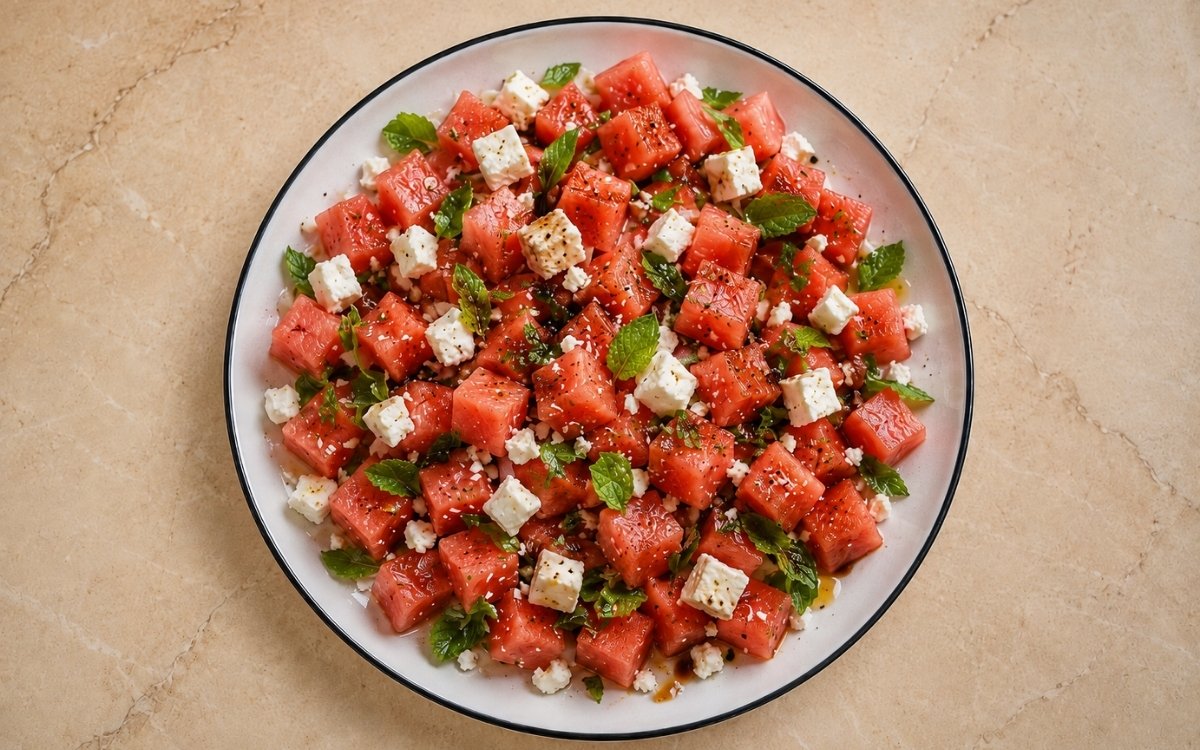
- Cut the watermelon into thick slices and remove the rind completely, cutting generously to remove the pale green-white flesh closest to the skin that is watery and flavourless rather than the deep red, sweet flesh at the centre. Cut the flesh into 1-inch cubes — approximately 2.5cm per side. The thickness of the cube matters for this salad's texture and eating experience. Thin, small pieces of watermelon become lost in the dressing and break down quickly, producing a watery, indistinct result. Large 1-inch cubes hold their shape through tossing, provide a satisfying, substantial bite, and remain structurally distinct from the crumbled feta around them — the visual contrast of the red watermelon cubes against the white feta is part of the salad's visual identity. Transfer the cubed watermelon to a large bowl. If time permits, refrigerate the cut watermelon for 20–30 minutes before assembling — cold watermelon in contact with the dressing produces a more refreshing, vivid result than room-temperature watermelon.
Prepare the Mint
- Stack all 30 mint leaves on top of each other in a neat pile, with the largest leaf on the bottom and progressively smaller leaves on top. Roll the stack tightly lengthwise into a compact cylinder — this technique is called a chiffonade preparation. Using a sharp knife, slice through the entire rolled stack in thin, uniform cuts perpendicular to the roll, producing fine, ribbon-like mint strips. This single-pass slicing through the entire stack cuts every leaf simultaneously with a clean edge, which preserves the mint's volatile aromatic compounds at the cut surface. Tearing mint by hand is an alternative method that some preparations prefer for rustic salads — tearing ruptures the cells along natural lines and releases aromatic oils differently from cutting. For this dressing, where the mint is incorporated into the liquid, the chiffonade cut is slightly preferred as the thin strips distribute more evenly throughout the dressing and release their flavour into the honey-lime base more readily than larger torn pieces. Add the sliced mint to the dressing bowl.
Make the Honey-Lime Dressing
- In a small bowl, combine the honey, lime juice, lime zest, 1 tablespoon of balsamic vinegar, olive oil, a generous pinch of salt, and freshly ground black pepper. Whisk together until the honey is fully dissolved — honey's viscosity means it takes 20–30 seconds of firm whisking to fully incorporate into the lime juice and olive oil rather than sitting as a separate layer at the bottom. The dressing is a deliberately simple four-component formula: honey provides sweetness that amplifies the watermelon's natural sugar; lime juice and zest provide the bright, multi-layered citrus acidity that cuts through both the honey and the feta's creaminess; balsamic vinegar adds a deeper, slightly tannic secondary acid with a sweet-sour complexity that lime alone cannot provide; and olive oil provides the smooth fat medium that carries all aromatic compounds — particularly the mint and lime zest — evenly across every piece of watermelon. Add the sliced mint to the dressing and stir to combine. Allow to sit for 2–3 minutes so the mint begins to infuse the honey and lime with its aromatic character.
Dress the Watermelon
- Pour the honey-lime-mint dressing over the cubed watermelon in the large bowl. Toss gently using two large spoons or your hands, lifting from the bottom and turning the watermelon cubes through the dressing in slow, deliberate motions. The watermelon at this stage is the most fragile component — its cells are fully hydrated and its flesh is soft and yielding. Aggressive tossing breaks the cubes into smaller, irregular pieces, releases their juice into the bowl, and produces a watery, structurally collapsed salad rather than one with distinct, individually-dressed pieces. Toss only until every cube is lightly coated in the dressing — 6–8 gentle turns is usually sufficient.
Add the Feta and Final Toss
- Crumble the drained feta cheese directly over the dressed watermelon, breaking it into irregular pieces of varying sizes — some chunks, some smaller crumbles. The irregularity is intentional: different sizes provide different textural experiences throughout the salad and ensure the feta looks naturally scattered rather than uniformly processed. Fold the feta through the salad using the same slow, lifting motion — 3–4 gentle turns at most. The goal is to distribute the feta throughout the watermelon without mashing it into a creamy smear that coats the fruit. Properly handled feta in this salad should retain distinct, recognisable pieces that provide their own salty, slightly tangy, creamy bite alongside the sweet watermelon rather than dissolving into the dressing. Feta from a tub packed in brine has a higher moisture content and more delicate structure than drier, vacuum-packed feta — it crumbles easily but also smears easily under aggressive handling. Treat it gently.
Garnish and Serve
- Transfer to a large, shallow serving platter or serve directly from the bowl. Scatter a generous handful of whole fresh mint leaves across the surface — these are not a garnish in the decorative sense but a flavour element that provides the most concentrated mint character in the dish. A whole mint leaf eaten with a piece of watermelon and a crumble of feta produces the full combination the salad is designed around. Drizzle the remaining 2 tablespoons of balsamic vinegar over the entire surface of the salad from a height, allowing it to fall in thin, uneven lines across the watermelon, feta, and mint. The finishing balsamic drizzle serves a different purpose from the balsamic in the dressing — the dressing's balsamic was whisked into the honey-lime and distributed evenly as a background flavour throughout the dish, while the finishing drizzle sits on the surface as visible, concentrated lines of sweet-acidic balsamic that add dramatic visual appeal and allow tasters to experience the balsamic as a distinct flavour note in individual bites. Serve immediately — this salad is at its absolute best within the first 15–20 minutes of assembly.
Notes
The quality of the watermelon is the entire foundation of this dish and cannot be compensated for by any technique or additional ingredient. A perfect watermelon for this salad is deeply red, very sweet, firm-fleshed enough to hold cube shapes through tossing, and cold throughout. The easiest field indicator for watermelon sweetness and ripeness is the yellow field spot — the patch of yellow or orange discoloration on the underside where the watermelon rested on the ground during growth. A deep, creamy yellow spot indicates extended time on the vine and higher sugar development. A white or pale yellow spot indicates harvesting before full ripeness. A second indicator is weight relative to size — a ripe watermelon contains more water and feels heavy for its dimensions.
Feta cheese packed in brine is specified over dry, crumbly vacuum-packed feta for reasons of both flavour and texture. Brine-packed feta retains more moisture, making it creamier and more pliable — it crumbles into the irregular, varied-size pieces that look natural and distribute well through the salad. More importantly, the brine maintains the active culture and complex, tangy flavour that distinguishes quality feta from cheaper versions. Drain the feta well before using — the brine itself is too salty to add to the bowl, but the cheese that was packed in it has absorbed enough brine to be properly seasoned throughout rather than only on the surface.
Balsamic vinegar performs two distinct roles in this recipe — as an ingredient in the dressing and as a finishing drizzle — and understanding why it cannot simply be doubled in one application explains the structure of the recipe. Balsamic whisked into the dressing becomes homogeneously distributed and contributes as a background flavour throughout every bite. Balsamic drizzled on the surface after assembly sits as concentrated, visible threads that add a visual element and allow the balsamic's specific character — sweet, thick, slightly tannic — to be tasted as a distinct note in the bites it touches. The two applications create a layered balsamic presence rather than a single-dimensional one.