
Strawberry Mango Smoothie
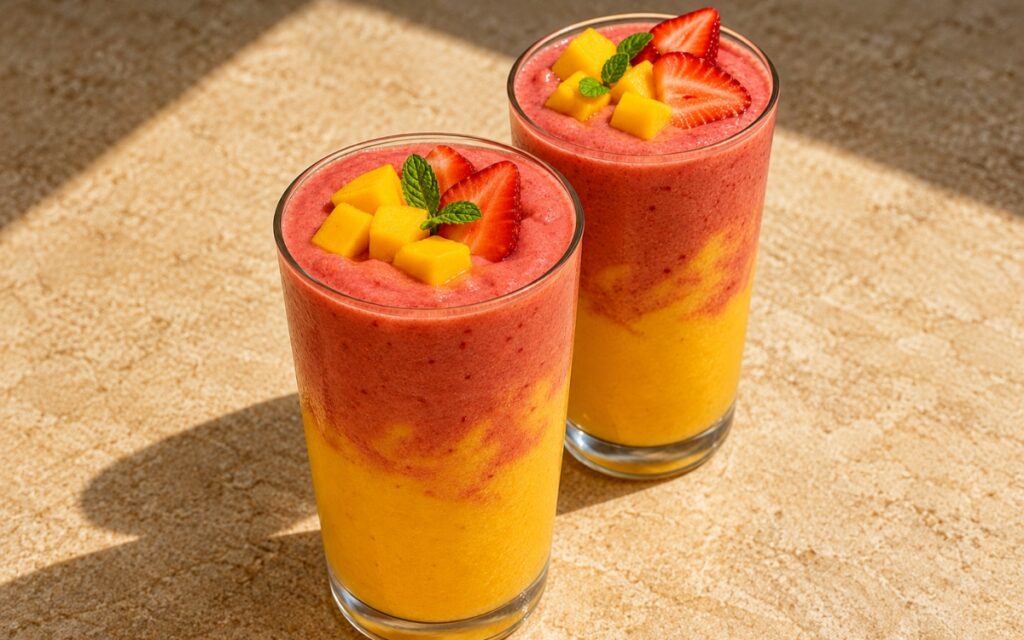
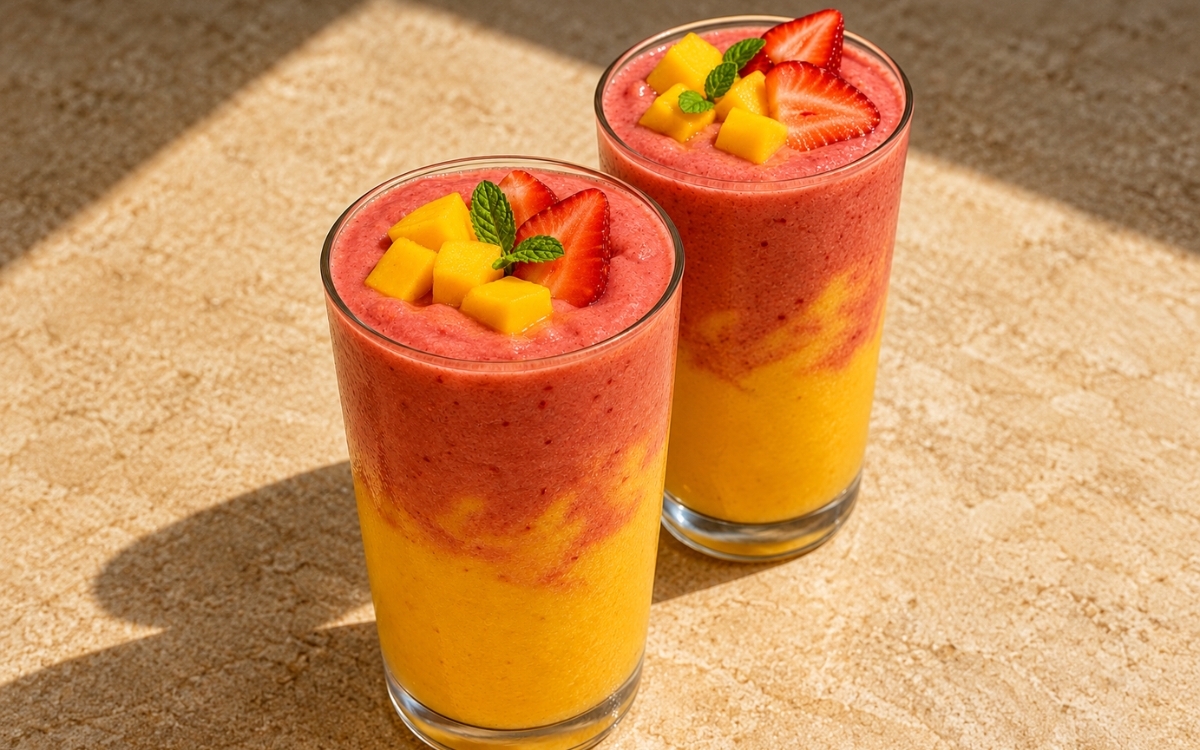
A thick layered smoothie with a bright golden mango base and a creamy strawberry-pink top layer, slightly swirled where the colors meet, both layers blended thick so they hold their separation in the glass, finished with diced mango, strawberry slices, and a few mint leaves. Blending each layer genuinely thick, able to mound slightly on a spoon before settling, is the technique this whole smoothie depends on for its real, clean separation — a thin smoothie blends together instead of forming distinct layers, the same thick-layer-for-separation principle used elsewhere in this collection whenever a layered drink’s own visual definition depends on real, independent body in each component rather than a loose, free-flowing texture. Giving the mango layer a brief chill in the freezer before the strawberry layer goes on top is what lets it firm just enough for the second layer to sit on it more cleanly. Pouring the strawberry layer slowly over the back of a spoon, rather than directly in, is what protects the two distinct colours from mixing together on contact. The payoff is a smoothie with real, striking visual contrast — a golden mango base and a creamy pink strawberry top, lightly swirled where they meet, finished with fresh fruit and mint.
Prep Time : 15 min
Total Time : 15 min
Servings : 4
15 min
15 min
4
Ingredients
For the Mango Layer
• 300g frozen mango chunks
• 120g Greek yogurt
• 80–120ml orange juice, milk, or coconut milk, very cold
• 1–2 tsp honey or maple syrup, optional
• 1 tsp lime juice
• Small pinch fine salt
For the Strawberry Layer
• 300g frozen strawberries
• 120g Greek yogurt
• 80–120ml milk or orange juice, very cold
• 1–2 tsp honey or maple syrup, optional
• 1 tsp lemon juice
• Small pinch fine salt
For the Garnish
• 80–100g mango, cut into small cubes
• 2–3 strawberries, thinly sliced
• Small mint leaves
Directions
- Prepare the Fruit and Glasses
Use frozen fruit for both layers for the best thick texture and clean separation. If using fresh fruit, freeze the cut mango and strawberries for 1–2 hours first until very cold and firm. Chill 4 glasses before filling. Both layers must be thick and spoonable-pourable, not loose. A thin smoothie will blend together instead of forming distinct layers. That genuine thickness in both layers is the whole structural foundation this smoothie’s layered look depends on — anything looser simply wouldn’t hold its own shape long enough to stay separate once poured together. - Blend the Mango Layer
Add the mango, Greek yogurt, 80ml of the cold liquid, honey if using, lime juice, and salt to the blender. Blend until smooth, stopping to scrape down the sides as needed. Add a little more liquid only if necessary, 1 tablespoon at a time. The mango layer should be thick, glossy, and smooth, able to mound slightly on a spoon before settling. That specific, checkable target — a soft mound that briefly holds — confirms the layer has reached genuine thickness before it’s ever poured into the glass. - Build the Bottom Layer
Divide the mango smoothie evenly between the 4 glasses, about halfway up each glass. Tap the glasses lightly on the counter to level the surface, then place them in the freezer for 5 minutes while you make the strawberry layer. This short chill helps the mango layer firm slightly so the top layer sits on it more cleanly. That brief freezer rest gives the mango layer’s own surface real time to set just enough that the strawberry layer poured on top settles cleanly rather than sinking straight through. - Blend the Strawberry Layer
Rinse the blender or wipe it clean. Add the strawberries, Greek yogurt, 80ml of the cold liquid, honey if using, lemon juice, and salt. Blend until very smooth. Add extra liquid only as needed, again 1 tablespoon at a time. The strawberry layer should be as thick as or slightly thicker than the mango layer. It should not be runny. That deliberate matching, or slight thickening, protects the strawberry layer from being thin enough to sink down into the mango layer once it’s poured over the top. - Layer the Smoothie
Spoon or slowly pour the strawberry smoothie over the back of a spoon onto the mango layer in each glass. Let it settle naturally. If desired, use a thin skewer or spoon tip to make just 1–2 light swirls where the colors meet. Do not stir deeply, or the clean pink-and-gold layered look will disappear. That spoon-back pouring technique slows the strawberry layer’s own descent, letting it settle gently on the surface of the mango layer rather than crashing through and mixing on contact. - Garnish and Serve
Top each smoothie with a few mango cubes, 1–2 strawberry slices, and a few tiny mint leaves. Serve immediately. That immediate serving is what protects the whole layered presentation — the two distinct colours begin softening and merging together the longer the finished smoothie sits.
*Notes :
- Blending each layer to a genuinely thick, spoon-mounding consistency deserves genuine recognition as the technique most directly responsible for this smoothie’s whole layered look. The recipe’s own explicit warning that “a thin smoothie will blend together instead of forming distinct layers” reflects the real, structural foundation this entire presentation depends on.
- Giving the mango layer a brief freezer rest before the strawberry layer is ever added deserves genuine attention as a deliberate, functional technique. That short chill firms the mango layer’s own surface just enough for the second layer to settle cleanly on top, protecting against the two layers sinking into and mixing with each other.
- Pouring the strawberry layer slowly over the back of a spoon, rather than directly into the glass, deserves genuine respect as the detail responsible for a clean, defined boundary between the two colours. That slowed, gentle descent is specifically what keeps the strawberry layer settling on the surface rather than crashing through and immediately mixing.
- Avoiding deep stirring once both layers are in place deserves attention as a real, deliberate restraint protecting the finished presentation. The recipe’s own explicit warning that deep stirring makes “the clean pink-and-gold layered look will disappear” reflects exactly how fragile that visual contrast actually is once the two layers meet.
Why This Recipe Works
This recipe works because both layers are blended to a genuinely thick, spoon-mounding consistency, giving them the real structural body needed to hold their own shape once combined. The mango layer is given a brief freezer rest, firming its surface just enough for the strawberry layer to settle cleanly on top. Pouring that strawberry layer slowly over the back of a spoon protects the clean boundary between the two colours, and avoiding deep stirring preserves the finished, layered presentation. Serving immediately captures that whole visual effect before the layers have any real chance to soften and merge.
Ingredient Breakdown
Frozen Mango and Strawberries
The critical technique — real thickness and cold build the independent body each layer needs to stay distinct.
Spoon-Mounding Consistency (Both Layers)
The critical technique — a specific, checkable thickness target confirms each layer is thick enough to hold its own shape.
Brief Freezer Rest Between Layers
The critical technique — firms the mango layer’s own surface just enough for the strawberry layer to settle cleanly on top.
Spoon-Back Pouring Technique
The critical technique — slows the strawberry layer’s descent, protecting the clean boundary between the two colours.
No Deep Stirring
The critical technique — preserves the finished, layered presentation rather than blending the two colours together.
Immediate Serving
The finishing technique — captures the layered visual effect before it has any chance to soften and merge.
Flavor Structure Explained
This strawberry mango smoothie follows a layered balance model:
- Golden, tropical foundation (thick mango and Greek yogurt layer)
- Creamy, pink top layer (thick strawberry and Greek yogurt layer)
- Sharp, brightening accents (lime juice in mango, lemon juice in strawberry)
- Fresh finishing garnish (mango cubes, strawberry slices, mint)
A thick golden mango and Greek yogurt layer provides this smoothie’s foundational, genuinely tropical body. A thick, creamy strawberry and Greek yogurt layer sits visibly on top, matching or slightly exceeding the mango layer’s own thickness. Lime juice in the mango layer and lemon juice in the strawberry layer each add a sharp, brightening accent that keeps their respective fruit from tasting flat. A final garnish of mango cubes, strawberry slices, and tiny mint leaves finishes each glass with a fresh, visually striking touch that completes this classic, layered presentation.
Common Mistakes to Avoid
- Blending Either Layer Too Thin – This causes the two layers to blend together rather than staying distinct. Always blend each to a genuinely thick, spoon-mounding consistency.
- Skipping the Freezer Rest Between Layers – This lets the strawberry layer sink into the still-soft mango layer. Always give it the full 5 minutes to firm slightly.
- Pouring the Strawberry Layer Directly In – This causes the two colours to mix on contact. Always pour slowly over the back of a spoon.
- Stirring Too Deeply Once Both Layers Are In the Glass – This destroys the clean pink-and-gold layered look. Always keep any swirling light and minimal.
- Letting the Smoothie Sit Before Serving – This lets the layers soften and begin to merge. Always serve immediately after assembling.
Variations
Coconut Milk Version
Use coconut milk as the liquid in either or both layers, per the recipe’s own note on it making the smoothie richer and more tropical, for a more indulgent finished drink.
Orange Juice Version
Use orange juice instead, per the recipe’s own note on it giving a brighter fruit flavour, for a lighter, more citrus-forward finished smoothie.
Swirled Version
Use a thin skewer or spoon tip to create 1 to 2 light swirls where the colours meet, per the recipe’s own suggestion, for a more decorative, marbled finish while still keeping the layers mostly distinct.
Extra-Thick Version
Blend in a little more frozen fruit to either layer if it seems too thin, per the recipe’s own guidance, for an even more defined, structured layered look.
Storage & Make-Ahead
Frozen fruit is strongly recommended for both layers for the thickest texture and the best possible layer definition, so plan ahead and freeze fresh fruit for 1 to 2 hours if frozen isn’t already on hand.
Greek yogurt gives this smoothie real body and helps the layers stay genuinely distinct once combined, and your choice of liquid shapes the final flavour: orange juice brightens, milk creamifies, and coconut milk adds richness and tropical character.
Add liquid gradually to either layer, since the biggest mistake here is adding too much too early, which makes the smoothie too thin to hold its own layered structure.
If the blender struggles with either layer, stop, scrape down the sides, and add only a small splash more liquid rather than a large amount at once, and if a layer turns out too thin, blend in a little more frozen fruit to thicken it back up.
For the cleanest layered look, chill the glasses beforehand and briefly chill the mango layer before adding the strawberry layer on top, and serve the finished smoothie right away, since the layers slowly soften and begin to merge as it sits.
Frequently Asked Questions
Why does each layer need to be blended so genuinely thick?
A thin smoothie blends together rather than forming distinct layers. Real thickness in both layers is the structural foundation this smoothie’s whole layered presentation depends on.
Why does the mango layer need a brief freezer rest before the strawberry layer is added?
That short chill firms the mango layer’s own surface just enough for the strawberry layer to settle cleanly on top, rather than sinking straight through and mixing with the still-soft layer beneath.
Why is the strawberry layer poured slowly over the back of a spoon rather than directly into the glass?
That technique slows the strawberry layer’s own descent, letting it settle gently on the mango layer’s surface instead of crashing through and mixing the two colours together on contact.
Why shouldn’t the two layers be stirred together once they’re both in the glass?
Deep stirring destroys the clean pink-and-gold layered look this smoothie is specifically built around. Keeping any swirling light and minimal preserves that visual contrast.
Are there other classic layered, fruit-forward smoothie, or berry drink recipes worth trying?
Peach Mango Smoothie and Strawberry Banana Greek Yogurt Smoothie both offer other classic fruit-forward smoothie directions worth exploring. Mango Pineapple Smoothie is also worth trying for another tropical variation, and Virgin Strawberry Daiquiri and Strawberry Smoothie Bowl offer other classic strawberry-forward drinks worth exploring.
Nutrition Facts
( Per Serving — 250ml )
Calories
~200 kcal
Protein
9 g
Fat
2 g
Carbs
38 g
Calories
~200 kcal
Protein
9 g
Fat
2 g
Carbs
38 g
Related Recipes
Related Recipes
-

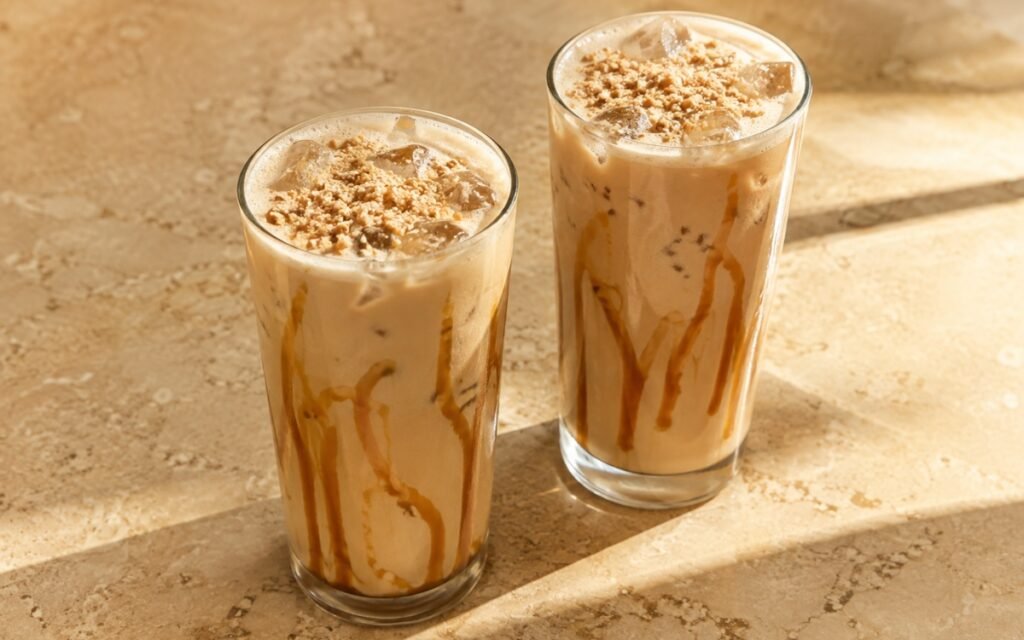
Iced Hazelnut Latte
Hazelnut syrup, cold milk, and ice topped with freshly brewed espresso, finished with a thin foam layer and light caramel drizzle.
-
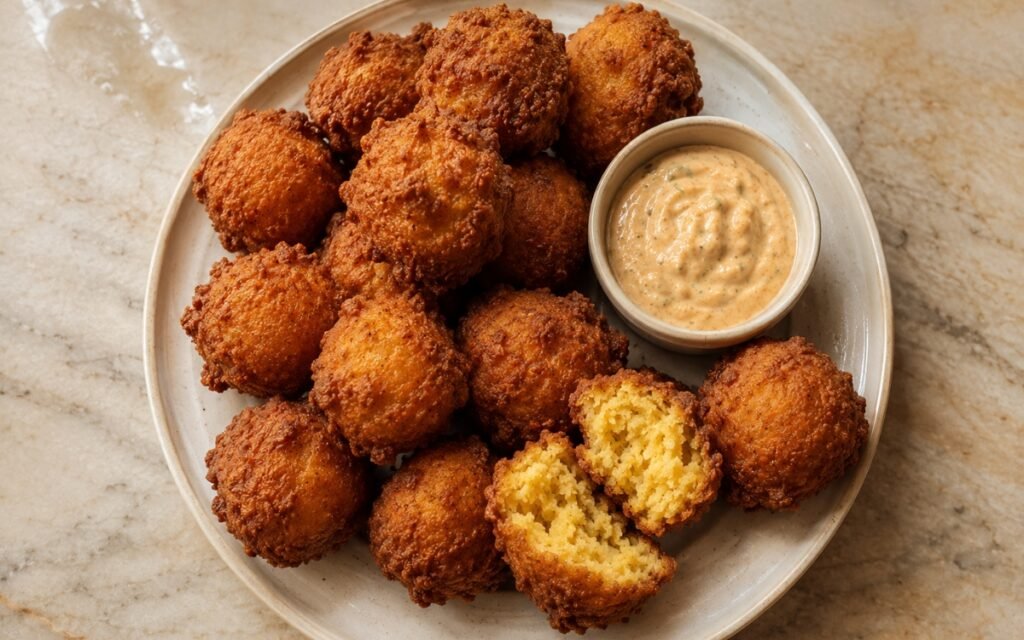
Hush Puppies
Thick cornmeal batter with finely minced onion, fried until deeply golden and crisp outside with a soft, steaming interior, served with tangy remoulade.
-
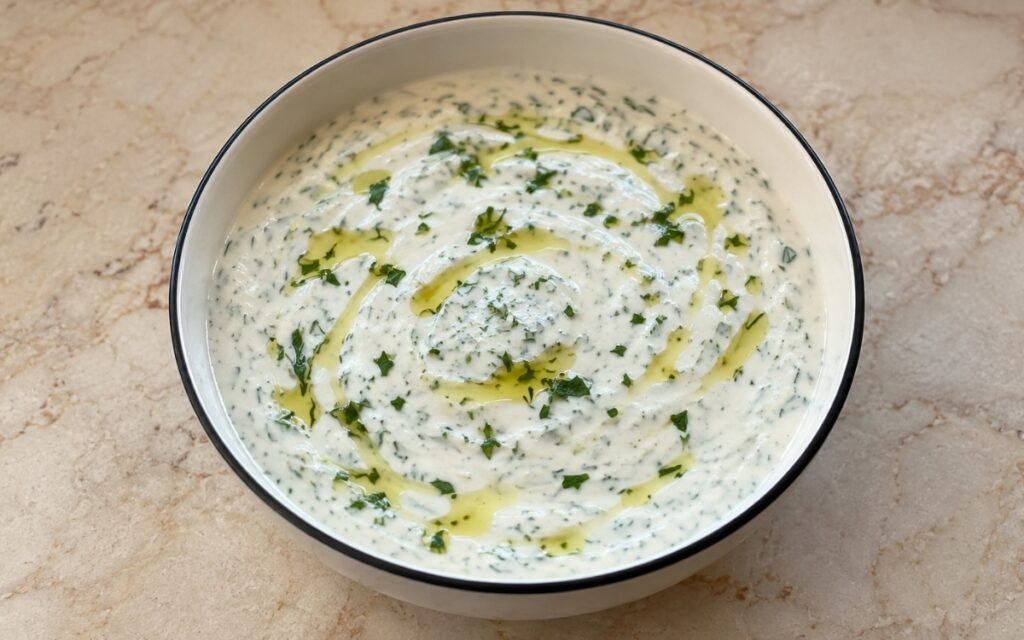
Creamy Lemon Herb Yogurt Sauce
Fresh Greek yogurt sauce with lemon, dill, parsley, and garlic ready in 10 minutes—no cooking!
You might also like
You might also like
-
Cinnamon Sugar Muffins
Tall bakery-style muffins with a crisp cinnamon-sugar crust and a soft, fluffy crumb.
-
Blackberry Banana Smoothie
A thick, creamy blackberry banana smoothie with a deep berry-purple color, visible blackberry flecks, finished with a yogurt swirl and fresh fruit.
-
Caribbean Sauce Chien
A loose, rustic French Caribbean herb sauce of hand-chopped scallions, parsley, chives, garlic, and chili in lime, lemon, and oil.
Strawberry Mango Smoothie
Ingredients
Method
- Use frozen fruit for both layers for the best thick texture and clean separation. If using fresh fruit, freeze the cut mango and strawberries for 1–2 hours first until very cold and firm. Chill 4 glasses before filling. Both layers must be thick and spoonable-pourable, not loose. A thin smoothie will blend together instead of forming distinct layers. That genuine thickness in both layers is the whole structural foundation this smoothie’s layered look depends on — anything looser simply wouldn’t hold its own shape long enough to stay separate once poured together.
- Add the mango, Greek yogurt, 80ml of the cold liquid, honey if using, lime juice, and salt to the blender. Blend until smooth, stopping to scrape down the sides as needed. Add a little more liquid only if necessary, 1 tablespoon at a time. The mango layer should be thick, glossy, and smooth, able to mound slightly on a spoon before settling. That specific, checkable target — a soft mound that briefly holds — confirms the layer has reached genuine thickness before it’s ever poured into the glass.
- Divide the mango smoothie evenly between the 4 glasses, about halfway up each glass. Tap the glasses lightly on the counter to level the surface, then place them in the freezer for 5 minutes while you make the strawberry layer. This short chill helps the mango layer firm slightly so the top layer sits on it more cleanly. That brief freezer rest gives the mango layer’s own surface real time to set just enough that the strawberry layer poured on top settles cleanly rather than sinking straight through.
- Rinse the blender or wipe it clean. Add the strawberries, Greek yogurt, 80ml of the cold liquid, honey if using, lemon juice, and salt. Blend until very smooth. Add extra liquid only as needed, again 1 tablespoon at a time. The strawberry layer should be as thick as or slightly thicker than the mango layer. It should not be runny. That deliberate matching, or slight thickening, protects the strawberry layer from being thin enough to sink down into the mango layer once it’s poured over the top.
- Spoon or slowly pour the strawberry smoothie over the back of a spoon onto the mango layer in each glass. Let it settle naturally. If desired, use a thin skewer or spoon tip to make just 1–2 light swirls where the colors meet. Do not stir deeply, or the clean pink-and-gold layered look will disappear. That spoon-back pouring technique slows the strawberry layer’s own descent, letting it settle gently on the surface of the mango layer rather than crashing through and mixing on contact.
- Top each smoothie with a few mango cubes, 1–2 strawberry slices, and a few tiny mint leaves. Serve immediately. That immediate serving is what protects the whole layered presentation — the two distinct colours begin softening and merging together the longer the finished smoothie sits.