
Vietnamese Lemongrass Chicken Rice Bowl
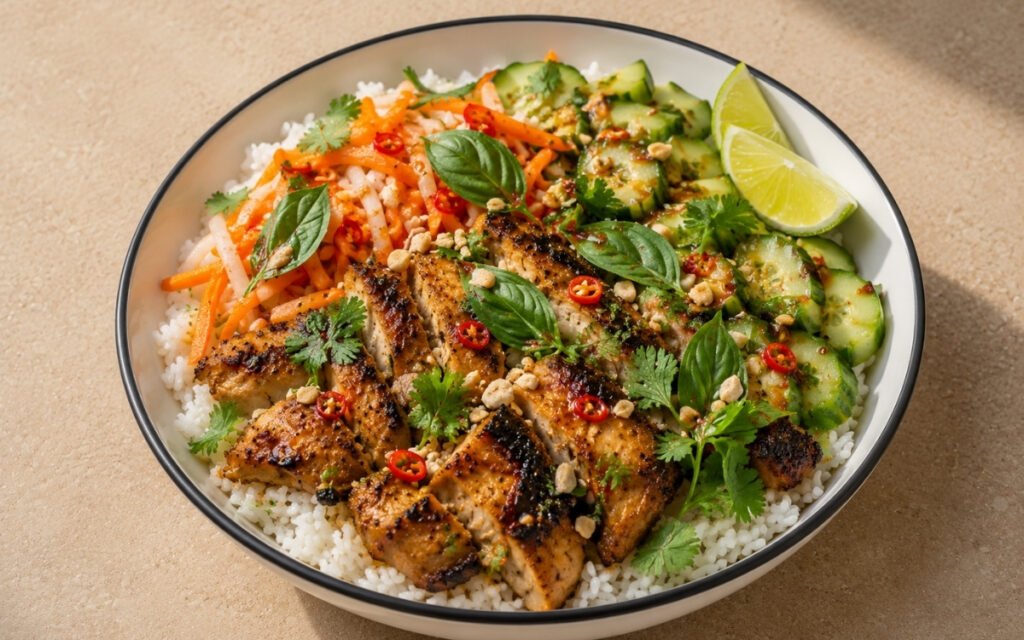
Lemongrass prepared correctly — only the tender white and pale green inner sections finely minced, the fibrous outer layers discarded — combined with fish sauce, soy, honey, ginger, garlic, and sesame oil into a marinade that caramelises specifically well on chicken thighs at high heat. The nuoc cham dressing whisked and tasted until it genuinely balances all four notes — sweet, salty, sour, and the chili’s heat — rather than being dominated by any one. Quick-pickled daikon and carrot made while the chicken marinates for the textural crunch and sharp acid contrast. Three fresh herbs at serving — cilantro, mint, and Thai basil — together, not as a choice between them. The Vietnamese rice bowl that teaches you nuoc cham is worth making from scratch.
Prep Time : 20 min
Cook Time : 25 min
Servings : 4
20 min
25 min
4
Ingredients
For the Lemongrass Chicken
• 600g boneless skinless chicken thighs
• 3 stalks fresh lemongrass, approximately 60g trimmed weight, tender white and pale green parts only, finely minced
• 45ml fish sauce — this one on Amazon
• 30ml soy sauce
• 30g honey
• 20g garlic cloves, approximately 5 cloves, minced
• 15g fresh ginger, peeled and grated
• 15ml toasted sesame oil — this one on Amazon
• 3g freshly ground black pepper
• 20ml neutral cooking oil (such as vegetable or canola)
For the Pickled Vegetables
• 120ml rice vinegar
• 40g granulated sugar
• 6g fine salt
• 150g carrot, julienned
• 150g daikon radish, julienned
For the Nuoc Cham Dressing
• 60ml fresh lime juice, approximately 2 limes
• 30ml fish sauce
• 25g granulated sugar
• 60ml water
• 10g garlic, minced
• 1 red Thai chili, thinly sliced, approximately 5g
For Serving
• 200g cucumber, sliced
• 30g fresh cilantro leaves
• 30g fresh mint leaves
• 20g fresh Thai basil leaves
• 40g roasted unsalted peanuts, crushed
• Lime wedges for serving
This post may contain affiliate links. As an Amazon Associate I earn from qualifying purchases, at no additional cost to you.
Directions
- Prepare the Lemongrass Marinade
Prepare the lemongrass first — the most technique-dependent preparation in the recipe. Each lemongrass stalk has three distinct zones from base to tip: the tough, fibrous outer leaves that are aromatic but impossible to properly mince and unpleasant to eat; the firm, pale lower section and tender inner core that contain the most concentrated aromatic oils and mince to a fine, paste-like texture; and the dry, papery upper green portion that has minimal flavour. Remove the outer two or three tough layers from each stalk by peeling them away with your fingers. Cut off and discard the fibrous green upper portion, leaving only the white and pale green lower section — typically the bottom 10–12cm of each stalk. Slice into thin rounds, then mince very finely — the finer the mince, the more aromatic oil is released and the more evenly the lemongrass flavour distributes through the marinade. Lemongrass that is roughly chopped rather than finely minced remains fibrous and provides uneven flavour distribution; finely minced lemongrass produces a paste-like texture that coats the chicken uniformly and releases its aromatic compounds during the high-heat cooking step rather than remaining as identifiable pieces. In a large bowl, combine the minced lemongrass with the 45ml of fish sauce, 30ml of soy sauce, 30g of honey, 20g of minced garlic, 15g of grated ginger, 15ml of toasted sesame oil, and 3g of black pepper. Stir to combine fully. Add the 600g of chicken thighs and massage the marinade thoroughly into every surface. Cover and refrigerate for a minimum of 30 minutes — 2–4 hours for maximum lemongrass penetration. - Quick-Pickle the Vegetables
While the chicken marinates, prepare the pickled daikon and carrot. In a medium bowl, combine the 120ml of rice vinegar, 40g of sugar, and 6g of salt. Stir vigorously until the sugar and salt have completely dissolved — undissolved sugar produces unevenly sweetened pickle brine with concentrated sweet pockets. Add the 150g of julienned carrot and 150g of julienned daikon radish, pressing them down to ensure complete submersion in the brine. Allow to sit at room temperature for a minimum of 20 minutes, stirring occasionally to ensure even brine contact with all surfaces. After 20 minutes, the vegetables will have softened slightly at their surfaces while retaining their crisp interior structure — producing the characteristic texture of Vietnamese đồ chua, the pickled vegetable accompaniment that appears throughout Vietnamese rice and noodle dishes. The daikon’s slight pungency and the carrot’s earthy sweetness both moderate during pickling as the vinegar draws out some of each vegetable’s stronger flavour compounds, producing a milder, more balanced result than the raw vegetables. The pickled vegetables can be prepared up to 3 days ahead and refrigerate well — they improve over the first 24 hours as the brine penetrates more completely. - Cook the Jasmine Rice
Rinse the 300g of jasmine rice under cold running water until completely clear. Combine the rinsed rice with 450ml of cold water in a medium saucepan. Bring to a full rolling boil over high heat, then reduce immediately to the lowest possible setting, cover tightly, and simmer for 15 minutes without lifting the lid. Remove from heat and allow to stand covered for 5 minutes — do not open the lid during either the cooking or the resting period. After the full rest, uncover and fluff with a fork. The finished rice should have distinct but slightly sticky grains — the slightly sticky quality is correct for this bowl and aids in the chopstick or spoon scooping that Vietnamese bowl food naturally requires. - Make the Nuoc Cham
Nuoc cham is the foundational dipping sauce and dressing of Vietnamese cooking, and its quality depends entirely on achieving genuine balance between its four components rather than having any single flavour dominate. In a small bowl, combine the 60ml of fresh lime juice, 30ml of fish sauce, 25g of granulated sugar, and 60ml of water. Whisk until the sugar has completely dissolved. Add the 10g of minced garlic and the thinly sliced Thai chili. Taste immediately and assess each flavour dimension independently — the sour from the lime, the salty-umami from the fish sauce, the sweet from the sugar, and the heat from the chili should all be clearly present and roughly equal in presence. Adjust: if the lime dominates, add a small amount of additional water or sugar; if the fish sauce is too assertive, add additional lime juice and a small amount of water; if the sweetness overwhelms, increase the lime juice; if the heat is insufficient, add additional chili or a pinch of chili flakes. The correct nuoc cham tastes simultaneously of all four notes with no single note overpowering — the balance is more important than the exact quantities, which vary with the sourness of specific limes and the saltiness of specific fish sauce brands. - Cook the Lemongrass Chicken
Remove the marinated chicken from the refrigerator and allow to rest at room temperature for 10 minutes while the cooking surface is prepared. Heat a grill pan or large heavy skillet over medium-high heat and add the 20ml of neutral oil. Allow to heat until shimmering. Remove each chicken thigh from the marinade and allow excess to drip off briefly — very thick honey-based marinade excess can burn before the chicken is cooked through. Add the thighs in a single layer with space between each piece. Cook undisturbed for 6–7 minutes — the honey in the marinade caramelises against the hot surface alongside the lemongrass’s aromatic oils and the soy’s proteins, producing the characteristic golden-brown with caramelised, slightly charred patches that give lemongrass chicken its specific visual and flavour identity. The lemongrass’s volatile aromatic compounds bloom explosively during this caramelisation, producing the citrusy, slightly floral aroma that is the dish’s olfactory signature. After 6–7 minutes, flip each thigh and cook the second side for 6–7 minutes until the internal temperature reads 75°C throughout the thickest part of the thigh. Transfer to a plate and rest for 5 minutes, then slice against the grain into strips. - Assemble and Serve
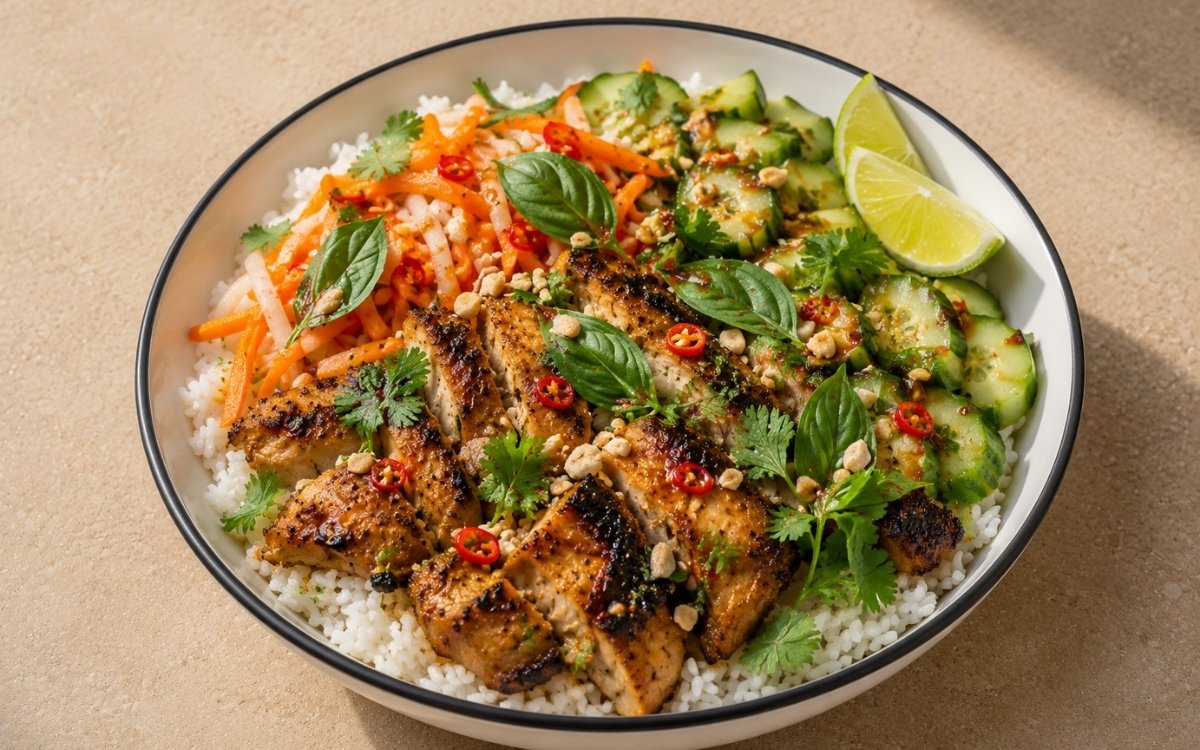
Divide the warm jasmine rice among four wide bowls. Top each bowl with the sliced lemongrass chicken strips. Drain the pickled vegetables and arrange alongside the chicken — their bright orange and white colours against the white rice and golden chicken provide the visual variety that Vietnamese bowl food is characterised by. Add the sliced cucumber in a distinct section. Over each bowl, distribute the fresh herbs — a combination of cilantro, mint, and Thai basil together rather than choosing between them. The three-herb combination is a deliberate Vietnamese culinary principle: cilantro provides clean, slightly citrusy herbal freshness; mint provides cooling aromatic contrast; Thai basil provides the specifically anise-like, slightly clove-adjacent aroma that neither cilantro nor regular basil provides. Together they produce an aromatic complexity that a single herb cannot approximate and that is fundamentally characteristic of Vietnamese fresh-herb-forward cooking. Drizzle the nuoc cham generously over each assembled bowl — it should reach the chicken, the rice, and the vegetables. Scatter the 40g of crushed roasted peanuts over each bowl — their toasted, buttery crunch provides the textural contrast this bowl specifically benefits from against the soft rice and tender chicken. Serve lime wedges alongside for additional squeezing at the table.
*Notes :
- Lemongrass preparation is worth understanding fully because improper preparation produces either no flavour contribution (coarse chopping) or unpleasant fibrous texture in the finished dish (insufficient trimming). The aromatic compounds in lemongrass — primarily citral, limonene, and myrcene — are concentrated in the essential oils of the plant’s cell walls. Very fine mincing ruptures more cell walls and releases more oil than rough chopping. At the same time, the outermost and uppermost portions of the stalk have almost no essential oil content compared to the fibrous structural material — removing these sections entirely before mincing means 100% of the minced material is aromatic rather than fibrous filler.
- Nuoc cham — literally “dipping fish sauce” — is one of the foundational preparations of Vietnamese cuisine and appears in almost every Vietnamese meal in some form. Its balance of sweet, salty, sour, and spicy is not a background flavour note but the primary seasoning for the entire bowl, drizzled generously enough to season every component. The water dilutes the fish sauce’s saltiness and the lime’s acidity to the correct intensity for a generous drizzle rather than a concentrated dip — without the water the undiluted sauce would be too assertive to use at the quantities this bowl requires.
Why This Recipe Works
This recipe works because the marinade’s honey produces the caramelisation that lemongrass-and-fish-sauce alone would not achieve — creating the specific caramelised surface that is the dish’s visual and flavour signature at the cooking step.
The nuoc cham is specifically made to taste balanced rather than being added without tasting — the assessment and adjustment step is what produces the dressing that ties every component together.
And the three-herb combination is treated as a unit rather than a garnish — the specific combination of cilantro, mint, and Thai basil is what makes Vietnamese bowl food taste specifically Vietnamese.
Ingredient Breakdown
Fresh Lemongrass (Finely Minced Inner Core Only)
The defining aromatic — citral and limonene compounds in the essential oil produce the specific citrusy, floral depth that no other ingredient replicates; fine mincing maximises oil release.
Fish Sauce (In Both Marinade and Nuoc Cham)
The Vietnamese umami base — present at two stages producing savoury depth in the marinade and the primary dressing flavour.
Honey (In Marinade)
The caramelisation agent — its concentrated sugars produce the golden-brown char at high heat that lemongrass and fish sauce alone would not achieve.
Nuoc Cham (Balanced to Taste)
The unifying dressing — the balance of lime, fish sauce, sugar, water, and chili is more important than exact quantities; tasting and adjusting is the critical step.
Đồ Chua — Quick-Pickled Daikon and Carrot
The Vietnamese pickle — sharp acidity and textural crunch providing the contrast that cuts through the honey-caramelised chicken and tahini.
Three-Herb Combination (Cilantro, Mint, Thai Basil)
The specifically Vietnamese aromatic finish — each herb provides a distinct note; the combination together produces the fresh complexity characteristic of Vietnamese cooking.
Flavor Structure Explained
This lemongrass chicken rice bowl follows a layered balance model:
- Sweet caramelized layer (honey, carrot, nuoc cham sugar)
- Salty-umami core (fish sauce)
- Bright acidic lift (lime, pickled vinegar)
- Aromatic-spiced freshness (lemongrass, ginger, chili, herbs)
Sweetness defines the first layer through caramelised honey, natural vegetable sweetness, and balanced sugar in the dressing. Fish sauce forms the backbone, delivering deep savory umami throughout both marinade and sauce. Lime and pickled acidity cut through the richness and sweetness, keeping the bowl vivid and light. Lemongrass, ginger, chili, and fresh herbs create the aromatic identity — citrusy, warm, spicy, and herbal simultaneously. The structure depends on equilibrium: sweet, salty, sour, and aromatic notes all landing together in every bite rather than one dominating the others.
Common Mistakes to Avoid
- Using the Fibrous Outer Layers of Lemongrass – They contribute no flavour and unpleasant texture. Always peel and discard the outer 2–3 layers and cut off the upper green portion before mincing.
- Roughly Chopping Rather Than Finely Mincing the Lemongrass – Coarse chopping releases minimal aromatic oil and produces inconsistently flavoured pieces. Always mince as finely as possible.
- Not Tasting and Adjusting the Nuoc Cham – Lime acidity and fish sauce saltiness vary significantly between brands and batches. Always taste and adjust until genuinely balanced.
- Not Dissolving the Sugar Before Adding Vegetables to the Pickle – Undissolved sugar produces sweet pockets in the brine rather than uniform sweetness throughout the pickle.
- Crowding the Chicken – The honey in the marinade requires direct pan contact to caramelise. Crowded pieces trap steam and produce pale, soft-surfaced chicken without the characteristic caramelised surface.
- Adding All Three Herbs Separately Rather Than Together – The three-herb combination is a unit — always add all three simultaneously to each bowl.
Variations
With Pork
Replace the chicken with 600g of pork shoulder or tenderloin cut into thin strips — the same marinade and cooking technique apply. Pork’s slightly sweeter, more delicate flavour is classically paired with lemongrass in Vietnamese cooking.
With Tofu
Press 600g of extra-firm tofu thoroughly dry and cut into 2cm slabs. Marinate for 30 minutes and pan-fry in the neutral oil for 4–5 minutes per side until deeply golden. The same marinade and serving technique apply.
Bun Bowl Version
Replace the jasmine rice with 400g of cooked rice vermicelli noodles — the classic Vietnamese bún format. The noodles, served at room temperature, produce a lighter, more refreshing bowl that is specifically traditional with the same protein and herb combination.
With Extra Chili
Double the Thai chili quantity in the nuoc cham and add sliced fresh chili as a bowl garnish for a version where the heat is a prominent rather than balanced note.
Storage & Make-Ahead
Marinated raw chicken can be kept in the refrigerator for up to 4 hours before cooking.
Cooked lemongrass chicken can be refrigerated for up to 3 days. To reheat it, warm it in a hot, dry skillet for 2 to 3 minutes per side.
Quick-pickled vegetables can be refrigerated for up to 3 days, and the pickling flavor will deepen and improve overnight. Nuoc cham can be refrigerated in a sealed jar for up to 1 week. Stir or whisk it before using, since the garlic tends to settle.
Cooked rice can be refrigerated for up to 4 days. Reheat it covered with a splash of water.
Frequently Asked Questions
Which part of the lemongrass stalk do I use?
Use only the white and pale green lower portion of each stalk — approximately the bottom 10–12cm. Remove and discard the outer 2–3 dry, fibrous leaves, then cut off and discard the dry green upper section. Only the tender, moist inner core is minced and used.
What is nuoc cham
Nuoc cham — literally “dipping fish sauce” — is the foundational Vietnamese dipping sauce and dressing. Its defining character is the balance between all four taste notes simultaneously: sour from lime, salty-umami from fish sauce, sweet from sugar, and spicy from chili. It appears in almost every Vietnamese meal in some form and is the primary seasoning for this bowl.
What is Thai basil and can I substitute it?
Thai basil has a specifically anise-like, slightly clove-adjacent aroma that is distinct from Italian or sweet basil — it is a separate variety with a more assertive, spicier character. It is available at Asian grocery stores. Regular Italian basil provides sweetness without the anise note — a reasonable substitute if Thai basil is unavailable, though the combination’s specific character changes.
What is daikon radish?
Daikon is a large, white, mild East Asian radish — its flesh is crisp, slightly peppery, and considerably milder than European red radishes. Available at Asian grocery stores and most mainstream supermarkets. Regular red radish can substitute at a smaller quantity as it is more pungent.
Why three herbs rather than one?
Cilantro, mint, and Thai basil provide three distinct aromatic notes — citrusy freshness, cool menthol, and spiced anise respectively. The combination together produces the fresh aromatic complexity characteristic of Vietnamese cooking; any single herb provides only one dimension of this combination.
Nutrition Facts
( per serving )
Calories
~775 kcal
Protein
38 g
Fat
26 g
Carbs
94 g
Calories
~775 kcal
Protein
38 g
Fat
26 g
Carbs
94 g
Related Recipes
Related Recipes

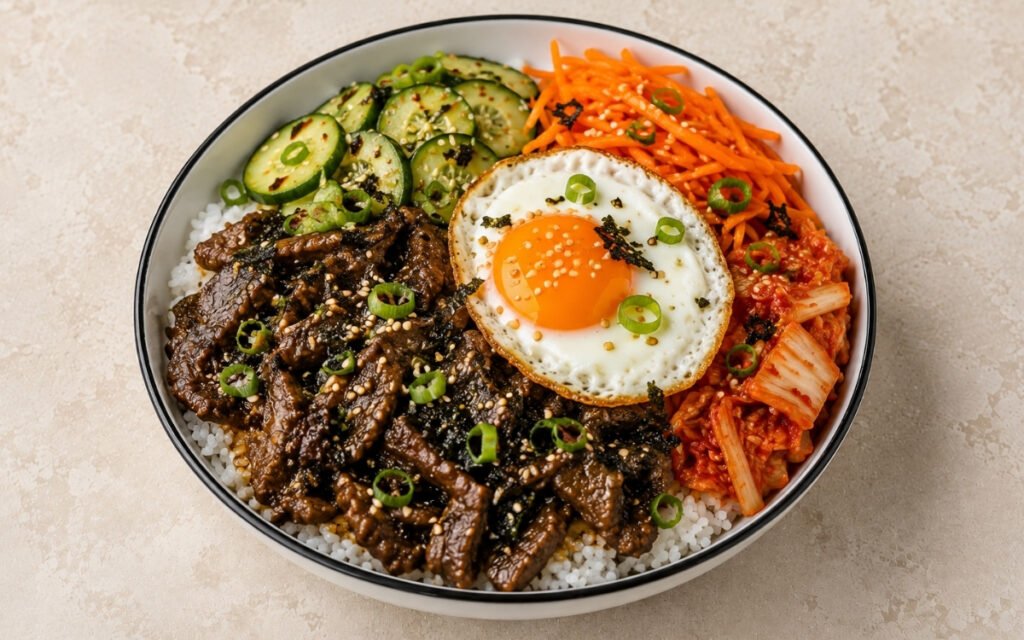
Korean Beef Bulgogi Rice Bowl
Caramelized beef bulgogi over rice with kimchi, pickled cucumber, carrots, a fried egg, scallions, and sesame.
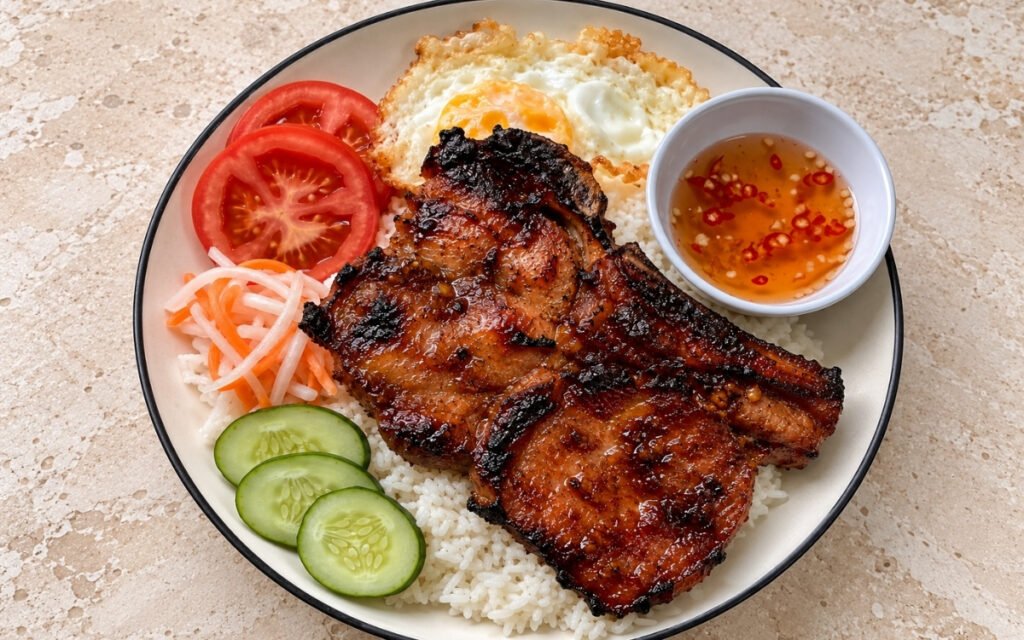
Broken Rice with Grilled Pork (Cơm Tấm)
Grilled lemongrass pork chop over broken rice with a fried egg, quick pickled carrot and daikon, cucumber, tomato, and nước chấm.
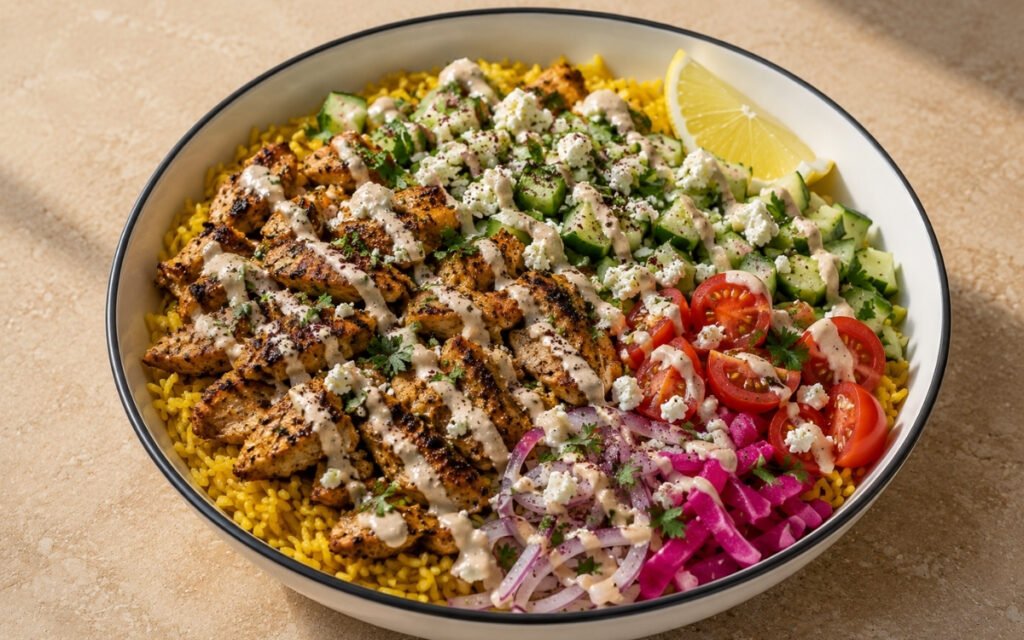
Lebanese Chicken Shawarma Rice Bowl
Chicken thighs marinated in yogurt and seven Lebanese spices, charred undisturbed in cast iron — over turmeric rice with cold-whisked tahini sauce and pickled turnips. 45 minutes.
You might also like
You might also like
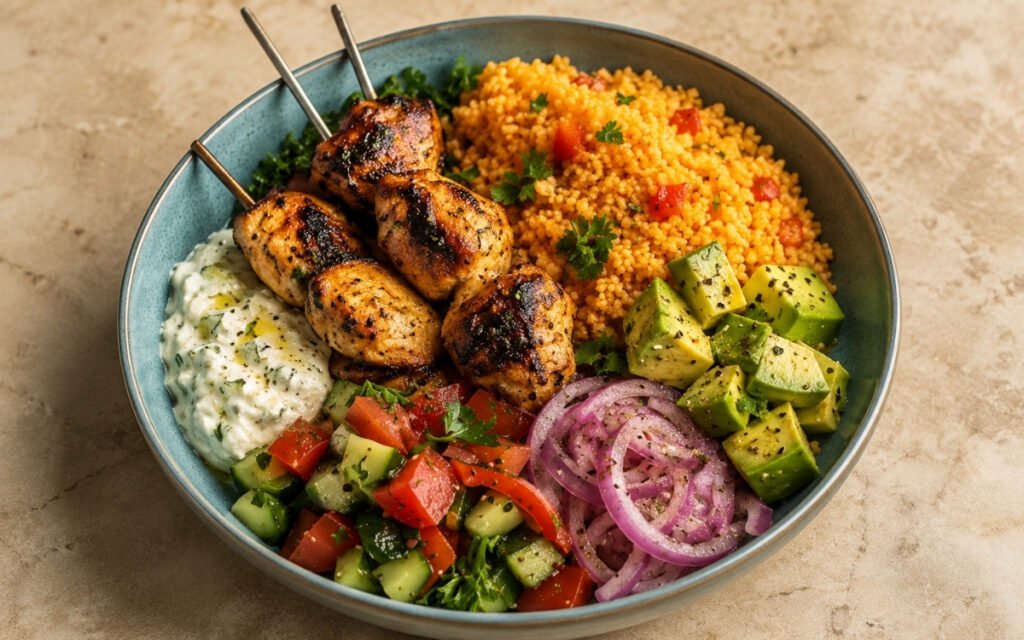
Greek Chicken Souvlaki Mediterranean Bowl
Charred chicken souvlaki over golden couscous with tzatziki, pink pickled onion, tomato-cucumber salad and avocado.
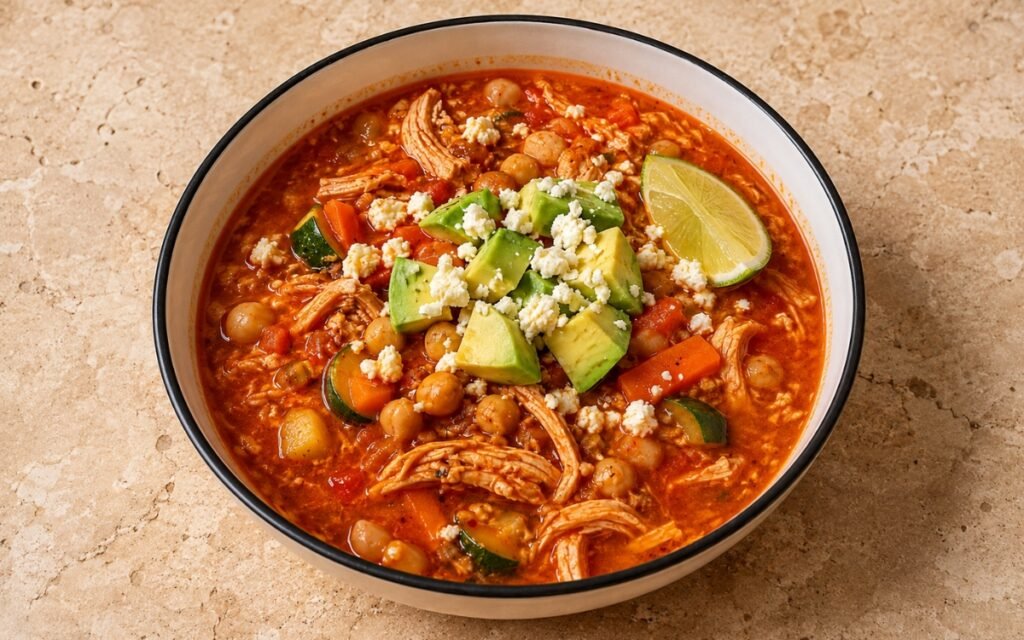
Caldo Tlalpeño
A clear chipotle-tomato chicken broth with shredded chicken, chickpeas, carrots, and zucchini, finished with avocado and queso fresco.
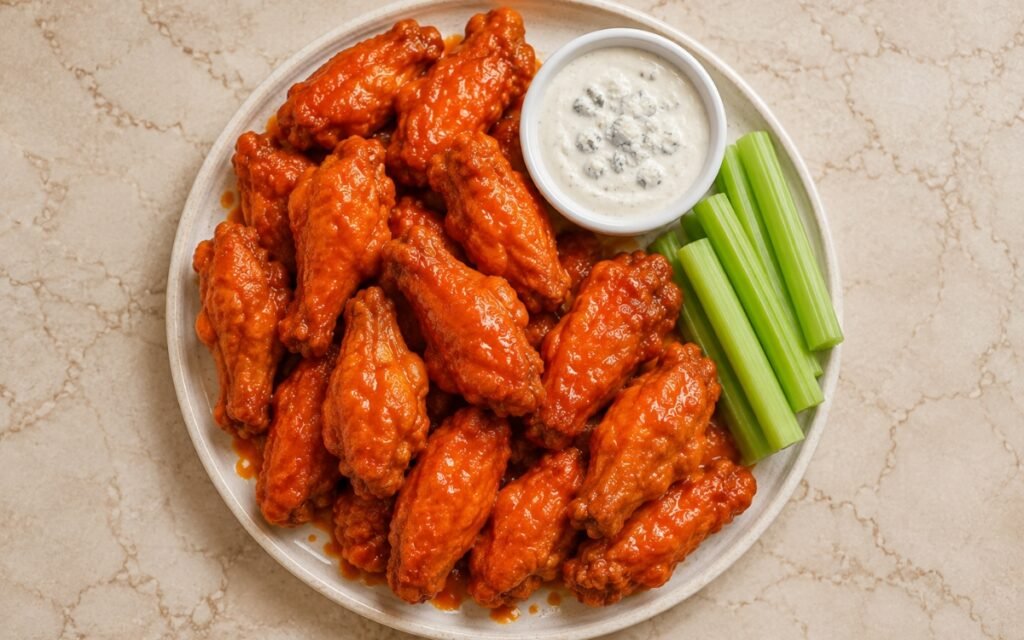
Hot Buffalo Wings
Double-fried chicken wings tossed hot in a glossy butter-and-hot-sauce Buffalo coating, served with blue cheese dressing and celery.
Vietnamese Lemongrass Chicken Rice Bowl
Ingredients
Method
- Prepare the lemongrass first — the most technique-dependent preparation in the recipe. Each lemongrass stalk has three distinct zones from base to tip: the tough, fibrous outer leaves that are aromatic but impossible to properly mince and unpleasant to eat; the firm, pale lower section and tender inner core that contain the most concentrated aromatic oils and mince to a fine, paste-like texture; and the dry, papery upper green portion that has minimal flavour. Remove the outer two or three tough layers from each stalk by peeling them away with your fingers. Cut off and discard the fibrous green upper portion, leaving only the white and pale green lower section — typically the bottom 10–12cm of each stalk. Slice into thin rounds, then mince very finely — the finer the mince, the more aromatic oil is released and the more evenly the lemongrass flavour distributes through the marinade. Lemongrass that is roughly chopped rather than finely minced remains fibrous and provides uneven flavour distribution; finely minced lemongrass produces a paste-like texture that coats the chicken uniformly and releases its aromatic compounds during the high-heat cooking step rather than remaining as identifiable pieces. In a large bowl, combine the minced lemongrass with the 45ml of fish sauce, 30ml of soy sauce, 30g of honey, 20g of minced garlic, 15g of grated ginger, 15ml of toasted sesame oil, and 3g of black pepper. Stir to combine fully. Add the 600g of chicken thighs and massage the marinade thoroughly into every surface. Cover and refrigerate for a minimum of 30 minutes — 2–4 hours for maximum lemongrass penetration.
- While the chicken marinates, prepare the pickled daikon and carrot. In a medium bowl, combine the 120ml of rice vinegar, 40g of sugar, and 6g of salt. Stir vigorously until the sugar and salt have completely dissolved — undissolved sugar produces unevenly sweetened pickle brine with concentrated sweet pockets. Add the 150g of julienned carrot and 150g of julienned daikon radish, pressing them down to ensure complete submersion in the brine. Allow to sit at room temperature for a minimum of 20 minutes, stirring occasionally to ensure even brine contact with all surfaces. After 20 minutes, the vegetables will have softened slightly at their surfaces while retaining their crisp interior structure — producing the characteristic texture of Vietnamese đồ chua, the pickled vegetable accompaniment that appears throughout Vietnamese rice and noodle dishes. The daikon’s slight pungency and the carrot’s earthy sweetness both moderate during pickling as the vinegar draws out some of each vegetable’s stronger flavour compounds, producing a milder, more balanced result than the raw vegetables. The pickled vegetables can be prepared up to 3 days ahead and refrigerate well — they improve over the first 24 hours as the brine penetrates more completely.
- Rinse the 300g of jasmine rice under cold running water until completely clear. Combine the rinsed rice with 450ml of cold water in a medium saucepan. Bring to a full rolling boil over high heat, then reduce immediately to the lowest possible setting, cover tightly, and simmer for 15 minutes without lifting the lid. Remove from heat and allow to stand covered for 5 minutes — do not open the lid during either the cooking or the resting period. After the full rest, uncover and fluff with a fork. The finished rice should have distinct but slightly sticky grains — the slightly sticky quality is correct for this bowl and aids in the chopstick or spoon scooping that Vietnamese bowl food naturally requires.
- Nuoc cham is the foundational dipping sauce and dressing of Vietnamese cooking, and its quality depends entirely on achieving genuine balance between its four components rather than having any single flavour dominate. In a small bowl, combine the 60ml of fresh lime juice, 30ml of fish sauce, 25g of granulated sugar, and 60ml of water. Whisk until the sugar has completely dissolved. Add the 10g of minced garlic and the thinly sliced Thai chili. Taste immediately and assess each flavour dimension independently — the sour from the lime, the salty-umami from the fish sauce, the sweet from the sugar, and the heat from the chili should all be clearly present and roughly equal in presence. Adjust: if the lime dominates, add a small amount of additional water or sugar; if the fish sauce is too assertive, add additional lime juice and a small amount of water; if the sweetness overwhelms, increase the lime juice; if the heat is insufficient, add additional chili or a pinch of chili flakes. The correct nuoc cham tastes simultaneously of all four notes with no single note overpowering — the balance is more important than the exact quantities, which vary with the sourness of specific limes and the saltiness of specific fish sauce brands.
- Remove the marinated chicken from the refrigerator and allow to rest at room temperature for 10 minutes while the cooking surface is prepared. Heat a grill pan or large heavy skillet over medium-high heat and add the 20ml of neutral oil. Allow to heat until shimmering. Remove each chicken thigh from the marinade and allow excess to drip off briefly — very thick honey-based marinade excess can burn before the chicken is cooked through. Add the thighs in a single layer with space between each piece. Cook undisturbed for 6–7 minutes — the honey in the marinade caramelises against the hot surface alongside the lemongrass’s aromatic oils and the soy’s proteins, producing the characteristic golden-brown with caramelised, slightly charred patches that give lemongrass chicken its specific visual and flavour identity. The lemongrass’s volatile aromatic compounds bloom explosively during this caramelisation, producing the citrusy, slightly floral aroma that is the dish’s olfactory signature. After 6–7 minutes, flip each thigh and cook the second side for 6–7 minutes until the internal temperature reads 75°C throughout the thickest part of the thigh. Transfer to a plate and rest for 5 minutes, then slice against the grain into strips.
- Divide the warm jasmine rice among four wide bowls. Top each bowl with the sliced lemongrass chicken strips. Drain the pickled vegetables and arrange alongside the chicken — their bright orange and white colours against the white rice and golden chicken provide the visual variety that Vietnamese bowl food is characterised by. Add the sliced cucumber in a distinct section. Over each bowl, distribute the fresh herbs — a combination of cilantro, mint, and Thai basil together rather than choosing between them. The three-herb combination is a deliberate Vietnamese culinary principle: cilantro provides clean, slightly citrusy herbal freshness; mint provides cooling aromatic contrast; Thai basil provides the specifically anise-like, slightly clove-adjacent aroma that neither cilantro nor regular basil provides. Together they produce an aromatic complexity that a single herb cannot approximate and that is fundamentally characteristic of Vietnamese fresh-herb-forward cooking. Drizzle the nuoc cham generously over each assembled bowl — it should reach the chicken, the rice, and the vegetables. Scatter the 40g of crushed roasted peanuts over each bowl — their toasted, buttery crunch provides the textural contrast this bowl specifically benefits from against the soft rice and tender chicken. Serve lime wedges alongside for additional squeezing at the table.