
Blueberry Buttermilk Pancakes
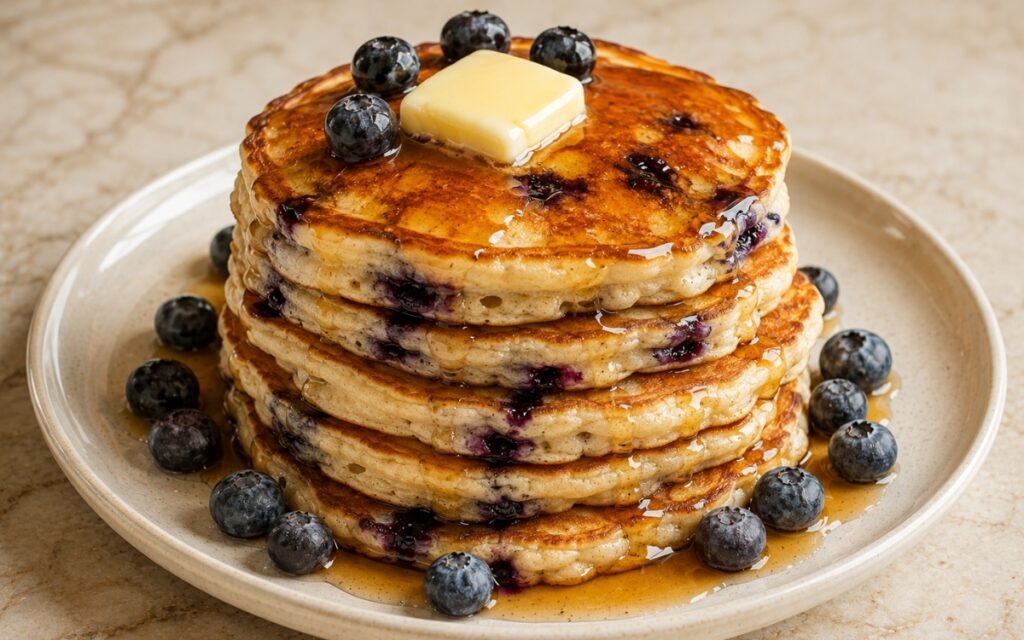
A dual-leavening batter — both baking powder and baking soda — where the baking soda reacts specifically with the buttermilk’s acidity to produce immediate lift from the moment the batter hits the hot pan, and the baking powder provides the sustained rise that keeps each pancake tall through the full cooking time. The buttermilk’s acidity also tenderises the gluten in the flour, producing the specific soft, cloud-like crumb that water or regular milk cannot replicate. Maple syrup in the batter rather than only at serving — its depth present throughout every bite rather than only on the surface. Blueberries folded into the batter and added again individually on top of each poured portion in the pan, so every bite contains berries rather than pockets where they sank during mixing. The batter stirred only until just combined — the lumps left in place, because overmixing develops the gluten and converts a tender, tall pancake into a flat, slightly tough one. The weekend breakfast stack that earns the reputation.
Prep Time : 10 min
Cook Time : 15 min
Servings : 4
10 min
15 min
4
Ingredients
For the Blueberry Buttermilk Pancakes
• 240g all-purpose flour
• 25g granulated sugar — approximately 2 tbsp
• 1 tsp baking powder
• 1 tsp baking soda
• 1 tsp kosher salt
• 415ml buttermilk
• 2 large eggs
• 60g unsalted butter, melted and slightly cooled — this one on Amazon
• 30ml maple syrup — approximately 2 tbsp — this one on Amazon
• 300g fresh blueberries — approximately 200g for the batter, 100g reserved for topping individual pancakes in the pan
• Additional unsalted butter, for greasing the pan
For Serving
• 60g unsalted butter — 15g per person
• 60ml maple syrup — 15ml per person
This post may contain affiliate links. As an Amazon Associate I earn from qualifying purchases, at no additional cost to you.
Directions
- Combine the Dry Ingredients
In a large mixing bowl, whisk together the 240g of flour, 25g of sugar, 1 tsp of baking powder, 1 tsp of baking soda, and 1 tsp of kosher salt until completely uniform. The even distribution of the leavening agents through the flour is the preparation that ensures consistent lift across every portion of the pancake — concentrated pockets of baking soda produce aggressive local lift with a slightly soapy, metallic flavour; evenly distributed baking soda produces uniform, neutral lift throughout. - Combine the Wet Ingredients
In a separate bowl, whisk together the 415ml of buttermilk, 2 eggs, 60g of melted butter, and 30ml of maple syrup until smooth and fully combined. The butter must be melted but slightly cooled before adding — hot butter added to cold buttermilk can partially cook the eggs or cause the butter to resolidify into small clumps on contact. The maple syrup’s contribution at this stage is internal rather than surface-level: its complex, slightly caramel sweetness infuses every part of the batter, so the maple character is present in the pancake’s crumb itself rather than only on the surface where it is poured at serving. - Make the Batter
Pour the wet mixture into the dry ingredients bowl. Whisk gently — 8 to 10 strokes — until just combined. Stop as soon as no large pockets of dry flour are visible. The batter should look rough, thick, and lumpy — visibly unsmooth. Lumps in pancake batter are not a problem to fix; they are the sign that the gluten has not been over-developed. Overmixing develops the gluten structure progressively — a smooth pancake batter has fully developed gluten that resists the leavening’s upward expansion during cooking, producing flat, rubbery pancakes. An under-mixed, lumpy batter has minimal gluten development and offers no resistance to the leavening, producing the specific tall, fluffy, tender result. Fold approximately 200g of the fresh blueberries into the batter with a gentle folding motion — turning the batter over itself rather than stirring — until the berries are distributed throughout. Reserve the remaining 100g for adding directly to each pancake in the pan. - Preheat the Pan
Heat a large non-stick skillet or griddle over medium heat for 2–3 minutes. Add a small amount of butter and allow it to melt until just beginning to foam and bubble lightly across the entire surface. The butter’s foaming state indicates the correct pan temperature for pancakes — hot enough to cook the batter immediately and set the underside within 2–3 minutes, but not so hot that the butter browns before the pancake has time to develop its pale golden colour gradually. If the butter browns within 20 seconds of entering the pan the heat is too high; reduce to medium-low and allow the pan to stabilise. - Cook the Pancakes
Scoop approximately ⅓ cup (80ml) of batter per pancake onto the buttered surface — a standard measuring cup or ladle provides consistent sizing. Immediately after pouring each portion, scatter 5–6 individual blueberries from the reserved 100g directly onto the top surface of each uncooked pancake. This secondary addition ensures visual presence of the blueberries on the finished top surface and guarantees berries in every bite — folded-batter blueberries can sink during cooking, while surface-placed berries are incorporated directly into the cooked surface. Allow each pancake to cook undisturbed until small bubbles form uniformly across the entire surface and the edges of the pancake have lost their wet, glossy appearance and show a visibly set, matte border — typically 2–3 minutes. This bubble-and-edge indicator is the reliable signal that the underside is golden and the interior has set sufficiently to survive the flip without collapsing. Do not flip before both indicators are clearly present. Flip each pancake once using a wide, thin spatula — a confident, rapid flip rather than a hesitant one that may deflate the structure. Cook the second side for 1–2 minutes until cooked through. The second side cooks more quickly than the first and will be slightly less golden — this is correct. Transfer to a plate and add more butter to the pan as needed between batches. The butter coating must be renewed for each batch as it is absorbed and evaporated during cooking. - Serve
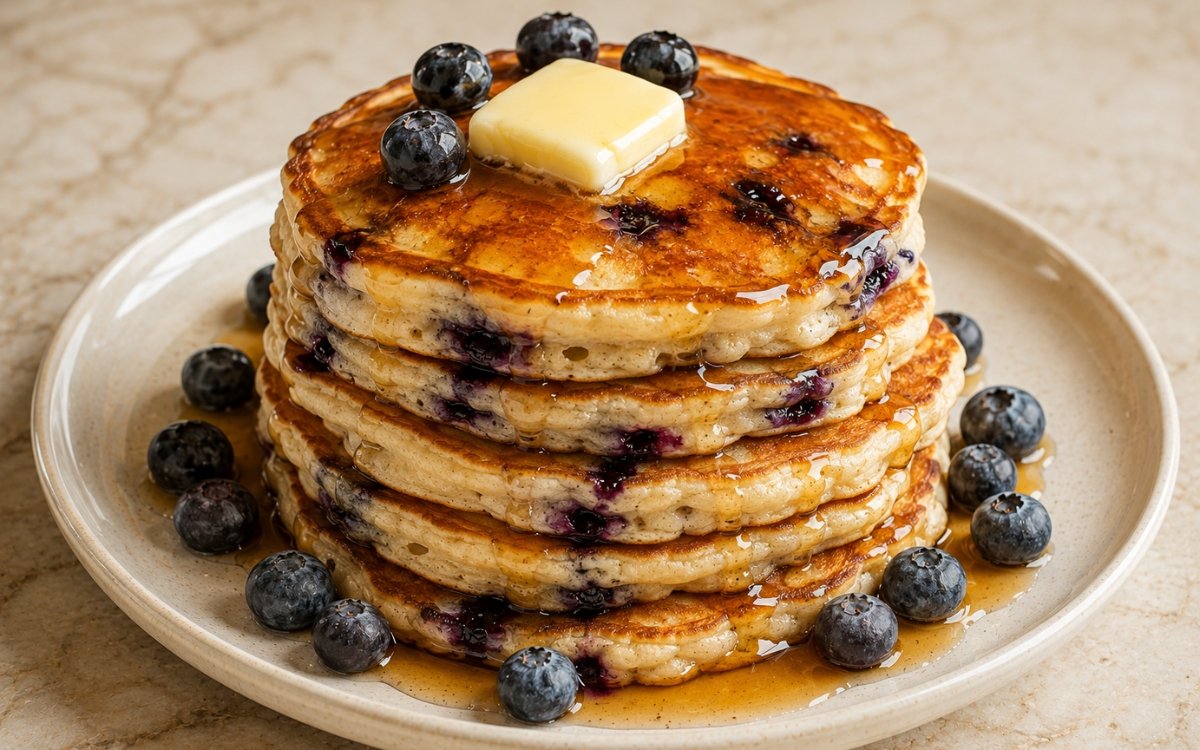
Stack the pancakes immediately — 3–4 per serving for a proper tall stack. Place a 15g pat of cold unsalted butter on the top pancake of each stack. The cold butter melts progressively down the hot stack’s sides as it sits — its richness and slightly sweet-salty flavour complementing the buttermilk’s tang and the blueberries’ jammy sweetness. Drizzle 15ml of maple syrup per serving over the butter and allow it to run down the stack’s sides into every layer. Serve immediately while the pancakes are hot and at their maximum fluffiness — pancakes cool quickly and deflate slightly within minutes of leaving the pan.
*Notes :
- The dual-leavening system — both baking powder and baking soda together — is specifically more effective for tall, fluffy pancakes than either alone. Baking soda reacts immediately with the buttermilk’s lactic acid on contact, producing rapid carbon dioxide release that creates the initial height and open crumb structure from the first seconds in the pan. Baking powder — which contains its own buffered acid and reacts primarily with heat — provides a second, sustained lift as the pancake heats through, maintaining the height that the baking soda’s initial reaction starts. Together they produce a taller, lighter pancake than a single-leavener batter of comparable total quantity.
- Buttermilk’s role in this recipe is specifically dual: its acidity activates the baking soda for the chemical leavening, and its acid content simultaneously tenderises the gluten by inhibiting the cross-linking of gluten proteins during mixing. The result is a batter that produces a softer, more tender crumb than a milk-based batter even with identical mixing technique. Plain milk does not activate the baking soda at the same rate and does not produce the same tenderising effect.
Why This Recipe Works
This recipe works because the dual-leavening system produces the maximum height for the minimum mixing required, the buttermilk tenderises the batter simultaneously while activating the soda, the maple syrup is incorporated into the batter for internal flavour depth rather than only at serving, and the blueberries are added at two stages — in the batter for distribution and on top of each poured pancake for guaranteed surface presence. Every technique decision serves the same goal: the tallest, softest, most flavourful pancake from the simplest preparation.
Ingredient Breakdown
Dual Leavening (Baking Powder and Baking Soda)
The height system — baking soda’s immediate reaction with buttermilk acid provides initial lift; baking powder’s heat-activated reaction provides sustained rise; together producing taller pancakes than either alone.
Buttermilk
The dual-function liquid — activates the baking soda chemically and tenderises gluten simultaneously, producing both the lift and the soft crumb.
Maple Syrup in the Batter
The internal flavour depth — present throughout the pancake’s crumb rather than only on the surface at serving.
Lumpy Batter (Minimal Mixing)
The gluten management technique — 8–10 strokes and visible lumps indicates minimal gluten development and maximum leavening effectiveness.
Two-Stage Blueberry Addition
The distribution technique — folded into batter for internal presence, added to the pan surface for visual surface presence and guaranteed per-bite fruit.
Bubble-and-Edge Indicator
The flip timing signal — bubbles across the surface and matte set edges are the reliable signal that the underside is ready and the interior has sufficient structure for the flip.
Flavor Structure Explained
This Blueberry buttermilk pancakes follow a layered balance model:
- Tangy dairy core (buttermilk)
- Sweet maple foundation (sugar, maple syrup)
- Fruity acidic contrast (blueberries)
- Rich buttery depth (butter in batter and at serving)
- Tender soft structure (pancake crumb)
Buttermilk defines the character with gentle tanginess that keeps the pancakes bright and balanced against their sweetness. Maple and sugar create the warm sweet foundation that supports both fruit and butter flavors. Blueberries provide bursts of jammy sweetness and slight acidity that cut through the richness and keep each bite dynamic. Butter contributes smooth dairy richness throughout the batter and again at serving, reinforcing the pancakes’ comforting softness. The tender crumb ties all elements together into a soft, rich, fruit-forward breakfast structure.
Common Mistakes to Avoid
- Overmixing the Batter – The most common and most consequential error. Fully developed gluten resists leavening and produces flat, slightly rubbery pancakes. Always stop at 8–10 strokes with visible lumps remaining.
- Not Cooling the Melted Butter Before Adding – Hot butter added to cold buttermilk can partially scramble the eggs or cause the butter to resolidify. Always cool to room temperature before adding to the wet mixture.
- Flipping Too Early – Flipping before the bubbles appear and the edges set produces a pancake that collapses and tears on the spatula. Always wait for both the bubble formation and the matte edge indicator.
- Flipping More Than Once – Each flip deflates some of the leavening’s accumulated height. One flip only — confident and immediate.
- Using Cold Buttermilk Directly from the Refrigerator – Cold buttermilk slows the baking soda reaction. Allow the buttermilk to sit at room temperature for 10–15 minutes before using, or warm briefly.
- Not Refreshing the Butter Between Batches – Each batch requires a fresh butter coating — the previous batch’s butter has been absorbed or evaporated.
Variations
With Frozen Blueberries
Replace the fresh blueberries with frozen — add directly from the freezer without thawing. Frozen blueberries folded into batter while still frozen release less juice during mixing and prevent the purple batter streaking that thawed frozen blueberries produce.
With Lemon Zest
Add the zest of 1 lemon to the dry ingredients — its citrus volatiles provide a bright, aromatic note that amplifies the blueberries’ flavour and the buttermilk’s tang into a specifically more complex profile.
With Vanilla
Add 1 tsp of pure vanilla extract to the wet mixture — its warm, aromatic sweetness rounds the maple and buttermilk flavours and adds depth without being identifiable as vanilla in the finished pancake.
With Brown Butter
Replace the regular melted butter in the batter with brown butter — cooked until the milk solids turn golden and smell nutty. The hazelnut depth of brown butter specifically complements the blueberries’ sweetness and the buttermilk’s tang.
Storage & Make-Ahead
Cooked pancakes can be refrigerated for up to 2 days if they are stacked with paper towels between the layers. To reheat them, warm them in a 160°C oven on a wire rack for about 5 minutes, or use a toaster for the best texture.
Pancakes also freeze very well. Let them cool completely, then freeze them in a single layer on a baking sheet until solid. After that, transfer them to a sealed freezer bag with parchment paper between the layers. They can be frozen for up to 1 month and reheated directly from frozen in a 175°C oven for about 8 minutes or in a toaster on a medium setting.
The dry ingredients can be mixed together ahead of time and stored in a sealed jar for up to 1 month. This is a useful make-ahead step for faster morning preparation. It is also a good idea to label the jar with the wet ingredient quantities needed later.
Frequently Asked Questions
Why both baking powder and baking soda?
Baking soda reacts with the buttermilk’s acid immediately on contact, providing rapid initial lift. Baking powder reacts with heat during cooking, providing sustained rise. The combination produces taller, fluffier pancakes than either leavener alone at equivalent quantities — each performs a different function in the lift sequence.
Why is buttermilk specifically better than regular milk?
Buttermilk’s lactic acid serves two functions simultaneously: it activates the baking soda for chemical leavening, and it inhibits gluten cross-linking during mixing, producing a more tender crumb. Regular milk activates the baking soda at a much lower rate and produces no meaningful tenderising effect.
Why does the batter need to be lumpy?
Lumps indicate minimal gluten development — the flour’s proteins have not been worked into an extended network. An extended gluten network in pancake batter resists the leavening’s upward expansion during cooking, producing flat, slightly dense pancakes. Lumpy batter offers minimal resistance, allowing maximum height from the same quantity of leavening.
Why add blueberries both in the batter and on top in the pan?
Blueberries folded into the batter distribute throughout the pancake’s interior but can sink to the bottom of each portion during cooking. Blueberries added to the top surface of each poured portion ensure visible, jammy fruit on the finished surface of every pancake and guarantee berries in every bite regardless of their movement during cooking.
Can I use frozen blueberries?
Yes — add them directly from the freezer without thawing. Frozen blueberries added to the batter while still frozen release significantly less juice than thawed ones, preventing the purple batter streaking and the grey-blue interior that thawed frozen blueberries produce in the cooked pancake.
Nutrition Facts
( per serving )
Calories
~620 kcal
Protein
14 g
Fat
27 g
Carbs
81 g
Calories
~620 kcal
Protein
14 g
Fat
27 g
Carbs
81 g
Related Recipes
Related Recipes

Pasta e Ceci
Small pasta and chickpeas in a thick, creamy brothy base with soffritto, garlic, and rosemary. Rustic Italian comfort food.
Baked Mac and Cheese
Cheddar, Gruyère, and mozzarella melted into a béchamel off the heat — layered with underdone macaroni, baked bubbling, broiled golden. Serves 12.
Cheddar Chive Scones
Savory cheddar chive scones with golden craggy tops, buttery flaky interiors, sharp cheddar pockets, and fresh chive flecks throughout.
You might also like
You might also like
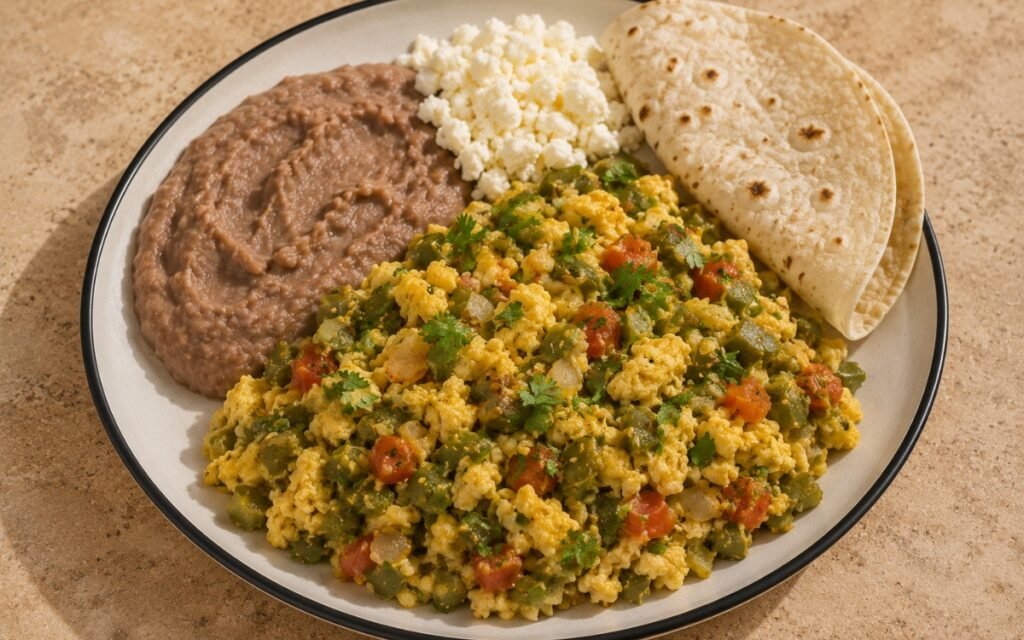
Nopales con Huevo
Scrambled eggs cooked with tender diced nopales, onion, tomato, and green chile, finished with fresh cilantro.
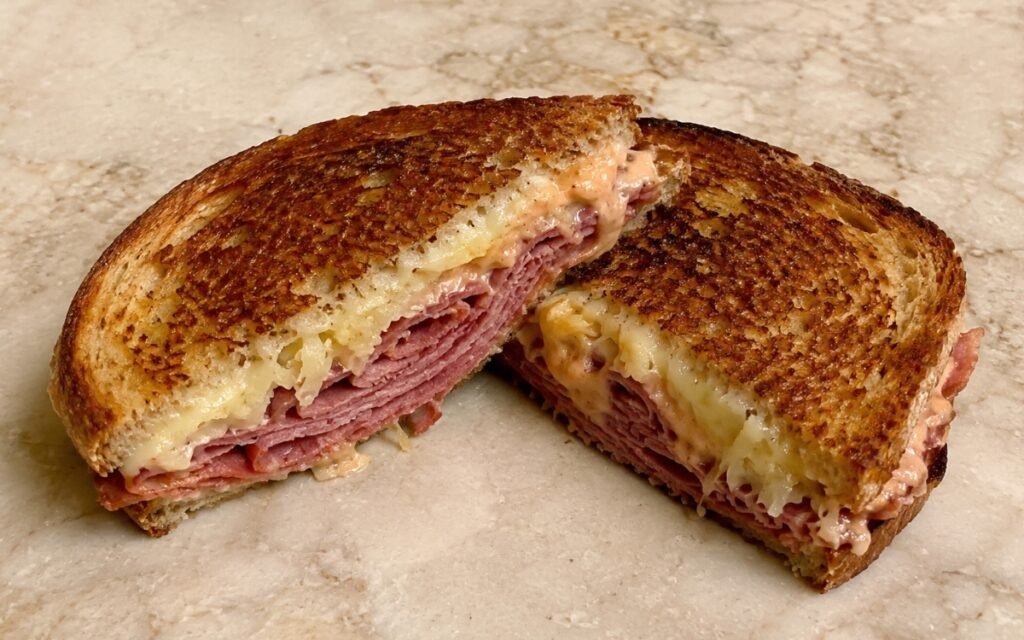
Reuben Sandwich
Griddled rye bread layered with warm corned beef, melted Swiss cheese, well-drained sauerkraut, and Russian dressing, pressed until crisp and golden.
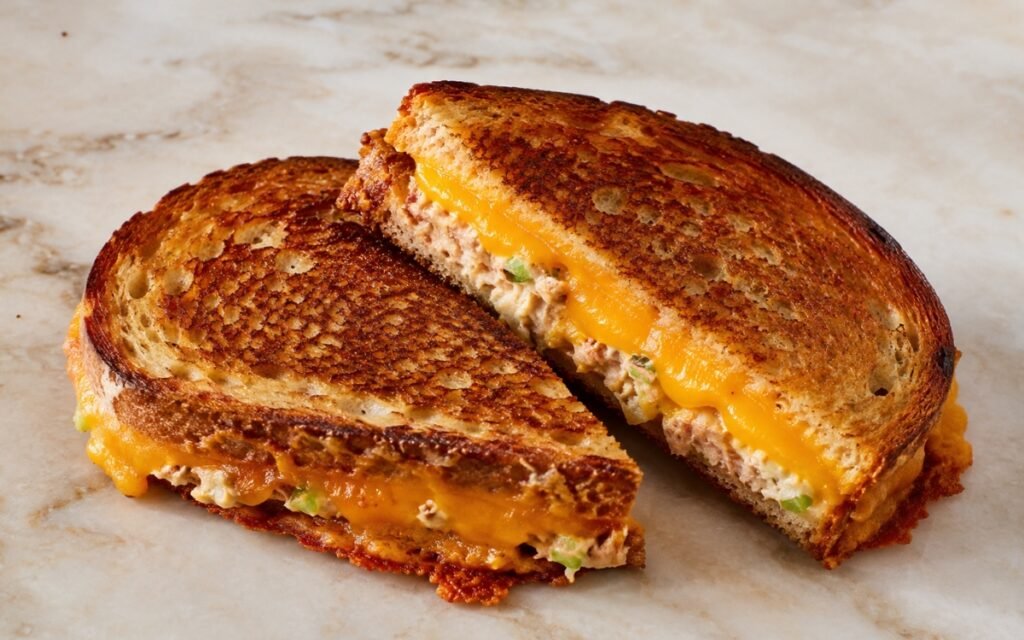
Tuna Melt
Creamy tuna salad and sharp melted cheddar griddled between buttery sourdough until deeply golden and crisp.
Blueberry Buttermilk Pancakes
Ingredients
Method
- In a large mixing bowl, whisk together the 240g of flour, 25g of sugar, 1 tsp of baking powder, 1 tsp of baking soda, and 1 tsp of kosher salt until completely uniform. The even distribution of the leavening agents through the flour is the preparation that ensures consistent lift across every portion of the pancake — concentrated pockets of baking soda produce aggressive local lift with a slightly soapy, metallic flavour; evenly distributed baking soda produces uniform, neutral lift throughout.
- In a separate bowl, whisk together the 415ml of buttermilk, 2 eggs, 60g of melted butter, and 30ml of maple syrup until smooth and fully combined. The butter must be melted but slightly cooled before adding — hot butter added to cold buttermilk can partially cook the eggs or cause the butter to resolidify into small clumps on contact. The maple syrup’s contribution at this stage is internal rather than surface-level: its complex, slightly caramel sweetness infuses every part of the batter, so the maple character is present in the pancake’s crumb itself rather than only on the surface where it is poured at serving.
- Pour the wet mixture into the dry ingredients bowl. Whisk gently — 8 to 10 strokes — until just combined. Stop as soon as no large pockets of dry flour are visible. The batter should look rough, thick, and lumpy — visibly unsmooth. Lumps in pancake batter are not a problem to fix; they are the sign that the gluten has not been over-developed. Overmixing develops the gluten structure progressively — a smooth pancake batter has fully developed gluten that resists the leavening’s upward expansion during cooking, producing flat, rubbery pancakes. An under-mixed, lumpy batter has minimal gluten development and offers no resistance to the leavening, producing the specific tall, fluffy, tender result. Fold approximately 200g of the fresh blueberries into the batter with a gentle folding motion — turning the batter over itself rather than stirring — until the berries are distributed throughout. Reserve the remaining 100g for adding directly to each pancake in the pan.
- Heat a large non-stick skillet or griddle over medium heat for 2–3 minutes. Add a small amount of butter and allow it to melt until just beginning to foam and bubble lightly across the entire surface. The butter’s foaming state indicates the correct pan temperature for pancakes — hot enough to cook the batter immediately and set the underside within 2–3 minutes, but not so hot that the butter browns before the pancake has time to develop its pale golden colour gradually. If the butter browns within 20 seconds of entering the pan the heat is too high; reduce to medium-low and allow the pan to stabilise.
- Scoop approximately ⅓ cup (80ml) of batter per pancake onto the buttered surface — a standard measuring cup or ladle provides consistent sizing. Immediately after pouring each portion, scatter 5–6 individual blueberries from the reserved 100g directly onto the top surface of each uncooked pancake. This secondary addition ensures visual presence of the blueberries on the finished top surface and guarantees berries in every bite — folded-batter blueberries can sink during cooking, while surface-placed berries are incorporated directly into the cooked surface. Allow each pancake to cook undisturbed until small bubbles form uniformly across the entire surface and the edges of the pancake have lost their wet, glossy appearance and show a visibly set, matte border — typically 2–3 minutes. This bubble-and-edge indicator is the reliable signal that the underside is golden and the interior has set sufficiently to survive the flip without collapsing. Do not flip before both indicators are clearly present. Flip each pancake once using a wide, thin spatula — a confident, rapid flip rather than a hesitant one that may deflate the structure. Cook the second side for 1–2 minutes until cooked through. The second side cooks more quickly than the first and will be slightly less golden — this is correct. Transfer to a plate and add more butter to the pan as needed between batches. The butter coating must be renewed for each batch as it is absorbed and evaporated during cooking.
- Stack the pancakes immediately — 3–4 per serving for a proper tall stack. Place a 15g pat of cold unsalted butter on the top pancake of each stack. The cold butter melts progressively down the hot stack’s sides as it sits — its richness and slightly sweet-salty flavour complementing the buttermilk’s tang and the blueberries’ jammy sweetness. Drizzle 15ml of maple syrup per serving over the butter and allow it to run down the stack’s sides into every layer. Serve immediately while the pancakes are hot and at their maximum fluffiness — pancakes cool quickly and deflate slightly within minutes of leaving the pan.