Ingredients
Method
Combine the Dry Ingredients
- In a large mixing bowl, whisk together the 240g of flour, 25g of sugar, 1 tsp of baking powder, 1 tsp of baking soda, and 1 tsp of kosher salt until completely uniform. The even distribution of the leavening agents through the flour is the preparation that ensures consistent lift across every portion of the pancake — concentrated pockets of baking soda produce aggressive local lift with a slightly soapy, metallic flavour; evenly distributed baking soda produces uniform, neutral lift throughout.
Combine the Wet Ingredients
- In a separate bowl, whisk together the 415ml of buttermilk, 2 eggs, 60g of melted butter, and 30ml of maple syrup until smooth and fully combined. The butter must be melted but slightly cooled before adding — hot butter added to cold buttermilk can partially cook the eggs or cause the butter to resolidify into small clumps on contact. The maple syrup's contribution at this stage is internal rather than surface-level: its complex, slightly caramel sweetness infuses every part of the batter, so the maple character is present in the pancake's crumb itself rather than only on the surface where it is poured at serving.
Make the Batter
- Pour the wet mixture into the dry ingredients bowl. Whisk gently — 8 to 10 strokes — until just combined. Stop as soon as no large pockets of dry flour are visible. The batter should look rough, thick, and lumpy — visibly unsmooth. Lumps in pancake batter are not a problem to fix; they are the sign that the gluten has not been over-developed. Overmixing develops the gluten structure progressively — a smooth pancake batter has fully developed gluten that resists the leavening's upward expansion during cooking, producing flat, rubbery pancakes. An under-mixed, lumpy batter has minimal gluten development and offers no resistance to the leavening, producing the specific tall, fluffy, tender result. Fold approximately 200g of the fresh blueberries into the batter with a gentle folding motion — turning the batter over itself rather than stirring — until the berries are distributed throughout. Reserve the remaining 100g for adding directly to each pancake in the pan.
Preheat the Pan
- Heat a large non-stick skillet or griddle over medium heat for 2–3 minutes. Add a small amount of butter and allow it to melt until just beginning to foam and bubble lightly across the entire surface. The butter's foaming state indicates the correct pan temperature for pancakes — hot enough to cook the batter immediately and set the underside within 2–3 minutes, but not so hot that the butter browns before the pancake has time to develop its pale golden colour gradually. If the butter browns within 20 seconds of entering the pan the heat is too high; reduce to medium-low and allow the pan to stabilise.
Cook the Pancakes
- Scoop approximately ⅓ cup (80ml) of batter per pancake onto the buttered surface — a standard measuring cup or ladle provides consistent sizing. Immediately after pouring each portion, scatter 5–6 individual blueberries from the reserved 100g directly onto the top surface of each uncooked pancake. This secondary addition ensures visual presence of the blueberries on the finished top surface and guarantees berries in every bite — folded-batter blueberries can sink during cooking, while surface-placed berries are incorporated directly into the cooked surface. Allow each pancake to cook undisturbed until small bubbles form uniformly across the entire surface and the edges of the pancake have lost their wet, glossy appearance and show a visibly set, matte border — typically 2–3 minutes. This bubble-and-edge indicator is the reliable signal that the underside is golden and the interior has set sufficiently to survive the flip without collapsing. Do not flip before both indicators are clearly present. Flip each pancake once using a wide, thin spatula — a confident, rapid flip rather than a hesitant one that may deflate the structure. Cook the second side for 1–2 minutes until cooked through. The second side cooks more quickly than the first and will be slightly less golden — this is correct. Transfer to a plate and add more butter to the pan as needed between batches. The butter coating must be renewed for each batch as it is absorbed and evaporated during cooking.
Serve
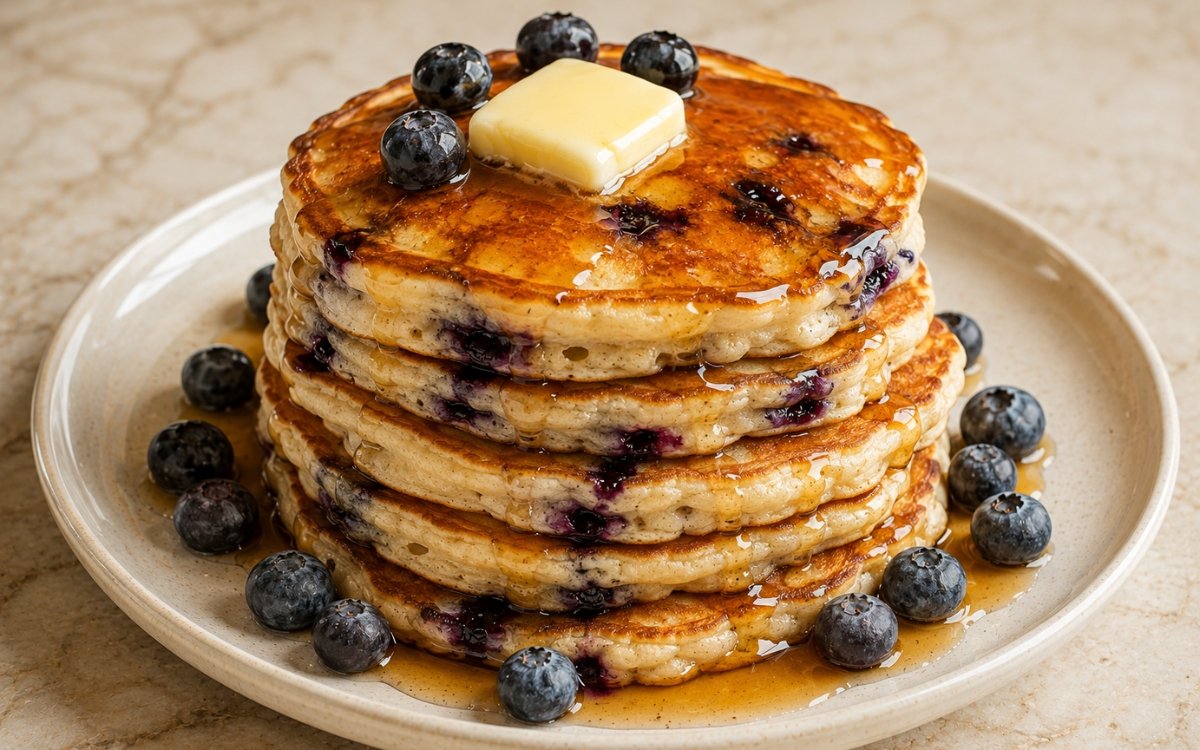
- Stack the pancakes immediately — 3–4 per serving for a proper tall stack. Place a 15g pat of cold unsalted butter on the top pancake of each stack. The cold butter melts progressively down the hot stack's sides as it sits — its richness and slightly sweet-salty flavour complementing the buttermilk's tang and the blueberries' jammy sweetness. Drizzle 15ml of maple syrup per serving over the butter and allow it to run down the stack's sides into every layer. Serve immediately while the pancakes are hot and at their maximum fluffiness — pancakes cool quickly and deflate slightly within minutes of leaving the pan.
Notes
The dual-leavening system — both baking powder and baking soda together — is specifically more effective for tall, fluffy pancakes than either alone. Baking soda reacts immediately with the buttermilk's lactic acid on contact, producing rapid carbon dioxide release that creates the initial height and open crumb structure from the first seconds in the pan. Baking powder — which contains its own buffered acid and reacts primarily with heat — provides a second, sustained lift as the pancake heats through, maintaining the height that the baking soda's initial reaction starts. Together they produce a taller, lighter pancake than a single-leavener batter of comparable total quantity.
Buttermilk's role in this recipe is specifically dual: its acidity activates the baking soda for the chemical leavening, and its acid content simultaneously tenderises the gluten by inhibiting the cross-linking of gluten proteins during mixing. The result is a batter that produces a softer, more tender crumb than a milk-based batter even with identical mixing technique. Plain milk does not activate the baking soda at the same rate and does not produce the same tenderising effect.