
Basil Lemonade — Blended
Basil and mint are the two herbs used in blended lemonades in this collection, and they behave differently under high-speed blending in ways that require slightly different calibration. Mint’s aromatic character is dominated by menthol — a compound with a specifically cool, clean, immediately recognisable aromatic quality that shifts toward grassy-chlorophyll with over-blending. Basil’s primary aromatic compounds are linalool, eugenol (at low concentrations, the warm-spicy-sweet component), and various basil-specific terpenes including methylchavicol (responsible for the specifically anise-adjacent, warm-sweet quality of Italian sweet basil). At correct brief-blend concentration these compounds produce basil’s characteristic warm, sweet, slightly anise-adjacent, complex herbal character — specifically different from mint’s cool, clean freshness and specifically more unexpected in a lemonade context. Basil’s over-blend transition moves toward harsh eugenol dominance and chlorophyll release: rather than mint’s specifically grassy cooling, basil becomes specifically peppery-bitter with a dark green, vegetal quality. The quantity is calibrated at 1/3 to ½ cup rather than the mint version’s full ½ cup — basil’s aromatic compounds are more concentrated per gram than mint’s, and fewer leaves provide a comparable aromatic impact. The result is a blended lemonade that is specifically green and unexpectedly elegant rather than simply cool and refreshing.
Prep Time : 15 min
Cook Time : 5 min
Servings : 8
15 min
5 min
8
Ingredients
For the Lemon Structure
• Clean pulp or segments from 2–3 lemons — seeds and all tough membranes removed; no white pith
For the Peel-Infused Simple Syrup
• 180ml water
• 150g white granulated sugar — this one on Amazon
• Zest of 2 lemons — yellow part only, no white pith; added off heat
For the Blended Lemonade Base
• 240ml fresh lemon juice — approximately 5–6 lemons
• 120–150ml peel-infused simple syrup — start with 120ml; adjust after tasting
• 360–480ml ice-cold water — start with 360ml; adjust for texture
• 140–200g ice cubes — start with 140g for lighter slushy; 200g for thicker colder result
• ⅓–½ cup fresh basil leaves — loosely packed; approximately 10–15g; start with ⅓ cup
• Pinch of fine sea salt
For Serving
• Lemon slices
• Fresh basil leaves
This post may contain affiliate links. As an Amazon Associate I earn from qualifying purchases, at no additional cost to you.
Directions
- Make the Peel-Infused Simple Syrup
Combine the 180ml of water and 150g of white sugar in a small saucepan over medium heat. Stir until completely dissolved and clear. Remove from heat immediately. Add the lemon zest. Cover and steep for 8–10 minutes. Strain completely. Allow to cool. The peel-infused syrup’s stable aromatic depth is specifically more important in the basil blended lemonade than in the mint version for a nuanced reason. Basil’s pleasant warm-sweet aromatic compounds — particularly linalool and the anise-adjacent methylchavicol — share aromatic space with lemon’s own aromatic compounds more closely than mint’s menthol does. The lemon peel’s terpene oils infused into the syrup provide a citrus depth that specifically resonates with basil’s warm terpene character in a way that creates a more specifically unified herbal-citrus aromatic profile in the finished blended drink. - Prepare the Lemon Pulp
Segment 2–3 lemons, removing all seeds and tough membranes while keeping clean citrus pulp. Remove all white pith completely. In the blended format, complete pith removal is as critical as in the Mint Lemonade — Blended for the same reason: the blender’s mechanical action fully extracts pith bitterness into the liquid rather than the selective pressure-and-mash release of the still lemonade preparations. - Build the Blender With Basil Added Last
Add the ingredients in sequence: ice cubes first, then lemon pulp, then fresh lemon juice, then 120ml of cooled peel-infused syrup, then 360ml of ice-cold water, then the pinch of salt. Add the basil leaves last — placed on top of the other ingredients. The same blade-contact management principle from the mint version applies: basil placed on top is drawn into the vortex from above rather than being at direct, immediate, sustained blade contact from the blender’s start. The difference is marginal in absolute terms but meaningful for a preparation where the blend time is deliberately so brief. The quantity: begin with ⅓ cup of loosely packed fresh basil leaves — approximately 10g — rather than the ½ cup starting point of the mint preparation. Basil contains a higher concentration of its primary aromatic compounds per gram than mint does, meaning ⅓ cup of basil provides an aromatic impact broadly comparable to ½ cup of mint at the same very brief blend time. Starting at ⅓ cup and adjusting after the initial blend allows the basil’s concentration to be calibrated to the specific preference and specific batch of basil without the irreversibility of starting too high. - Blend Briefly — The Basil-Specific Timing
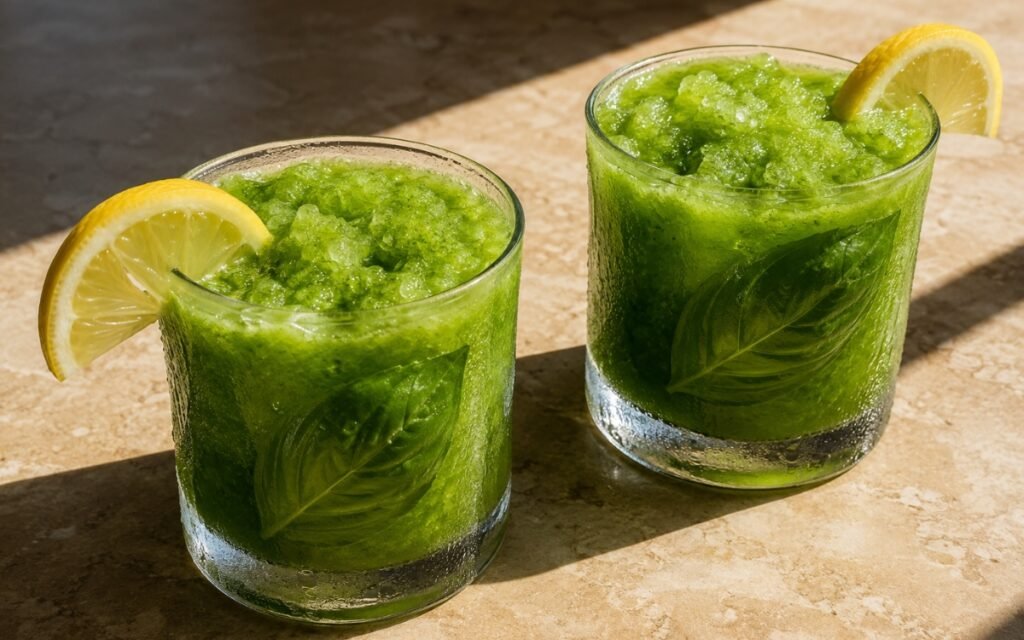
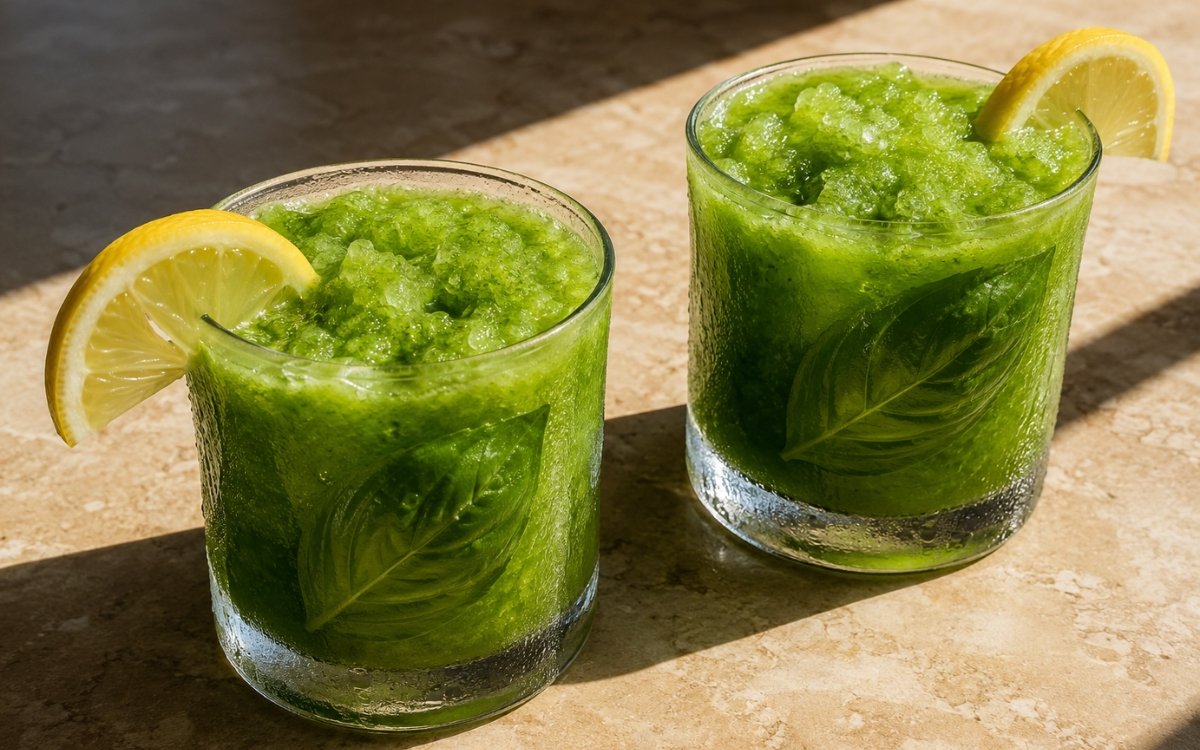
Blend at high speed for 15–25 seconds only — the same window as the mint preparation with the same absolute stop. The visual target state is the same: pale to medium green, slushy-thick, ice granules visible throughout, a vortex moving but not fully smooth. The colour indicator differs between mint and basil: correctly blended basil produces a pale-to-medium, somewhat grassy green colour — slightly more yellow-green than mint’s more vivid blue-green. Over-blended basil produces a dark, olive-drab green from chlorophyll dominance alongside the harsh eugenol and pepper-adjacent bitterness. The colour is a reliable indicator. After the initial brief blend, taste immediately. If the basil character is specifically present and warm-herbal-sweet but clearly behind the lemon’s brightness — correct, proceed to serve. If the basil is not sufficiently present, add the additional basil leaves (up to the remaining ½ cup total) to the blender and pulse 3–4 times rather than running a full second blend. Short pulses add basil character with less additional over-blend risk than a sustained second blend. Once the basil character is at or above the desired level, no further basil addition can be corrected — only dilution with cold water reduces the basil concentration. - Adjust and Serve Immediately
If additional adjustments are needed beyond the basil calibration: more cold water (up to 60ml, pulsed in) for concentration; more ice (30–40g, pulsed in) for texture; more peel-infused syrup (small amount, pulsed in) for sweetness. Always minimal additional blending after adjustments — short pulses rather than sustained blends. Pour immediately into chilled glasses. Garnish with a lemon slice and 2–3 fresh whole basil leaves resting on top of the slushy surface — the fresh leaves’ surface aromatic oils providing the first aromatic impression. Serve within 2–3 minutes. Do not store — basil’s volatile aromatic compounds diminish faster than mint’s once blended and distributed into liquid; the characteristic warm-sweet basil character fades noticeably within 10–15 minutes and the colour shifts from pale green toward a darker, duller tone as chlorophyll oxidises.
*Notes :
- Italian sweet basil — the standard large-leaf, mild-sweet basil available in supermarkets — is the specifically correct variety for this preparation. Thai basil, with its more assertive anise and clove character from higher eugenol and methylchavicol concentrations, produces a significantly more assertive, more specifically spiced result that is interesting but different in character. Lemon basil — a hybrid with high citral content — produces a specifically more citrusy, more specifically lemon-herb result that is excellent and specifically beautiful in this preparation for those who can source it.
- Fresh basil quality varies significantly by season. Summer-grown field basil in warm conditions produces the most specifically fragrant, most aromatic leaves with the highest volatile oil concentration. Supermarket basil grown under glass in cooler conditions has a noticeably milder aromatic character and may require the full ½ cup rather than the ⅓ cup starting point.
Why This Recipe Works
This recipe works because the peel-infused syrup provides a stable aromatic foundation that specifically resonates with basil’s warm terpene character. The basil is added last and at a lower starting quantity than mint to account for its higher per-gram aromatic concentration.
The brief blend stops before eugenol dominance and chlorophyll release. And immediate service preserves both the slushy texture and the specific warm-sweet basil aromatic character before either can diminish.
Ingredient Breakdown
Brief Blend (15–25 Seconds Maximum)
The technique’s defining constraint — basil’s pleasant warm-sweet aromatic character extracted in the first phase of blending; harsh eugenol dominance and chlorophyll in the subsequent phase.
⅓ Cup Starting Quantity (Lower Than Mint’s ½ Cup)
The basil-specific aromatic concentration calibration — more aromatic compounds per gram than mint means fewer leaves provide comparable impact.
Basil Added Last and On Top
The blade-contact delay — fractionally less high-speed blade contact from the blend’s start compared to placing basil at the bottom.
Peel-Infused Syrup Resonating With Basil’s Terpenes
The flavour unity contribution — lemon terpene oils from the peel infusion sharing aromatic space with basil’s warm terpene character more specifically than mint’s menthol-dominant profile.
Immediate Service
The quality preservation requirement — basil’s specific warm aromatic compounds and the slushy texture both diminish rapidly after blending.
Flavor Structure Explained
This Blended basil lemonade follows a layered balance model:
- CitruBright citrus core (fresh lemon juice)
- Warm herbal complexity (basil)
- Icy textured refreshment (blended ice)
- Deep aromatic citrus foundation (peel-infused syrup)
- Vivid cold finish (slushy structure)
Lemon defines the foundation with sharp acidity and immediate citrus brightness that cut cleanly through the drink. Basil provides the defining contrast, contributing sweet herbal depth and subtle anise-like aromatics that feel warmer and more savory than mint’s cooling freshness. The blended ice creates a slushy texture that intensifies both refreshment and flavor delivery, making the citrus and herbs feel more vivid through extreme cold. Peel-infused syrup adds concentrated citrus-oil complexity beneath the brighter lemon juice, giving the drink a fuller aromatic structure. The result is a preparation where texture, temperature, citrus sharpness, and warm herbal depth all work together simultaneously.
Common Mistakes to Avoid
- Blending Beyond 25 Seconds – The transition from warm-sweet basil to bitter-harsh eugenol-and-chlorophyll occurs within seconds after the correct end point. Always stop at 15–25 seconds.
- Starting With Too Much Basil – Basil is easier to add than to remove. Always start at ⅓ cup and taste before adding more.
- Using a Second Full Blend for Adjustments – Short pulses for any post-taste adjustment. A second sustained high-speed blend continues extracting the harsh compounds even if the first blend was correctly timed.
- Storing the Blended Lemonade – Basil’s volatile aromatic character fades faster than mint’s once blended. Always serve within 2–3 minutes.
- Not Removing All Pith from the Lemon Pulp – Same as the mint version — the blender fully extracts pith bitterness. Always remove completely.
Variations
With Cucumber
Add 100g of roughly chopped peeled cucumber to the blender with the other ingredients — the cucumber’s cool mineral freshness alongside basil and lemon produces a specifically spa-adjacent, green, aromatic version.
With Strawberry
Add 150g of fresh hulled strawberries to the blender — the strawberry’s warm, fruity sweetness alongside basil and lemon is the same combination as the Raspberry Basil Lemonade direction in a blended slushy format.
With Thai Basil
Replace the Italian basil with Thai basil at the same quantity for a more assertive, more clove-and-anise forward result — stronger but specifically interesting for those who want a more assertive herbal direction.
With Honey
Replace the peel-infused simple syrup with honey syrup — the honey’s floral warmth alongside basil’s anise-adjacent character and lemon’s brightness produces a specifically more complex, more Mediterranean direction.
Storage & Make-Ahead
Peel-infused syrup can be refrigerated for up to 2 weeks, making it an excellent component to prepare well in advance.
The lemon base, without the ice and basil, can be prepared by combining the lemon juice, syrup, and water and refrigerating the mixture for up to 2 days. For the freshest flavor and brightest herbal character, add the ice and fresh basil only at the moment of blending.
Once blended, basil lemonade is not suitable for storage and should be served within 2 to 3 minutes.
Frequently Asked Questions
How is basil’s over-blend problem different from mint’s?
Mint’s over-blend produces a specifically grassy, cooler, chlorophyll-forward note from the menthol-path breakdown. Basil’s over-blend produces a specifically peppery-bitter, darker, more assertive note from harsh eugenol dominance alongside chlorophyll release. Both are specifically unpleasant but in different directions — mint’s is more universally recognisable as “over-blended herb”; basil’s is more specifically a peppery harshness.
Why use ⅓ cup rather than the ½ cup of mint?
Basil’s primary aromatic compounds — particularly linalool, eugenol, and methylchavicol — are present at higher concentrations per gram than mint’s primary menthol compounds. At the same brief blend time, ⅓ cup of basil provides a comparable aromatic impact to ½ cup of mint; starting at ⅓ cup prevents the common error of over-basil which cannot be corrected after blending.
Why does the peel-infused syrup specifically work better with basil than it does with mint?
Basil’s warm terpene aromatic compounds — including linalool, which is also found in lemon zest — share overlapping aromatic chemistry with lemon peel’s terpene oils. The peel-infused syrup’s depth resonates with basil’s character more specifically than it does with mint’s menthol-dominant aromatics, producing a more unified herbal-citrus aromatic profile in the finished blended drink.
What other herbal lemonade preparations share this character?
The Mint Lemonade — Blended shares the identical blended format with the cool, clean menthol character of mint rather than basil’s warm, anise-adjacent complexity — the most directly comparable preparation in a different aromatic direction. The Lemon Basil Spritz Mocktail shares the basil-and-lemon combination in a sparkling, cold-infusion format — the same primary flavour pairing in the most structurally different possible still preparation. The Raspberry Basil Lemonade shares the basil-as-primary-herb direction with raspberry and lime rather than lemon alone — a more assertively fruity, still (non-blended) direction.
Nutrition Facts
( per serving )
Calories
~65 kcal
Protein
0 g
Fat
0 g
Carbs
17 g
Calories
~65 kcal
Protein
0 g
Fat
0 g
Carbs
17 g
Related Recipes
Related Recipes

Peach Ginger Lemonade
Cold-extracted lemon zest and juice combined with raw-blended peaches and a gently extracted ginger infusion for a bright golden-orange lemonade.
Mint Lemonade — Blended
Lemon zest syrup off heat, mint added last to blender — blended 15–25 seconds maximum, served immediately for slushy icy texture. Aromatic, cool, and bright.
Fresh Peach Lemonade
Ripe peaches simmered with sugar for 10–12 minutes, pressed through a sieve — fresh lemon juice and cold water added, chilled. Sweet, tart, and intensely peachy.
You might also like
You might also like
Raspberry Basil Limeade
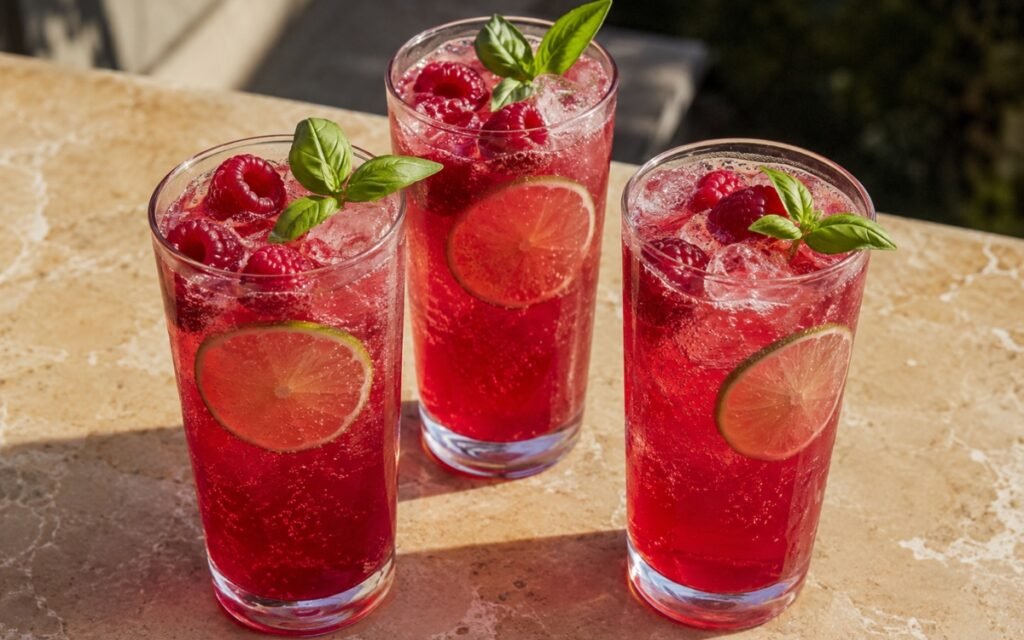
Raspberries blended with lime juice, strained — honey no-cook syrup, basil and mint steeped cold 5–10 minutes, club soda right before serving. Vivid red and tart.
Peach Iced Tea Pitcher Drink
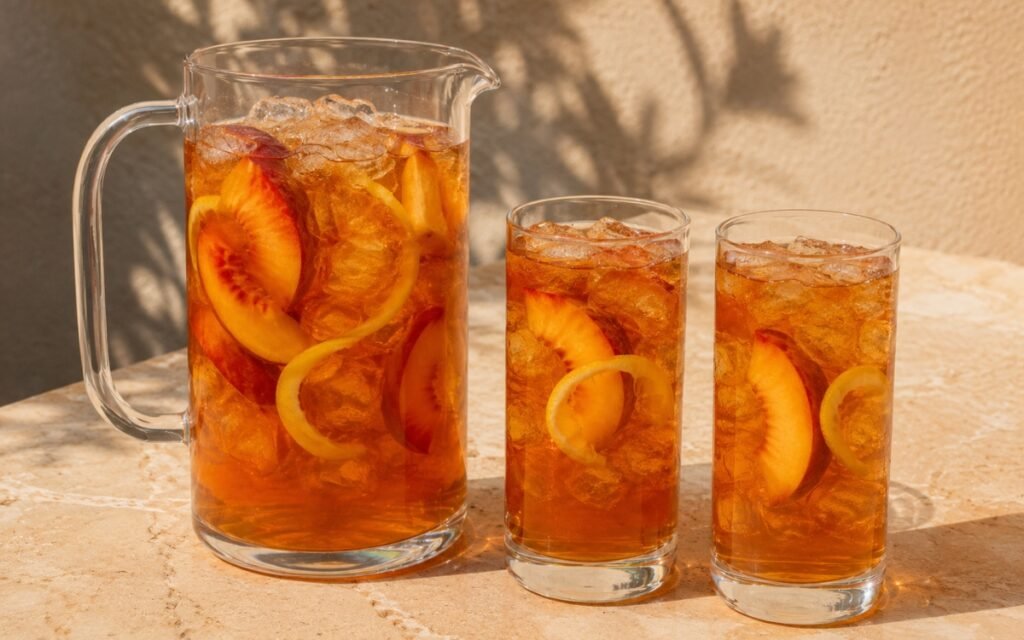
Ceylon tea at 90–95°C for 3 minutes, cooled to 70–75°C — skin-on peaches and lemon zest steeped 10–12 minutes in warm tea, strained, combined with cold water, chilled. Clean and peachy.
Passion Fruit Mint Spritzer Mocktail
Raw passion fruit with lime, honey, and cold-infused mint over club soda — intensely tropical.

Basil Lemonade — Blended
Ingredients
Method
- Combine the 180ml of water and 150g of white sugar in a small saucepan over medium heat. Stir until completely dissolved and clear. Remove from heat immediately. Add the lemon zest. Cover and steep for 8–10 minutes. Strain completely. Allow to cool. The peel-infused syrup’s stable aromatic depth is specifically more important in the basil blended lemonade than in the mint version for a nuanced reason. Basil’s pleasant warm-sweet aromatic compounds — particularly linalool and the anise-adjacent methylchavicol — share aromatic space with lemon’s own aromatic compounds more closely than mint’s menthol does. The lemon peel’s terpene oils infused into the syrup provide a citrus depth that specifically resonates with basil’s warm terpene character in a way that creates a more specifically unified herbal-citrus aromatic profile in the finished blended drink.
- Segment 2–3 lemons, removing all seeds and tough membranes while keeping clean citrus pulp. Remove all white pith completely. In the blended format, complete pith removal is as critical as in the Mint Lemonade — Blended for the same reason: the blender’s mechanical action fully extracts pith bitterness into the liquid rather than the selective pressure-and-mash release of the still lemonade preparations.
- Add the ingredients in sequence: ice cubes first, then lemon pulp, then fresh lemon juice, then 120ml of cooled peel-infused syrup, then 360ml of ice-cold water, then the pinch of salt. Add the basil leaves last — placed on top of the other ingredients. The same blade-contact management principle from the mint version applies: basil placed on top is drawn into the vortex from above rather than being at direct, immediate, sustained blade contact from the blender’s start. The difference is marginal in absolute terms but meaningful for a preparation where the blend time is deliberately so brief. The quantity: begin with ⅓ cup of loosely packed fresh basil leaves — approximately 10g — rather than the ½ cup starting point of the mint preparation. Basil contains a higher concentration of its primary aromatic compounds per gram than mint does, meaning ⅓ cup of basil provides an aromatic impact broadly comparable to ½ cup of mint at the same very brief blend time. Starting at ⅓ cup and adjusting after the initial blend allows the basil’s concentration to be calibrated to the specific preference and specific batch of basil without the irreversibility of starting too high.
- Blend at high speed for 15–25 seconds only — the same window as the mint preparation with the same absolute stop. The visual target state is the same: pale to medium green, slushy-thick, ice granules visible throughout, a vortex moving but not fully smooth. The colour indicator differs between mint and basil: correctly blended basil produces a pale-to-medium, somewhat grassy green colour — slightly more yellow-green than mint’s more vivid blue-green. Over-blended basil produces a dark, olive-drab green from chlorophyll dominance alongside the harsh eugenol and pepper-adjacent bitterness. The colour is a reliable indicator. After the initial brief blend, taste immediately. If the basil character is specifically present and warm-herbal-sweet but clearly behind the lemon’s brightness — correct, proceed to serve. If the basil is not sufficiently present, add the additional basil leaves (up to the remaining ½ cup total) to the blender and pulse 3–4 times rather than running a full second blend. Short pulses add basil character with less additional over-blend risk than a sustained second blend. Once the basil character is at or above the desired level, no further basil addition can be corrected — only dilution with cold water reduces the basil concentration.
- If additional adjustments are needed beyond the basil calibration: more cold water (up to 60ml, pulsed in) for concentration; more ice (30–40g, pulsed in) for texture; more peel-infused syrup (small amount, pulsed in) for sweetness. Always minimal additional blending after adjustments — short pulses rather than sustained blends. Pour immediately into chilled glasses. Garnish with a lemon slice and 2–3 fresh whole basil leaves resting on top of the slushy surface — the fresh leaves’ surface aromatic oils providing the first aromatic impression. Serve within 2–3 minutes. Do not store — basil’s volatile aromatic compounds diminish faster than mint’s once blended and distributed into liquid; the characteristic warm-sweet basil character fades noticeably within 10–15 minutes and the colour shifts from pale green toward a darker, duller tone as chlorophyll oxidises.