Ingredients
Method
Start the Mexican Style Rice
- The rice goes on first — its 20-minute cook time plus 5-minute rest covers the entire preparation window for every other component. For the complete technique — including the toasting method, the tomato incorporation, and the correct stock ratio — follow the full Mexican Style Rice recipe. Summary: heat the 15ml of vegetable oil in a medium saucepan over medium heat. Add the 300g of rinsed long-grain rice and toast, stirring continuously, for 2–3 minutes until the grains turn lightly golden and smell nutty — the toasting is what produces the Mexican rice's specific separate-grain character and prevents sticking during simmering. Add the garlic and diced onion and cook for 1 minute until fragrant. Pour in the 200ml of tomato sauce — stir immediately. Add the 400ml of chicken stock, 3g of cumin, and 3g of salt. Bring to a boil, reduce to the lowest heat, cover tightly, and simmer for 18–20 minutes until all liquid is absorbed. Remove from heat and rest covered for 5 minutes. Fluff with a fork — the rice should be fluffy, separate, and a deep golden-orange from the tomato.
Sear the Ground Beef Using the Cast Iron Method
- This is the technique step that defines this recipe and distinguishes it from standard taco-night ground beef. Heat a large cast iron skillet over medium-high heat for 2–3 minutes until genuinely hot. Add the 15ml of olive oil and swirl to coat the entire surface. Add the 600g of ground beef as a single mass and immediately use a spatula to press and spread it across the entire surface of the cast iron in an even, flat layer — as though making a large, thin patty that covers the pan from edge to edge. The surface contact is the critical factor: ground beef pressed flat against the entire surface of a smoking-hot cast iron creates the maximum possible direct Maillard contact area simultaneously, rather than the small surface areas produced by immediately crumbling the beef. Leave completely undisturbed for 4–5 minutes. The fat from the 80/20 beef renders progressively into the cast iron surface during this undisturbed period while the beef's surface proteins caramelise — producing a deeply browned, almost crusty bottom layer across the entire pan's width. The 80/20 fat ratio is specified rather than leaner beef because the fat content is what enables the caramelisation — leaner beef produces insufficient rendered fat and drier, less flavourful seared surfaces. After 4–5 minutes, the bottom should be visibly deeply browned with a crust that releases naturally from the cast iron. Using a wide spatula, slice through the flat beef layer into 4–6 large sections and flip each section over. Allow the second side to sear undisturbed for 3–4 minutes — the top surface that was facing up during the first sear is now against the hot surface and will develop its own crust in this second phase. Once both sides have developed deep caramelisation, begin breaking the seared beef into smaller pieces using a firm spatula or a potato masher — pressing and breaking the caramelised sections into irregular, smaller crumbles. The goal is not fine, uniform crumbles but slightly irregular, textured pieces where some surfaces retain their seared character. Add the 3g of smoked paprika, 3g of cumin, 7g of salt, and 3g of garlic powder directly to the broken beef and fold and mix continuously for 1–2 minutes until the spices are evenly distributed through every piece. The spices bloom in the residual beef fat in the hot pan during this final mixing, distributing their aromatic compounds through the beef evenly rather than remaining as uncooked powder concentrated in pockets.
Make the Pico de Gallo
- While the beef sears undisturbed, begin the pico. For the complete technique — including the tomato preparation, the correct salting and resting method, and the balance — follow the full Pico de Gallo recipe. Summary: finely dice the 4 Roma tomatoes, ½ white onion, and 1 jalapeño into uniform, small pieces — approximately 5mm dice throughout. Combine in a bowl with the 30g of roughly chopped cilantro, 30ml of lime juice, and 3g of salt. Toss and allow to rest at room temperature for at least 10 minutes — the resting period draws moisture from the tomatoes and onion and mellows the onion's raw sharpness into a cleaner, more balanced salsa. The correct pico is bright, evenly seasoned, and has a moderate amount of liquid from the tomatoes and lime rather than being watery or dry. Taste and adjust — additional lime juice for brightness, additional salt for seasoning.
Make the Mexican Grilled Corn Salad
- For the complete technique — including the char method and the full dressing — follow the full Mexican Grilled Corn Salad recipe. Summary: after the beef has been removed or while the second side of the beef sears in the cast iron, heat a separate large heavy skillet over high heat until smoking. Add the 400g of corn kernels directly to the dry pan in a single layer without oil. Leave completely undisturbed for 2–3 minutes — the corn's natural sugars caramelise and char at the direct contact points, producing the smoky-sweet charred corn character that defines the salad. Stir once and cook for a further 1–2 minutes. Transfer to a bowl and allow to cool slightly. Add the diced jalapeño, diced red onion, chopped cilantro, 30ml of lime juice, 60g of crumbled cotija or feta, and 3g of chili powder. Toss and season with 2g of salt. Set aside at room temperature.
Make the Guacamole
- For the complete technique — including the correct avocado preparation, the mashing method, and the balance — follow the full Classic Guacamole recipe. Make this step last among the cold components to minimise oxidation time before serving. Summary: halve the 3 ripe avocados, remove the stones, and scoop the flesh into a bowl. Add the 30ml of lime juice immediately — the acid slows the enzymatic browning from the moment of contact. Add the minced garlic, finely diced onion, diced jalapeño, chopped cilantro, and 3g of salt. Mash to a partially chunky consistency — some avocado pieces remaining is the correct texture for a bowl component. Taste and adjust with additional lime or salt. Press plastic wrap directly against the surface if not serving immediately.
Warm the Spiced Black Beans
- Heat the drained and rinsed 400g of black beans in a small saucepan over medium heat. Add the 2g of cumin, 3g of smoked paprika, and 3g of salt. Add a small splash of water — approximately 30ml — to prevent sticking and to create the light coating that carries the spices evenly around every bean. Heat for 3–4 minutes, stirring occasionally, until the beans are thoroughly warmed through and the spices have bloomed into the surrounding moisture. The beans should taste specifically and assertively seasoned — the cumin and smoked paprika clearly present rather than subtle. Taste and adjust with additional salt.
Assemble the Bowls
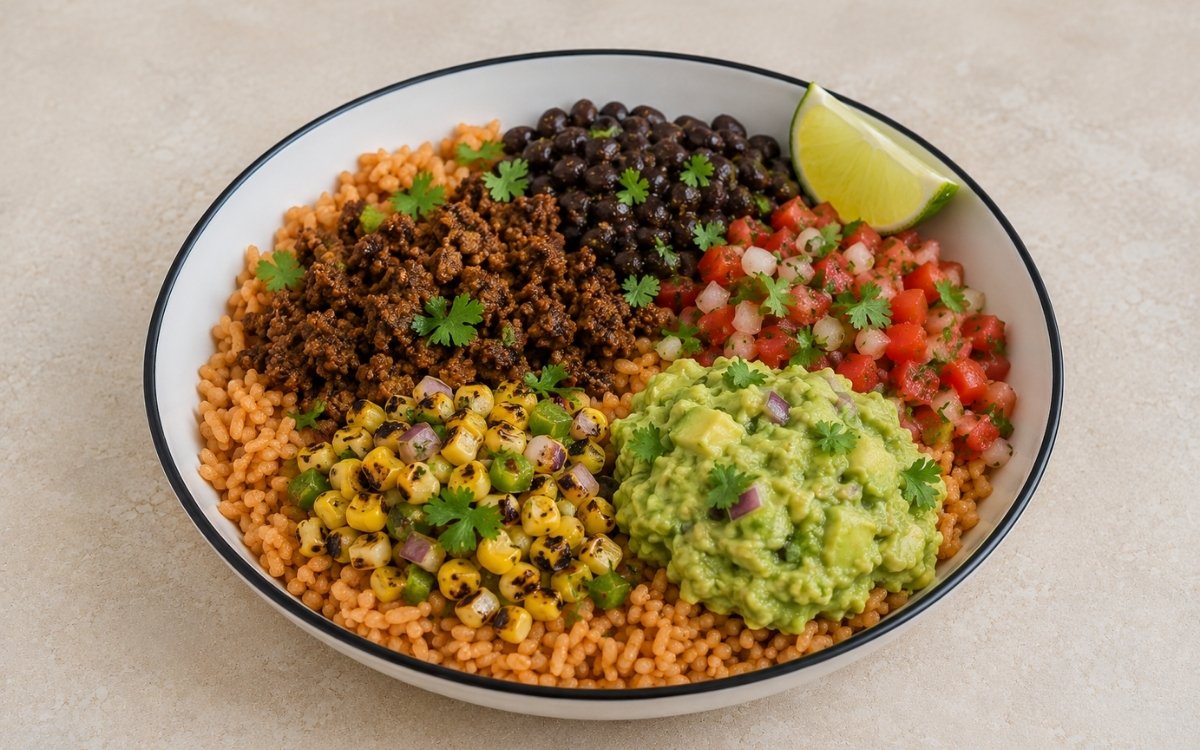
- Assemble all four bowls in rapid succession — the beef is at its best warm and the guacamole begins to oxidise once exposed. Divide the Mexican rice as the base of each bowl — a generous mound that covers the bowl's surface and forms the platform for every component above. Working around the rice base, place each component in its own distinct section: the seasoned ground beef in the centre or the largest section, the spiced black beans alongside, the pico de gallo in its own section, the grilled corn salad adjacent, and the guacamole in the final section. Distinct placement is both visually more appealing and practically better — the pico's moisture does not prematurely soften the corn salad, and the guacamole's lime does not begin breaking down the other components before the bowl is eaten. Over each assembled bowl, scatter 25g of the Mexican cheese blend in equal portions. The residual heat from the warm rice and beef partially melts the cheese into the bowl without any additional heat — the cheese should appear as half-melted, slightly pulled strings rather than a fully melted layer. Serve immediately.
Notes
The single-layer sear technique for ground beef is the specific innovation in this recipe that makes it worth making over any standard taco-meat preparation. Standard ground beef crumbled immediately into a pan undergoes a steaming phase as the moisture released from the beef is trapped between the moving pieces — the pieces grey and soften before the moisture fully evaporates and browning can begin. By the time proper browning occurs, the beef is overcooked and dry. The flat-patty technique eliminates this problem entirely: the beef is pressed into contact with the hot surface before any moisture has been released, maximum Maillard contact occurs immediately, and the moisture released during cooking drains away from the flat surface rather than steaming the pieces. The result — deeply caramelised, textured, slightly crispy in places — is specifically more satisfying than standard crumbled beef and is the technique difference that makes restaurant-quality ground beef distinctly better than home versions.
The 80/20 fat ratio is non-negotiable for this technique. The 20% fat content renders into the pan during the sear, both lubricating the surface and participating in the caramelisation that produces the crust. Leaner beef — 90/10 or 85/15 — does not render sufficient fat and produces a drier, less flavourful sear with a tendency to stick to the cast iron rather than releasing naturally after 4–5 minutes.
The corn salad, pico, and guacamole together provide the specific fresh, acid, and creamy registers that make the bowl feel complete rather than simply protein over rice. See the linked full recipes for each — Mexican Grilled Corn Salad, Pico de Gallo, Classic Guacamole — for the technique details that produce restaurant-quality versions of each component.