
Hot Honey Salmon Rice Bowl
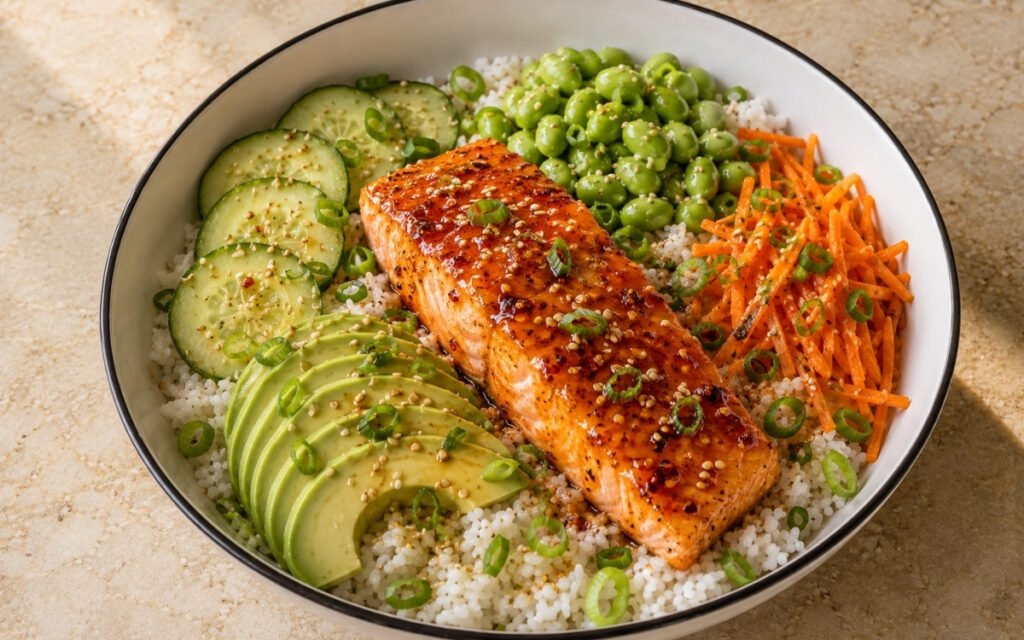
A gochugaru hot honey glaze — honey, Korean red pepper flakes, and rice vinegar whisked together — brushed onto pan-seared salmon in the final minute of cooking so it caramelises against the hot pan rather than simply coating. The glaze’s heat is fruity and building rather than sharp, and its sweetness against the soy sauce drizzle at serving produces the specific sweet-savoury-spiced balance that makes this bowl feel more restaurant than weeknight. Quick-pickled carrots made while the salmon cooks add the acid contrast that brings everything together. Thirty-five minutes from start to bowl.
Prep Time : 20 min
Cook Time : 15 min
Servings : 4
20 min
15 min
4
Ingredients
For the pan seared Salmon
• 600g skinless salmon fillets, cut into 4 equal portions
• 15ml toasted sesame oil — this one on Amazon
• 4g kosher salt
• 2g black pepper
For the Hot Honey Glaze
• 90g honey
• 15g gochugaru (Korean red pepper flakes) — this one on Amazon
• 30ml rice vinegar
• 2g kosher salt
For the Rice
• 300g jasmine rice, uncooked
• 450ml water
• 3g kosher salt
For the Salmon Rice Bowl Toppings
• 150g cucumber, thinly sliced
• 200g ripe avocado, sliced — about 1 large
• 100g shelled edamame, cooked
• 80g carrots, julienned
• 10g granulated sugar
• 15ml low-sodium soy sauce
• 10g toasted sesame seeds
• 30g scallions, thinly sliced
This post may contain affiliate links. As an Amazon Associate I earn from qualifying purchases, at no additional cost to you.
Directions
- Cook the Jasmine Rice
Rinse the 300g of jasmine rice under cold running water in a fine-mesh sieve, working the grains gently until the water running through them is completely clear. The rinsing removes the surface starch coating that, if left on, causes the grains to stick together and produces a gummy finished rice rather than the fluffy, individually distinct grains that make a good rice bowl base. Combine the rinsed rice with the 600ml of water and 3g of kosher salt in a medium saucepan. Bring to a full rolling boil over high heat, then immediately reduce to the lowest possible setting, cover tightly, and simmer for 15 minutes without lifting the lid. The trapped steam inside the covered pot is the active cooking medium — any escape disrupts the absorption ratio. After 15 minutes, remove from the heat and allow to stand covered for 5 minutes. This resting period lets the steam redistribute through the uppermost layers of rice and allows the bottom grains to firm slightly from the cooling pan — the result is evenly cooked, perfectly fluffy rice throughout. Remove the lid and fluff with a fork using a gentle lifting and separating motion. - Make the Hot Honey Glaze
While the rice cooks, prepare the hot honey glaze. In a small bowl, whisk together the 90g of honey, 15g of gochugaru, 30ml of rice vinegar, and 2g of kosher salt until fully combined and uniform. The gochugaru — Korean coarse red pepper flakes made from sun-dried, deseeded chilies — provides a fundamentally different heat character from generic red pepper flakes or cayenne. Its heat is fruity, moderately spiced, and building rather than sharp or immediate, and its slight natural sweetness integrates with the honey rather than contrasting against it. The rice vinegar provides the acid counterpoint that prevents the glaze from tasting one-dimensionally sweet, and its brightness amplifies the gochugaru’s fruity character. At 15g the glaze is prominently spiced — the heat builds progressively through each glazed bite. Reduce to 8g for a milder result. The glaze is made in advance of the salmon step so it is ready to brush immediately when needed — the glazing window is the final minute of cooking and does not allow for concurrent preparation. - Quick-Pickle the Carrots
In a small bowl, combine 30ml of rice vinegar — using the same vinegar as the glaze for flavour consistency — with the 10g of sugar and a pinch of salt. Stir until the sugar and salt have dissolved completely. Add the 80g of julienned carrots and toss to coat. Allow to sit for at least 10 minutes while the salmon cooks and the bowls are assembled. In 10 minutes the carrots will have absorbed the vinegar’s acidity and the sugar’s sweetness, softening very slightly at their surface while retaining their crisp interior — producing the specific texture and flavour of a quick pickle rather than either a raw carrot or a fully preserved one. The pickled carrots are the acid element that makes the bowl feel complete — their bright, slightly sweet sharpness cuts through the salmon glaze’s sweetness, the avocado’s richness, and the rice’s neutrality. The pickled carrots can be made up to 3 days ahead and refrigerated — they improve with additional pickling time. - Season and Sear the Salmon
Pat all four salmon portions completely dry on both sides with paper towels — this is the non-negotiable preparation step for a proper sear. Surface moisture prevents the direct, dry-heat contact between the salmon’s surface proteins and the hot pan that produces the Maillard crust. Season both sides with the 4g of kosher salt and 2g of black pepper, pressing the seasoning gently into the surface. Heat the 15ml of toasted sesame oil in a large non-stick skillet over medium-high heat until shimmering. Toasted sesame oil is used specifically for its aromatic character — its nutty, slightly roasted fragrance infuses the salmon’s exterior during searing and provides a background sesame note that complements the Asian-inflected bowl composition. It has a moderate smoke point suitable for medium-high searing without burning. Add the salmon fillets flesh-side up — skin-side down first if the fillets have skin, but for these skinless portions, either side can go down first. Place them with space between each portion and leave completely undisturbed for 4–5 minutes. The sustained, uninterrupted contact with the hot sesame oil and pan surface develops the golden, caramelised crust that contributes the textural contrast and Maillard depth that makes seared salmon specifically more satisfying than baked. - Flip and Glaze
After 4–5 minutes, carefully flip each salmon fillet using a thin spatula. Cook on the second side for 3–4 minutes. In the final minute of cooking — when the salmon has nearly reached 52°C internal temperature and is just barely translucent at the very centre — brush the top surface of each fillet generously with the hot honey glaze. The timing of the glaze application is deliberate: the honey’s sugars caramelise rapidly against the heat radiating from the salmon and any residual pan heat around it, developing a light, slightly sticky, glistening glaze rather than a raw honey coating. Applied too early the glaze burns; applied at the very end without any cooking it remains raw and coats without caramelising. The final minute is the specific window where the heat is sufficient to develop the glaze’s character without burning it. At 52°C the salmon will be slightly translucent at the centre with firm, opaque outer flesh — the residual heat will finish the centre to a moist, perfectly cooked result on the plate. For a fully cooked-through result, cook to 57°C before glazing. - Assemble and Serve
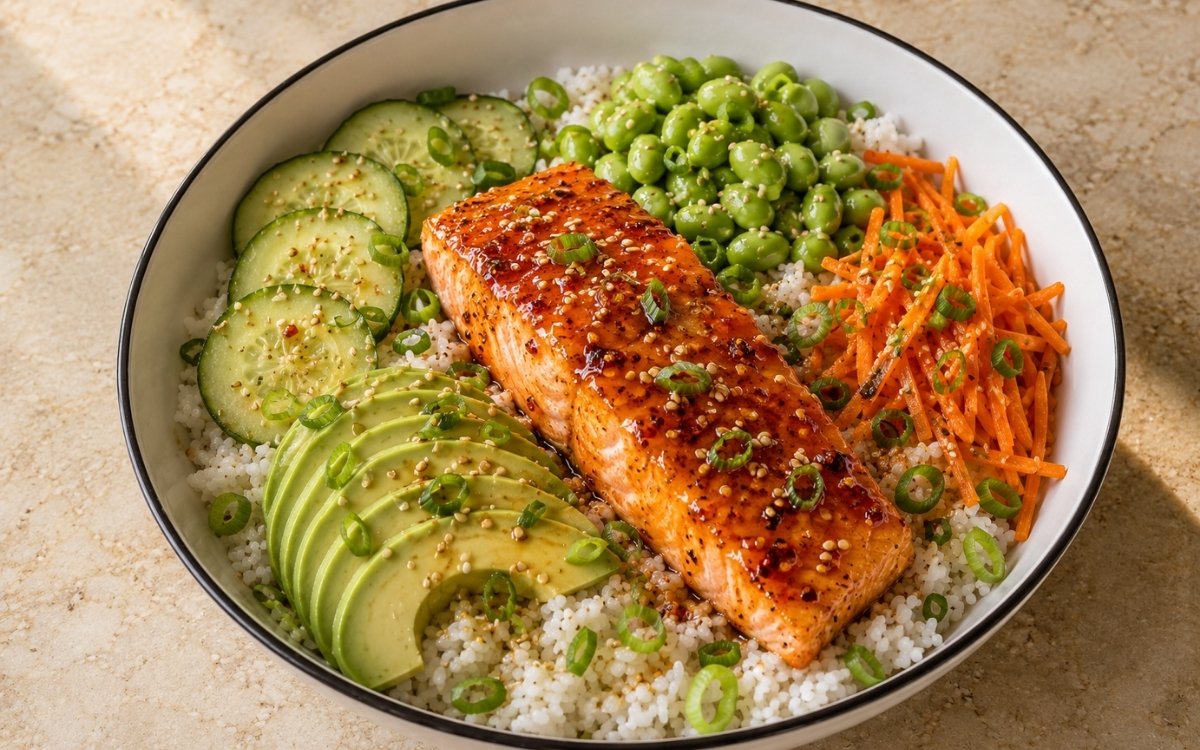
Divide the fluffed jasmine rice among four wide bowls, spreading it across the base. Arrange the toppings around the bowl — fan the cucumber slices across one section, fan the avocado slices across another, arrange the edamame in a concentrated area, and place the drained pickled carrots alongside. The visual arrangement of distinct components in dedicated sections of the bowl produces both a more attractive presentation and the practical benefit of each component remaining distinct rather than mixing prematurely. Place one glazed salmon fillet in the centre of each assembled bowl. Drizzle the 15ml of soy sauce evenly over each bowl — spreading it across the salmon and the rice, not only the salmon. The soy sauce at serving adds the savoury umami depth that the hot honey glaze’s sweetness specifically needs as a counterpoint. Add a small additional drizzle of the remaining hot honey glaze if desired — the extra drizzle amplifies the sweet-spiced character for those who want more heat. Scatter the toasted sesame seeds and sliced scallions over each bowl. Serve immediately.
*Notes :
- The gochugaru hot honey formula is among the most versatile preparations in Korean-influenced cooking — its sweet-fruity-spiced character makes it as effective as a marinade, a dipping sauce, or a finishing drizzle as it is as a glaze. The rice vinegar in the glaze performs a specific function beyond flavour: its mild acidity slightly inhibits caramelisation at the highest temperatures, allowing the honey to glaze rather than burn during the final cooking minute. Without the vinegar, pure honey on a hot pan progresses to burning more quickly than the short window allows.
- The bowl composition follows a deliberate balance principle — each component addresses a specific sensory role. The jasmine rice provides the neutral, slightly fragrant base. The glazed salmon provides the primary flavour hit — sweet, spiced, and rich. The avocado provides creamy richness and cooling contrast to the glaze’s heat. The cucumber provides cool, refreshing crunch. The edamame provides mild, slightly sweet protein bulk. The pickled carrots provide the acid brightness that ties all the other elements together. The sesame seeds and scallions provide the aromatic, textural finish. Remove any single element and the bowl’s balance shifts noticeably.
Why This Recipe Works
This recipe works because the hot honey glaze is applied at the specific moment — the final minute of cooking — when the pan heat caramelises it rather than burning it, and when the salmon is at the correct temperature to finish perfectly from residual heat after the pan is removed.
The quick-pickled carrots made during the salmon cooking period provide the acid contrast that prevents the bowl from tasting only sweet and rich. And the soy sauce drizzle at assembly provides the savoury counterpoint that makes the hot honey’s sweetness feel balanced rather than dominant.
Ingredient Breakdown
Gochugaru Hot Honey Glaze
The defining element — fruity, building Korean chili heat in honey and rice vinegar, brushed on at the last cooking minute for caramelisation without burning.
Skinless Salmon (Seared in Sesame Oil)
The bowl’s protein — sesame oil for aromatic character during searing; 52°C internal temperature for moist, just-translucent centre.
Quick-Pickled Carrots
The acid element — rice vinegar and sugar providing the brightness that balances the glaze’s sweetness and the avocado’s richness.
Soy Sauce (At Assembly)
The savoury counterpoint — drizzled at serving to provide the umami depth that makes the sweet glaze feel complete.
Jasmine Rice (Rinsed and Rested)
The neutral, fragrant base — rinsed for distinct fluffy grains, rested for even texture throughout.
Avocado and Cucumber
The fresh cooling elements — creamy avocado against the spiced glaze’s heat; cool, crisp cucumber as refreshing contrast.
Flavor Structure Explained
This hot honey salmon rice bowl follows a layered balance model:
- Sweet-spiced core (hot honey glaze, gochugaru)
- Savory umami depth (soy sauce, sesame oil)
- Bright fresh contrast (pickled carrots, cucumber, scallions)
- Neutral grounding base (rice, edamame)
- Caramelized finishing layer (reduced glaze)
The hot honey glaze defines the dominant flavor with sweetness, spice, acidity, and caramelised depth concentrated around the salmon. Soy sauce and sesame oil build the savory foundation underneath, grounding the sweetness with umami and nuttiness. Pickled and fresh vegetables provide sharp brightness and cooling freshness that prevent the bowl from becoming heavy. Rice and edamame stabilize the structure with neutral substance and mild vegetal sweetness. The dish works through simultaneous balance — sweet, savory, fresh, and rich all hitting together in every bite.
Common Mistakes to Avoid
- Applying the Glaze Too Early – Honey glazes burn quickly at searing temperatures — applied more than 1 minute before the end of cooking, the honey darkens to bitter rather than caramelising to sweet. Always brush in the final minute only.
- Not Drying the Salmon – Surface moisture prevents the Maillard sear. Always pat completely dry before seasoning and searing.
- Skipping the Pickled Carrots – The acid contrast of the pickled carrots is the element that prevents the bowl from tasting only sweet and rich. The 10-minute quick pickle is a short step with a disproportionately large flavour impact.
- Overcooking the Salmon – Beyond 57°C the salmon dries significantly. Pull at 52°C for the best eating quality — the residual heat continues cooking it to a moist, fully satisfying result.
- Not Drizzling the Soy Sauce Over Rice as Well as Salmon – The soy sauce’s savoury depth should season the entire bowl, not only the salmon — it connects the rice and vegetables to the overall flavour.
- Assembling Too Early – Avocado oxidises quickly once sliced and cut. Always slice immediately before assembling and serve without delay.
Variations
With Gochujang Instead of Gochugaru
Replace the gochugaru with 20g of gochujang paste for a more complex, deeper, slightly fermented heat in the glaze — the paste’s additional components (rice, fermented soybean) add savoury depth alongside the heat.
With Mango
Add 150g of fresh mango cubed alongside the avocado — mango’s tropical sweetness amplifies the hot honey’s fruity character while its bright acidity complements the pickled carrots.
With Tofu
Replace the salmon with 600g of extra-firm tofu, pressed thoroughly dry and cut into thick planks — sear in sesame oil for 3–4 minutes per side until deeply golden, then glaze in the same final-minute window.
With Sriracha Honey
Replace the gochugaru with 20ml of sriracha for a simpler, more immediately sharp heat with a slightly garlic-forward character — different from gochugaru’s fruity profile but quickly assembled from pantry staples.
Storage & Make-Ahead
These bowls are not suitable for storage, so they should be assembled only in the amount that will be eaten immediately.
Glazed salmon can be refrigerated for up to 2 days. During that time, the glaze will firm up and become sticky. To reheat it, warm the salmon in a 180°C oven for 6 to 8 minutes so it heats through without cooking further.
Hot honey glaze can be kept at room temperature in a sealed jar for up to 1 week. As it sits, the gochugaru continues to infuse the honey, so a glaze made a day ahead will taste noticeably deeper than one made fresh.
Quick-pickled carrots can be refrigerated for up to 3 days. The pickling flavor will deepen over time, and the carrots will soften slightly, but they will still be very good. This makes them a useful make-ahead component for meal prep.
Cooked rice can be refrigerated for up to 4 days. Reheat it covered with a splash of water.
Frequently Asked Questions
Why gochugaru specifically?
Gochugaru’s fruity, moderately spiced, slightly sweet heat integrates with honey in a way that sharp chili flakes or cayenne do not — the heat builds warmly rather than shocking, and its natural sweetness complements rather than fights the honey’s character. It produces a genuinely different eating experience from a sriracha or standard chili flake version.
What temperature should the salmon reach?
52°C internal temperature produces a medium result — firm and opaque on the exterior, slightly translucent and very moist at the centre. The residual heat finishes it perfectly on the plate. For fully cooked-through salmon, cook to 57°C before glazing.
Why rice vinegar in both the glaze and the pickle?
Using the same acid in both components creates flavour continuity across the bowl — the glaze and the pickled carrots share the same bright, clean acidity that makes them work together rather than competing.
Can I use a different rice?
Short-grain sushi rice produces a stickier, more cohesive base that holds together better on a spoon. Basmati produces a drier, more separate grain with a different aromatic character. Both work — jasmine is specified for its specific fragrance and medium-sticking quality that sits between sushi rice and basmati.
Why sesame oil for searing rather than neutral oil?
The toasted sesame oil’s aromatic compounds infuse the salmon’s exterior during searing, adding a background nuttiness that amplifies the bowl’s Asian-inspired character. It has sufficient heat tolerance for medium-high searing without burning at this temperature.
Nutrition Facts
( per serving )
Calories
~830 kcal
Protein
41 g
Fat
30 g
Carbs
97 g
Calories
~830 kcal
Protein
41 g
Fat
30 g
Carbs
97 g
Related Recipes
Related Recipes

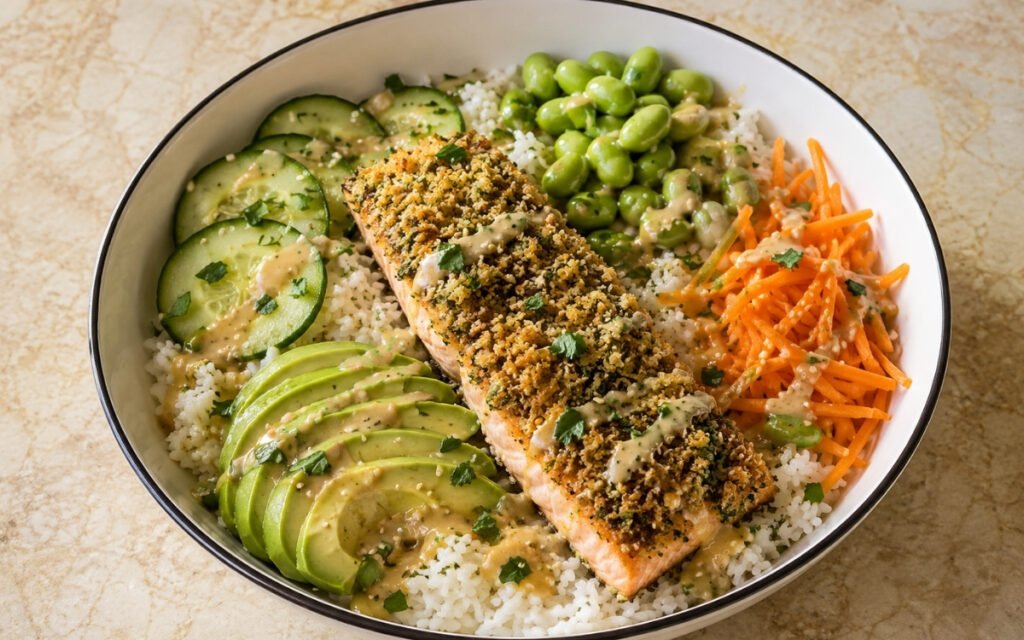
Herb-Crusted Salmon Rice Bowl
Salmon seared flesh-first, herb-panko crust pressed on post-flip — crispy skin and golden crust simultaneously, over jasmine rice with lemon-miso dressing. 40 minutes.
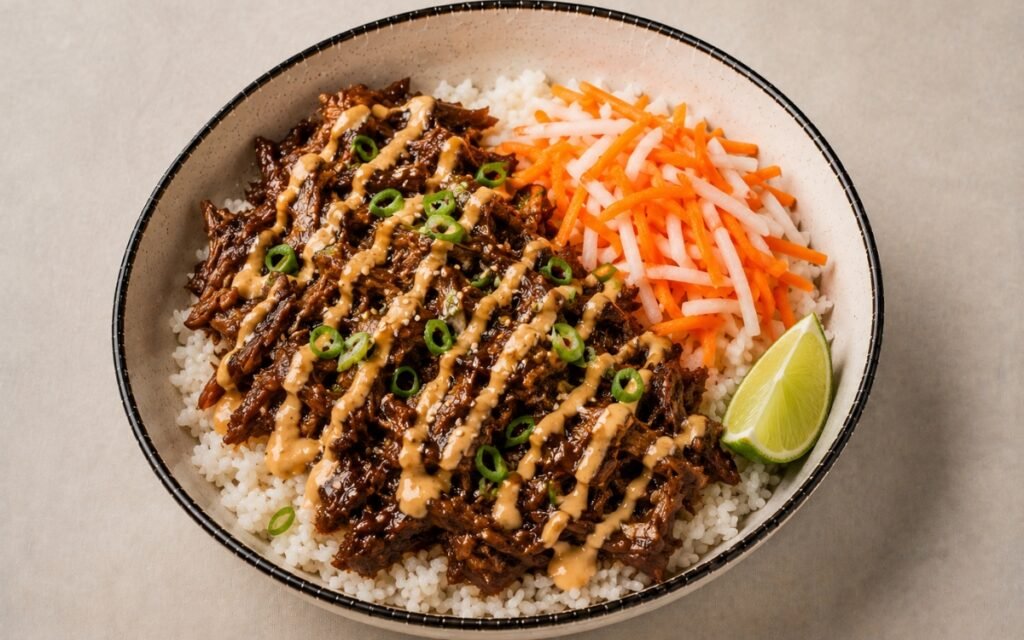
Asian Pulled Pork Rice Bowl
Pork shoulder braised 3 hours in soy-star anise-ginger, shredded, and tossed in its own reduced braising glaze — over jasmine rice with pickled vegetables and sriracha mayo.
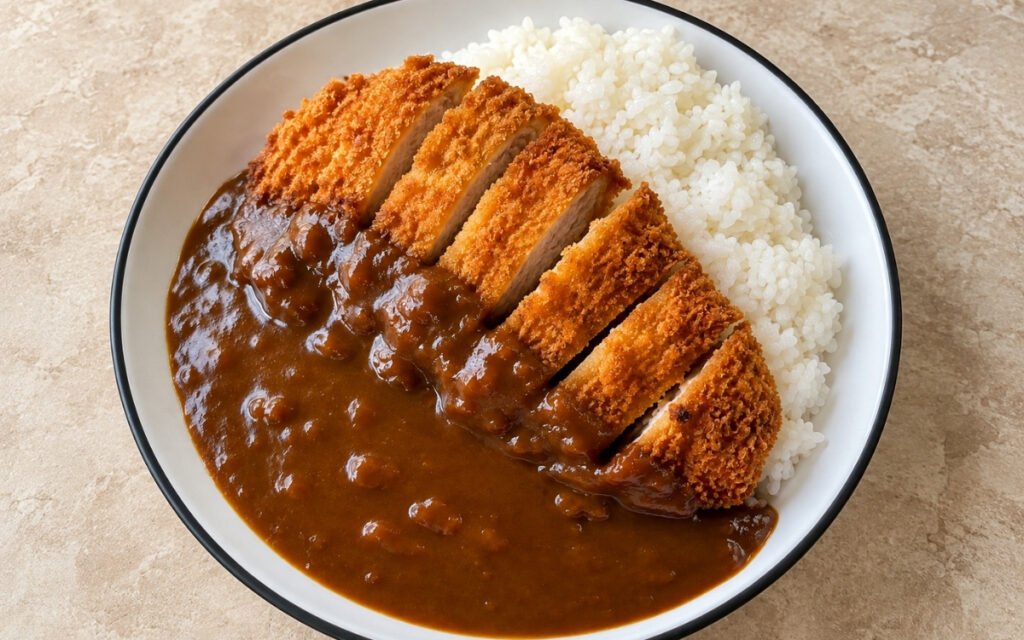
Katsu Curry — Japanese Pork Cutlet Curry
Crisp golden panko-breaded pork cutlets, fluffy white rice, and a thick glossy dark-brown curry sauce, savory-sweet and rich.
You might also like
You might also like
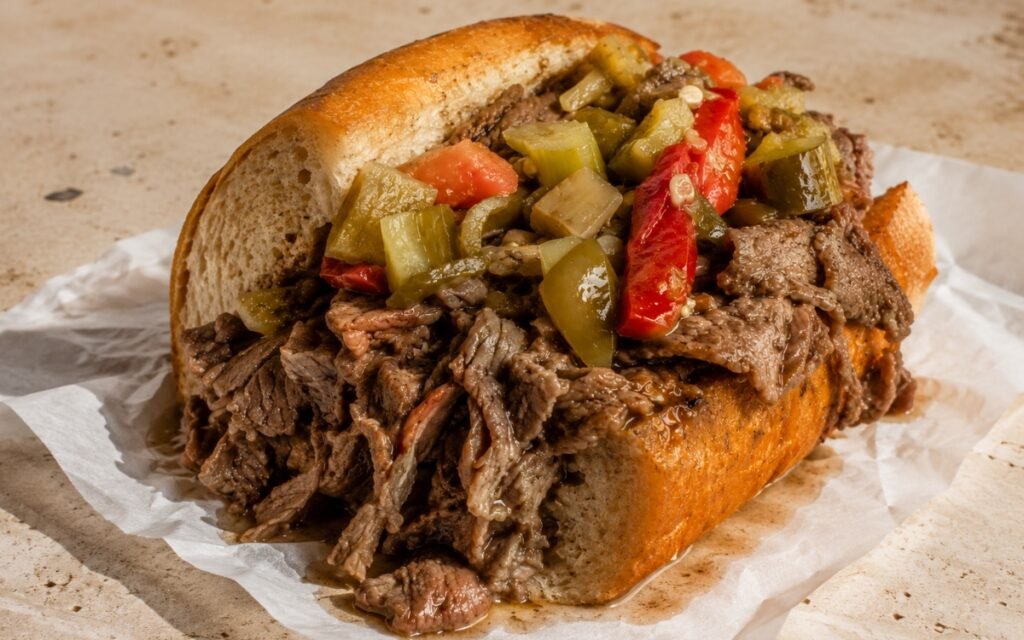
Italian Beef Sandwich
Thin-sliced roast beef warmed in a heavily seasoned au jus, piled into crusty homemade French rolls with sharp giardiniera and roasted peppers.
Sloppy Joe Sandwich
Well-seared 85/15 ground beef finished in a glossy, tangy tomato-based sauce, piled generously into soft toasted burger buns.
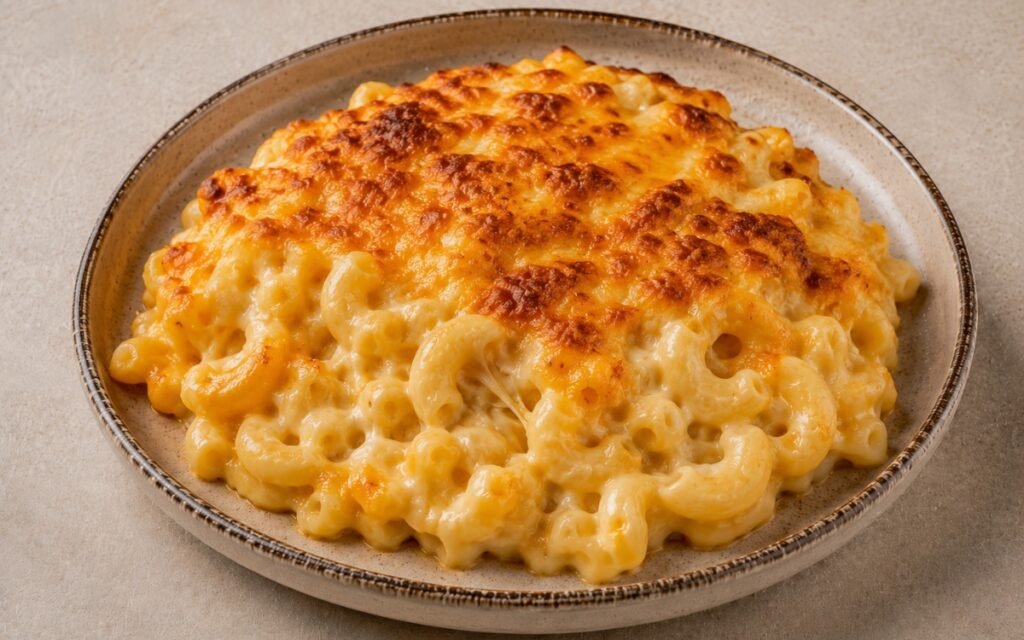
Baked Mac and Cheese
Cheddar, Gruyère, and mozzarella melted into a béchamel off the heat — layered with underdone macaroni, baked bubbling, broiled golden. Serves 12.

Hot Honey Salmon Rice Bowl
Ingredients
Method
- Rinse the 300g of jasmine rice under cold running water in a fine-mesh sieve, working the grains gently until the water running through them is completely clear. The rinsing removes the surface starch coating that, if left on, causes the grains to stick together and produces a gummy finished rice rather than the fluffy, individually distinct grains that make a good rice bowl base. Combine the rinsed rice with the 600ml of water and 3g of kosher salt in a medium saucepan. Bring to a full rolling boil over high heat, then immediately reduce to the lowest possible setting, cover tightly, and simmer for 15 minutes without lifting the lid. The trapped steam inside the covered pot is the active cooking medium — any escape disrupts the absorption ratio. After 15 minutes, remove from the heat and allow to stand covered for 5 minutes. This resting period lets the steam redistribute through the uppermost layers of rice and allows the bottom grains to firm slightly from the cooling pan — the result is evenly cooked, perfectly fluffy rice throughout. Remove the lid and fluff with a fork using a gentle lifting and separating motion.
- While the rice cooks, prepare the hot honey glaze. In a small bowl, whisk together the 90g of honey, 15g of gochugaru, 30ml of rice vinegar, and 2g of kosher salt until fully combined and uniform. The gochugaru — Korean coarse red pepper flakes made from sun-dried, deseeded chilies — provides a fundamentally different heat character from generic red pepper flakes or cayenne. Its heat is fruity, moderately spiced, and building rather than sharp or immediate, and its slight natural sweetness integrates with the honey rather than contrasting against it. The rice vinegar provides the acid counterpoint that prevents the glaze from tasting one-dimensionally sweet, and its brightness amplifies the gochugaru’s fruity character. At 15g the glaze is prominently spiced — the heat builds progressively through each glazed bite. Reduce to 8g for a milder result. The glaze is made in advance of the salmon step so it is ready to brush immediately when needed — the glazing window is the final minute of cooking and does not allow for concurrent preparation.
- In a small bowl, combine 30ml of rice vinegar — using the same vinegar as the glaze for flavour consistency — with the 10g of sugar and a pinch of salt. Stir until the sugar and salt have dissolved completely. Add the 80g of julienned carrots and toss to coat. Allow to sit for at least 10 minutes while the salmon cooks and the bowls are assembled. In 10 minutes the carrots will have absorbed the vinegar’s acidity and the sugar’s sweetness, softening very slightly at their surface while retaining their crisp interior — producing the specific texture and flavour of a quick pickle rather than either a raw carrot or a fully preserved one. The pickled carrots are the acid element that makes the bowl feel complete — their bright, slightly sweet sharpness cuts through the salmon glaze’s sweetness, the avocado’s richness, and the rice’s neutrality. The pickled carrots can be made up to 3 days ahead and refrigerated — they improve with additional pickling time.
- Pat all four salmon portions completely dry on both sides with paper towels — this is the non-negotiable preparation step for a proper sear. Surface moisture prevents the direct, dry-heat contact between the salmon’s surface proteins and the hot pan that produces the Maillard crust. Season both sides with the 4g of kosher salt and 2g of black pepper, pressing the seasoning gently into the surface. Heat the 15ml of toasted sesame oil in a large non-stick skillet over medium-high heat until shimmering. Toasted sesame oil is used specifically for its aromatic character — its nutty, slightly roasted fragrance infuses the salmon’s exterior during searing and provides a background sesame note that complements the Asian-inflected bowl composition. It has a moderate smoke point suitable for medium-high searing without burning. Add the salmon fillets flesh-side up — skin-side down first if the fillets have skin, but for these skinless portions, either side can go down first. Place them with space between each portion and leave completely undisturbed for 4–5 minutes. The sustained, uninterrupted contact with the hot sesame oil and pan surface develops the golden, caramelised crust that contributes the textural contrast and Maillard depth that makes seared salmon specifically more satisfying than baked.
- After 4–5 minutes, carefully flip each salmon fillet using a thin spatula. Cook on the second side for 3–4 minutes. In the final minute of cooking — when the salmon has nearly reached 52°C internal temperature and is just barely translucent at the very centre — brush the top surface of each fillet generously with the hot honey glaze. The timing of the glaze application is deliberate: the honey’s sugars caramelise rapidly against the heat radiating from the salmon and any residual pan heat around it, developing a light, slightly sticky, glistening glaze rather than a raw honey coating. Applied too early the glaze burns; applied at the very end without any cooking it remains raw and coats without caramelising. The final minute is the specific window where the heat is sufficient to develop the glaze’s character without burning it. At 52°C the salmon will be slightly translucent at the centre with firm, opaque outer flesh — the residual heat will finish the centre to a moist, perfectly cooked result on the plate. For a fully cooked-through result, cook to 57°C before glazing.
- Divide the fluffed jasmine rice among four wide bowls, spreading it across the base. Arrange the toppings around the bowl — fan the cucumber slices across one section, fan the avocado slices across another, arrange the edamame in a concentrated area, and place the drained pickled carrots alongside. The visual arrangement of distinct components in dedicated sections of the bowl produces both a more attractive presentation and the practical benefit of each component remaining distinct rather than mixing prematurely. Place one glazed salmon fillet in the centre of each assembled bowl. Drizzle the 15ml of soy sauce evenly over each bowl — spreading it across the salmon and the rice, not only the salmon. The soy sauce at serving adds the savoury umami depth that the hot honey glaze’s sweetness specifically needs as a counterpoint. Add a small additional drizzle of the remaining hot honey glaze if desired — the extra drizzle amplifies the sweet-spiced character for those who want more heat. Scatter the toasted sesame seeds and sliced scallions over each bowl. Serve immediately.