
Everything Bagels
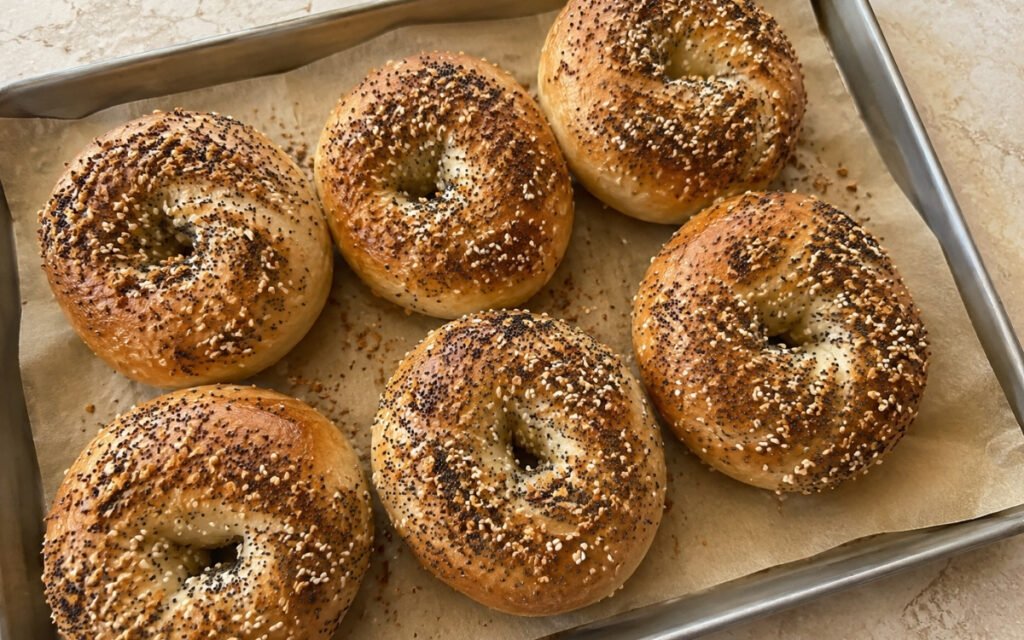
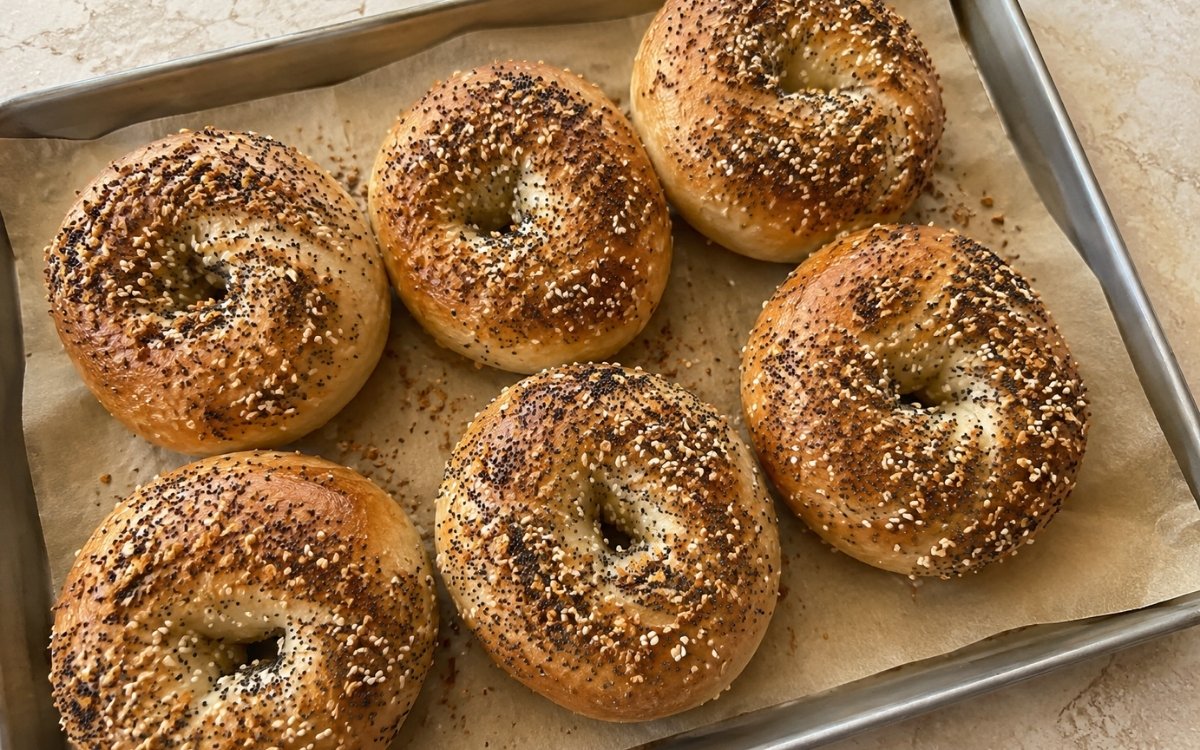
Chewy, dense, deeply golden bagels made the proper way — barley malt syrup in the dough for authentic flavour, overnight cold proof for complexity and structure, and a boiling bath before baking that produces the glossy, tight crust that separates a real bagel from bread shaped like a ring. The everything seasoning coating is the classic — sesame, poppy, onion, garlic — but the dough is universal. Skip the topping for plain bagels. Use only poppy seeds for the poppy version. The method is identical whatever you put on top.
Prep Time : 30 min
Cook Time : 20 min
Servings : 8
30 min
20 min
8
Ingredients
For the Dough
• 360ml water, heated to 32°C (90°F)
• 1 tsp active dry yeast
• 2 tsp barley malt syrup — this one on Amazon
• 600g bread flour — this one on Amazon
• 16g fine sea salt, about 1 tbsp
• Fine cornmeal or semolina, for dusting the tray
• Cooking spray, for multiple stages
For the Boiling Bath
• 3–3.5L water
• 1 tbsp barley malt syrup
• Large pinch of sea salt
For the Everything Bagel Seasoning (60–80g total, or use store-bought)
• 3 tbsp white sesame seeds — this one on Amazon
• 3 tbsp poppy seeds — this one on Amazon
• 1 tbsp dried onion flakes
• 1 tsp dried garlic flakes
• 1 tbsp flaky salt, optional for extra-salty bagels
Variations on Topping
• Everything bagels: full seasoning blend as above
• Poppy seed bagels: poppy seeds only
• Plain bagels: no topping
This post may contain affiliate links. As an Amazon Associate I earn from qualifying purchases, at no additional cost to you.
Directions
- Activate the Yeast and Mix the Dough
In a medium bowl, combine the water heated to 32°C with the active dry yeast and barley malt syrup. Whisk until both are fully dissolved — the barley malt syrup is viscous and takes 20–30 seconds of whisking to fully incorporate into the water. Allow to stand for 5 minutes. The barley malt syrup is not a dispensable ingredient and has no adequate substitute in bagel making. Made from sprouted barley grain, it contains maltose and diastatic enzymes that feed the yeast during fermentation, contribute a distinctive malt flavour to the finished bagel’s crumb and crust, and participate in the Maillard browning reaction during baking to produce the deep golden-brown exterior characteristic of authentic bagels. Without it, the dough ferments less actively, the flavour is noticeably flatter, and the crust browns less richly. In a separate large bowl, whisk the bread flour and salt together until combined. Bread flour rather than all-purpose flour is specified because its higher protein content — typically 12–14% compared to all-purpose’s 10–12% — produces more gluten when hydrated and kneaded. This stronger gluten network is what gives bagels their characteristic dense, chewy bite rather than the soft, open crumb of standard bread. Pour the yeast-water mixture into the flour-salt mixture and begin mixing with your hand, working from the edges toward the centre, until no dry flour remains and a rough, shaggy dough has formed. If the dough is too dry to come together as a cohesive mass, add water one tablespoon at a time, kneading briefly between additions until the dough is uniform. - Knead to the Windowpane
Turn the dough out onto a clean, unfloured counter — bagel dough is relatively stiff and does not require flouring at this stage, and a lightly tacky surface-to-counter friction actually assists the kneading process. Knead by pushing the dough away from you with the heel of your hand, folding it back over itself, rotating a quarter turn, and repeating. Work continuously for 5 minutes. The dough will become progressively smoother, more elastic, and less sticky as the gluten network develops. Assess the gluten development using the windowpane test: pinch a small piece of dough between your fingers, stretch it slowly and steadily outward, and hold it up to a light source. If the dough stretches thin enough to be translucent — allowing light to pass through without the dough tearing — the gluten network is fully developed and kneading is complete. If the dough tears before reaching translucency, continue kneading for another 2 minutes and test again. The windowpane test is not ceremonial — it is a diagnostic tool that tells you precisely whether the gluten development is sufficient to produce a chewy bagel rather than a dense, compact one. This entire process can be done in a stand mixer with a dough hook at medium speed for 8–10 minutes if preferred. - First Rest
Shape the kneaded dough into a smooth ball and transfer to a large bowl lightly greased with cooking spray. Turn the dough once in the bowl to coat all surfaces in a thin film of oil, which prevents the surface from drying out during the rest. Cover tightly with plastic wrap and allow to rest at room temperature for 30–45 minutes. The dough does not need to double in size during this rest — bagel dough is stiffer than standard bread dough and rises less dramatically. What the rest accomplishes is allowing the yeast to begin its fermentation activity and the gluten to relax slightly from the vigorous kneading, making the dough easier to divide and shape without it springing back aggressively. - Divide and Shape
Weigh the rested dough and divide by 8 — note the per-piece weight and cut accordingly, using a kitchen scale to confirm each piece is equal. Uniform weight produces bagels that cook evenly in the boiling bath and bake at the same rate. Unequal pieces produce some undercooked and some over-baked bagels in the same batch. Spray a large baking sheet with cooking spray and dust evenly with a thin, uniform layer of fine cornmeal or semolina — this prevents the bagels from sticking to the tray during the proof and produces the characteristic slightly gritty bottom crust of an authentic bagel. There are two shaping methods that produce equally valid results. The log-and-coil method: roll each dough piece on the counter into an even 8-inch log, applying consistent pressure throughout. Flatten one end with a rolling pin until it is slightly wider. Bring the opposite end around and lay it on top of the flattened end. Pull the edges of the flattened section up and around the non-flattened end to fully enclose it, then press and pinch the seam firmly until completely sealed. The ball-and-punch method: shape each piece into a tight, smooth ball by rolling on the counter with cupped hands in a circular motion, applying slight downward pressure. Cover the balls with a damp towel and rest for 10–15 minutes to allow the gluten to relax — without this rest the balls resist stretching and tear rather than opening smoothly. Press your thumb through the centre of each ball from one side and your index finger through from the other, meeting in the middle to create an opening, then gently stretch the hole by rotating the bagel ring with both hands, widening the opening evenly until it is approximately 1.5–2 inches in diameter. - Cold Proof Overnight
Place the shaped bagels on the prepared cornmeal-dusted tray with 5–6cm of space between each one. Spray the tops lightly with cooking spray — this prevents the plastic wrap covering from adhering to the bagels as they expand. Cover the tray as tightly as possible with greased plastic wrap, pressing it around the edges of the tray to create a near-airtight seal without pressing down onto the bagels themselves. Leave the covered tray at room temperature for 5–10 minutes before refrigerating — this brief room-temperature exposure allows the yeast to activate slightly before the cold environment slows its activity, which helps initiate the fermentation process that continues slowly overnight in the refrigerator. Refrigerate for 8–12 hours, ideally overnight. The slow, cold fermentation is the single most flavour-developing step in the entire recipe. Rapid room-temperature fermentation produces bagels with a one-dimensional, simple yeast flavour. Overnight cold fermentation produces complex flavour compounds — organic acids, esters, and other fermentation byproducts — that give the finished bagel a depth and subtlety that immediately distinguishes it from anything commercially produced. - Boil the Bagels
When ready to bake, preheat the oven to 230°C (450°F) and line two baking sheets with parchment paper sprayed with cooking spray. If using a pizza stone, place it in the oven while preheating. In a large, wide pot, combine the boiling bath water with the barley malt syrup and a generous pinch of salt. Bring to a full boil over medium-high heat. Remove the bagels from the refrigerator and remove the plastic wrap. The boiling step is the defining technique that separates bagels from all other bread. When the bagel’s surface contacts boiling water, the outer starch layer gelatinises almost instantly — the water molecules penetrate the outermost starch granules and cause them to absorb water and swell, forming a dense, continuous, semi-rigid shell around the bagel’s exterior before it enters the oven. This gelatinised exterior is what produces the tight, glossy, chewy crust rather than the open, soft crust of standard oven-baked bread. Gently lower the bagels into the boiling water top-side down, working in batches of 2–3 to avoid crowding. Boil for exactly 30 seconds, then flip with a slotted spoon or spider strainer and boil for another 30 seconds on the second side. 30 seconds per side is the calibrated time for the correct crust density — longer produces an increasingly thick, tough crust; shorter produces a thinner, less definitive crust. - Season and Bake
Using a slotted spoon or spider strainer, lift each boiled bagel from the water and hold it briefly over the pot to allow excess water to drip away, then transfer to the prepared lined baking sheets. Work quickly for the seasoning application — the window for the topping to adhere is narrow. The wet, gelatinised surface of a freshly boiled bagel is intensely sticky and provides excellent adhesion for any topping. As the surface cools and dries, this adhesion decreases rapidly. Immediately after transferring each bagel, apply the topping: for everything bagels, scatter the combined seasoning blend generously and evenly over the top surface, pressing very gently to ensure contact. For poppy seed bagels, cover the top surface with a uniform, generous layer of poppy seeds. For plain bagels, proceed directly to baking without any topping. If making a mixed batch of all three types, plan the order before beginning — season the everything bagels first, then poppy, then plain, working quickly through each boiled batch. Bake for 15–18 minutes until the exterior is a deep, rich golden-brown — not pale gold but a genuine, dark amber. The deep colour indicates that the Maillard reaction has run its full course and the complex flavour compounds associated with it have developed completely. Transfer to a wire rack and allow to cool completely before cutting — cutting a hot bagel traps steam in the crumb and produces a gummy, compressed interior.
*Notes :
- The everything bagel seasoning blend is one of the most widely-used condiment preparations in American deli culture, credited to various New York bagel bakers of the 1970s and 1980s though its precise origin is disputed. Its four-component combination — sesame, poppy, dried onion, dried garlic — produces a flavour profile specifically designed for the bagel’s dense, malty crumb: the sesame and poppy seeds provide nutty, slightly bitter toastiness; the dried onion provides sweet, caramelised allium depth when toasted in the oven; and the dried garlic provides pungent, savory background. When all four are toasted on the bagel’s exterior at 230°C for 15–18 minutes, they develop flavour compounds that raw versions of the same ingredients cannot produce, and the combination of all four simultaneously creates a flavour greater than any single one alone.
- Bread flour is not interchangeable with all-purpose flour in this recipe without affecting the final texture. The higher protein content of bread flour is the source of the chewiness that defines bagel texture. Bakers who find their homemade bagels soft rather than chewy have almost always used all-purpose flour. If bread flour is unavailable, adding 10g of vital wheat gluten per 100g of all-purpose flour approximates bread flour’s protein content.
- The characteristic hole in the centre of a bagel is not merely decorative — it was originally a practical feature that allowed bagels to be threaded onto a dowel or string for transportation and display. The hole also ensures even cooking: without it, the dense dough would take considerably longer to cook through completely and the exterior would over-bake before the interior set.
Why This Recipe Works
This recipe works because it applies the three techniques that distinguish an authentic bagel from bread-in-a-ring-shape: barley malt syrup in the dough for genuine malt flavour and active yeast feeding; overnight cold proofing for the flavour complexity that rapid fermentation cannot produce; and a boiling bath with barley malt syrup that gelatinises the surface starch into the dense, glossy crust that is the bagel’s defining physical characteristic. Every step serves the same goal — a bagel with the chewy, dense, flavourful character of a proper New York deli bagel rather than the soft, bready result of shortcuts.
Ingredient Breakdown
Bread Flour
Higher protein content produces the strong gluten network responsible for bagels’ characteristic dense, chewy bite — cannot be replaced with all-purpose flour without texture compromise.
Barley Malt Syrup (Dough)
Feeds the yeast, contributes malt flavour to the crumb, and participates in the Maillard reaction that produces the deep golden crust. The ingredient that most distinguishes authentic bagels from approximations.
Barley Malt Syrup (Boiling Water)
Contributes to the starch gelatinisation of the outer crust and adds a faint malt character to the exterior.
Overnight Cold Proof
The flavour-development stage — slow fermentation produces complex organic acids and aromatic compounds that rapid fermentation cannot generate.
Boiling Bath
The crust-forming step — gelatinises surface starch into the tight, glossy, chewy exterior shell that defines bagel crust.
Cornmeal or Semolina Dusting
The bottom-of-bagel texture — a slight grainy quality on the base that is characteristic of authentic bakery bagels.
Everything Seasoning
The four-component topping that toasts during baking into a complex, savory, deeply aromatic crust coating — the defining flavour of the everything bagel.
Flavor Structure Explained
This bagels follow a layered balance model:
- Dense wheaty base (bagel crumb)
- Caramelized crust (Maillard exterior)
- Malt sweetness (dough)
- Toasted seasoning layer (everything mix)
- Fermented depth (cold proofing)
The crumb establishes the foundation with dense, chewy texture and a subtly sweet, wheaty flavor developed through fermentation. The crust delivers the second layer — deeply caramelised, slightly bitter, and malt-forward from high-heat baking. Malt runs through both layers, reinforcing sweetness and depth. On an everything bagel, the seasoning creates an additional top layer, with toasted sesame, poppy, onion, and garlic adding nutty, sweet, and pungent complexity. The result is a multi-register structure where interior, crust, and topping combine into a single, fully developed flavor experience.
Common Mistakes to Avoid
- Under-kneading – Insufficient gluten development produces bagels that are dense rather than chewy — a different texture from the desired result. Always test with the windowpane before ending the kneading phase.
- Skipping the Barley Malt Syrup – Honey or sugar are commonly suggested substitutes. Neither produces the same result — barley malt syrup’s enzymatic and flavour-chemical properties are specific to its malt origin. Source it properly.
- Skipping or Shortening the Cold Proof – Room-temperature proofing for a few hours produces noticeably flatter, less complex flavour. The overnight cold proof is the most important step for flavour quality.
- Boiling Too Long – More than 30 seconds per side produces an increasingly thick, tough, gummy crust that overtakes the bagel’s chewiness and becomes unpleasant. Time precisely.
- Applying the Seasoning Late – The adhesion window is very brief — the gelatinised wet surface cools and loses stickiness within minutes. Season immediately after removing from the water.
- Cutting While Hot – Steam trapped in the crumb produces a gummy, compressed interior. Cool completely on a wire rack before cutting.
Variations
Plain Bagels
Make the identical dough and follow every step through boiling. Apply no topping. The plain bagel reveals the malt and overnight fermentation flavour of the dough without any topping complexity — the most honest expression of a properly made bagel.
Poppy Seed Bagels
Apply a generous, uniform layer of poppy seeds immediately after boiling. Their slightly bitter, nutty character and satisfying crunch on the crust produce a cleaner, less complex topping than the everything blend — the classic bagel pairing for smoked salmon and cream cheese.
Sesame Bagels
Apply white or black sesame seeds generously. Toasted sesame’s nutty, slightly sweet character is one of the most versatile bagel toppings and pairs naturally with both sweet and savory applications.
Cinnamon Raisin Bagels
Add 10g ground cinnamon and 15g sugar to the flour-salt mixture before mixing, and fold 120g of plump raisins into the dough after kneading. No boiling bath additions required. Bake plain with no topping.
Storage & Make-Ahead
Bagels are at their absolute best within the first 6 hours after baking, when the crust has its maximum crunch and the crumb has its ideal chewiness. A freshly baked bagel is noticeably better than any stored version.
For short-term storage, keep bagels in an airtight container or sealed plastic bag at room temperature for up to 4 to 5 days. The crust will soften within 24 hours as moisture from the crumb moves outward, which is normal and unavoidable. Toasting will help bring back some of the crunch.
Bagels also freeze exceptionally well for up to 3 months. For convenience, slice them before freezing, since frozen sliced bagels can go straight from the freezer into the toaster without thawing.
If you want to prepare them ahead, the shaped but unboiled bagels can be refrigerated for up to 24 hours before boiling and baking. Extending the cold proof beyond the overnight minimum will deepen the fermentation flavor even further. When ready, boil and bake them straight from the refrigerator.
Frequently Asked Questions
What is barley malt syrup and where do I find it?
A thick, dark syrup made from sprouted barley grain, with a strong, distinctly malty, slightly bitter-sweet flavour. Available at health food stores, specialty grocery stores, and online. It is not interchangeable with molasses, honey, or regular sugar for authentic bagel production — its enzymatic properties and flavour profile are specific. Source it properly for genuine results.
Why do my bagels not have the right chewy texture?
The most common cause is all-purpose flour rather than bread flour — the lower protein content produces insufficient gluten for bagel chewiness. The second most common cause is under-kneading. Use bread flour, knead to the windowpane test, and the texture will be correct.
Can I proof at room temperature instead of overnight in the refrigerator?
Yes — proof at room temperature for 3–4 hours instead. The bagels will bake successfully but the flavour will be noticeably less complex. The overnight cold proof develops organic acids and aromatic fermentation compounds that room-temperature proofing in a few hours cannot generate.
Why does my seasoning fall off after baking?
The seasoning must be applied immediately after the bagels come out of the boiling water while the surface is still wet and maximally sticky. If the surface has dried at all before seasoning is applied, the adhesion is insufficient and the topping falls off during handling. Work quickly.
Can I make sesame seeds, poppy seeds, and everything bagels from the same batch?
Yes — divide the batch and apply different toppings to different bagels immediately after boiling. Plan the application order before you begin: have all the different seasonings ready in separate shallow bowls for quick, efficient dipping or sprinkling before the surface adhesion window closes.
Nutrition Facts
( per everything bagel )
Calories
~320 kcal
Protein
11 g
Fat
4 g
Carbs
60 g
Calories
~320 kcal
Protein
11 g
Fat
4 g
Carbs
60 g
Related Recipes
Related Recipes

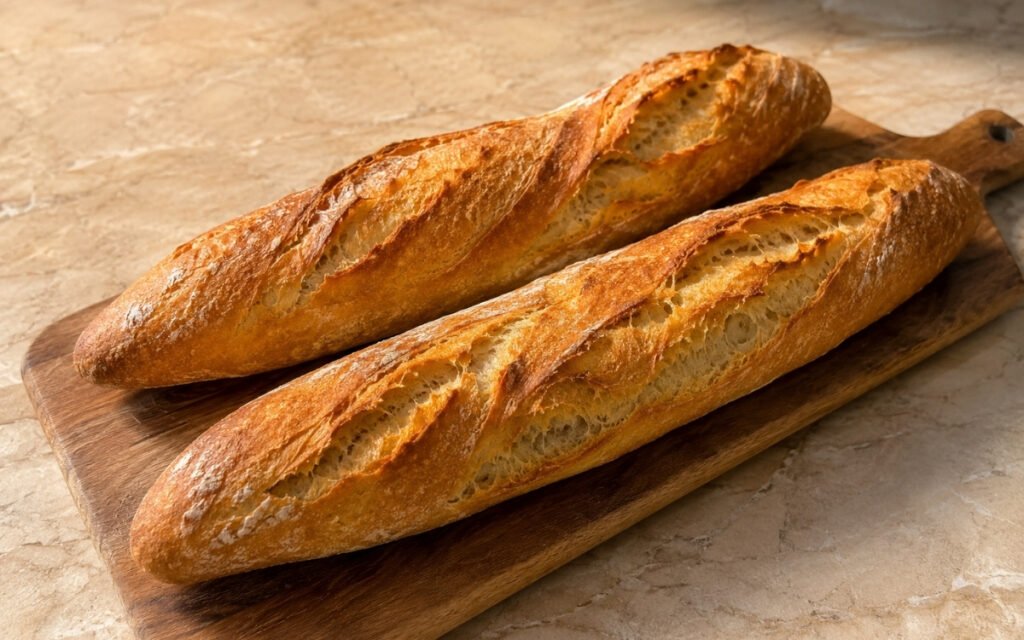
Classic French Baguette
Overnight poolish, proper scoring, and steam baking — a classic French baguette with crackling crust and complex flavour made properly at home.
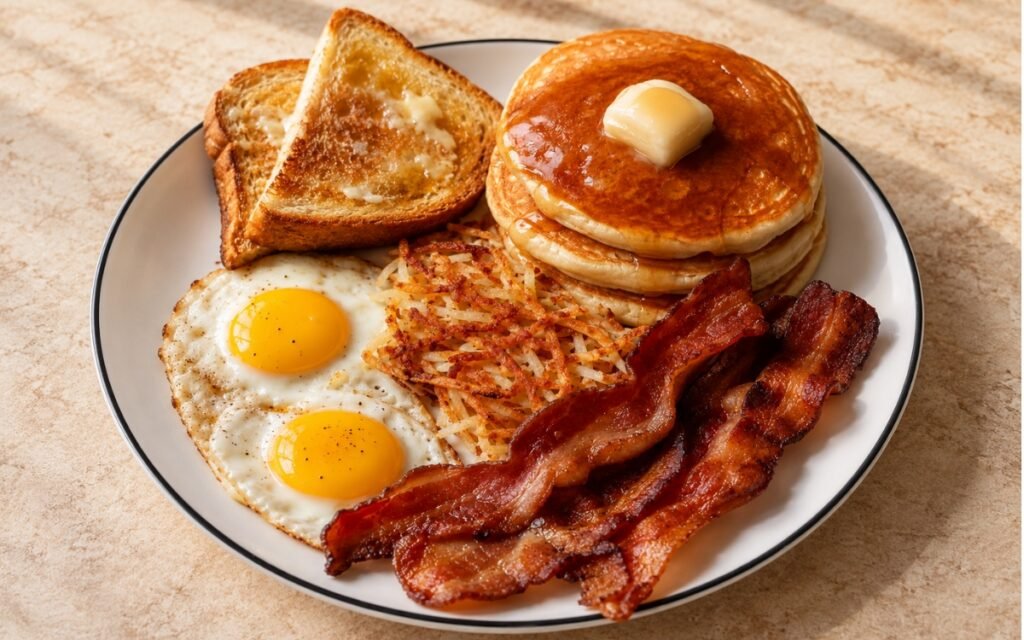
Classic American Breakfast Plate
Sunny-side-up eggs, crispy bacon, golden hash browns, buttered toast, and a small stack of fluffy buttermilk pancakes with maple syrup.
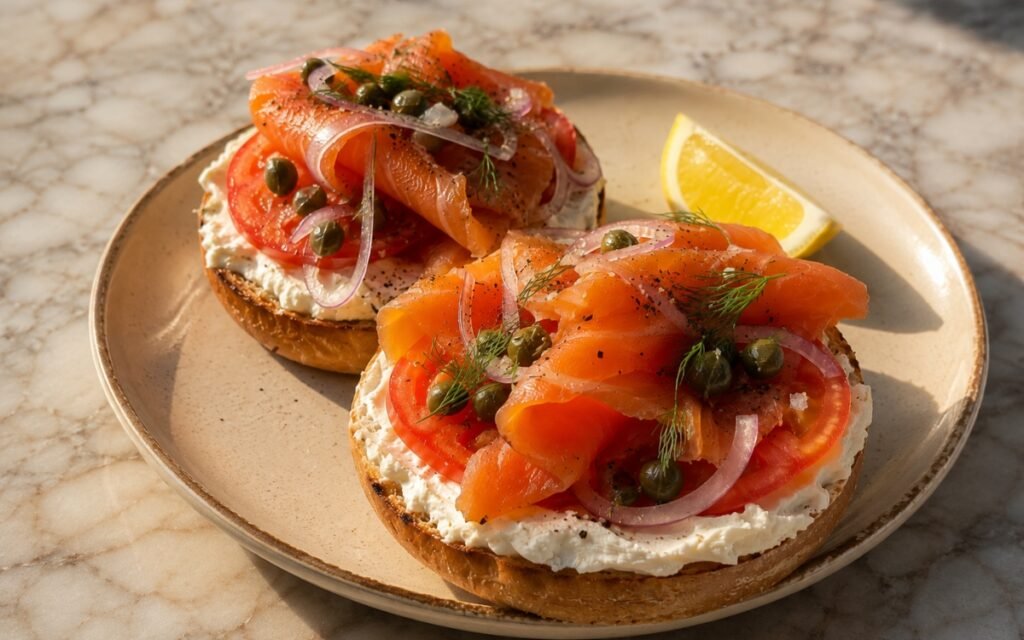
Lox and Cream Cheese Bagel
Nova lox, whipped cream cheese on both halves, salted tomato, paper-thin red onion, fresh dill, capers, and lemon on a toasted bagel — the New York classic in 10 minutes.
You might also like
You might also like
Easy Breakfast Shakshuka
Bell pepper and onion in butter, spices dry-toasted on the bare pan, crushed tomatoes simmered thick — six eggs baked at 190°C with feta and cilantro. Under 30 minutes, eaten from the skillet.
Challah Bread
Oil-and-egg enriched dough kneaded 10–12 minutes for braid structure — three strands braided at even tension, thoroughly egg-washed into every crevice, and baked to a deep amber. Soft, golden, slightly chewy.
Classic Belgian Waffles with Berries
Thick Belgian-style waffles with crisp golden edges, fluffy interiors, deep square pockets, fresh berries, melting butter, and maple syrup.

Everything Bagels
Ingredients
Method
- In a medium bowl, combine the water heated to 32°C with the active dry yeast and barley malt syrup. Whisk until both are fully dissolved — the barley malt syrup is viscous and takes 20–30 seconds of whisking to fully incorporate into the water. Allow to stand for 5 minutes. The barley malt syrup is not a dispensable ingredient and has no adequate substitute in bagel making. Made from sprouted barley grain, it contains maltose and diastatic enzymes that feed the yeast during fermentation, contribute a distinctive malt flavour to the finished bagel’s crumb and crust, and participate in the Maillard browning reaction during baking to produce the deep golden-brown exterior characteristic of authentic bagels. Without it, the dough ferments less actively, the flavour is noticeably flatter, and the crust browns less richly. In a separate large bowl, whisk the bread flour and salt together until combined. Bread flour rather than all-purpose flour is specified because its higher protein content — typically 12–14% compared to all-purpose’s 10–12% — produces more gluten when hydrated and kneaded. This stronger gluten network is what gives bagels their characteristic dense, chewy bite rather than the soft, open crumb of standard bread. Pour the yeast-water mixture into the flour-salt mixture and begin mixing with your hand, working from the edges toward the centre, until no dry flour remains and a rough, shaggy dough has formed. If the dough is too dry to come together as a cohesive mass, add water one tablespoon at a time, kneading briefly between additions until the dough is uniform.
- Turn the dough out onto a clean, unfloured counter — bagel dough is relatively stiff and does not require flouring at this stage, and a lightly tacky surface-to-counter friction actually assists the kneading process. Knead by pushing the dough away from you with the heel of your hand, folding it back over itself, rotating a quarter turn, and repeating. Work continuously for 5 minutes. The dough will become progressively smoother, more elastic, and less sticky as the gluten network develops. Assess the gluten development using the windowpane test: pinch a small piece of dough between your fingers, stretch it slowly and steadily outward, and hold it up to a light source. If the dough stretches thin enough to be translucent — allowing light to pass through without the dough tearing — the gluten network is fully developed and kneading is complete. If the dough tears before reaching translucency, continue kneading for another 2 minutes and test again. The windowpane test is not ceremonial — it is a diagnostic tool that tells you precisely whether the gluten development is sufficient to produce a chewy bagel rather than a dense, compact one. This entire process can be done in a stand mixer with a dough hook at medium speed for 8–10 minutes if preferred.
- Shape the kneaded dough into a smooth ball and transfer to a large bowl lightly greased with cooking spray. Turn the dough once in the bowl to coat all surfaces in a thin film of oil, which prevents the surface from drying out during the rest. Cover tightly with plastic wrap and allow to rest at room temperature for 30–45 minutes. The dough does not need to double in size during this rest — bagel dough is stiffer than standard bread dough and rises less dramatically. What the rest accomplishes is allowing the yeast to begin its fermentation activity and the gluten to relax slightly from the vigorous kneading, making the dough easier to divide and shape without it springing back aggressively.
- Weigh the rested dough and divide by 8 — note the per-piece weight and cut accordingly, using a kitchen scale to confirm each piece is equal. Uniform weight produces bagels that cook evenly in the boiling bath and bake at the same rate. Unequal pieces produce some undercooked and some over-baked bagels in the same batch. Spray a large baking sheet with cooking spray and dust evenly with a thin, uniform layer of fine cornmeal or semolina — this prevents the bagels from sticking to the tray during the proof and produces the characteristic slightly gritty bottom crust of an authentic bagel. There are two shaping methods that produce equally valid results. The log-and-coil method: roll each dough piece on the counter into an even 8-inch log, applying consistent pressure throughout. Flatten one end with a rolling pin until it is slightly wider. Bring the opposite end around and lay it on top of the flattened end. Pull the edges of the flattened section up and around the non-flattened end to fully enclose it, then press and pinch the seam firmly until completely sealed. The ball-and-punch method: shape each piece into a tight, smooth ball by rolling on the counter with cupped hands in a circular motion, applying slight downward pressure. Cover the balls with a damp towel and rest for 10–15 minutes to allow the gluten to relax — without this rest the balls resist stretching and tear rather than opening smoothly. Press your thumb through the centre of each ball from one side and your index finger through from the other, meeting in the middle to create an opening, then gently stretch the hole by rotating the bagel ring with both hands, widening the opening evenly until it is approximately 1.5–2 inches in diameter.
- Place the shaped bagels on the prepared cornmeal-dusted tray with 5–6cm of space between each one. Spray the tops lightly with cooking spray — this prevents the plastic wrap covering from adhering to the bagels as they expand. Cover the tray as tightly as possible with greased plastic wrap, pressing it around the edges of the tray to create a near-airtight seal without pressing down onto the bagels themselves. Leave the covered tray at room temperature for 5–10 minutes before refrigerating — this brief room-temperature exposure allows the yeast to activate slightly before the cold environment slows its activity, which helps initiate the fermentation process that continues slowly overnight in the refrigerator. Refrigerate for 8–12 hours, ideally overnight. The slow, cold fermentation is the single most flavour-developing step in the entire recipe. Rapid room-temperature fermentation produces bagels with a one-dimensional, simple yeast flavour. Overnight cold fermentation produces complex flavour compounds — organic acids, esters, and other fermentation byproducts — that give the finished bagel a depth and subtlety that immediately distinguishes it from anything commercially produced.
- When ready to bake, preheat the oven to 230°C (450°F) and line two baking sheets with parchment paper sprayed with cooking spray. If using a pizza stone, place it in the oven while preheating. In a large, wide pot, combine the boiling bath water with the barley malt syrup and a generous pinch of salt. Bring to a full boil over medium-high heat. Remove the bagels from the refrigerator and remove the plastic wrap. The boiling step is the defining technique that separates bagels from all other bread. When the bagel’s surface contacts boiling water, the outer starch layer gelatinises almost instantly — the water molecules penetrate the outermost starch granules and cause them to absorb water and swell, forming a dense, continuous, semi-rigid shell around the bagel’s exterior before it enters the oven. This gelatinised exterior is what produces the tight, glossy, chewy crust rather than the open, soft crust of standard oven-baked bread. Gently lower the bagels into the boiling water top-side down, working in batches of 2–3 to avoid crowding. Boil for exactly 30 seconds, then flip with a slotted spoon or spider strainer and boil for another 30 seconds on the second side. 30 seconds per side is the calibrated time for the correct crust density — longer produces an increasingly thick, tough crust; shorter produces a thinner, less definitive crust.
- Using a slotted spoon or spider strainer, lift each boiled bagel from the water and hold it briefly over the pot to allow excess water to drip away, then transfer to the prepared lined baking sheets. Work quickly for the seasoning application — the window for the topping to adhere is narrow. The wet, gelatinised surface of a freshly boiled bagel is intensely sticky and provides excellent adhesion for any topping. As the surface cools and dries, this adhesion decreases rapidly. Immediately after transferring each bagel, apply the topping: for everything bagels, scatter the combined seasoning blend generously and evenly over the top surface, pressing very gently to ensure contact. For poppy seed bagels, cover the top surface with a uniform, generous layer of poppy seeds. For plain bagels, proceed directly to baking without any topping. If making a mixed batch of all three types, plan the order before beginning — season the everything bagels first, then poppy, then plain, working quickly through each boiled batch. Bake for 15–18 minutes until the exterior is a deep, rich golden-brown — not pale gold but a genuine, dark amber. The deep colour indicates that the Maillard reaction has run its full course and the complex flavour compounds associated with it have developed completely. Transfer to a wire rack and allow to cool completely before cutting — cutting a hot bagel traps steam in the crumb and produces a gummy, compressed interior.