Ingredients
Method
Prepare the Sauce and Noodles
- Before the wok is turned on, have every component ready — yaki udon moves too fast for concurrent preparation once the heat is on. In a small bowl, whisk together the 60ml of soy sauce, 45ml of mirin, 30ml of sake, and 15ml of oyster sauce until completely combined. Set beside the wok. The sauce's four components each contribute a distinct dimension: soy provides the primary salt and deep savoury umami that coats every noodle; mirin provides sweetness and the characteristic Japanese glaze that caramelises slightly on the noodle surface during the final toss; sake provides aromatic, subtle fermented grain depth and a mild acidity that prevents the sauce from tasting flat; oyster sauce adds a secondary, more concentrated savoury-sweet umami depth and a slight thickness that helps the sauce adhere. Together they produce the specific sweet-savoury-umami balance that defines Japanese stir-fried noodle sauces. If using shelf-stable vacuum-packed udon noodles — the most common format outside Japan — blanch them in boiling water for exactly 1 minute, then drain and rinse under cold water. Separate the noodles gently with your fingers, working them apart completely — fresh udon's surface starch causes strands to stick together and any clumps that enter the wok will not separate during cooking, producing uneven sauce distribution. If the noodles are sold in a fresh or pre-cooked format that requires no blanching, simply loosen them at room temperature.
Sear the Pork Belly
- Heat the large wok or 14-inch skillet over the absolute highest heat your burner produces for a full 2–3 minutes until the wok is smoking. The wok must reach genuinely smoking-hot temperature before the first ingredient is added — this is the prerequisite for wok hei, the slight smoky caramelised character of high-heat wok cooking that sets restaurant stir-fry apart from home cooking. Add 15ml of vegetable oil and swirl to coat the wok surface completely. Add the thinly sliced pork belly in a single layer — work in two batches if needed to ensure space between slices. Leave completely undisturbed for 2 minutes. The undisturbed contact with the smoking-hot wok surface caramelises the pork's natural sugars and rendered fat simultaneously, producing the deep golden-brown crust that is both a flavour contribution and a textural element — the rendered fat also leaves a pork-enriched cooking medium in the wok for the subsequent vegetable and noodle stages. Flip each slice and cook the second side for 90 seconds. Transfer to a plate. The pork does not need to be cooked entirely through at this stage — it will return to the wok for the final toss and finish there.
Cook the Aromatics and Mushrooms
- Add 15ml of fresh oil to the still-smoking wok. Add the grated ginger and minced garlic simultaneously. Stir-fry for exactly 15 seconds, moving continuously — at the wok's temperature, garlic and ginger move from raw to fragrant to burnt in under 30 seconds. The 15-second window produces the correct transition: the sharp, pungent raw character of both aromatics is converted to a sweeter, more complex fragrance by the brief high-heat contact without burning. Immediately add the 200g of sliced shiitake mushrooms without reducing the heat. Stir-fry for 2 minutes — allowing brief stationary contact with the wok surface between stirs, which produces the caramelised edges that distinguish wok-fried shiitake from simply cooked shiitake. The mushrooms will first release moisture, creating a brief steaming period, then the moisture evaporates and the caramelisation begins. By the 2-minute mark the mushrooms should be showing golden-brown colouring at their edges and smelling of toasted, concentrated mushroom.
Stir-Fry the Vegetables
- Add the 120g of julienned carrots and 150g of cabbage squares to the wok with the mushrooms. Stir-fry vigorously for 2 minutes — keeping the vegetables in near-constant motion, tossing from the bottom of the wok up and over, pressing briefly against the hot surface and immediately lifting. The cabbage will wilt slightly at the edges while remaining crisp at the centre — the correct tender-crisp texture that distinguishes high-heat wok vegetable cooking from the uniform softness of medium-heat sautéing. Push all the vegetables to the sides of the wok, creating a clear well in the centre. Add the remaining 15ml of oil to the centre well. Add the blanched and separated udon noodles to the oil in the centre well. Spread them out with tongs or chopsticks and leave them completely undisturbed for 45 seconds — this is the technique step that most directly produces the yaki udon character that distinguishes it from simply tossed noodles. The 45 seconds of direct contact between the noodles and the smoking-hot wok surface, with the fresh oil as the medium, produces very slight charring and caramelisation on the exterior noodle surfaces — a subtle smokiness and slight crust that is specific to yaki udon and that no amount of tossing at lower temperatures produces. After 45 seconds, toss the noodles together with the vegetables from the sides of the wok.
Return the Pork, Add Remaining Vegetables, and Finish with Sauce
- Return the seared pork belly pieces to the wok along with any accumulated resting juices from the plate — the juices contain rendered pork fat and caramelised protein compounds that add flavour to the final dish. Add the 100g of bean sprouts and 80g of scallion pieces. Pour the entire prepared sauce mixture over everything in a single, decisive pour — distributing it as evenly as possible across the noodles, meat, and vegetables. Using two spatulas, tongs, or chopsticks, toss everything vigorously for 90 seconds. The tossing must be continuous and high-energy — lifting from the bottom and folding over the top, working around the entire wok circumference. The sauce coats every noodle strand and vegetable piece during this 90 seconds. The mirin's sugar caramelises slightly against the still-hot wok surface, producing the characteristic glaze on the noodles. The 90-second toss is calibrated to heat the bean sprouts and scallions through while preserving their crunch — longer cooking softens both significantly. Scatter the 3g of white pepper over the stir-fry and toss once more to distribute. Remove from the heat immediately.
Garnish and Serve
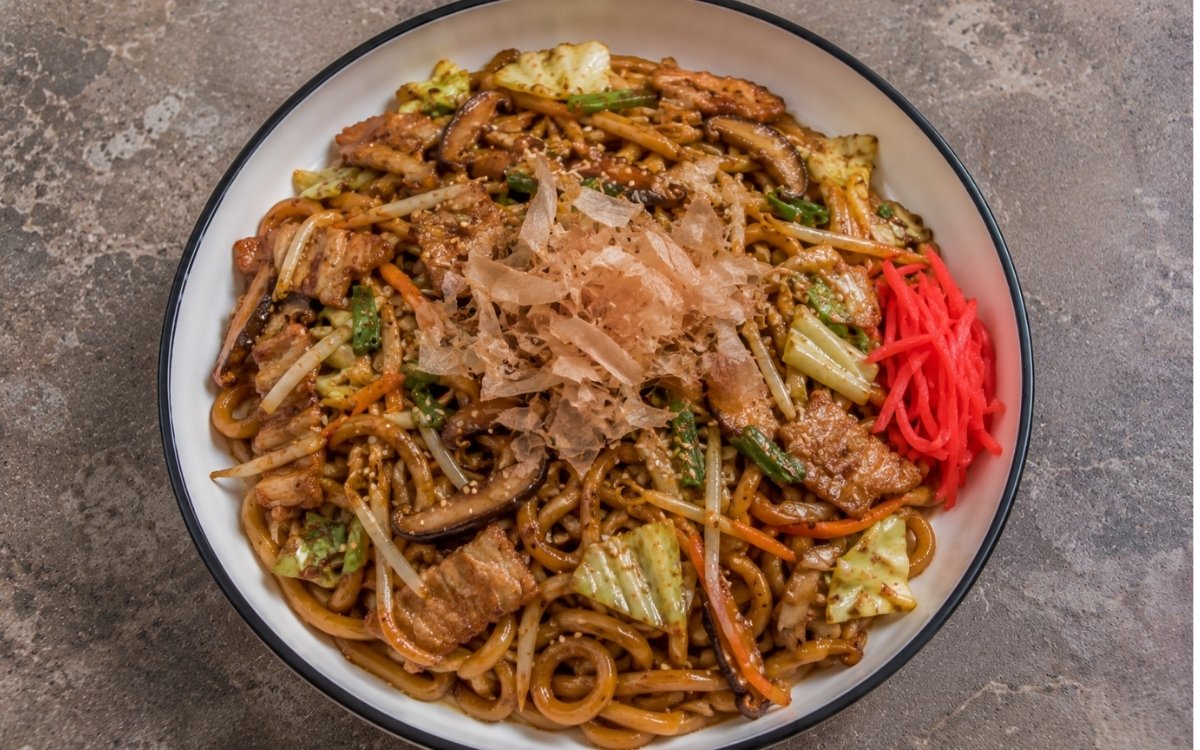
- Divide among four plates or wide shallow bowls immediately. The bonito flakes, sesame seeds, and pickled red ginger are not optional garnishes in yaki udon — they are integral components of the traditional preparation that each contribute specific texture, flavour, and visual character. Scatter the toasted sesame seeds over each bowl. Place a small pinch of bonito flakes on top of each portion — katsuobushi's delicate, umami-rich, slightly smoky flavour and the way the thin flakes move in the heat rising from the noodles is the visual signature of the dish. Place the pickled red ginger alongside each bowl — beni shoga's vinegary, slightly sweet, bright pink presence provides the acid contrast that cuts through the sauce's sweetness and richness, and its crunch against the chewy noodles provides the final textural element. Serve immediately.
Notes
Fresh udon noodles are specified because their specific character — thick, very chewy, with a slightly slippery, silky exterior surface — is what makes yaki udon specifically satisfying. Fresh udon's chew comes from its high-gluten wheat flour composition and its hydration level, which is significantly higher than dried pasta. This high hydration means fresh udon softens quickly in boiling water (hence the 1-minute blanch rather than 8–10 minutes), holds its chew through high-heat wok cooking without becoming soft or mushy, and produces the characteristic slightly sticky, slightly silky surface that the sauce adheres to efficiently. Dried udon, if used, should be cooked to full tenderness before wok cooking — it becomes too firm to wok-cook correctly if pulled al dente as Italian pasta is.
The wok hei technique — creating a hot zone in the centre of the wok for the noodles while vegetables rest at the sides — is the authentic yaki udon technique found in Japanese izakaya and teishoku restaurants. Home stoves produce less BTU than restaurant burners, which is why the 2–3 minute preheat and the staged cooking are more important at home than in a restaurant — the strategy compensates for lower available heat by maximising each ingredient's contact time with the wok surface at its hottest.
Bonito flakes (katsuobushi) are dried, fermented, and smoked skipjack tuna shaved into paper-thin flakes. Their flavour is specifically umami-rich, slightly smoky, and deeply savoury — the dried fermentation process concentrates glutamate and inosinate, the two umami compounds that act synergistically to produce an amplified savoury response. They waver and move on top of hot food because of the convection currents from the rising heat — a presentation element that signals temperature and freshness simultaneously.