Ingredients
Method
Prepare and Drain the Watermelon
- Remove the rind from the watermelon completely. Cut into large, irregular, rustic chunks — roughly 4–6cm in their largest dimension, with uneven shapes rather than uniform cubes or triangles. The irregular shaping is not simply aesthetic: the rough, uneven surfaces created by irregular cuts have more surface area and more texture variation than smooth, flat-faced cubes, and the dressing's olive oil, lime, and Tajín cling more effectively to a rough, slightly porous surface than to the sealed, smooth faces of precision-cut pieces. Transfer the cut watermelon to a colander or fine-mesh strainer set over a bowl. Allow to drain at room temperature for 5–10 minutes. The watermelon's very high water content — approximately 92% water by weight — means its surface is actively wet with sweet, dilute juice at the moment of cutting. Applied over this wet surface, the dressing is immediately diluted and its flavour compounds are dispersed into the surrounding liquid rather than adhering to the fruit. The 5–10 minute drain removes this surface moisture without beginning to dry the watermelon's flesh — the fruit remains completely cold, crisp, and juicy inside while the surface is noticeably less wet and ready to hold the dressing.
Prepare the Fresno Chili
- Slice the fresno chili into thin, even rounds. For a milder, cleaner heat — the chili providing a fruity, slightly sweet warmth that is perceptible but not assertive — remove the seeds and white pith before slicing. Fresno chilies have a specific moderately bright, fruity heat (approximately 2,500–10,000 SHU) and a slightly thicker flesh than most red chilies — their roundness when sliced provides both visual appeal and a clean, not-too-thin slice that holds its shape in the salad without wilting. Leaving the seeds produces a sharper, more directly spiced result where the chili's heat is clearly present alongside the Tajín's milder background warmth.
Make the Dressing
- In a small bowl, combine the 2 tbsp of Tajín, the juice of 2 limes, 1 tbsp of extra-virgin olive oil, and a pinch of black pepper. Whisk until the Tajín powder is fully suspended in the liquid — Tajín does not fully dissolve but disperses evenly with whisking, ensuring even distribution over the watermelon rather than concentrated patches of chili-salt on some pieces and bland pieces elsewhere. Tajín — a commercially produced Mexican seasoning made from a specific blend of chili peppers, dehydrated lime juice, and salt — has a specific citrus-forward, mildly spiced character that makes it the defining seasoning in this recipe rather than simply a heat source. The dehydrated lime component in Tajín contributes a different quality of citrus intensity than fresh lime juice — concentrated, slightly more aromatic, and less immediately sharp — that the fresh lime juice amplifies and brightens. The olive oil does not emulsify with the lime juice without a binding agent but distributes sufficiently with whisking to carry the Tajín's fat-soluble aromatic compounds more evenly across every piece of watermelon than a Tajín-and-lime-only dressing would provide.
Dress and Toss
- Transfer the drained watermelon to a large bowl. Pour the dressing over the watermelon and toss gently but thoroughly — using two large spoons or clean hands to turn every piece through the dressing without breaking the larger chunks. The watermelon's flesh is fragile and breaks easily under pressure; confident, gentle turning movements produce a complete coating without disintegrating the pieces into an unstructured mass.
Plate and Garnish
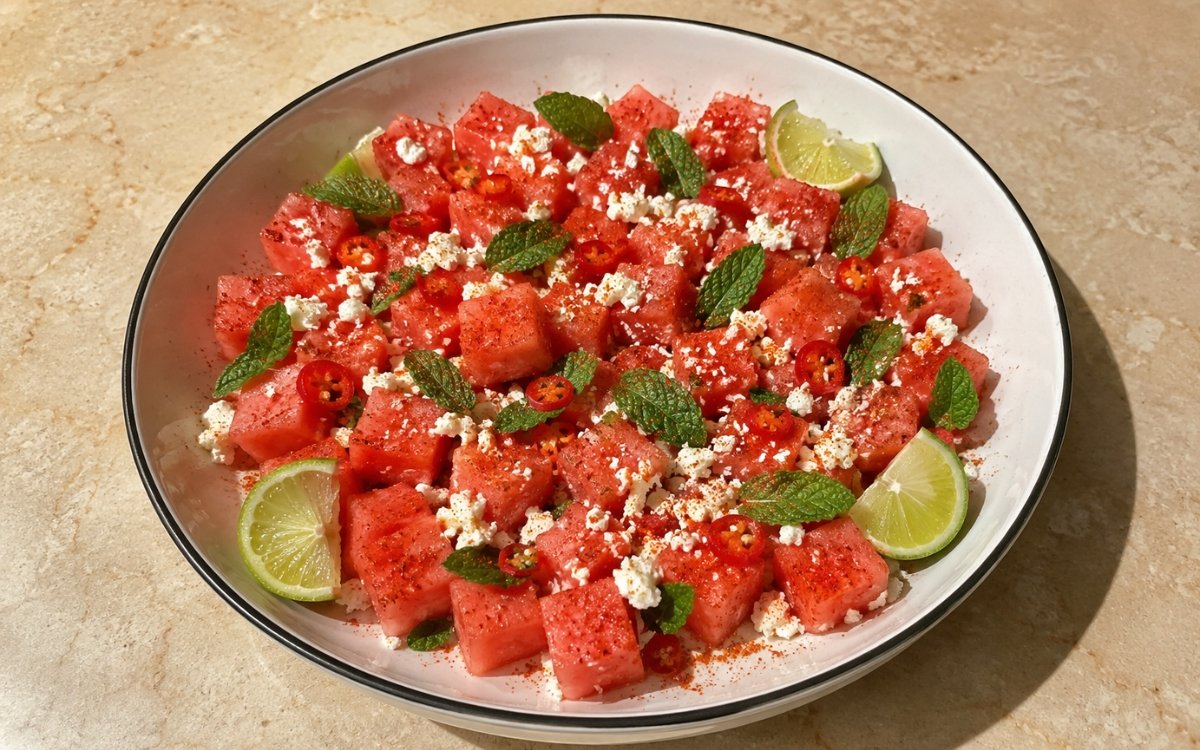
- Transfer the dressed watermelon to a wide, shallow serving bowl or platter — spreading it out into a single irregular layer rather than piling it into a mound. The shallow, spread presentation keeps the salad visually clean, prevents the lower pieces from being crushed under the weight of those above, and prevents the excess dressing and watermelon juice that accumulates at the bottom of a piled arrangement from making the lower pieces soggy while the top pieces remain underdressed. Crumble the 60g of cotija evenly over the surface. Scatter the sliced fresno chili rounds. Distribute the fresh mint leaves. Finish with an additional sprinkle of Tajín directly over the top — the additional seasoning dusting provides stronger red-orange colour contrast against the pink watermelon and the white cotija, and its concentrated chili-lime character provides a more assertive bite at the top of the salad where each serving is scooped from. Place lime wedges alongside. Serve immediately.
Notes
Tajín Clásico — the standard variety of the Mexican seasoning — is the specific product for this recipe. It is made from a proprietary blend of mild red chilies, dehydrated lime juice, and salt, producing a seasoning that is simultaneously salty, acidic, mildly spiced, and specifically citrusy in a dehydrated-lime way that cannot be produced by substituting plain chili powder and lime salt. Available at Mexican grocery stores, Latin supermarkets, and increasingly at mainstream supermarkets in the international foods section. Its specific character is central to the dish — the salad made with a substitute seasoning blend produces a different, less characteristically Mexican result.
Cotija cheese is a Mexican aged cheese with a hard, granular, very dry texture and a sharp, salty, slightly tangy flavour. When crumbled, it produces distinct, firm pieces that retain their identity against the watermelon's moisture rather than dissolving — the specific textural and flavour contrast between the crumbly, salty cheese and the cold, sweet, juicy watermelon is the pairing that makes this salad specifically more interesting than dressed watermelon alone. Crumbled feta can substitute at a similar quantity — its comparable saltiness and crumbly texture produce a comparable result with a slightly less dry, slightly creamier character.