Ingredients
Method
Prepare and Press the Aromatic Base
- Add the roughly chopped white onion, 4 garlic cloves and the 15g of parsley leaves to a food processor. Pulse until the mixture forms a coarse, wet paste with small pieces still visible, rather than a smooth purée. Tip it into a piece of cheesecloth or a fine-mesh sieve set over a bowl, then squeeze the cloth tightly or press repeatedly with the back of a spoon until no more liquid runs out. Expect a surprising amount of liquid from one medium onion. The pressed paste should feel noticeably drier, look slightly clumped and hold its shape when squeezed rather than spreading. If liquid still beads on the surface, press again. That thorough pressing is what stops the kebabs steaming on the grill and slipping off their skewers.
Mix the Kebab Mixture to Proper Binding
- In a large bowl, combine the 800g of ground lamb shoulder, 25g of softened butter, the pressed aromatic paste, 2 tsp of pul biber, 1½ tsp of cumin, 1 tsp of paprika, 1½ tsp of fine sea salt and 1 tsp of black pepper. Work the mixture with both hands for a full 3–5 minutes, kneading, folding and pressing it against the bowl. It is ready when it looks more uniform, feels sticky and paste-like, and a pinched piece holds its shape between your fingers; if it still feels loose and crumbly, keep working. Cover the bowl and refrigerate for 30 minutes to 1 hour, and soak wooden skewers in water now if using them. That sustained kneading is what draws out the lamb’s binding proteins, and the chill is what firms the fat so the mixture shapes cleanly.
Prepare the Tomato Couscous
- While the kebab mixture chills, light or preheat the grill, then make the couscous. Heat the 2 tbsp of olive oil in a saucepan over medium heat and cook the 3 minced garlic cloves for 30 seconds until fragrant. Add the 1 tsp of cumin, 1 tsp of paprika, ½ tsp of coriander and the pinch of cinnamon and toast for 20–30 seconds. Stir in the 400g of tomatoes and simmer for 5 minutes until slightly thickened. Pour in the 400ml of hot stock, bring to a boil, then stir in the 300g of couscous, cover and remove from the heat. Leave to steam for 5 minutes, then fluff with a fork, fold through the chopped parsley and cilantro, and season with salt and pepper. Keep covered until serving. That brief toasting of the spices in oil is what gives the couscous its warm, rounded depth.
Shape the Kebabs onto Skewers
- Divide the chilled mixture into 8 equal portions, weighing them for consistency. With wet hands, re-wetting often from a bowl of cold water, press each portion firmly around a flat metal skewer or a soaked thick wooden skewer. Shape it along the skewer into a long, rectangular kebab about 15–18cm long and an even 2.5–3cm thick from end to end, pressing it tightly so the meat grips the skewer rather than sitting loosely around it. Pinch both ends firmly closed. If the mixture feels too soft to hold its shape, refrigerate the shaped skewers on a tray for 15–20 minutes before grilling. That even thickness is what lets every part of each kebab cook through at the same rate.
Preheat and Prepare the Grill
- A charcoal or wood fire gives the most authentic result, because the lamb fat dripping onto the coals creates brief flare-ups that add smoke to the crust. Heat the grill thoroughly until the grates are very hot, and keep one area of the grill cooler, with fewer coals or a lower burner, so the kebabs can be moved there if needed. Brush or wipe the hot grates with a little high-smoke-point oil just before cooking. If a drop of water does not sizzle away almost instantly, keep heating. That fully preheated, oiled surface is what lets the meat sear and release rather than stick and tear.
Grill with Continuous Rotation
- Lay the skewers over the hottest part of the grill and turn them every 60–90 seconds, so each of the four flat faces meets the direct heat in turn. After about 10 minutes, start checking each kebab by inserting an instant-read thermometer into the thickest part of the centre, close to but not touching the skewer. Keep grilling and turning until every kebab reads at least 71°C / 160°F; over a hot fire this usually takes 10–15 minutes, but fire heat, thickness and how cold the meat is all change the timing, so the thermometer decides, not the clock. If the outside chars too heavily before the centre is there, move the skewers to the cooler area and keep turning. Do not judge doneness by colour, because the pul biber and paprika keep cooked lamb reddish. That measured internal temperature is what confirms the minced lamb is safely cooked all the way through.
Rest and Plate
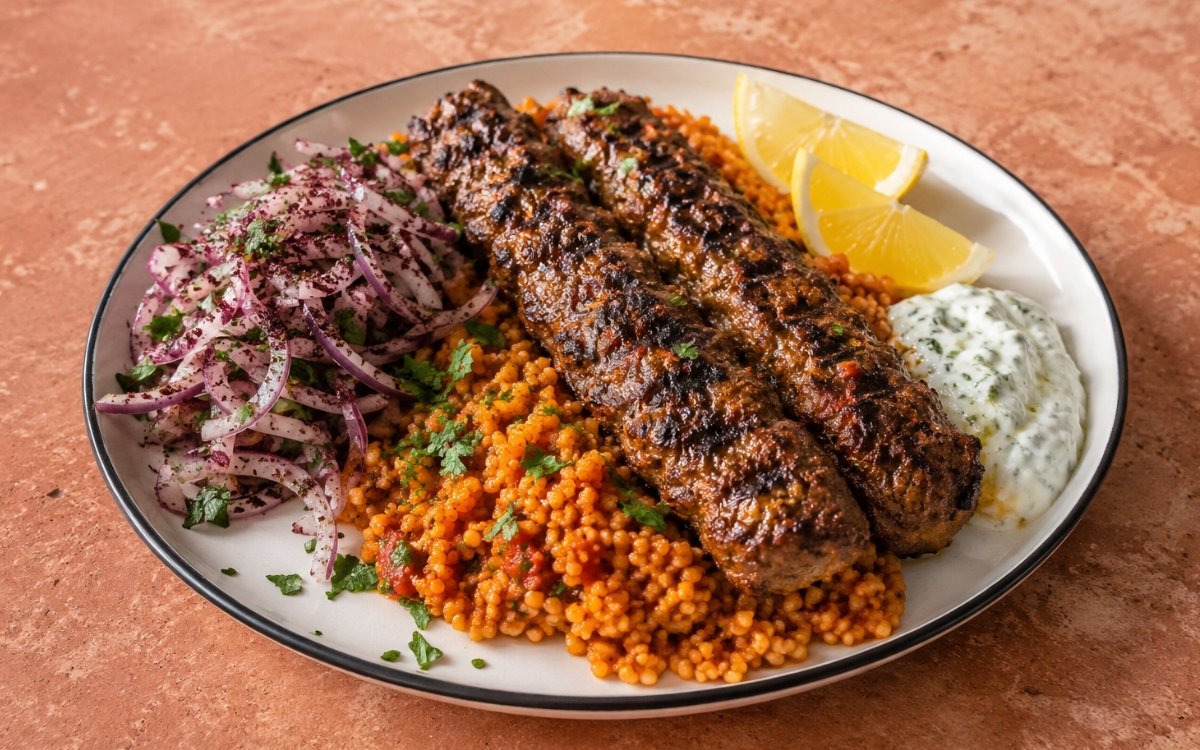
- Move the kebabs to a warm plate, tent them loosely with foil and rest for 5 minutes so the juices settle back into the meat. Fluff the tomato couscous again and divide it among four plates as the base. Slide 2 kebabs per person off their skewers onto the couscous. Add a portion of sumac onions alongside to cut through the rich lamb, then a generous spoonful of tzatziki for cool, garlicky contrast. Scatter over the fresh parsley and place lemon wedges on each plate. That short rest is what keeps the juices in the kebab rather than running out onto the plate.
Notes
Pressing the aromatic paste deserves genuine recognition as the technique most directly responsible for whether the kebabs hold on their skewers or fall into the coals. Onion is mostly water, and any liquid left in the paste turns to steam in the first minute on the grill — that steam stops the crust forming and loosens the meat from the skewer before its surface proteins can set.
Working the mixture for 3–5 minutes deserves the same attention any shaped minced-meat skewer needs, because a gentle mix simply cannot hold an 18cm kebab on a flat blade. Kneading draws salt-soluble proteins, mainly myosin, out of the lamb into a sticky network that behaves rather like gluten in bread dough, and that network is what keeps each kebab intact through constant turning.
Pul biber deserves genuine respect as the detail most directly responsible for making these kebabs taste distinctly Turkish rather than simply spiced grilled meat. These moderately hot, fruity and slightly oily red pepper flakes spread a gentle, building warmth through every bite, while standard chilli flakes at the same quantity give a sharper, less fruity heat without the same depth.
The 71°C centre temperature deserves attention as a genuine, checkable readiness cue rather than a loose approximation. Mincing spreads surface bacteria right through the lamb, so the inside of every kebab must reach at least 71°C / 160°F on an instant-read thermometer — no grilling time can promise that on every fire, and the pepper-tinted meat stays reddish even when fully cooked.