Ingredients
Method
Drain the Tuna
- Drain the tuna extremely well, then press out excess liquid with a fork or paper towel. This is non-negotiable. Wet tuna makes a soggy sandwich and weakens the cheese melt. The filling should be creamy, not watery. Canned tuna holds onto packing liquid more stubbornly than it might appear to at a glance — actively pressing it, rather than simply tipping the can and letting gravity do the work, removes considerably more of that residual moisture before it ever meets the mayonnaise.
Make the Tuna Salad
- Add the drained tuna to a bowl and flake it into medium pieces. Add the mayonnaise, celery, onion, dill pickles, Dijon mustard, lemon juice, parsley if using, salt, black pepper, and garlic powder if using. Fold until combined but do not mash it into paste. The tuna salad should hold together while still having visible texture. Taste and adjust salt, pepper, lemon, or Dijon. It should taste creamy, bright, lightly sharp, and properly seasoned before it goes into the sandwich. Folding gently rather than mashing preserves distinct flakes of tuna within the creamy base, giving the finished filling real textural interest rather than a uniform paste.
Prepare the Bread and Cheese
- Lay out the sourdough slices. Spread a thin layer of softened butter on the outside of each slice. Add cheddar to the inside of 4 slices, then add the tuna salad, then add another layer of cheddar over the tuna. Close with the remaining bread slices, buttered side facing out. Cheese on both sides of the tuna helps bind the sandwich together and gives a better melt. Putting tuna straight against bare bread is asking for a soggy interior. The cheese layers act as a moisture barrier as much as a flavour component — melting around the tuna salad, they help contain any remaining liquid rather than letting it seep directly into the bread during griddling.
Griddle the Sandwiches
- Heat a large skillet, griddle, or cast-iron pan over medium-low to medium heat. Add a tiny splash of neutral oil if needed, then place the sandwiches in the pan. Cook for 4–5 minutes on the first side, pressing gently with a spatula, until the bread is deeply golden-brown and crisp. Flip carefully and cook another 4–5 minutes on the second side, until the cheddar is fully melted and pulling slightly at the edges. Do not crank the heat. High heat burns the sourdough before the cheese melts. Medium-low heat is the whole game here. This moderate heat is calibrated to let the cold tuna filling and the cheese come up to temperature and fully melt in roughly the same window the bread needs to develop deep colour — a hotter pan would force a choice between burnt bread and unmelted cheese.
Finish Melting if Needed
- If the bread is browned but the cheese is not fully melted, lower the heat and cover the pan for 1–2 minutes. Do not keep blasting the bread. Burnt sourdough with cold cheese is a basic failure. Covering briefly traps residual heat and steam around the sandwich, giving the cheese a gentler, more contained environment to finish melting in without exposing the already-browned bread to any more direct, aggressive heat.
Rest and Slice
- Transfer the sandwiches to a cutting board and rest for 1–2 minutes. Cut each sandwich diagonally in half. The short rest keeps the tuna salad from spilling everywhere while still keeping the cheese melted enough to pull. This brief pause lets the melted cheese firm just slightly, enough that the first cut doesn't send tuna salad and molten cheese spilling out, while everything is still hot and the cheese still pulls cleanly.
Serve
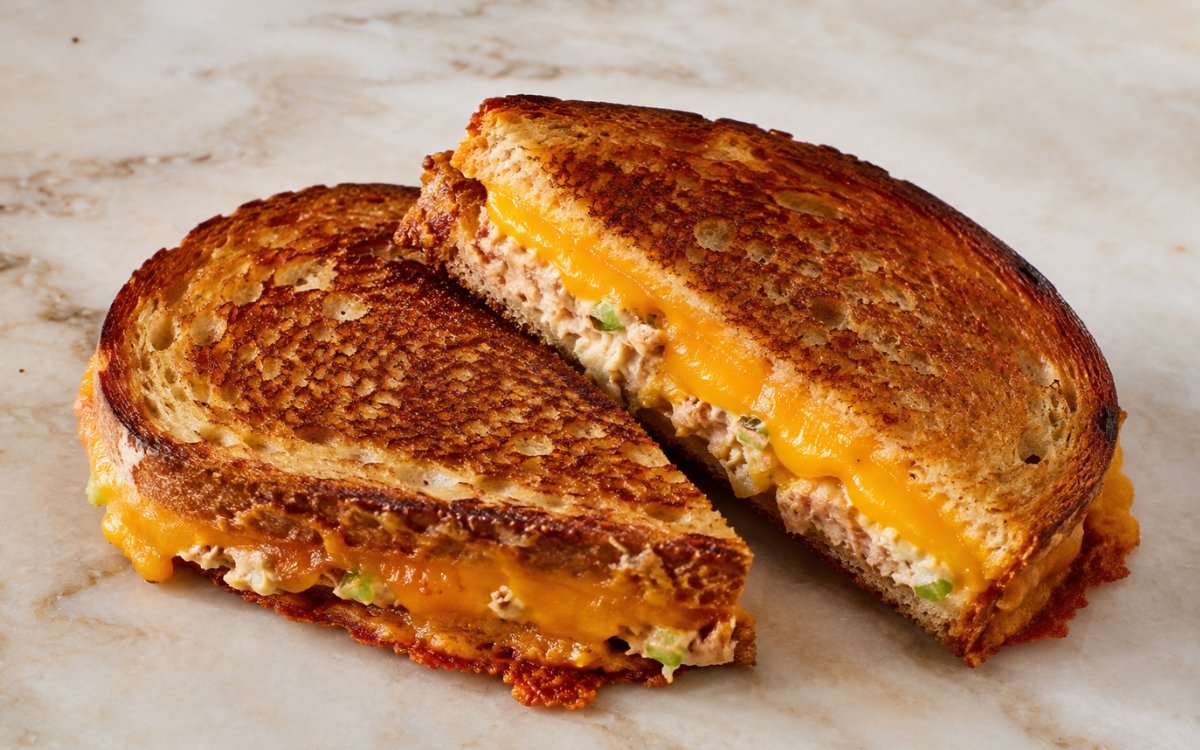
- Serve immediately while the sourdough is crisp, the cheddar is hot and melted, and the tuna salad is creamy inside. A tuna melt dies fast once steam softens the bread. Steam continues rising from the hot filling even after the sandwich leaves the pan, and that steam works directly against the crisp crust just built, so serving without delay is what keeps the sourdough's exterior genuinely crisp.
Notes
Draining the tuna as aggressively as this recipe calls for is worth taking seriously rather than treating as a quick, casual step. Canned tuna retains packing liquid more persistently than it appears to, and even tuna that looks reasonably dry after a simple tip-and-drain still typically carries enough residual moisture to thin out the mayonnaise-based salad and, more consequentially, to soften the sourdough during the multi-minute griddling process. Actively pressing the drained tuna with a fork or paper towel removes meaningfully more of that liquid than passive draining alone.
Sandwiching the tuna salad between two layers of cheddar rather than placing it against bare bread on either side is a structural decision worth understanding beyond its contribution to flavour and cheese pull. As the sandwich griddles, the cheese melts and forms a barrier around the tuna filling, both helping bind the whole sandwich into a cohesive unit and limiting how much of the filling's own moisture can migrate directly into the bread.
The moderate heat specified for griddling addresses a genuine timing tension specific to this sandwich's composition. Sourdough develops colour and crispness relatively quickly under higher heat, but the cold tuna filling and two layers of cheese both need real time to warm through and fully melt. Medium-low to medium heat is the setting that allows both processes to complete in roughly the same window, rather than forcing a trade-off between a burnt exterior and a filling that's still cold at the centre.
Folding the tuna salad gently, rather than mashing it into a smooth paste, protects a textural quality that's easy to lose without realising it. Distinct flakes of tuna suspended in the creamy mayonnaise base give the finished sandwich genuine textural variety bite to bite — a fully mashed version would still taste similar but would read as flatter and less interesting once it's inside the hot, melted sandwich.