Ingredients
Method
Soften the Tamarind and Dates
- Add the 100g chopped dates, the 50g broken-up tamarind and the 400ml water to a small saucepan. Bring to a gentle simmer over medium heat, then lower the heat so that only small, lazy bubbles break the surface. Cook for 10–12 minutes, stirring occasionally and scraping the bottom of the pan, until the dates are very soft and collapse when pressed against the side with a spoon, and the tamarind has loosened into the water as a thick, murky pulp. Do not let it boil hard; if it starts to bubble vigorously or catch on the base, turn the heat down at once. That gentle simmer is what fully softens the fruit and releases the tamarind without scorching the natural sugars on the bottom of the pan.
Blend Until Smooth
- Take the pan off the heat and let the mixture cool for 5 minutes, so that it is safer to blend and does not force the blender lid up with steam. Transfer everything to a blender, scraping in every bit of pulp, and blend for 1–2 minutes until very smooth. If the mixture is too thick to move around the blades, add a splash of water, 1–2 tbsp at a time, using just enough to help it blend smoothly. The purée should look thick, even and dark brown, with no visible pieces of date or clumps of tamarind left. That thorough blending is what breaks the fruit down completely, so the sieve in the next stage can separate fine purée from fibre rather than hold back flavour.
Strain for a Glossy Finish
- Set a fine sieve over the rinsed saucepan and pour in the blended mixture. Press it through firmly with the back of a spoon or a flexible spatula, working it against the mesh in circles and scraping the underside of the sieve into the pan as you go. Keep pressing until only a small amount of dry, fibrous paste remains in the sieve, then discard those solids. If the purée is too thick to pass through easily, loosen it with another 1 tbsp of water. That straining step is what removes the tamarind fibres and fragments of date skin, giving the chutney the smooth, sticky, polished texture of a classic chaat chutney.
Season and Reduce
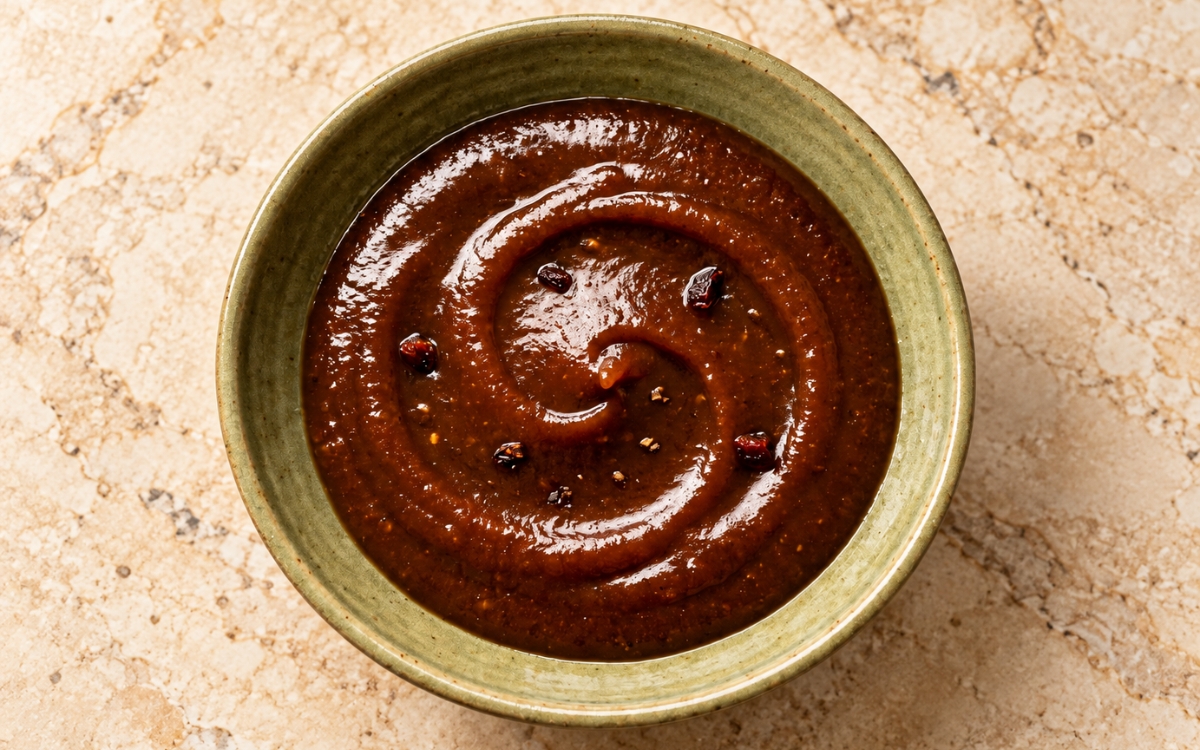
- Return the strained chutney to low heat. Stir in the 80g jaggery, the 1 tsp roasted cumin powder, the ½ tsp dry ginger powder, the ½ tsp Kashmiri chilli powder, the ½ tsp black salt and the ½ tsp fine salt. Simmer gently for 5–8 minutes, stirring often, until the jaggery has fully dissolved and the chutney thickens to a glossy, spoonable consistency. It should coat the back of a spoon and fall in a thick ribbon, but still be loose enough to drizzle. Stop cooking while it is slightly looser than you want, because it sets noticeably as it cools. That early stop is what keeps the cooled chutney pourable rather than turning it into a stiff, sticky paste.
Adjust, Cool and Store
- Taste the chutney while it is still warm. Add a little more jaggery if it tastes too sharp, or a little more fine salt or black salt if it tastes flat, stirring until any extra jaggery has dissolved. Let the chutney cool completely at room temperature for about 30 minutes, then transfer it to a clean jar or container. If it has thickened too much once cool, stir in warm water 1 tbsp at a time until smooth; if it is still thin, return it to the pan and simmer for a few more minutes. Serve as needed, garnished with a few very thin slices of date if you like. That final taste and adjustment is what brings sweetness, acidity and spice into genuine balance.
Notes
The gentle simmer deserves genuine recognition as the technique most directly responsible for whether this chutney tastes clean and rounded or faintly burnt. The recipe's own instruction, "Do not boil hard," reflects how quickly date and tamarind sugars settle and scorch on the base of a small pan — a hard boil also drives off water too fast, so the fruit catches before it has properly softened.
Fine-sieve straining deserves the same attention this technique receives throughout this collection's other smooth sauces and chutneys, because it decides the final texture more than any other step. Even a thoroughly blended base still carries tamarind fibres and date skins, which is why the recipe's own note says, "For the smoothest result, do not skip straining" — those particles dull the gloss and leave a gritty finish.
Adding the jaggery and spices only after straining deserves genuine respect as the detail most directly responsible for a bright, genuinely well-seasoned finish. Spices stirred in at the start would be partly trapped in the discarded solids, while jaggery added to the first simmer would raise the sugar content early and make scorching far more likely during the longer softening stage.
The ribbon test deserves attention as a genuine, checkable readiness cue rather than a loose approximation. When the chutney coats the back of a spoon and falls in a thick ribbon that still drizzles, it is done; the recipe's own reminder to "stop the cooking when the chutney is slightly looser than you want" matters because it keeps thickening as it cools.