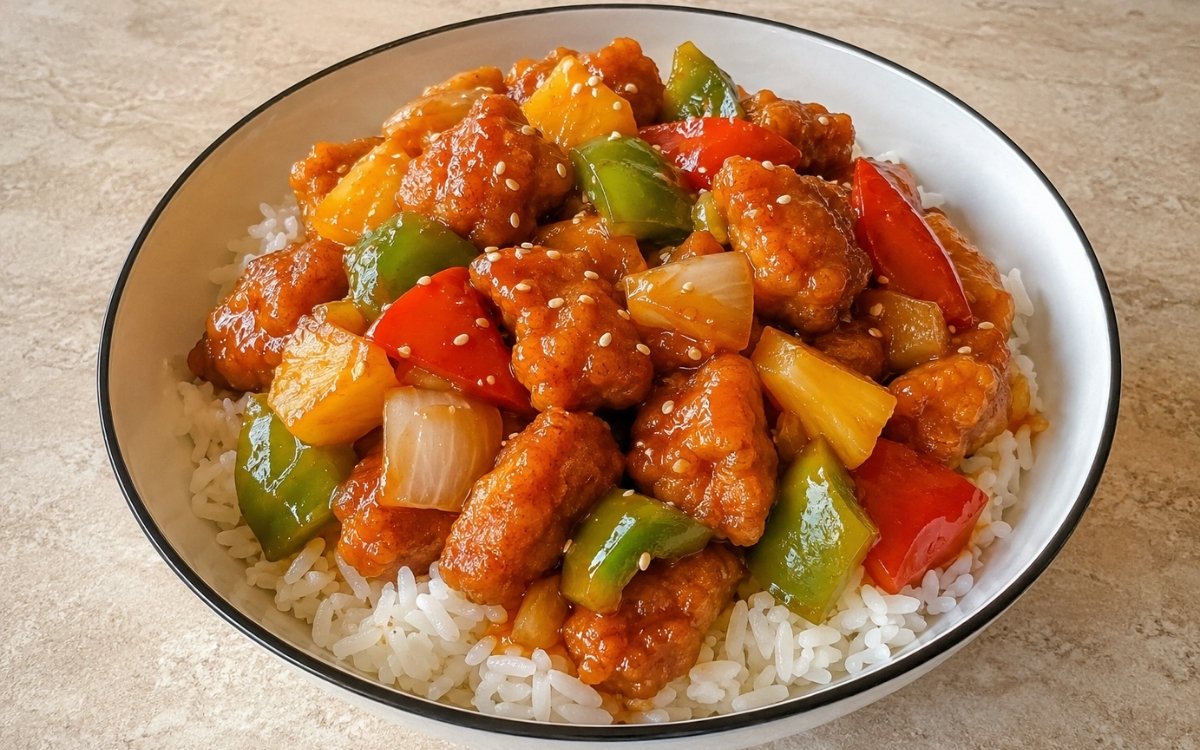
Ingredients
Method
Marinate the Chicken
- Cut the chicken thighs into 2.5cm cubes — as uniform in size as possible so every piece cooks through at the same rate in the hot oil. In a medium bowl, combine the oyster sauce, light soy sauce, cornstarch, water, and salt. Add the chicken cubes and mix thoroughly with your hand, turning every piece to ensure complete coating. The cornstarch in the marinade serves two functions simultaneously: it begins tenderising the surface proteins of the chicken through its interaction with the oyster and soy sauces, and it creates a thin, starchy surface layer that helps the subsequent batter adhere more completely during frying. Allow to marinate for a minimum of 15 minutes at room temperature — the flavour penetration in this time is limited but the surface preparation is sufficient for the batter to work correctly.
Prepare All Vegetables and Pineapple
- Cut all the vegetables and pineapple to approximately the same size — roughly 2cm in every dimension — so they cook evenly during the brief oil frying step and are proportionate to the chicken cubes in the finished dish. Slice the carrot on a diagonal at approximately 5mm thickness — the diagonal cut increases the surface area and produces a more visually interesting piece. Cut the red bell pepper and onion into triangles of approximately 2cm per side — triangles are the traditional cut for sweet and sour because their pointed edges char slightly in the oil while the thicker centre remains slightly crunchy. Cut the pineapple into 2cm chunks. Have all vegetables and pineapple arranged in separate groups ready for the frying step — they will be cooked in batches and need to be accessible quickly once the oil is at temperature.
Make the Sweet and Sour Sauce and Slurry
- In a small bowl or jug, combine the ketchup, red vinegar, rice vinegar, salt, and sugar. Stir until the sugar is completely dissolved — undissolved sugar produces an inconsistently sweet sauce that is overly sweet in some bites and not sweet enough in others. Taste the sauce before it reaches the wok and calibrate: it should taste balanced between sweet, tangy, and slightly salty at full intensity — noticeably sweeter and more acidic than you would want to eat directly because it will be diluted slightly by the wok heat and the slurry. The combination of red vinegar and rice vinegar is deliberate — red vinegar provides a sharper, slightly wine-like acidity with depth; rice vinegar provides a cleaner, milder, slightly sweet acidity. Together they produce a more complex sour note than either alone. In a separate small bowl, mix the potato starch and water for the slurry until completely smooth. The slurry should be lump-free — any lumps of undissolved starch will produce gelatinous chunks in the finished sauce. Set both the sauce and the slurry beside the wok.
Mix the Batter
- In a large bowl, combine the flour, cornstarch, baking powder, water, and oil. Whisk until just combined — the batter should be smooth but do not over-mix, which develops the flour's gluten and produces a dense, chewy crust rather than the light, slightly airy texture of a correctly mixed batter. The consistency should be similar to thick cream — it should coat the back of a spoon and drip slowly rather than running off immediately. The cornstarch in the batter — the same principle as in Japanese tempura — produces a crispier, more rigid crust than flour alone, because cornstarch has no gluten and does not form the chewy, elastic network that pure flour does. The baking powder provides gas expansion during frying, creating small air pockets in the crust that make it lighter and crispier. The teaspoon of oil lubricates the batter and produces a smoother, more even coating on each chicken piece. Add the marinated chicken cubes to the batter and turn to coat every piece completely.
First Fry at 175°C (350°F)
- Heat approximately 700ml–1L of neutral oil in a wok over high heat until it reaches 175°C (350°F). The wok is the correct vessel for this preparation — its curved sides and wide opening allow the oil to distribute efficiently, the high heat to maintain temperature between batches, and the surface area to accommodate the relatively large quantity of chicken without the significant temperature drop that a straight-sided pot would experience. Test the oil temperature with a small drop of batter — it should sizzle immediately and rise to the surface within 3–4 seconds. Begin frying the battered chicken in batches of 6–8 pieces maximum — crowding drops the oil temperature dramatically and produces pale, oil-saturated batter rather than crispy, golden crust. Lower each piece gently into the oil. Fry for 3–4 minutes per batch, turning occasionally, until the batter is set and pale golden — the colour at this stage should be pale, not the deep golden of the finished product. The first fry's purpose is to cook the chicken through to 74°C internal temperature — the full colour and crispness develop in the second fry. Transfer each batch to a wire rack. After all the chicken has been first-fried, proceed immediately to the second fry — do not allow the chicken to cool for more than a few minutes.
Second Fry at 193°C (380°F)
- Increase the oil temperature to 193°C (380°F). Return all the first-fried chicken to the oil simultaneously — all pieces going back in together is correct at this stage because the second fry is brief and the chicken is already cooked through. Fry for 60–90 seconds until the batter is a deep, even golden-brown and shatteringly crisp when you lift a piece and hear it with tongs. The elevated temperature in the second fry is what produces the dramatic improvement in crispness: the higher heat drives off the remaining surface moisture in the already-cooked batter almost instantly, producing a rigid, dry, crackling crust that would require significantly longer at the lower first-fry temperature to achieve — by which point the chicken would be overcooked. Remove all the chicken to a wire rack. Skim any loose batter pieces or burnt bits from the oil surface with a slotted spoon.
Fry the Vegetables
- With the oil still hot at approximately 175–180°C, fry the vegetables in batches. Do not add all vegetables simultaneously — a large volume of cold, wet vegetables added at once drops the oil temperature severely and causes the vegetables to absorb oil rather than being sealed quickly. Fry each vegetable type separately, or in small batches of one layer, for approximately 60 seconds per batch. The vegetables should emerge slightly softened at the edges but retaining a noticeable crunch — they will soften further when tossed in the hot sauce in the wok. Remove each batch with a slotted spoon and set aside. Once all vegetables and pineapple are fried, pour the oil from the wok into a heatproof container — do not wait for it to cool, as the wok needs to be available immediately and waiting for the oil to cool loses valuable time.
Make and Finish the Sauce
- Working quickly while the wok is still hot, wipe any oil residue from the inside with a folded paper towel held with tongs — caution, the wok is extremely hot. Return the wok to the burner over high heat. Pour in the prepared sweet and sour sauce. Bring to a full boil while stirring — the sauce will bubble vigorously as the vinegar's acidity and the ketchup's sugars heat rapidly. Once the sauce is at a full boil, reduce the heat to medium. Give the slurry a quick stir — it separates on standing — and add approximately half of it to the boiling sauce while stirring continuously. The sauce will begin to thicken within 20–30 seconds as the potato starch gelatinises. Assess the consistency: a well-thickened sweet and sour sauce should coat the back of a spoon and hold a clear line when you run your finger through it, but should not be so thick that it forms a gel-like layer. If it needs more thickness, add the remaining slurry in small additions. If it has thickened beyond the correct point, add a small splash of water and stir.
Combine and Serve
- Add the fried vegetables and pineapple to the sauce first and stir to coat every piece completely. The vegetables go in before the chicken because they are slightly more delicate and benefit from an additional 30–60 seconds in the sauce to fully absorb its flavour. Turn the heat off. Add all the double-fried chicken and stir vigorously but carefully — thorough coating of every chicken piece with the glossy sauce is the visual and flavour goal, but aggressive stirring can break the crispy crust. Either stir the sesame seeds into the combined dish now for even distribution throughout, or scatter generously over each portion when serving. Serve immediately over jasmine rice — the crispness of the double-fried batter begins to diminish the moment the sauce contacts it, and the dish is at its best within the first 5–10 minutes of final assembly.
Notes
The double-fry technique is the defining step of this recipe and the reason restaurant sweet and sour chicken has a distinctly more satisfying crust than most home versions. The physics are straightforward: during the first fry at 175°C, the chicken cooks through and the batter sets into a pale, slightly soft structure that still contains residual moisture from the batter's water content. During the brief second fry at 193°C, this higher temperature rapidly drives off the remaining moisture through flash evaporation, simultaneously drying and hardening the batter's starch structure into a rigid, crackling crust. The crust developed at 193°C in 90 seconds could not be achieved at 175°C in the same time — it would require several additional minutes of frying that would overcook the chicken interior. The two-stage process separates the cooking of the chicken from the development of the crust's maximum crispness.
Potato starch rather than cornstarch for the slurry is a small but noticeable detail. Potato starch produces a slightly clearer, more glossy thickened sauce than cornstarch, which can produce a slightly cloudy, gluey consistency at the same ratio. For a sweet and sour sauce where the glossy, jewel-like appearance is part of the visual identity, potato starch produces the more restaurant-accurate result.
The combination of red vinegar and rice vinegar in the sweet and sour sauce produces a more layered acidity than any single vinegar would. Red vinegar's depth — slightly wine-like, with a rounded sourness — provides the background acidity. Rice vinegar's clean, subtle sweetness provides the foreground brightness. White distilled vinegar can replace the red vinegar entirely for a sharper, more straightforward sour note.