Ingredients
Method
Prepare the Fruit and Glasses
- Use frozen fruit for both layers for the best thick texture and clean separation. If using fresh fruit, freeze the cut mango and strawberries for 1–2 hours first until very cold and firm. Chill 4 glasses before filling. Both layers must be thick and spoonable-pourable, not loose. A thin smoothie will blend together instead of forming distinct layers. That genuine thickness in both layers is the whole structural foundation this smoothie's layered look depends on — anything looser simply wouldn't hold its own shape long enough to stay separate once poured together.
Blend the Mango Layer
- Add the mango, Greek yogurt, 80ml of the cold liquid, honey if using, lime juice, and salt to the blender. Blend until smooth, stopping to scrape down the sides as needed. Add a little more liquid only if necessary, 1 tablespoon at a time. The mango layer should be thick, glossy, and smooth, able to mound slightly on a spoon before settling. That specific, checkable target — a soft mound that briefly holds — confirms the layer has reached genuine thickness before it's ever poured into the glass.
Build the Bottom Layer
- Divide the mango smoothie evenly between the 4 glasses, about halfway up each glass. Tap the glasses lightly on the counter to level the surface, then place them in the freezer for 5 minutes while you make the strawberry layer. This short chill helps the mango layer firm slightly so the top layer sits on it more cleanly. That brief freezer rest gives the mango layer's own surface real time to set just enough that the strawberry layer poured on top settles cleanly rather than sinking straight through.
Blend the Strawberry Layer
- Rinse the blender or wipe it clean. Add the strawberries, Greek yogurt, 80ml of the cold liquid, honey if using, lemon juice, and salt. Blend until very smooth. Add extra liquid only as needed, again 1 tablespoon at a time. The strawberry layer should be as thick as or slightly thicker than the mango layer. It should not be runny. That deliberate matching, or slight thickening, protects the strawberry layer from being thin enough to sink down into the mango layer once it's poured over the top.
Layer the Smoothie
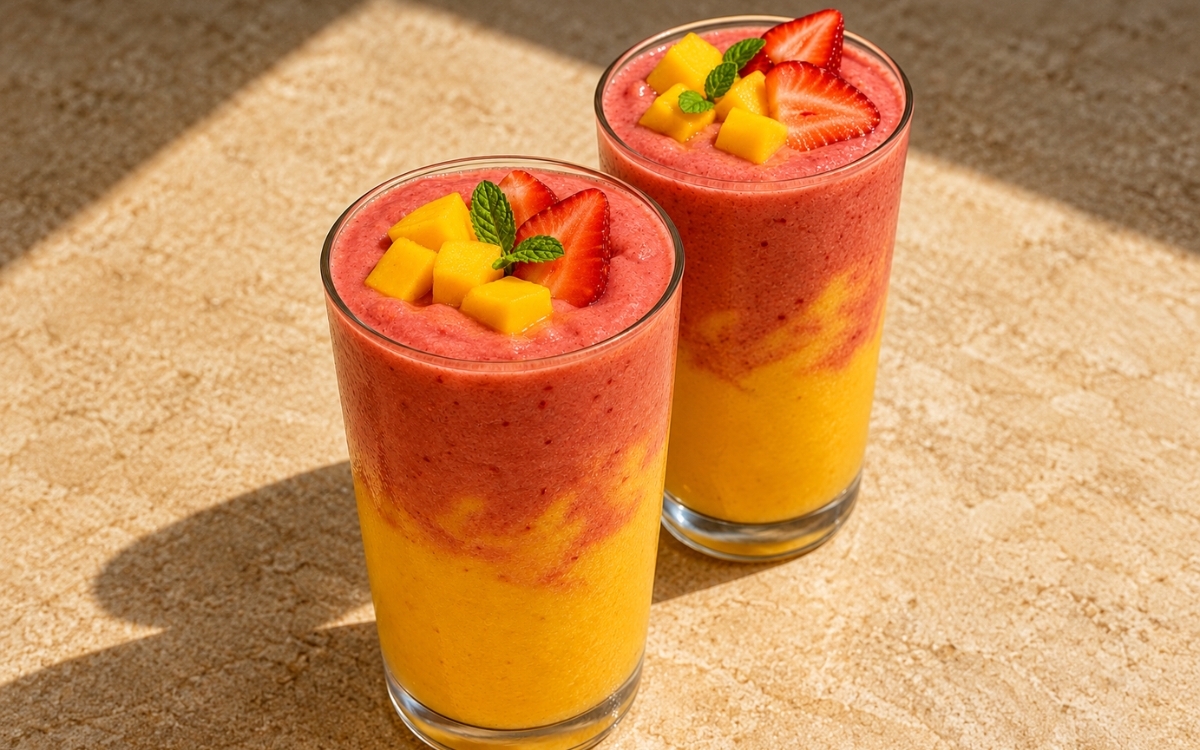
- Spoon or slowly pour the strawberry smoothie over the back of a spoon onto the mango layer in each glass. Let it settle naturally. If desired, use a thin skewer or spoon tip to make just 1–2 light swirls where the colors meet. Do not stir deeply, or the clean pink-and-gold layered look will disappear. That spoon-back pouring technique slows the strawberry layer's own descent, letting it settle gently on the surface of the mango layer rather than crashing through and mixing on contact.
Garnish and Serve
- Top each smoothie with a few mango cubes, 1–2 strawberry slices, and a few tiny mint leaves. Serve immediately. That immediate serving is what protects the whole layered presentation — the two distinct colours begin softening and merging together the longer the finished smoothie sits.
Notes
Blending each layer to a genuinely thick, spoon-mounding consistency deserves genuine recognition as the technique most directly responsible for this smoothie's whole layered look. The recipe's own explicit warning that "a thin smoothie will blend together instead of forming distinct layers" reflects the real, structural foundation this entire presentation depends on.
Giving the mango layer a brief freezer rest before the strawberry layer is ever added deserves genuine attention as a deliberate, functional technique. That short chill firms the mango layer's own surface just enough for the second layer to settle cleanly on top, protecting against the two layers sinking into and mixing with each other.
Pouring the strawberry layer slowly over the back of a spoon, rather than directly into the glass, deserves genuine respect as the detail responsible for a clean, defined boundary between the two colours. That slowed, gentle descent is specifically what keeps the strawberry layer settling on the surface rather than crashing through and immediately mixing.
Avoiding deep stirring once both layers are in place deserves attention as a real, deliberate restraint protecting the finished presentation. The recipe's own explicit warning that deep stirring makes "the clean pink-and-gold layered look will disappear" reflects exactly how fragile that visual contrast actually is once the two layers meet.