Ingredients
Method
Lightly Mash the Infusion Strawberries
- Place 1 cup (approximately 150g) of hulled strawberries in a bowl or directly in the bottom of the pitcher. Using a fork or the back of a large spoon, mash lightly — pressing firmly enough to crack the skin and release visible juice from the outer layers of approximately half to two-thirds of the berry pieces, while leaving the remainder recognisably intact. The visual target is berries that are partially crushed with released juice pooling at the bottom, not a uniform pink purée. The mashing technique for strawberry infused water balances two competing requirements. Strawberry's primary pleasant aromatic compounds — particularly mesifuran (the specifically warm, jam-adjacent, intensely fruity compound responsible for ripe strawberry's characteristic aroma) and various fruity esters — are present in the outer cell layers and release readily at cold temperature when the cell walls are disrupted. A light mash disrupts sufficient outer cells to produce a meaningful cold infusion rate; the remaining intact berry pieces continue releasing their compounds progressively during the infusion period. An aggressive purée or full mash releases everything immediately but also releases more of the inner cell compounds including some slightly more vegetal, slightly more oxidation-prone fractions that produce a less clean result over time. Roughly chopped rather than puréed keeps the base clean.
Optional Honey and Build
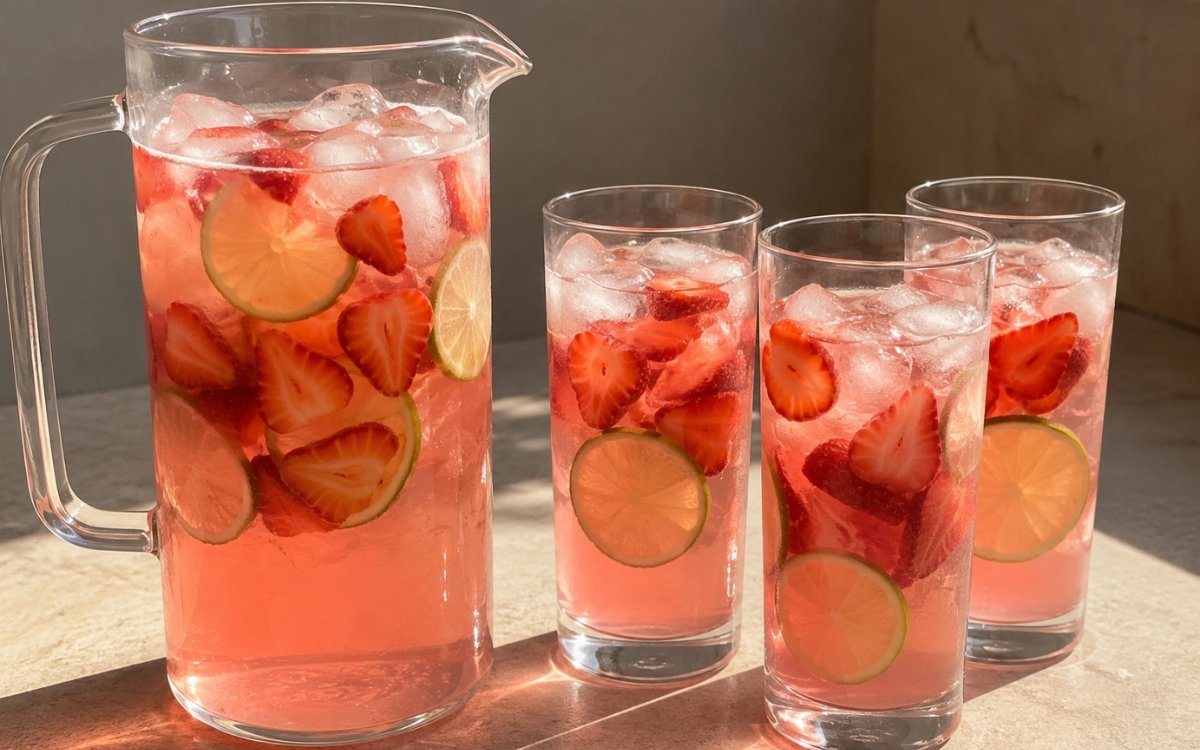
- If using honey, pre-dissolve in 2–3 tablespoons of warm water until completely fluid and clear. Add the pre-dissolved honey, optional lime juice (30ml in 3 litres is specifically restrained — a barely-perceptible citrus brightness rather than any lime flavour), and the 1–2 pinches of fine sea salt to the pitcher with the mashed strawberries. Add the 3 litres of ice-cold water, the sliced strawberries (2 cups/approximately 300g), and the thinly sliced lime rounds. Stir gently once or twice.
Infuse and Time Carefully
- Cover and refrigerate for 1–4 hours. The strawberry's cold infusion produces a progressively deeper pink-red colour and increasingly present strawberry aroma from 1 to 4 hours. At 1 hour: specifically light, clean, and refreshing — a subtle suggestion of strawberry and lime. At 2 hours: the mid-point of pleasant intensity. At 4 hours: the maximum of the specifically clean range. The lime slices' peel bitterness extraction in cold water is specifically faster than lemon peel's — lime's higher limonoid content and thinner, more permeable skin means the bitter compounds begin contributing more quickly. After 4 hours, remove all lime slices and strawberry pieces from the pitcher. The lime rounds specifically should be the priority removal: at 4 hours they are still providing brightness; beyond 4 hours they begin contributing a specifically bitter, astringent note that shifts the water's clean fresh character toward something less pleasant. The strawberries additionally become visibly faded, soft, and waterlogged beyond this point — contributing a dulled, slightly flat fruit flavour rather than the fresh aromatic quality of the infusion period. Serve well chilled directly from the pitcher, or over ice if preferred. Add fresh sliced strawberry and lime to the pitcher or individual glasses at the time of serving for visual freshness if the original infusion pieces have been removed.
Notes
Strawberry quality and ripeness are specifically more important in infused water than in cooked preparations where heat concentration can partially compensate for mild fruit. Cold infusion extracts exactly what is present in the berry's aromatic compounds — a vivid, fragrant, specifically sweet-fruity ripe strawberry produces a vivid, aromatic, specifically refreshing water; a pale, mild, under-ripe strawberry produces a faintly flavoured, mildly pink, specifically less interesting water regardless of technique. Always the most fragrant, most deeply red strawberries available.
Lime's specific peel-bitterness extraction in cold water is faster than lemon's for two reasons: lime peel's limonoid content per unit area is higher than lemon's; and lime skin is thinner and more permeable than lemon skin, allowing the limonoids to migrate into the surrounding cold water more rapidly. This is why the 4-hour maximum is applied with specific urgency to lime-containing infusions.