Ingredients
Method
Mash the Strawberries with Honey and Lemon Zest
- Add the 350g of hulled strawberries to a large bowl. Using a fork or potato masher, mash thoroughly until the strawberries are mostly broken down — a juicy, slightly chunky mixture with some visible pieces remaining rather than a completely smooth purée. The remaining texture is intentional: this is a smash rather than a smoothie, and the visible strawberry pieces distributed through the finished drink are part of both the visual appeal and the eating experience. Mash to the point where the majority of the fruit has released its juice but small pieces remain intact. Add the 45g of honey and the zest of ¼ lemon directly to the mashed strawberries. Stir well until the honey is fully incorporated and the lemon zest is evenly distributed. Honey's specific floral sweetness is particularly well-suited to this preparation rather than granulated sugar — it dissolves immediately into the wet strawberry mixture without any heating required, and its aromatic compounds specifically complement the strawberry's own floral, fruity sweetness in a way that plain sugar's neutral sweetness does not. The lemon zest contributes a fragrant, aromatic citrus thread — a small quantity at ¼ lemon's worth, present as background brightness rather than citrus flavour in the foreground.
Fold the Basil
- Add the 12 roughly torn or chopped basil leaves to the strawberry mixture. Fold them through gently using a large spoon — 3–4 slow, deliberate folding motions that distribute the basil through the mash without crushing the leaves aggressively. This technique distinction — folding rather than mashing — is what makes the basil's contribution aromatic and pleasantly herbal rather than grassy and slightly bitter. When basil leaves are mashed or muddled aggressively, the cell walls rupture completely, releasing chlorophyll alongside the pleasant volatile aromatic compounds — the chlorophyll contributing a specifically grassy, slightly vegetal note that competes with the strawberry's sweetness. When folded, the leaves release their surface aromatics through gentle contact with the acidic, sweet strawberry mixture while the cell walls remain largely intact, producing a specifically cleaner, sweeter, more floral basil character. Because this drink relies entirely on fresh fruit and fresh basil rather than a cooked-and-strained syrup, it is at its absolute best when prepared immediately before serving — the strawberries and basil at their most vivid and fragrant in the first 5 minutes after mashing. Prepared mash that waits begins to macerate: the strawberries release more liquid, the basil starts to darken, and both the visual appeal and the freshness of flavour diminish progressively.
Assemble and Serve Immediately
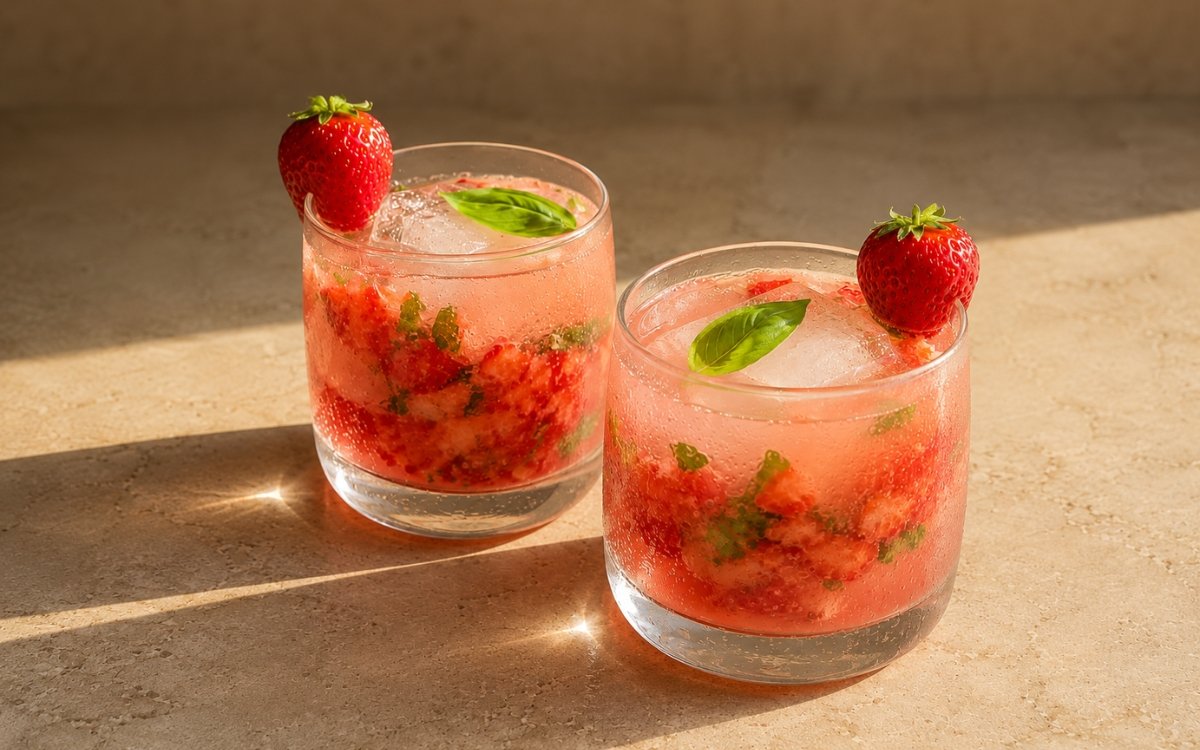
- Divide the strawberry basil mash evenly among four short, wide glasses — tumblers or rocks glasses with a wide base and mouth show the visible fruit pieces most attractively. Add a large ice cube or several smaller cubes to each glass. The large cube preference is specifically for this format: large cubes melt slower than small cubes, keeping the drink cold for longer without progressive dilution that washes out the fresh strawberry flavour before the glass is finished. Pour approximately 150ml of chilled club soda over each glass — pouring gently down the inner side to preserve the carbonation. Stir once or twice with a bar spoon or long stirrer — not to fully blend the mash into the club soda but to distribute the fruit pieces and basil loosely through the glass so every sip encounters some mash alongside the sparkling water. The correct finished appearance is a lightly mixed, slightly cloudy pink drink with visible strawberry pieces and basil leaves throughout — not a uniform, fully mixed red liquid. Slice each of the 4 garnish strawberries from the tip toward the hull, stopping before cutting through completely, and perch on the rim of each glass. Place one fresh basil leaf on top of the ice. Serve immediately — this drink exists only in the window when the strawberries are vibrant, the basil is aromatic, and the club soda is fully sparkling.
Notes
The strawberry quality in this recipe determines the drink's quality more directly than in any of the syrup-based mocktails in this collection — in a cooked syrup, imperfect fruit is concentrated and improved during the cooking process; in a raw mash, the flavour is exactly what the fruit contains, undisguised. Peak-season strawberries at full ripeness — small to medium, deeply red throughout rather than pale at the core, intensely fragrant — produce a mash of completely different quality from out-of-season supermarket strawberries that are large, pale inside, and mild. If the strawberries available are mild and watery, add an additional 10g of honey and the zest of a further ¼ lemon to compensate.
The smash format — raw fruit mashed with sweetener and diluted with sparkling water rather than built on a cooked syrup — produces a more textured, more visually interesting, and more immediately fresh-tasting drink at the cost of the extended shelf life that cooked syrups provide. It is the format to choose when the fruit is exceptional and the occasion is immediate.