Ingredients
Method
Salt the Steak
- Place the steak on a wire rack set over a tray. Season all sides with the fine sea salt. Refrigerate uncovered for 1 to 2 hours. This dry rest seasons the steak and pulls surface moisture out. That surface moisture has to be removed before searing, or the steak will steam instead of forming a crust. Salt draws moisture to the surface through osmosis before eventually reabsorbing back into the meat along with dissolved salt — that uncovered rest on a rack, rather than a plate, lets air circulate around the meat so the drawn-out moisture can actually evaporate rather than pooling underneath.
Rinse and Dry the Steak
- After salting, rinse the steak quickly under cold water to remove excess surface salt. Pat it extremely dry with paper towels. Season lightly with black pepper and garlic powder if using. Let the steak sit at room temperature for 25 to 35 minutes before cooking. The steak must be dry before it hits the pan. Rinsing is fine only if you dry it aggressively after. Any water left on the surface will damage the sear. That aggressive drying after rinsing matters just as much as the drying after the initial salt rest — any residual surface water, whatever its source, converts to steam the instant it meets the hot pan and works directly against real browning.
Prepare the Tortilla Dough
- Mix the masa harina and salt in a bowl. Add the warm water and mix until a soft dough forms. Knead briefly until smooth, then cover and rest for 20 to 30 minutes. Divide into 16 equal balls of about 22g each. Keep the dough balls covered at all times so the masa does not dry out. That brief resting period gives the masa harina genuine time to fully hydrate, which is part of what makes the dough smooth and pliable enough to press evenly rather than cracking at the edges.
Cook the Small Corn Tortillas
- Press each dough ball into a tortilla about 11.4cm / 4.5 inches wide. Cook on a dry hot skillet or griddle for about 45 to 60 seconds per side, flipping until lightly charred, flexible, and cooked through. Stack immediately under a clean towel so the tortillas steam and stay pliable. Tortillas for steak tacos need to stay soft and flexible. If they dry out, they crack when filled. That trapped steam under the towel is exactly what keeps the tortillas soft and pliable right through assembly, rather than stiffening as they cool uncovered.
Sear the Steak
- Heat a heavy skillet, cast iron pan, or grill pan over high heat until very hot. Add the neutral oil. Sear the steak hard, without moving it too early, until a dark crust forms. For steak about 2.5cm / 1 inch thick, use these guides: rare, sear 2 to 2½ minutes per side, pull at 46–48°C; medium-rare, sear 3 to 3½ minutes per side, pull at 50–52°C; medium, sear about 4 minutes per side, pull at 57–60°C; well done, cook 5+ minutes per side, final temperature 71°C+. Medium-rare works best for these tacos. It keeps the beef juicy after slicing and gives you the best contrast between charred edges and pink center. Leaving the steak genuinely undisturbed during that initial sear window is what gives it the sustained, direct pan contact real crust development depends on — moving it too early interrupts that contact before a proper sear has actually formed.
Rest the Steak
- Transfer the steak to a board and rest for 8 to 10 minutes. Do not slice immediately. Resting keeps the juices inside the steak. If you slice too early, the board gets the juice instead of the tacos. During cooking, the steak's internal juices are pushed toward the centre and held under real pressure — that rest period lets the muscle fibers relax and reabsorb those juices evenly throughout, rather than releasing them all at once the moment a knife cuts in too soon.
Slice the Steak
- Slice the steak thinly across the grain. Aim for small strips that fit easily inside the tortillas. Each taco should get about 50g sliced steak. Slicing across the grain is what makes the steak feel tender in the taco. Even perfectly cooked steak will eat tough if sliced the wrong way. Cutting perpendicular to the muscle fibers, rather than parallel to them, shortens those long fibers into much smaller segments — that's the literal mechanism behind why the same steak can taste tender or tough depending purely on slicing direction.
Warm the Tortillas Again
- Right before serving, rewarm the tortillas briefly on a dry skillet if needed. Keep them wrapped in a towel.
Assemble the Tacos
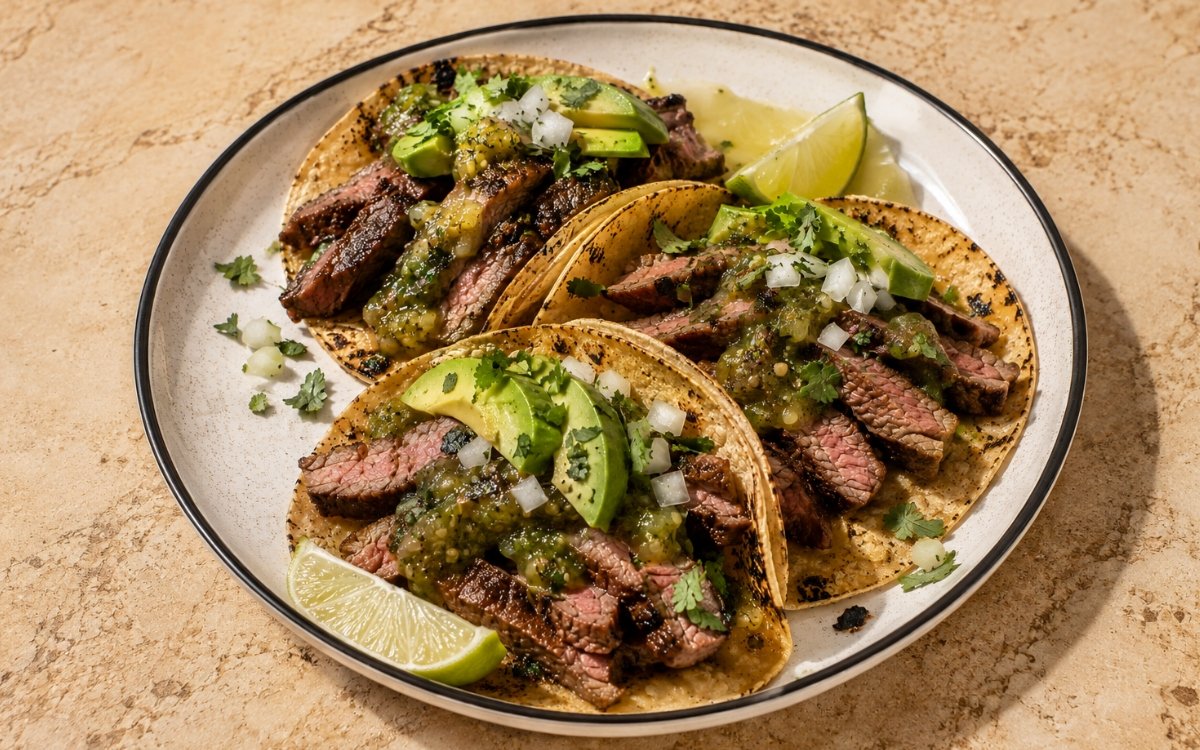
- Fill each warm tortilla with about 50g sliced steak. Top with salsa verde, diced white onion, cilantro, avocado slices, and a squeeze of lime. Serve immediately with extra lime wedges. Using salsa verde as a bright topping rather than a heavy sauce, as the recipe's own notes emphasise, keeps its role as an accent against the beef rather than something that overwhelms or drowns it.
Notes
Salting the steak well ahead and letting it rest uncovered on a rack deserves recognition as the technique most responsible for whether this steak develops a real, dark crust or ends up pale and steamed. That extended dry-brine period does genuine double duty — it seasons the meat throughout via osmosis, and it draws surface moisture out where open air circulation, rather than a covered plate, actually lets that moisture evaporate away.
Resting the steak fully before slicing deserves the same respect this technique receives throughout this collection's other seared and roasted proteins. During cooking, the steak's juices are pushed toward the centre under real pressure, and cutting in too soon releases them all at once onto the board rather than letting them redistribute evenly back through the meat — that patience is directly responsible for how juicy the finished tacos actually taste.
Slicing thinly and specifically across the grain deserves genuine attention as the final, decisive step in this whole process. Even a steak cooked to perfect doneness and rested correctly will still eat tough if sliced with the grain rather than against it — that direction determines whether the muscle's long fibers stay intact and chewy or get shortened into something genuinely tender to bite through.
The recipe's own explicit guidance to use salsa verde as a bright topping rather than a heavy, drowning sauce deserves to be treated as a real principle for this dish's overall balance. Every earlier technique choice — the careful salting, the hard sear, the proper rest and slice — is meant to deliver genuinely good beef as the dish's centre; a heavy-handed sauce would work against showcasing that carefully built result.