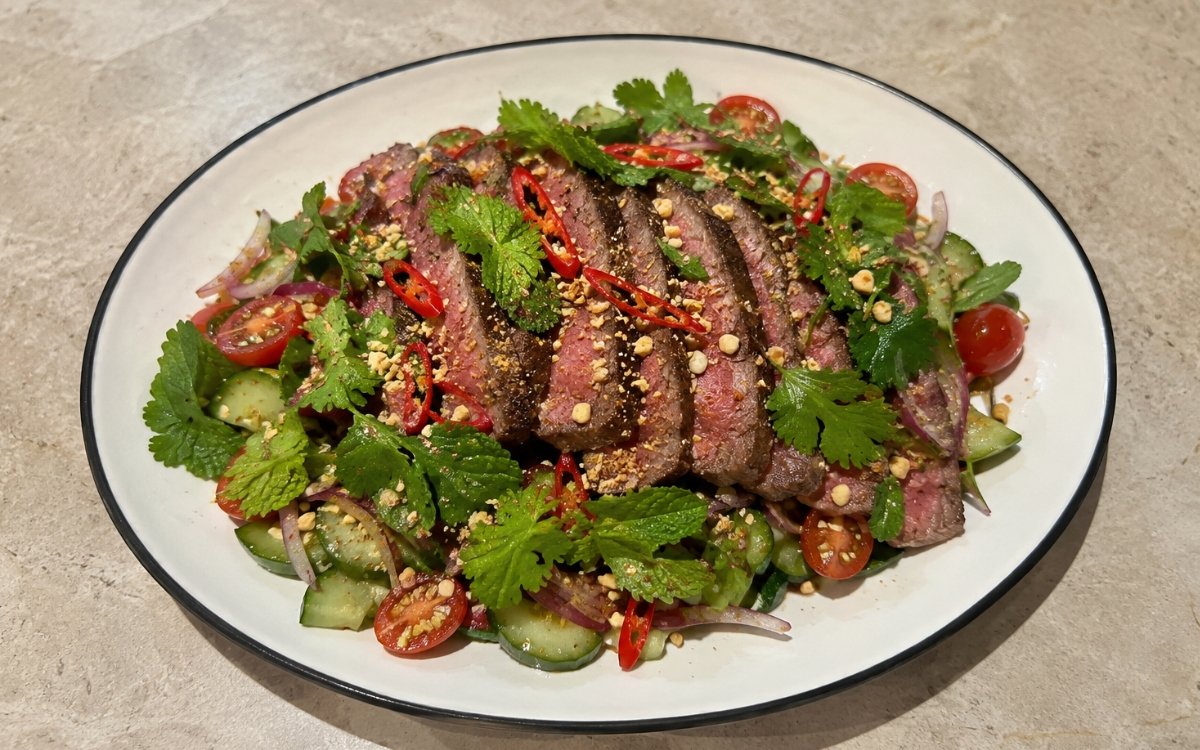
Ingredients
Method
Rest the Steak at Room Temperature
- Remove the steak from the refrigerator and pat completely dry on all surfaces with paper towels. Season lightly with fine sea salt and the 1 tsp of cracked black pepper. Allow to rest at room temperature for 20 minutes before cooking. The room-temperature rest reduces the temperature differential between the steak's cold interior and the ambient heat — a cold steak placed directly on a smoking-hot cast iron produces a larger temperature gradient that causes the exterior to overcook significantly before the interior reaches the correct medium-rare temperature. At room temperature, the heat penetrates more evenly and the cooking window for the correct internal temperature expands.
Make the Dressing
- In a small bowl, combine the 3 tbsp of fish sauce, 4 tbsp of fresh lime juice, 1–1½ tbsp of palm sugar, the finely minced red chilies, and the minced garlic clove. Stir vigorously until the palm sugar has dissolved completely — undissolved palm sugar produces sweet pockets in the dressing rather than uniform sweetness throughout. Taste and assess each dimension. The dressing should be simultaneously salty from the fish sauce, sharply acidic from the lime, spiced from the chili, lightly sweet from the palm sugar, and aromatic from the garlic — with the lime's brightness slightly more forward than the fish sauce's saltiness. This balance is the specific character of a properly made yam neua dressing and the single most important variable in the finished salad. Adjust: if the fish sauce dominates, add additional lime juice in small increments; if the acidity is too sharp, add a small additional amount of palm sugar; if the heat is insufficient, add more chili. Set the dressing aside — it can be made up to 2 hours ahead and kept at room temperature. Palm sugar — made from the sap of the sugar palm — has a specifically caramel-adjacent, slightly complex sweetness that is different from refined white sugar's clean, neutral sweetness. In the dressing, its caramel character softens the lime's acidity and the fish sauce's saltiness into a more rounded balance. Granulated white sugar is the functional substitute at ¾ the quantity, though the specific depth of palm sugar's character is absent.
Prepare the Salad Components
- Slice the 200g of cucumber lengthwise into thick vertical quarters, then cut each section diagonally into bite-sized angled pieces — the angled cut produces more surface area on each piece for dressing adhesion. Slice the ½ red onion into thin feathers — from root to tip following the onion's curve for the most supple, most evenly flavoured slices. Halve the 180g of cherry tomatoes. Pick the mint, cilantro, and Thai basil leaves from their stems, keeping them whole or roughly torn — the three-herb combination is the non-negotiable aromatic foundation of yam neua. Each herb provides a distinct dimension that the other two cannot supply: mint's cooling, slightly menthol freshness; cilantro's clean, slightly citrusy-green brightness; Thai basil's specifically anise-like, slightly spiced warmth. Together they produce the characteristically Thai fresh-herb complexity; any single herb provides only one dimension of this combination. Slice the spring onions thinly if using.
Toast the Rice Powder (If Using)
- If using the optional toasted rice powder — khao khua — prepare it now. Add 2 tbsp of uncooked glutinous or jasmine rice to a dry pan over medium-low heat. Toast, stirring frequently, for 8–10 minutes until the rice turns light golden-brown and smells nutty and toasted. Transfer to a bowl and allow to cool completely, then grind to a coarse powder in a mortar and pestle, a spice grinder, or a small food processor. The toasted rice powder is the garnish that makes each piece of beef and each vegetable adhere to the dressing more completely — its starchy, slightly rough surface texture acting as a binding agent between the dressing and the food. It also contributes a specifically nutty, slightly smoky depth that distinguishes yam neua from any other Thai beef preparation. It keeps at room temperature in a sealed container for up to 2 weeks.
Sear the Steak
- Heat a cast iron pan or grill over the absolute highest available heat for 2–3 full minutes until genuinely smoking — the quality of the sear is directly proportional to the surface temperature at the moment of contact. Add the 1 tbsp of neutral oil and allow to shimmer. Place the seasoned sirloin flat on the surface. Sear undisturbed for 2–4 minutes depending on thickness — a 2.5cm steak requires approximately 3 minutes per side for medium-rare. Leave completely undisturbed during this period: the Maillard crust that produces the specific charred, deeply savoury exterior of properly seared sirloin requires sustained, uninterrupted contact between the meat's surface and the hot iron. Flip once and sear the second side for the same time. The correct internal temperature for yam neua is medium-rare to medium — 52–57°C — where the beef is sufficiently pink and juicy to contrast with the dressing's acidity without the chewiness and dryness of well-done. For flank steak: flank is leaner and more fibrous than sirloin, with a more pronounced grain direction — cook according to thickness (typically 2–3 minutes per side for medium-rare) and slice specifically thin, strictly against the very visible grain, as flank becomes noticeably tough when sliced with the grain.
Rest and Slice
- Transfer the seared steak to a cutting board. Rest for 7–10 minutes without cutting. This rest is not optional and should not be shortened — the juices driven to the steak's surface by the sear's heat require time to redistribute back through the interior. A steak cut immediately after the pan loses a pool of juice onto the cutting board rather than into each slice; a properly rested steak retains these juices internally. After the full rest, slice the steak thinly against the grain — identifying the muscle fibres and cutting strictly perpendicular to them, into 5–8mm slices. Thin against-grain slices are specifically more tender than thick against-grain slices and significantly more tender than any with-grain slices regardless of thickness. Reserve all accumulated resting juices on the cutting board — they are added back to the salad with the beef.
Assemble and Serve Immediately
- In a large bowl, combine the cucumber, cherry tomatoes, red onion, mint, cilantro, Thai basil, and spring onions if using. Pour over approximately two-thirds of the prepared dressing and toss gently — just enough to coat every component without bruising the herbs. Lay the sliced beef on top of the herb and vegetable mixture — arranged rather than tossed through — and pour all the accumulated resting juices over the beef. Spoon the remaining dressing specifically over the steak slices. Scatter the crushed roasted peanuts and the toasted rice powder over the assembled salad. Serve immediately while the beef is still warm — the temperature contrast between the warm, charred beef and the cold fresh herbs, sharp lime dressing, and chili heat is the specific eating experience that makes yam neua compelling. A salad where the beef has cooled to room temperature alongside the herbs loses this contrast and produces a significantly less vivid result.
Notes
Yam neua — ยำเนื้อ — translates literally as beef salad in Thai, and the yam preparation category encompasses a wide range of Thai warm salads characterised by the fish sauce-lime-palm sugar-chili dressing applied to a combination of proteins, vegetables, and fresh herbs. What distinguishes yam neua from all other Thai salads is the specific interaction between warm seared beef's richness and char against the cold, sharp, intensely acidic dressing and the cooling fresh herbs — a thermal and flavour contrast that is more dramatic than in any other yam preparation.
The toasted rice powder — khao khua — is worth making from scratch rather than omitting. It appears in numerous Thai preparations (larb, yam neua, lab moo) precisely because its specific function — providing dressing adhesion and nutty depth simultaneously — cannot be approximated by any other garnish. Pre-made versions are available at Thai grocery stores but homemade, made immediately before using, has a more vivid toasted character.