Ingredients
Method
Toast and Grind the Sichuan Peppercorns
- Before any other preparation begins, toast the Sichuan peppercorns — their aromatic transformation through dry-heat toasting is significant and cannot be skipped. Place the 15g of Sichuan peppercorns in a small dry skillet over medium heat and toast for 2–3 minutes, shaking or stirring continuously, until they are noticeably more fragrant and show very light additional darkening on their surface. The toasting drives off moisture and activates the peppercorns' volatile aromatic compounds — the specific citrus-floral, slightly resinous aroma of Sichuan peppercorn is most fully present when the peppercorns have been dry-toasted. Remove immediately when the aroma intensifies — toasted beyond this point, Sichuan peppercorns develop a slightly bitter, ashy character. Allow to cool for 2 minutes, then grind to a coarse powder in a spice grinder, mortar and pestle, or under the flat side of a heavy knife. Coarse rather than fine grinding is preferred for this sauce — fine powder distributes more evenly but loses some of the direct textural impact of the spice; coarse ground particles provide occasional concentrated hits of the numbing-tingle alongside its background presence throughout the sauce. Set aside.
Cook the Noodles
- Bring a large pot of water to a full rolling boil. Add the 400g of udon noodles and cook according to package directions until just tender — typically 8–10 minutes. Udon noodles' thickness and dense, chewy structure require longer cooking than thinner Asian noodles, and they should be fully cooked through with no raw, hard centre when bitten, as they will not receive any further heat beyond warming in the sauce. Unlike Italian pasta where pulling al dente is essential before finishing in sauce, udon cooked to full tenderness is correct here because the sauce is not a cooking medium. Drain and rinse immediately under cold running water — the cold rinse stops cooking instantly and removes the excess surface starch that would cause the thick udon to clump together during the preparation time before sauce coating. Shake off excess water thoroughly and toss with the 5ml of sesame oil, coating every noodle. Set aside.
Make the Spicy Peanut Sauce
- In a medium bowl, combine the 180g of natural peanut butter — natural peanut butter is specified because it contains only peanuts and salt, without the added sugar and stabilising hydrogenated oils in commercial peanut butter that produce a sweeter, more solidified sauce that does not emulsify as smoothly. Add the 60ml of soy sauce, 45ml of rice vinegar, 25ml of sesame oil, 25g of light brown sugar, 20g of finely grated fresh ginger, 20g of minced garlic, 8g of finely chopped bird's eye chilies, and the ground Sichuan peppercorns. Begin whisking. At this stage the mixture will be thick and difficult to combine — the peanut butter's fat resists uniform integration with the water-based soy and vinegar before the hot water is added. Whisk for 30 seconds to partially combine the ingredients, then add the 60ml of hot water gradually while whisking continuously. The hot water performs the critical emulsification — it dissolves the peanut butter's fat into the surrounding liquid by reducing the fat's viscosity at elevated temperature, producing a smooth, uniform, pourable sauce rather than a separated, oily-and-watery mixture. Continue whisking until the sauce is completely smooth, uniform, and drops slowly from the whisk in a thick ribbon. Taste the finished sauce — it should be simultaneously rich, salty, sour, sweet, garlicky, gingery, and spicy with the background numbing tingle of the Sichuan peppercorn beginning to develop. Adjust: more rice vinegar for brightness, more soy for saltiness, more brown sugar for sweetness, more chili for heat.
Stir-Fry the Vegetables
- Heat a large wok or deep skillet over medium-high heat until hot. Add the 200g of julienned red bell pepper and 120g of julienned carrot directly to the dry or very lightly oiled wok. Stir-fry for 2–3 minutes, keeping the vegetables moving and allowing brief direct contact with the hot surface — the brief stationary contact produces the slight char at the edges that distinguishes stir-fried vegetables from simply softened ones. The target texture is tender-crisp: clearly cooked through but retaining a clean, pleasant crunch rather than being soft throughout. The bell pepper and carrot are the cooked-warm element of this dish's textural composition — they provide warmth and slight char alongside the cooler, raw crunch of the cucumber added at the end. Add the 100g of edamame and cook for 1 minute, stirring, to heat through.
Combine Noodles and Sauce
- Reduce the heat to medium-low. Add the sesame-tossed udon noodles to the wok with the stir-fried vegetables. Pour the entire peanut sauce over the noodles. Using tongs, toss everything together for 2–3 minutes, turning the noodles through the sauce continuously to coat every strand. The medium-low heat during this step warms the noodles through and loosens the peanut sauce slightly — at room temperature the sauce is thicker than at gentle wok warmth, and the slight heat from the wok makes the sauce flow more fluidly around each noodle. If the sauce is too thick to flow freely during tossing, add additional hot water one tablespoon at a time while tossing — the sauce should cling to the noodles as a glossy, thick coating rather than sitting in a pool at the bottom of the wok.
Add the Fresh Elements
- Remove from the heat completely. Add the 150g of julienned cucumber, half of the chopped peanuts, half of the cilantro, and half of the green onions. Toss gently to distribute — the cucumber goes in off the heat specifically to preserve its crunch and fresh, cool character. Cucumber cooked in the wok would release its moisture into the sauce, diluting it, and lose the structural crispness that provides the textural contrast this dish specifically needs. The cold cucumber against the warm noodles is part of the intended eating experience — do not add it earlier.
Serve
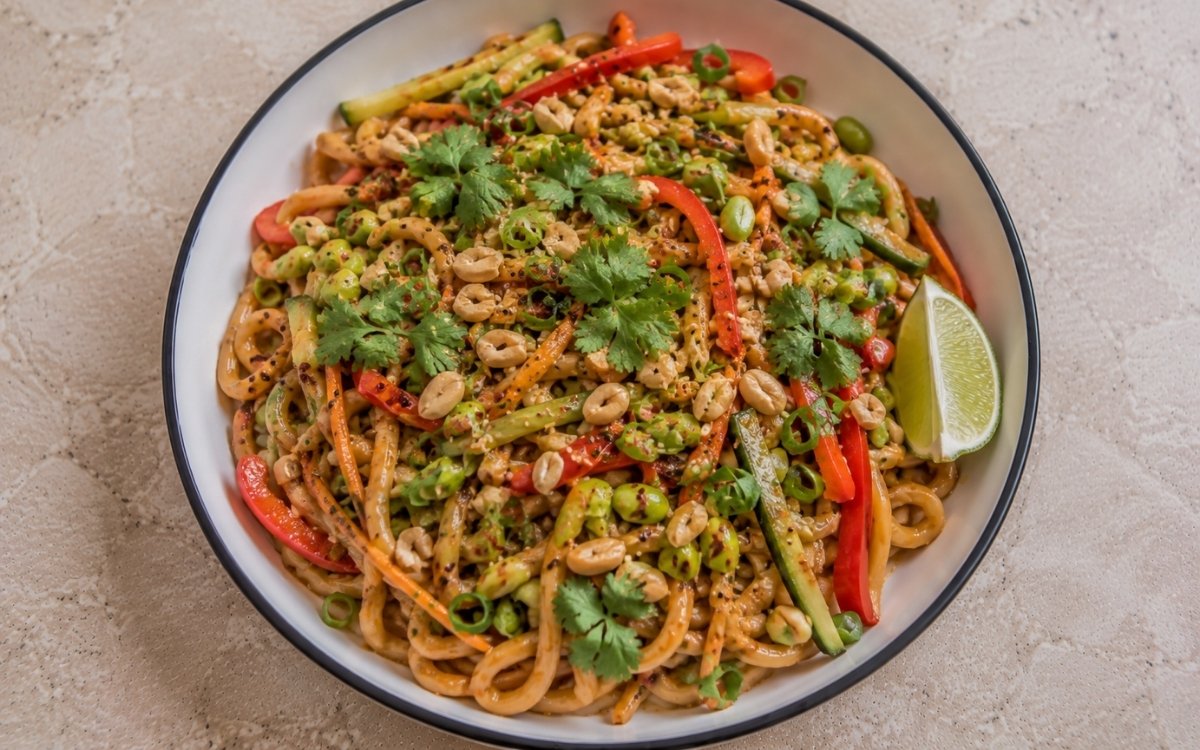
- Divide among four bowls. Top each bowl with the remaining chopped peanuts, cilantro, and green onions. Drizzle the 15ml of chili oil over all four bowls — this finishing chili oil adds an additional aromatic, slightly smoky heat on top of the integrated sauce's more distributed spice. Scatter the 10g of black sesame seeds across all four portions. Place lime wedges alongside each bowl for squeezing at the table — the lime's bright citrus acidity cuts through the peanut sauce's richness and amplifies the sauce's other acid elements in a way that makes the dish taste more complete. Serve immediately if eating hot, or allow to rest at room temperature for 30–60 minutes for the version where the noodles have absorbed the sauce and the flavours have deepened and integrated.
Notes
The room-temperature serving option for this dish is not simply a convenience note — it is a genuinely different and specifically better version of the dish for some people and occasions. When peanut sauce noodles are served immediately, the sauce is at maximum viscosity and all flavour components are at maximum individual distinctiveness. When the same dish rests for 30–60 minutes, the udon noodles absorb a significant portion of the sauce's liquid components, the peanut butter's fat distributes more completely through every noodle, and the garlic, ginger, and Sichuan peppercorn's aromatic compounds deepen and integrate with the surrounding peanut-sesame base. The chili heat also mellows and distributes more evenly. The result is a more unified, more deeply flavoured noodle dish where the individual components are less distinct and the overall sauce character is more completely present. Both are excellent — choose based on intention.
Natural peanut butter — ground peanuts with nothing else, or with only salt — is the only correct peanut butter for this sauce. Commercial peanut butters with added sugar and stabilising palm oil produce a sweeter, more solid sauce that does not emulsify properly with the hot water and soy, producing a grainy, slightly cloying result. Natural peanut butter emulsifies smoothly because its fat is un-stabilised and responds directly to hot-water dilution.
The bird's eye chili and Sichuan peppercorn combination produces a two-register heat profile that is specifically different from either alone. Bird's eye chilies provide direct, sharp, immediate heat from capsaicin. Sichuan peppercorns provide the tingling, numbing, slightly citrus-floral mala sensation. Together they produce alternating impressions — sharp heat followed by numbing tingle — that make the spice experience more interesting and more specifically Asian in character than any single chili or peppercorn alone.