Ingredients
Method
Prepare the Garlic
- Peel the 6 garlic cloves and inspect each one for a green inner sprout — the small central shoot that develops in older cloves and contributes the most bitter, most aggressively pungent compounds to any garlic preparation. Halve each clove and remove any visible sprout with the tip of a knife. Use the firmest, freshest cloves available — older, softening garlic with large sprouts has significantly degraded emulsifying compounds and produces both a harsher flavour and a more difficult emulsion to build.
Grind to a Completely Smooth Paste (Mortar and Pestle)
- Add the prepared garlic cloves to a mortar along with the ½ tsp of fine sea salt. The salt serves two simultaneous functions: it provides seasoning, and its abrasive crystal structure acts as a grinding medium against the mortar's interior surface — accelerating the reduction of the garlic cloves from rough pieces to the completely smooth, wet paste that the alioli's emulsification requires. Begin crushing the garlic with the pestle using downward pressing and smearing strokes — pressing the garlic against the mortar's curved interior and smearing outward rather than simply pounding, which produces pieces rather than paste. Continue for 3–5 minutes until every visible garlic piece has been reduced to a completely smooth, homogeneous paste with no fibrous strands or visible chunks remaining. Any remaining garlic chunks at this stage will prevent the emulsion from forming completely — the garlic's emulsifying saponins are released from its cells during grinding, and incompletely crushed pieces contain trapped saponins that are not available to the surrounding oil.
Begin the Oil Addition Drop by Drop
- This is the stage that requires the most patience and the most deliberate pace — and also the stage where the entire preparation succeeds or fails. With the pestle in one hand and the olive oil in the other, begin adding the 240ml of olive oil literally a few drops at a time — every addition should be visually smaller than a teaspoon. Simultaneously, grind and stir the mixture in a continuous, steady circular motion with the pestle, working the tiny oil drops into the garlic paste with each addition. Alioli's emulsification differs fundamentally from mayonnaise's because it has no egg-yolk lecithin as a primary emulsifying agent. The emulsion is held entirely by the garlic's natural saponins — plant-based surfactant compounds — and by the mechanical action of the mortar and pestle continuously breaking each oil addition into smaller droplets that the saponin-coated paste can encapsulate. This physical emulsification is significantly more fragile than lecithin-stabilised emulsions and completely intolerant of rapid oil addition at any stage, particularly at the beginning before the emulsion is established. A single large pour at the start produces an oil-flooded paste that the saponins cannot encapsulate faster than it arrives — the emulsion breaks immediately. For the first 3–5 tablespoons of oil: drop by drop. No faster.
Build the Emulsion and Increase Oil Flow Gradually
- After approximately 3–5 tablespoons of oil have been incorporated and the mixture has visibly thickened, whitened slightly, and begun to look glossy and cohesive rather than oily and separated, the emulsion has established itself sufficiently to tolerate a slightly faster addition. Increase from individual drops to the thinnest possible steady stream — a thread of oil rather than a pour — while continuing the circular grinding motion continuously. Any pause in the grinding motion allows the oil droplets to begin coalescing before they are fully encapsulated; continuous motion is what maintains the dispersed droplet state throughout.
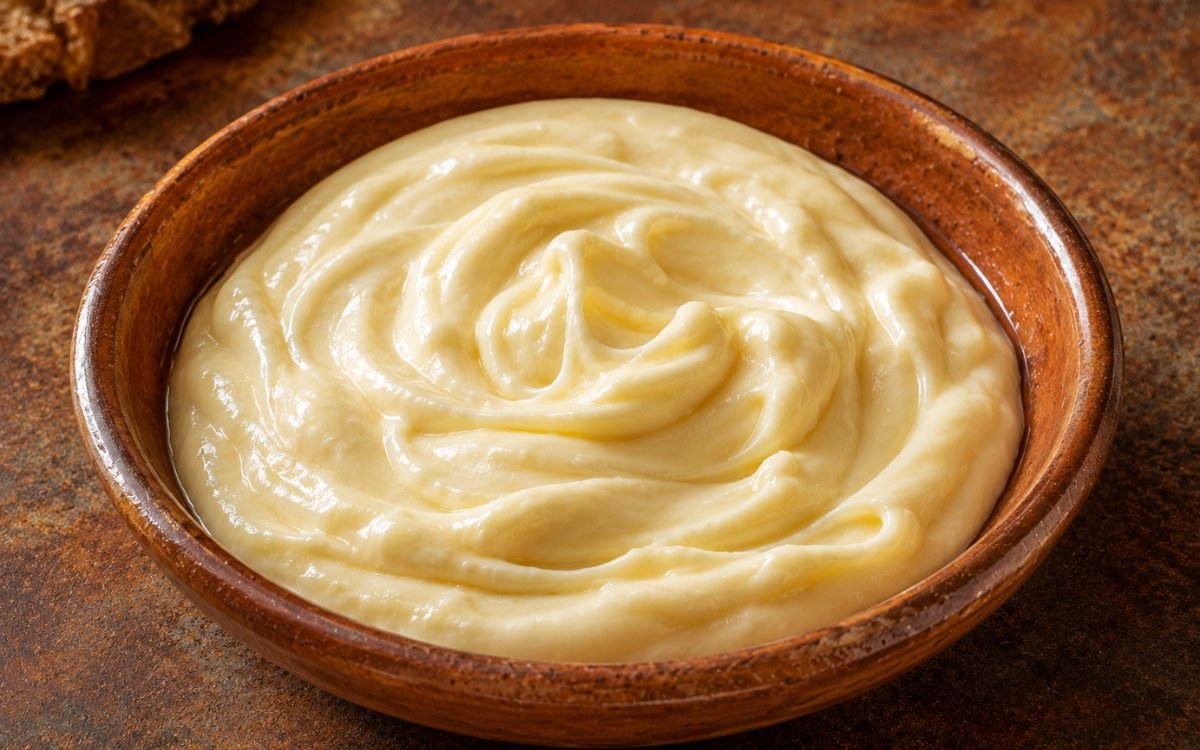
- Continue building gradually until all 240ml of olive oil has been incorporated. The entire process at the mortar and pestle takes 15–20 minutes from first oil drop to finished alioli — this is the correct time for this preparation. Rushing it produces a broken emulsion. The finished alioli should be thick enough to hold soft peaks when a spoon is lifted from it — maintaining its shape rather than flowing — and should be pale yellow-white in colour from the emulsified olive oil. Taste and adjust with additional salt if needed. Food Processor Method: Use a small food processor or mini chopper — a large standard processor bowl cannot properly process such a small quantity. Add the garlic and salt first. Process until the garlic forms a very smooth paste, scraping down the sides repeatedly — even more critical than in the mortar, because the machine's blades cannot make consistent contact with small quantities against the bowl's walls. With the machine running continuously, begin adding the olive oil drop by drop through the feed tube — identically to the mortar method. Do not pour. After the mixture begins thickening and whitening, increase to the thinnest possible thread of oil, pausing occasionally to scrape the bowl sides. If the alioli becomes too thick before all the oil is incorporated, add 1 tsp of cold water and continue. Avoid running the machine continuously for more than 30–40 seconds without a pause — heat generated by the motor can warm the emulsion and destabilise it.
Split Recovery
- If the alioli separates at any point — visible as the mixture returning to an oily, thin, separated state rather than the cohesive white cream — stop adding oil immediately. Adding more oil to a broken emulsion makes the recovery significantly harder, not easier. Mortar and pestle recovery: In a clean mortar, crush 1 fresh garlic clove with a small pinch of salt to a completely smooth paste — this new paste provides a fresh saponin base for re-emulsification. Add the split alioli back into the new paste one teaspoon at a time, grinding constantly and allowing each addition to be fully incorporated before adding the next. The split alioli will progressively re-emulsify as each small addition is worked into the new base. Food processor recovery: Make a fresh garlic paste with 1 clove and a small pinch of salt in a clean mini processor. With the machine running, drizzle the split alioli back in drop by drop until re-emulsified. If the alioli still struggles to stabilise after either recovery method, add a few drops of fresh lemon juice or 1 tsp of cold water — both help stabilise the emulsion when the garlic saponins are insufficient. Note that once lemon juice is added the preparation is technically no longer the strict three-ingredient traditional version, but remains a good alioli.
Notes
Traditional Spanish alioli — Catalan: all i oli, literally "garlic and oil" — is one of the oldest emulsified condiments in culinary history, predating both mayonnaise and aioli (the French-influenced egg-yolk version) by several centuries in the Catalan and Valencian regions of Spain. The three-ingredient version is specifically the Catalan tradition; the egg-yolk versions common in other parts of Spain and southern France are modern adaptations. The flavour difference between the traditional three-ingredient alioli and any garlic mayonnaise is dramatic — traditional alioli is significantly more pungent, more intensely garlicky, and more specifically aromatic because there is nothing between the palate and the raw garlic's full character.
The mortar and pestle versus food processor question is both practical and philosophical. The mortar and pestle produces the most authentic texture — the saponins released by the manual grinding method are more completely distributed through the paste than those released by machine processing, producing a more stable emulsion that is less prone to splitting. The food processor produces a good result more quickly with less physical effort. For the first attempt, the mortar method provides better control and better feedback about the emulsion's development state.
Extra-virgin olive oil — not light olive oil, not neutral oil — is the correct and only fat for traditional alioli. The olive oil's flavour is the secondary flavour of the finished condiment after the garlic; a bland oil produces a bland alioli. The robust, slightly bitter, peppery finish of good extra-virgin olive oil is specifically complementary to the garlic's pungency.