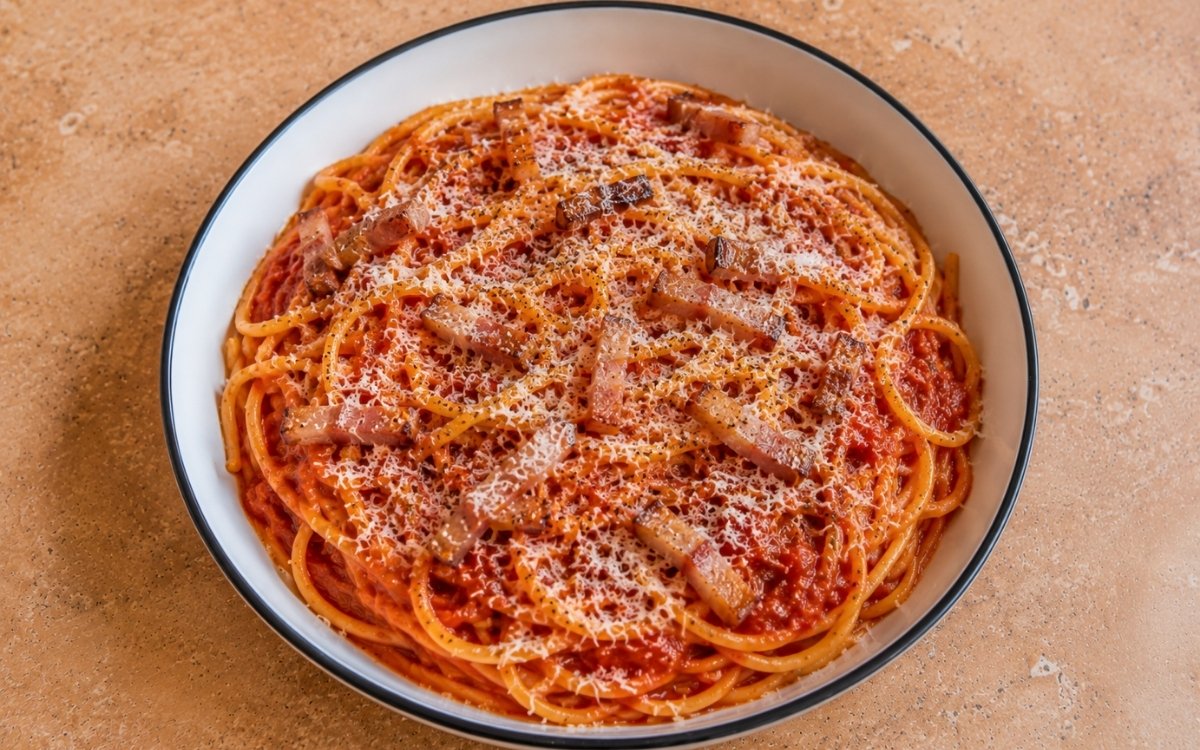
Ingredients
Method
Render the Guanciale from Cold
- Place the guanciale strips and olive oil in a large, cold skillet — stainless steel or carbon steel for maximum fond development. Start with the pan cold and bring the heat up together to medium-low, exactly as you would for carbonara. The cold-start method allows the guanciale's fat to render gradually from inside each strip, producing pieces that are completely rendered, golden and crispy at the edges, but still slightly tender and yielding at the centre — rather than the uniformly hard, dry result of a hot-pan start that browns the exterior before the interior fat can melt. Cook slowly for 8–10 minutes, stirring occasionally, until the strips are deeply golden at their edges, the fat has rendered fully into the pan — approximately 3–4 tablespoons of clear, sweet pork fat — and the pieces are crispy at the tips but still have some texture. The guanciale's rendered fat is not just a cooking medium — it is an active flavour component of the sauce. Every drop stays in the pan and becomes part of the finished amatriciana. Add the crushed dried chili pepper or red pepper flakes to the rendered fat and toast for 30 seconds, stirring continuously, until intensely fragrant. At low heat the chili's aromatic compounds and fat-soluble capsaicin bloom into the surrounding guanciale fat rather than burning — this blooming step infuses the fat that will subsequently coat every component of the sauce with a pervasive, even heat rather than delivering concentrated chili flavour only when a flake is encountered directly.
Deglaze with White Wine
- Increase the heat to medium-high and pour in the 150ml of dry white wine. The wine will sizzle and steam immediately on contact with the hot rendered fat and fond. Let it bubble vigorously for 2–3 minutes without stirring initially — the violent reduction is partly what lifts the fond from the pan surface. After 30 seconds of vigorous bubbling, scrape the bottom of the pan firmly with a wooden spoon or spatula to dissolve all browned bits into the wine. Continue cooking over medium-high heat until the wine is reduced by approximately half — the sharp, raw alcohol edge should be completely cooked off and the liquid should smell of concentrated wine rather than raw alcohol. The white wine serves three distinct functions in amatriciana: it deglazes the pan and incorporates the fond; it adds a secondary, more delicate acidity that bridges the guanciale's sweetness and the tomato's more direct acidic flavour; and it adds a slight fruity depth that you cannot add by any other means. Traditional Roman amatriciana does not always include wine — some recipes use only tomato — but the wine version produces a more layered, more complex sauce with noticeably better depth.
Add the Tomatoes and Simmer
- Add the hand-crushed San Marzano tomatoes with all their juices to the skillet. Hand-crushing — squeezing each whole tomato over the pan until it breaks open — rather than using pre-crushed tomatoes gives you textural control: some sections remain as identifiable tomato pieces that provide distinct tomato bites in the finished dish, while the rest becomes sauce. The varied texture is more interesting and more visually appealing than uniformly crushed tomatoes. Reduce the heat to medium-low and simmer uncovered for 12–15 minutes, stirring occasionally, until the sauce has thickened noticeably and the fat from the guanciale has begun to separate slightly at the edges of the sauce — visible as small orange-red pools of enriched oil at the perimeter. This fat separation is not a flaw but the sign that the sauce has reached the correct concentration and that the guanciale's fat has fully integrated and then re-emerged as a visible finishing element. The sauce should coat the back of a spoon clearly at this point. Season with salt very conservatively — taste first, because the guanciale's salt and the Pecorino that will be added at the end are both very salty. The sauce may need no additional salt at all, or only the smallest pinch. Add black pepper to taste.
Cook the Pasta
- While the sauce simmers, bring a large pot of water to a full rolling boil and add the 15g of fine sea salt. Add the spaghetti or bucatini and cook for 2 minutes less than the package directions indicate — the pasta will finish cooking in the sauce. Bucatini — the thick, hollow spaghetti shape — is the most traditional format for amatriciana, originating from the town of Amatrice from which the sauce takes its name. Its hollow core traps sauce and guanciale pieces inside, delivering a concentrated burst of flavour from the interior of each piece alongside the sauce-coated exterior. Thick spaghetti is equally traditional and more widely available. Standard spaghetti produces an excellent result. Before transferring the pasta, reserve at least 200ml of the starchy pasta cooking water in a heatproof jug and keep it warm.
Finish the Pasta in the Sauce
- Using tongs, transfer the underdrained pasta directly from the pot to the skillet with the amatriciana sauce — bringing approximately 60ml of pasta water with it in the transfer. Return the heat to medium. Toss the pasta vigorously in the sauce for 1–2 minutes, turning continuously to coat every strand. The pasta finishes cooking in the sauce during this time — absorbing the tomato, guanciale fat, and wine into the pasta itself rather than being simply coated externally. Add reserved pasta water in 30ml increments if the sauce tightens — the starchy water loosens it immediately while the starch also contributes to the emulsification. After 1–2 minutes the pasta should be at perfect al dente, coated in a glossy, slightly thickened tomato-guanciale sauce with the pasta water's starch having partially emulsified the fat into the sauce.
Add the Pecorino Romano
- Remove the skillet from the heat completely. Allow to rest for 30 seconds — this brief cooling is important because Pecorino Romano, like all high-protein hard cheeses, seizes and clumps when added to liquid that is at a full boil. The 30-second rest brings the sauce to the temperature range where the cheese proteins remain pliable and melt smoothly rather than seizing. Add 80g of the finely grated Pecorino Romano to the pasta and toss energetically — lift from the bottom and fold over the top in continuous motion. The residual heat of the pasta, sauce, and pan is precisely sufficient to melt the Pecorino smoothly into a creamy, coating emulsion that combines with the fat and starch in the sauce into a unified, glossy finish. Add small amounts of the reserved pasta water if needed to maintain a flowing consistency — the sauce should coat each strand without pooling at the bottom of the pan. Divide immediately among four warm bowls. Top each portion with a portion of the remaining 40g of Pecorino Romano and a generous crack of fresh black pepper. Serve without delay.
Notes
Amatriciana originates from Amatrice, a town in the Lazio region northeast of Rome that was partially destroyed in a 2016 earthquake — an event that brought renewed international attention and solidarity toward the town's cultural heritage, including its most famous culinary contribution. The original preparation, called gricia, contained only guanciale, Pecorino, black pepper, and pasta — no tomatoes, which were not incorporated until the 18th century. The tomato version — amatriciana — became the dominant preparation and eventually one of the four canonical Roman pasta dishes alongside carbonara, cacio e pepe, and cacio e pepe's cousin gricia.
The difference between guanciale and pancetta in this dish is more significant than in carbonara because amatriciana's guanciale fat becomes a visible, textural, and flavour component of the sauce rather than being emulsified invisibly into an egg-cheese coating. The sweet, delicate character of guanciale's fat specifically complements the tomato's acidity — pancetta's fat is more neutral and bacon's fat is smoked, which competes with rather than complements the tomato. Guanciale is increasingly available and worth sourcing for the authentic result.
San Marzano DOP tomatoes are specified because their balance of low acidity, high flesh content, and concentrated sweetness produces a sauce that reaches the correct consistency and flavour balance in 12–15 minutes. Standard crushed tomatoes require longer cooking and more sugar adjustment to reach the same balance.