Ingredients
Method
Prepare the Oven and Tray
- Preheat the oven to 200°C. Line a baking tray with parchment paper. Having the tray fully lined and ready before the wrapping stage begins means each piece can go straight from being wrapped to the tray without sitting around and warming up, which matters for how well the pastry holds its shape through baking.
Prepare the Filling
- Pat the cocktail sausages dry with paper towel so the pastry grips them better. Cut the cheddar into 16 small logs, each one slightly shorter than the sausage so the cheese stays mostly enclosed once wrapped. Drying the sausages thoroughly removes surface moisture that would otherwise sit between the meat and the pastry, weakening the seal at exactly the point where the wrap needs to hold together tightest.
Cut the Puff Pastry
- Lightly flour the work surface if needed and roll the puff pastry just enough to even it out. Cut the pastry into 16 strips or rectangles, large enough to wrap around one sausage and one cheddar log placed side by side. You want enough pastry to encase them snugly, but not so much that the layers become too thick. Cutting each piece to a snug rather than generous size keeps the pastry-to-filling ratio balanced — too much excess pastry produces a thicker, doughier wrap that takes longer to cook through and can overwhelm the small filling inside.
Wrap the Sausages
- Place one sausage and one cheddar log side by side on a piece of pastry. Wrap the pastry around them so the sausage sits beside the cheese inside the pastry, not on top of it. Seal the edge lightly by pressing the seam closed, then place seam-side down on the prepared tray. Repeat with the remaining sausages. Placing the sausage and cheese side by side rather than stacked keeps the finished cross-section compact and even, and positioning the seam face-down against the tray uses gravity and the pastry's own weight to help hold it closed through the initial stages of baking, before the heat has set the dough.
Egg Wash and Finish
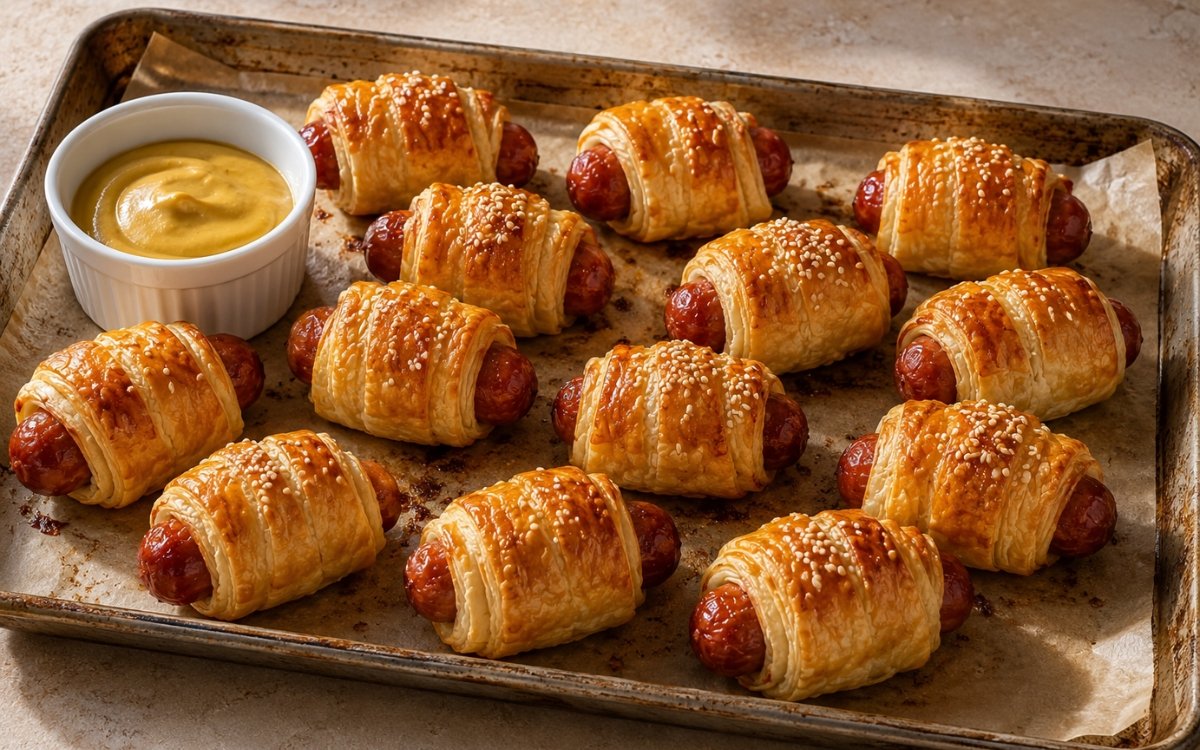
- Whisk the egg with the milk or water until smooth. Brush each wrapped sausage generously with the egg wash. Sprinkle some of them with sesame seeds if desired, leaving some plain for a more classic mixed look. A generous, even egg wash is what produces the deep golden colour and glossy sheen on the finished pastry — thin or patchy coverage bakes up duller and less uniformly browned.
Bake
- Bake for 18–22 minutes, or until the pastry is deep golden-brown, glossy, and fully puffed. The pastry should look crisp and cooked through, and the sausage ends should be lightly browned. A little melted cheddar escaping at the seams is completely fine. Puff pastry's rise depends on layers of butter creating steam as they heat, which is why the oven needs to be properly preheated before the tray goes in — a cooler starting oven gives the butter time to melt and seep out before the pastry has a chance to puff, producing a flatter, greasier result.
Rest and Serve
- Let them rest for 3–5 minutes after baking so the cheese settles slightly. Serve warm with mustard and ketchup on the side. The cheese is at its most fluid straight out of the oven; a short rest lets it firm up just enough to stay contained rather than spilling out completely the moment each piece is picked up, while it's still warm and melted when eaten.
Notes
Drying the sausages before wrapping is a step that's easy to skip given how quick and simple this recipe otherwise is, but it has a real effect on how cleanly the pastry seals. Any lingering surface moisture on the sausage sits directly against the pastry at the seam, which is exactly the point where a clean, tight seal matters most for keeping the wrap intact through baking — a damp surface there makes that seal noticeably less reliable.
Positioning the cheese log beside the sausage rather than stacked on top of it is a small assembly choice with a real payoff in the finished shape. Side by side, the two fillings sit at roughly the same height, which lets the pastry wrap around them evenly without one component distorting the shape more than the other. Stacking them instead tends to produce a lumpier, less consistent wrap from piece to piece.
The seam-side-down placement on the tray is worth doing consistently rather than treating as optional, since it uses the simplest available tool — gravity — to help keep the wrap closed during the early part of baking, before the pastry itself has set. A seam left facing upward or to the side has a better chance of opening slightly as the pastry puffs and shifts, which is when filling and melted cheese are most likely to escape untidily.
A properly preheated oven is worth confirming rather than assuming, given how directly puff pastry's rise depends on heat arriving quickly and consistently. The pastry's characteristic flaky layers come from butter melting and releasing steam as the dough heats — that process needs to happen fast enough that the steam gets trapped and pushes the layers apart before the butter simply melts out and pools. An underheated oven undermines that timing and produces a flatter, less flaky result.