Ingredients
Method
Prepare the Sushi Rice
- Rinse 300g sushi rice under cold running water in a fine mesh strainer, working the grains gently with your fingers for 2–3 minutes until the water runs completely clear. This rinsing step removes the excess surface starch that would otherwise make sushi rice sticky and clumped rather than glossy and individual. Drain thoroughly. Combine the rinsed rice and 480ml cold water in a medium, heavy-bottomed pot with a tight-fitting lid. Bring to a boil over high heat, then immediately reduce to the lowest possible heat, cover tightly, and simmer for 15 minutes without lifting the lid at any point. Remove from heat and let stand covered for a further 10 minutes — the residual steam completes the cooking and equalizes moisture from bottom to top. While the rice rests, combine the 30ml rice vinegar, 15g sugar, and 5g salt in a small bowl and stir until the sugar and salt are fully dissolved. When the rice is ready, fluff gently with a rice paddle or fork using folding strokes rather than stirring. Pour the vinegar mixture over the rice in a thin stream while continuing to fold, distributing it evenly without crushing the grains. The rice should look glossy and taste gently sweet-sour with a pleasant stickiness. Spread on a flat tray or leave in the uncovered pot to cool slightly — poke bowls are assembled with warm, not hot rice.
Make the Salmon Marinade
- In a medium bowl large enough to hold the salmon, whisk together the soy sauce, sesame oil, rice vinegar, honey, grated ginger, and minced garlic until fully combined and the honey is dissolved. This marinade is a calibrated balance of four distinct flavor notes — salt and umami from the soy, nuttiness from the sesame oil, brightness from the rice vinegar, and sweetness from the honey — that together create the distinctive flavor of authentic poke without any single element dominating. The grated ginger and garlic provide the aromatic savory base that grounds the four primary flavors. Taste the marinade before adding the salmon — it should taste pleasantly bold, slightly sweet, and deeply savory. Adjust the honey if more sweetness is needed or add an additional small amount of rice vinegar if it needs brightening.
Marinate the Salmon
- The quality of the salmon is the single most important variable in this recipe. Sushi-grade or sashimi-grade salmon from a reputable fishmonger is non-negotiable — this fish will be served with minimal cooking from the marinade acid, and the quality, freshness, and handling of the fish determines both the safety and the eating quality of the finished bowl. Do not use ordinary supermarket salmon labelled simply as "fresh." When in doubt, ask your fishmonger directly whether the fish is suitable for raw consumption. Cut the salmon into uniform 2cm cubes — consistent size ensures even marination and a uniform texture throughout. Add the cubed salmon to the marinade and fold gently with a spatula or your hands, ensuring every piece is evenly coated. Cover and refrigerate for exactly 15 minutes. This timing is not arbitrary — 15 minutes allows the marinade to penetrate the surface of each cube and season the salmon thoroughly without the acid in the rice vinegar beginning to denature the proteins. Beyond 20–25 minutes, the texture of the salmon begins to change noticeably, becoming firmer and slightly opaque at the edges as the acid chemically cooks the surface — this is the same process as making ceviche, and it is not what poke should be. Set a timer.
Make the Spicy Mayo
- In a small bowl, whisk together the Japanese mayonnaise, sriracha, and lime juice until smooth and fully incorporated. The lime juice is a small but important addition that distinguishes this spicy mayo from a simple sriracha-mayo combination — its citrus acidity brightens the rich, egg-heavy mayonnaise and sharpens the sriracha's heat into something more vivid and defined. Japanese mayonnaise, specifically Kewpie brand, is strongly preferred over Western mayonnaise — its higher egg yolk ratio, rice vinegar base, and slight umami note produce a fundamentally different and superior result in this application. Transfer to a squeeze bottle for controlled drizzling. If a squeeze bottle is unavailable, a small ziplock bag with one corner snipped works equally well and produces the same decorative drizzle effect. Refrigerate until assembly.
Prepare the Vegetables
- While the salmon marinates, prepare all bowl components. Julienne the cucumber into matchsticks — thin, uniform strips approximately 5cm long and 3–4mm wide. Unpeeled cucumber adds color and a slightly bitter edge; peeled cucumber is cleaner in flavor — both work. Slice the radishes as thinly as possible, ideally on a mandoline, for the delicate, almost translucent appearance that makes radishes visually striking in a bowl. Dice the avocado into pieces slightly larger than the salmon cubes — the avocado should have presence and be clearly distinguishable rather than disappearing into the bowl. Shred the carrot on the large holes of a box grater or with a julienne peeler. If the edamame is frozen, blanch briefly in boiling water for 2 minutes and drain. Slice the green onions thinly on a diagonal — the angled cut exposes more of the interior of each slice and is both the visually correct cut for this bowl and the one that produces the most pleasant bite.
Assemble the Bowls
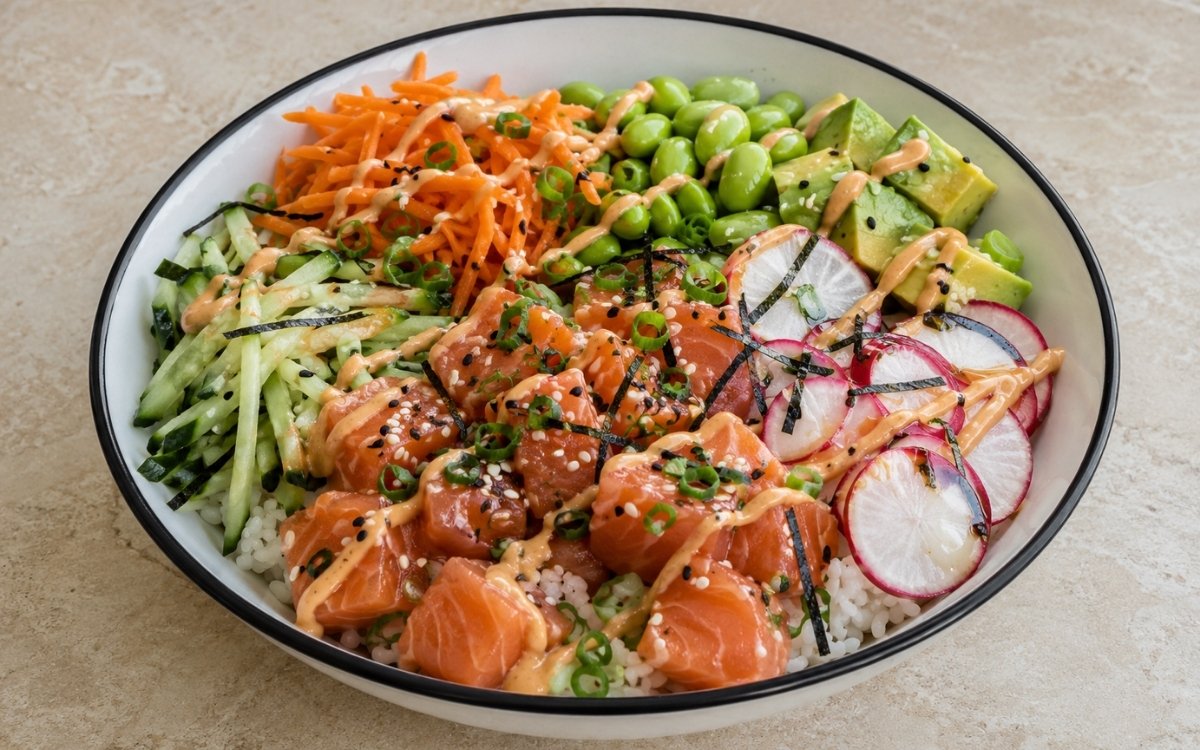
- Divide the seasoned sushi rice evenly among four wide, shallow bowls — the surface area matters for this bowl style, as the visual composition depends on all components being clearly visible from above. The rice goes in as a base covering the bottom of the bowl. Arrange the marinated salmon, julienned cucumber, sliced radishes, edamame, diced avocado, and shredded carrot in distinct, separate sections on top of the rice — work around the bowl placing each component in its own clearly defined area rather than mixing or scattering. This sectioned arrangement is what gives a poke bowl its characteristic visual identity: a mosaic of colors, textures, and shapes, each component visible and identifiable. Sprinkle the sesame seeds over the entire bowl from a height to distribute them evenly, then add the sliced green onions. Drizzle the spicy mayo in a zigzag pattern across the bowl from a squeeze bottle or spoon — enough to cover most of the components with a thin line rather than pooling in one area. Tuck or scatter the nori strips across the top. Serve immediately — this bowl does not hold well once assembled.
Notes
Sourcing sushi-grade salmon is the step that many home cooks skip or approximate, and it is the step that cannot be compromised. "Sushi-grade" is not a formally regulated term in most countries, but a reputable fishmonger using it means the fish has been handled at temperatures and under conditions that make it appropriate for raw consumption. In practice, this usually means the fish was frozen at very low temperature at sea immediately after catch — freezing at -20°C for 7 days or -35°C for 15 hours kills parasites that can be present in wild salmon. Farm-raised Atlantic salmon, which is the most commonly available sushi-grade salmon, carries lower parasite risk than wild Pacific salmon. If you are preparing this for guests with compromised immune systems, pregnant guests, or young children, the brief searing option noted in the recipe provides an additional safety margin.
Spicy mayonnaise is available ready-made in most Asian grocery stores and increasingly in mainstream supermarkets. Making your own takes 30 seconds: combine 60g Japanese mayonnaise (Kewpie brand if available — it is richer and more umami-forward than Western mayo) with 15–20g sriracha and stir. Adjust the sriracha quantity to heat preference. Kewpie mayonnaise in particular has a dramatically better flavor than standard Western mayonnaise in this application — its egg-yolk richness and mild sweetness are specifically well-suited to Japanese-inspired dishes.
Sushi rice vinegar seasoning is added while the rice is still warm for a specific reason — warm rice absorbs the vinegar mixture more readily and the folding motion distributes it more evenly than cold rice, which resists absorption and can leave sour patches. The rice should be warm but not hot when assembled with the cold marinated salmon — hot rice partially cooks the fish from below.