Ingredients
Method
Make the Honey-Raspberry Syrup
- Combine the 150g of raspberries, 120ml of water, and 90g of honey in a small saucepan. Place over low heat — specifically low rather than medium or medium-low, consistent with the extraction-not-reduction principle applied to the cranberry, blueberry, and pink lemonade preparations. Stir gently until the honey is completely dissolved into the warming liquid and the raspberries begin releasing their juice. Cook for 5–8 minutes, pressing the raspberries gently with the back of a spoon as they soften to encourage juice release. The liquid should remain fluid and vivid ruby-red; no reduction in volume should be visible. Honey's choice over white sugar in this syrup is specific to raspberry's aromatic profile. Honey's primary constituent sugars — fructose and glucose — are identical to white sugar's breakdown products and provide the same sweetening effect. However, honey retains trace aromatic compounds from the nectar sources visited by the bees, and mild honeys (acacia, clover, or orange blossom) specifically share geraniol and linalool compounds with raspberry's own aromatic profile — producing a specific aromatic resonance that white sugar cannot. The sweetness tastes warmer and more rounded alongside raspberry's fruitiness. Remove from the heat. Add the lemon zest and cover. Allow to steep for 5–8 minutes. The lemon zest's aromatic oils integrating into the warm raspberry-honey medium produce the same specifically unified citrus-fruit aromatic depth as in the blueberry and mango lemonade preparations. Strain through a fine-mesh sieve, pressing gently but firmly — firm enough to extract the maximum ruby-coloured syrup from the cooked raspberry solids, but not forcing dry pulp or seeds through. Discard solids. Allow to cool completely.
Extract the Fresh Raspberry Juice
- Add the second 150g of raspberries to a separate bowl. Using a fork, mash gently until the berries have broken down and released their juice — soft pressing rather than aggressive crushing. Strain through a fine-mesh sieve, pressing lightly on the seeds to extract the bright, fresh, volatile-compound-rich raw raspberry juice while keeping the seeds out of the finished drink. Press lightly rather than firmly — the goal is fresh, aromatic juice rather than maximum yield, and the seeds' tannins are more specifically present in the pressed residue from raw berries than from cooked ones. The distinction between the two raspberry preparations is the key to this lemonade's specific character. The honey syrup's cooked raspberries have developed a warm, deep, specifically concentrated fruity richness — the heat conversion of some volatile esters into more stable, warmer-tasting compounds. The fresh strained juice retains raspberry's specifically vivid, bright, almost floral fruitiness — the volatile aromatic esters (principally α-ionone, α-terpineol, and various furanones) that are responsible for fresh raspberry's characteristic bright, vivid character and that evaporate rapidly at cooking temperatures. Both together produce the specifically layered raspberry flavour that neither alone provides.
Build the Lemonade
- Add the lemon pulp to the large pitcher and mash gently until juice is released. Add the 240ml of fresh lemon juice, 120ml of the cooled honey-raspberry syrup, all of the fresh raspberry juice, 750ml of ice-cold water, and the pinch of fine sea salt. Stir thoroughly. Taste carefully with attention to the balance between raspberry and lemon. The correctly built base should be immediately identifiable as lemonade — the lemon's bright, clean, structural acid present throughout — while the raspberry's vivid, layered fruity character (warm depth from the syrup, bright freshness from the raw juice) provides the primary fruit register. If the raspberry has taken over to the point where the lemon's structural function is not perceptible, a small splash of additional lemon juice restores the balance. If the flavour is flat, more honey-raspberry syrup provides additional depth; the fresh juice can also be increased by mashing and straining an additional 50g of raspberries.
Chill and Serve
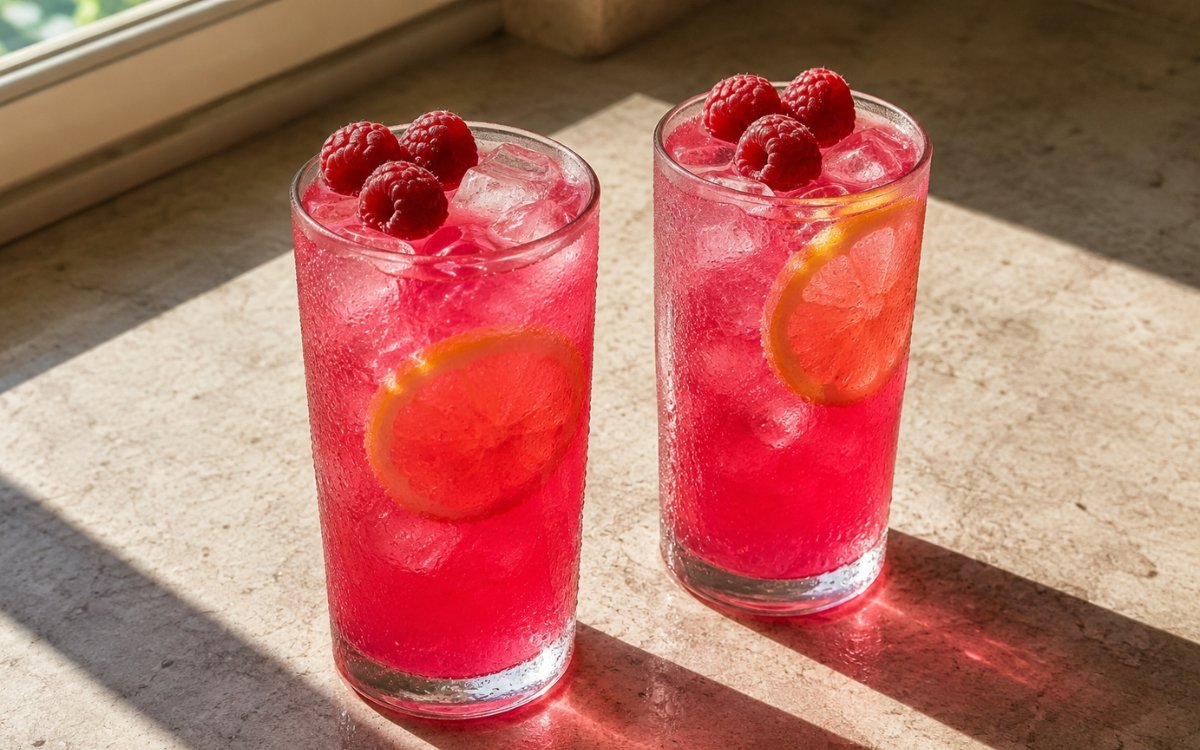
- Refrigerate for 1–2 hours. Fill glasses with ice. Pour the chilled raspberry lemonade over the ice. Garnish with a lemon slice and several fresh raspberries resting on the ice. Serve immediately.
Notes
The dual-extraction approach — cooked syrup plus raw cold-pressed juice — is the most technically considered preparation in this collection, and its rationale is the clearest possible illustration of why temperature matters in fruit drink preparation: raspberry's most pleasant aromatic character contains two distinct categories of compounds with opposite heat responses.
The pigment-carrying anthocyanins and the larger flavour compounds that provide warm, concentrated, deeply fruity richness are heat-stable and extract efficiently at low simmering temperature. The volatile esters responsible for raspberry's vivid, bright, specifically fresh aromatic character are heat-sensitive and evaporate rapidly. By splitting the raspberries into two preparations — one cooked, one raw — both categories of compounds are preserved in the finished drink in a way that neither a fully cooked nor a fully raw preparation achieves alone.