Ingredients
Method
Dissolve the Honey Without Heat
- Combine the honey and 80ml of warm water in a small bowl. Stir vigorously until the honey is completely dissolved — the warm water reducing the honey's viscosity enough for full dissolution without any heating required. The water temperature should be warm to the touch — approximately 40–50°C — not boiling or simmering. The goal is a fluid honey syrup that mixes evenly into the raspberry-lime base without leaving viscous honey deposits concentrated at the bottom of the pitcher. Honey at full concentration in cold water resists dissolution regardless of how long it is stirred; the brief warm water step is the specific shortcut that makes the no-cook approach viable.
Blend and Strain the Raspberries with Lime
- Add the 250g of fresh raspberries and 120ml of fresh lime juice to a blender. Blend at high speed for 30–40 seconds until completely smooth and vivid red — no visible raspberry pieces remaining. The lime juice serves a dual purpose here: it provides the primary acid component and simultaneously prevents the raspberry's colour from oxidising during blending, preserving the specifically vivid, saturated red that makes the finished limeade visually striking. Strain through a fine-mesh sieve into a large pitcher, pressing firmly on the raspberry pulp to extract as much liquid as possible. The pressed solids should be dry and pink-white — all the colour and juice having transferred to the strained liquid. Discard the seeds and dry pulp. The strained base should be a clear, vivid, deep ruby-red with a clean, sharp raspberry-lime aroma.
Build the Limeade Base and Taste
- Stir the honey syrup and 300ml of cold water into the strained raspberry-lime base. Stir well until the honey syrup is completely distributed through the larger liquid volume. Taste carefully and adjust each dimension: if the flavour is too sharp and acidic, add additional honey in small increments; if the raspberry-lime combination tastes flat or one-dimensional, add more lime juice to brighten it; if the overall concentration is too intense for a long-drink format, add up to 100ml more cold water. The base at this stage should taste assertively flavoured — more concentrated than the intended final drink — because it will be further diluted by both the ice and the club soda at serving. A base that tastes correctly balanced before the club soda is added will taste diluted and mild in the glass.
Clap and Cold-Infuse the Herbs
- Lightly clap the 20g of basil leaves and 10g of mint leaves together between your palms — one firm clap to bruise the surface aromatic oils without crushing the leaves aggressively. Add both to the pitcher with the raspberry-lime base. Cover and refrigerate for 5–10 minutes only. The specific 5–10 minute window is the most conservative herb-infusion time in this collection for a specific reason: basil is among the most aromatic but also most volatile and most pH-sensitive of the herbs used across these preparations. In an acidic medium — raspberry and lime juice — basil's pleasant aromatic compounds (primarily linalool and eugenol) begin shifting toward the less pleasant chlorophyll-dominant, slightly bitter, grassy character more rapidly than in neutral or lightly sweet mediums. Five minutes in cold, acidic raspberry-lime produces a specifically clean, slightly anise-fresh, aromatic basil note; ten minutes is the maximum before a grassy edge begins developing. Always strain at or before the 10-minute point.
Add Club Soda Right Before Serving
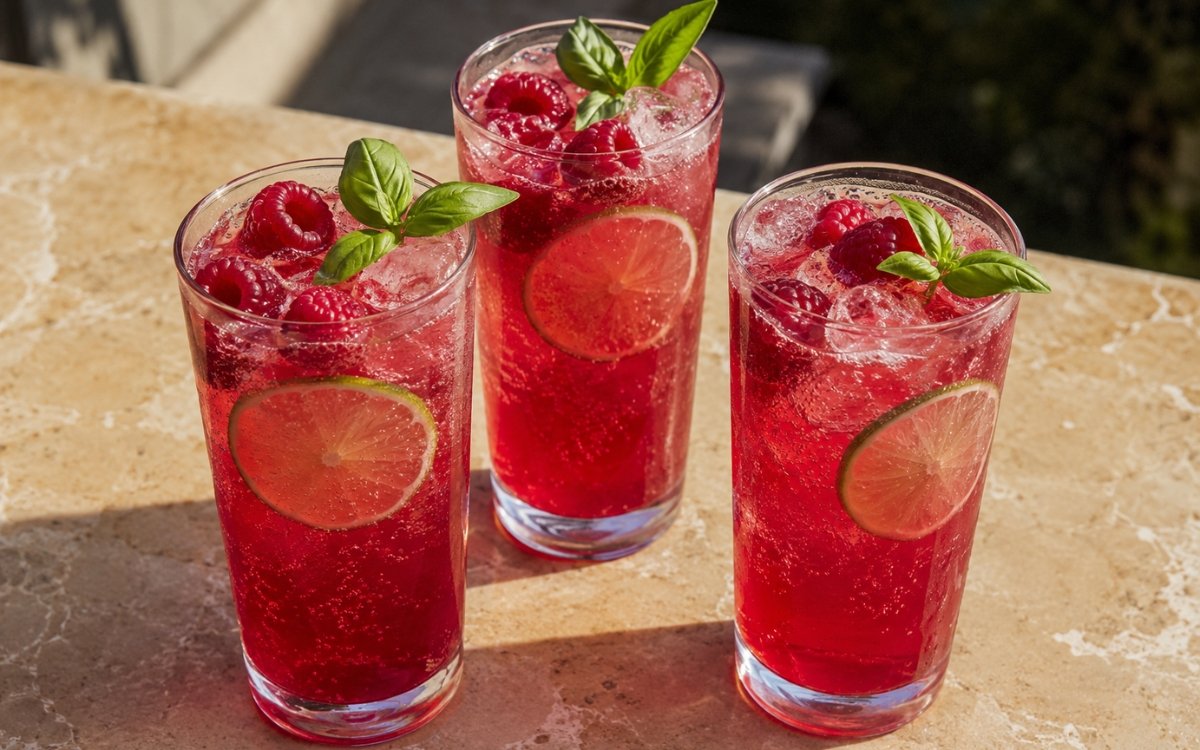
- After straining the herbs, the base is ready. Do not add the club soda to the pitcher in advance — the carbonation will be significantly depleted before the drink is served. Add the 900–1000ml of chilled club soda to the pitcher immediately before serving, pouring gently down the side of the pitcher rather than pouring into the centre which releases carbonation rapidly. Stir once or twice gently — enough to distribute the raspberry base through the club soda without collapsing the effervescence. Fill glasses with ice and pour the limeade over the top rather than pouring the base first and adding soda to the individual glass — the pitcher method ensures the carbonation is distributed evenly. Garnish each glass with a lime slice slipped against the ice, a few fresh raspberries if desired, and a small basil or mint sprig. Serve immediately.