Ingredients
Method
Soak the Corn Husks
- Place the dried corn husks in a large bowl or tray and cover with hot water. Weigh them down with a plate so they stay submerged. Soak for at least 30 minutes, until flexible and easy to fold. Tear a few smaller husks into thin strips for tying if needed. Drain and pat dry before assembling. Fully submerged, evenly soaked husks are what make clean folding possible — a husk that's only partially rehydrated will crack right at the fold line, exactly where the tamale needs the most structural integrity.
Cook the Pork
- Season the pork shoulder with salt and black pepper. Heat the neutral oil in a heavy pot over medium-high heat. Sear the pork in batches for 3–4 minutes per side, until browned. Do not crowd the pot. Add the onion, garlic, bay leaves, and water or chicken stock. Bring to a simmer, then reduce the heat to low. Cover and cook gently for 1 hour 45 minutes to 2 hours, until the pork shreds easily with a fork. The liquid should stay at a gentle simmer, not a hard boil. Add more water if the pot gets too dry. Searing the pork before it ever meets the braising liquid builds a foundation of browned flavour in both the meat and the broth — that same broth goes on to hydrate the masa later, so this early step is quietly seasoning two components of the finished tamale at once.
Toast and Soften the Chiles
- Toast the guajillo and ancho chiles in a dry skillet over medium heat for 10–15 seconds per side, just until fragrant and pliable. Do not let them blacken or smoke. Burned chiles will make the filling bitter. Cover the toasted chiles with hot water and soak for 15 minutes until softened. Drain before blending. The brief dry toast blooms each chile's specific aromatic character before rehydration — guajillo's fruity tang and ancho's raisin-like sweetness both come through more clearly toasted than simply soaked from raw.
Make the Red Chile Sauce
- Blend the softened chiles with the onion, garlic, tomato paste, cumin, Mexican oregano, smoked paprika, apple cider vinegar, hot pork cooking broth, and salt until smooth. Strain if the sauce has visible chile skin or grit. Heat 15ml neutral oil in a skillet over medium heat. Add the blended sauce and fry for 5–7 minutes, stirring often, until darker, thicker, and glossy. The sauce should smell roasted and rich, not raw or dusty. Frying the blended sauce briefly in oil after blending, rather than using it straight from the blender, is what moves it from tasting like raw chile purée to something roasted and rounded — this step matters for both the pork filling and the small amount folded into the masa.
Shred and Sauce the Pork
- Remove the cooked pork from the broth and rest for 10 minutes. Reserve the broth for the masa. Discard the bay leaves. Shred the pork into medium strands. Mix the shredded pork with enough red chile sauce to coat it generously, about 250–300ml. The filling should be juicy and glossy but not soupy. If it drips liquid heavily, cook it for a few minutes over medium heat to tighten it. The 10-minute rest firms the pork's fibres just enough to shred into clean strands rather than tearing into mush, and reserving the broth at this exact point — before it's reduced or seasoned further for any other purpose — is what keeps it available at the right consistency for hydrating the masa later.
Make the Tamale Masa
- Whisk the masa harina, baking powder, and salt in a large bowl. In a separate bowl, beat the softened lard until lighter and creamy, about 2–3 minutes. Add the masa mixture to the lard, then gradually mix in 300ml warm pork broth. Add 30ml red chile sauce if using. Beat or mix until the dough is soft, spreadable, and slightly fluffy. Add more warm broth 15ml at a time if the masa feels stiff. The masa should spread easily with the back of a spoon but hold its shape. If it cracks when spread, it is too dry. If it runs, it is too wet. Beating the lard on its own first incorporates air into the fat before it ever meets the dry masa — that trapped air is what gives the finished masa its light, slightly fluffy texture rather than a dense, heavy one, and it's not something that can be recovered by mixing harder once everything is combined.
Prepare the Salsa Verde
- Toss the tomatillos, onion wedges, jalapeños, and garlic with olive oil and salt. Broil or roast on a hot tray until the tomatillos soften and collapse slightly, and the onion and garlic develop browned edges, about 8–12 minutes. Transfer everything to a blender with the cilantro, lime juice, and 3 tbsp water. Blend until spoonable but still slightly textured. Add more water only if needed. Taste and adjust with salt or extra lime juice. The salsa should be bright, tangy, and vivid green. Broiling rather than simmering the tomatillos and aromatics develops a light char that deepens and brightens the salsa's flavour at the same time — a boiled version tends to taste flatter and more purely acidic by comparison.
Assemble the Tamales
- Lay one softened corn husk flat with the wide end closest to you. Spread about 60–70g masa in a rectangle across the centre, leaving space at the narrow end and sides for folding. Add about 45–55g red chile pork filling down the centre of the masa. Fold one side of the husk over the filling, then fold the other side over to enclose it. Fold the narrow bottom end upward. Tie with a thin strip of corn husk if needed. Repeat with the remaining masa and filling. You should get about 8 tamales, or 2 tamales per serving. Leaving a clear margin of husk around the spread masa, rather than covering it edge to edge, is what allows a clean fold — masa spread too close to the edges squeezes out and mixes with the next tamale's husk during steaming.
Steam the Tamales
- Set up a steamer pot with water below the steamer basket. Arrange the tamales upright with the open ends facing up. Cover with extra soaked corn husks, then cover the pot. Steam over medium heat for 60–75 minutes, checking occasionally to make sure the pot does not run dry. The tamales are done when the masa pulls cleanly away from the husk and feels set, not wet or sticky. If the masa still clings heavily to the husk, steam for another 10–15 minutes and check again. Standing the tamales upright with the open end facing up keeps steam moving directly through each one from the top, cooking the masa evenly from the outside in — laid on their sides, they'd cook unevenly and the open ends would be prone to unwrapping in the steamer.
Rest the Tamales
- Turn off the heat and let the tamales rest in the covered steamer for 10–15 minutes. This rest is important. Freshly steamed masa is fragile and firms as it sits. Masa straight off the steamer is still setting internally — cutting or unwrapping it immediately tears rather than pulls cleanly away from the husk, which is exactly the wet, broken look this rest period is designed to prevent.
Serve
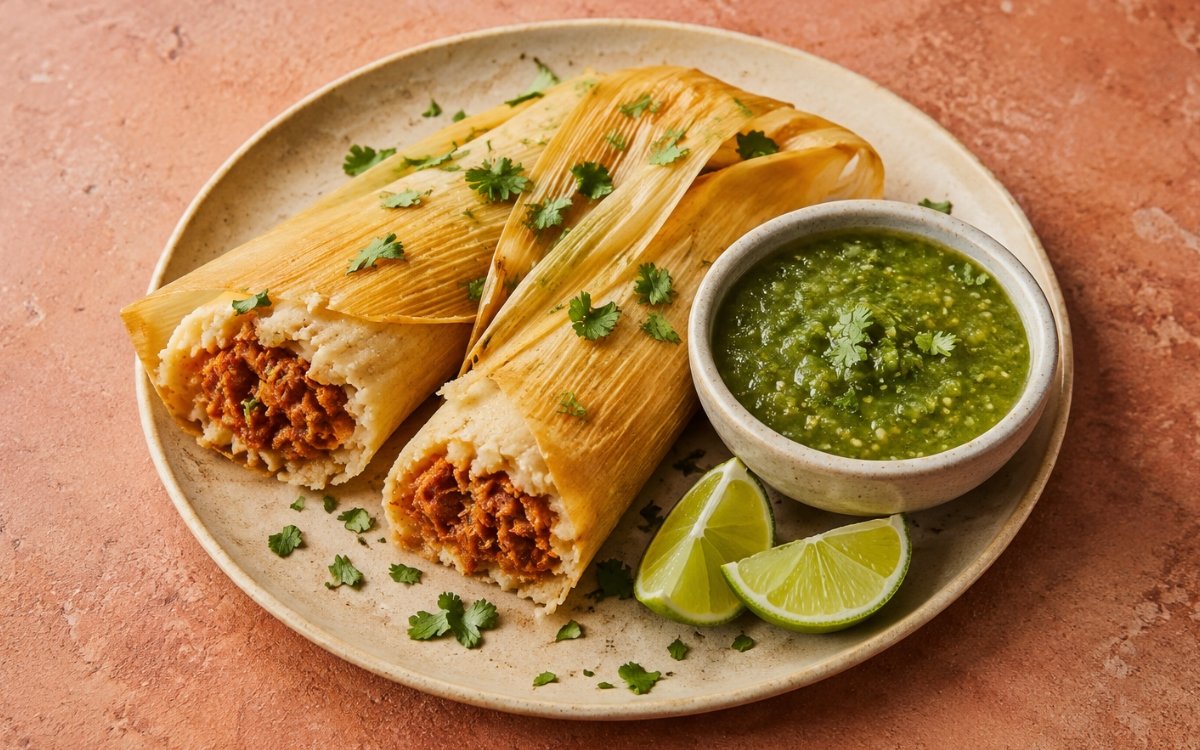
- Partially unwrap the tamales from their corn husks so the pale masa and red pork filling are visible at the open end. Arrange 2 tamales per serving on plates. Serve with salsa verde in a small bowl beside the tamales, fresh cilantro scattered over the plate, and lime wedges on the side. Serve warm. Partially unwrapping rather than fully removing the husk keeps the tamale intact and easy to handle while still showing off the contrast between the pale masa and the red pork filling at the open end.
Notes
Beating the lard before it meets the dry masa is the single technique that separates genuinely tender, light tamale masa from dense, heavy masa, and it's also the step most often skipped or rushed at home. Softened lard beaten on its own for a full 2–3 minutes traps air throughout the fat; once that aerated lard is combined with the masa harina and broth, the trapped air carries through into the finished dough, giving it a slightly fluffy quality that plain mixing after combining everything can't replicate. Fat added flat, without this separate beating step, produces masa that steams up dense and compact instead.
Using the pork's own cooking broth to hydrate the masa, rather than plain water, threads the pork's flavour through the wrapper as well as the filling. This is a small detail with an outsized effect — the masa on its own is fairly neutral in flavour, and hydrating it with a rich, well-seasoned broth means even the plainest bite, away from the filling itself, still carries genuine savoury depth rather than tasting like bare corn dough.
The gap between "juicy and glossy" and "soupy" in the sauced pork filling is worth watching closely. A filling with too much liquid will seep out into the surrounding masa during the long steam, producing tamales that are soggy near the centre and structurally weaker overall. The brief stovetop tightening step, cooking the sauced pork down for a few minutes if it looks too loose, is a small adjustment that protects the texture of the entire tamale.
The resting period after steaming is not a formality. Freshly steamed masa is at its most fragile state directly off the heat — still fully hot and not yet fully set — and cutting into or unwrapping it at that point tears the masa rather than releasing cleanly from the husk. The 10–15 minute rest, still covered in the residual steam of the pot, allows the masa to finish firming up so that unwrapping reveals a clean, intact tamale rather than a torn, wet-looking one.