Ingredients
Method
Build the Ginger Syrup
- Add the 250ml of water, 70g of light brown sugar, 30g of thinly sliced fresh ginger, and the zest of ¼ lime to a small saucepan. The ginger should be sliced approximately 3–4mm thick rather than roughly chopped or grated — thin slices provide sufficient surface area for flavour extraction without producing a fibre-clouded syrup that requires aggressive straining to clear. Place over medium-low heat and bring to a gentle simmer, stirring until the brown sugar has completely dissolved. Continue simmering for 8–10 minutes, stirring occasionally. Unlike the mint in the watermelon fizz or the elderflower in the cucumber tonic — both of which require off-heat steeping at protected temperatures to preserve delicate volatile aromatics — ginger's primary flavour compounds (gingerols and their heat-converted derivatives, shogaols) are relatively heat-stable and specifically improve with sustained gentle cooking. Raw ginger added directly to cold liquid is sharp, pungent, and slightly harsh. Ginger simmered for 8–10 minutes in sugar syrup undergoes a partial conversion of its harsher pungent compounds into the warmer, more rounded, building heat that is ginger's most pleasant contribution in a drink context — present as a warm back-of-the-throat warmth rather than an aggressive sting. The brown sugar's molasses adds a caramel-adjacent warmth that is specifically complementary to the ginger's heat, producing a deeper, more interesting base than white sugar at the same quantity.
Mash the Pomegranate Seeds into the Warm Syrup Off Heat
- Remove the saucepan from the heat. Immediately add the 150g of fresh pomegranate seeds to the warm syrup. Using a muddler, the back of a sturdy spoon, or a potato masher, press firmly on the pomegranate seeds — not a gentle press but a decisive mashing that ruptures the majority of the arils and releases their juice fully into the surrounding syrup. The pomegranate seeds are added off heat specifically: the warm syrup (approximately 75–80°C at the moment of removal from the heat) is sufficient to draw additional colour, juice, and flavour from the broken arils during the steeping period without the active boiling that would drive off the fresh, bright, slightly tart volatile character of the pomegranate juice and replace it with a flat, jam-like cooked note. Allow the mashed pomegranate and ginger syrup to steep together for 10 minutes — the warm syrup progressively deepening in colour from a pale amber to the deep ruby-red of the fully extracted pomegranate juice. The temperature declines through this window, ensuring the extraction occurs at progressively lower temperatures rather than sustained high heat. The finished mixture should be a vivid, deeply ruby-coloured liquid with the mashed pomegranate solids and ginger slices suspended throughout.
Strain and Chill
- Strain the syrup through a fine-mesh sieve over a clean jug, pressing lightly on the pomegranate solids to extract as much liquid as possible without pressing so hard that the pomegranate skin's slightly bitter compounds over-extract into the syrup. Discard the ginger slices, lime zest, and mashed pomegranate solids. The finished strained syrup should be a clear, vivid, deep ruby-red — intensely coloured from the pomegranate's anthocyanins, specifically the same pigment family as the hibiscus fizz but producing a distinctly different, more wine-adjacent depth of colour. Allow to cool to room temperature for 10–15 minutes, then transfer to the refrigerator and chill completely before assembly — a minimum of 30 minutes.
Assemble and Serve
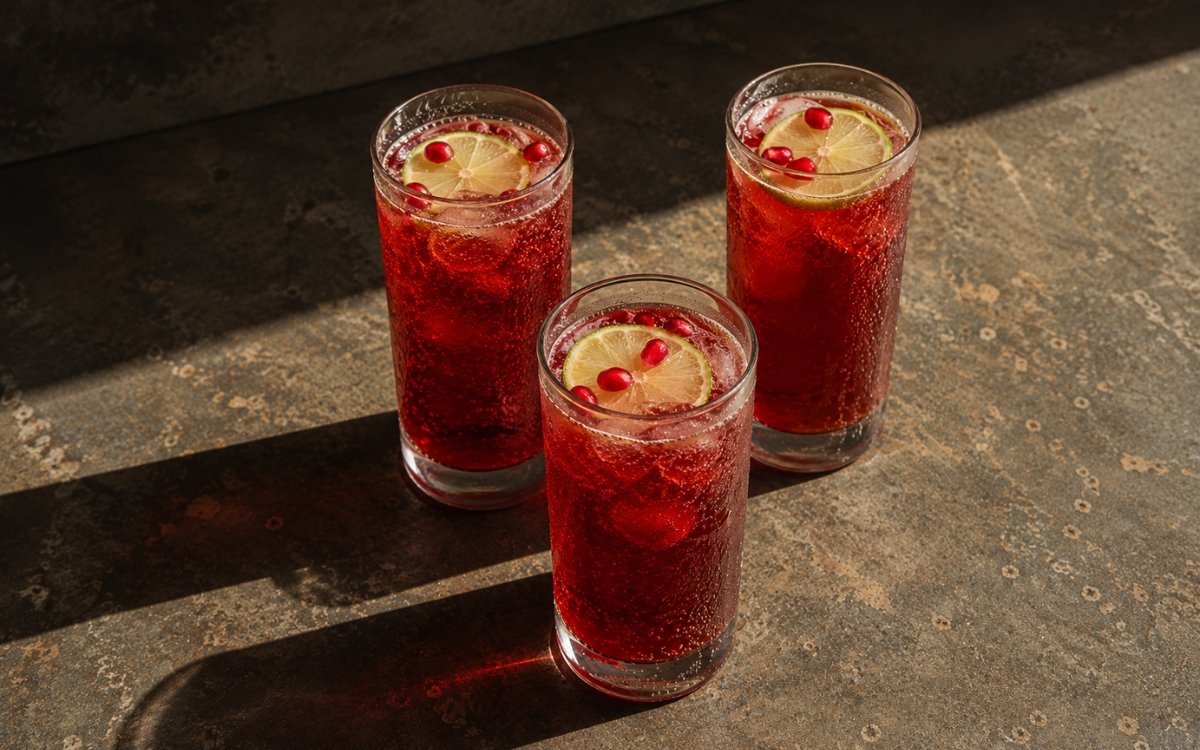
- Fill four tall glasses generously with ice cubes. Divide the chilled pomegranate ginger syrup evenly among the four glasses — approximately 65–70ml per glass. Stir briefly against the ice to further chill the syrup. Top each glass with approximately 125ml of chilled club soda, pouring gently down the inner side of the glass. The ruby syrup and the clear club soda meet briefly as two distinct layers before combining — the visual moment before the gentle stir is one of the preparation's most striking aspects. Stir gently once or twice to combine. Garnish each glass with a thin lime slice placed against the inner glass surface or across the rim. Scatter a small amount of fresh pomegranate seeds directly over the ice surface — the jewel-like ruby arils floating on the sparkling surface providing the visual counterpoint to the clear glass and the ice. For additional brightness, squeeze the lime slice directly into the drink immediately before serving and give one final gentle stir — the fresh lime juice's acidity lifting the pomegranate's tartness into something more specifically vivid. Serve immediately.
Notes
Pomegranate's colour comes from anthocyanins — the same water-soluble pigment family present in hibiscus, red cabbage, blueberries, and blackberries. In acidic environments (like a lime-brightened syrup) anthocyanins display vivid red-to-pink hues; in more alkaline environments they shift toward purple-blue. The lime zest and the optional lime squeeze at serving maintain the syrup's acidity and preserve the specific ruby-red rather than allowing the colour to shift toward darker, more purple-adjacent tones over time in storage.
Fresh pomegranate seeds are specifically the correct ingredient for this preparation — bottled pomegranate juice lacks the fresh brightness and the specific slightly tart, slightly wine-like complexity of freshly mashed seeds. If fresh pomegranate seeds are unavailable, bottled 100% pomegranate juice at 120ml added to the strained ginger syrup after straining and before chilling provides an acceptable substitute that requires no mashing or steeping step.