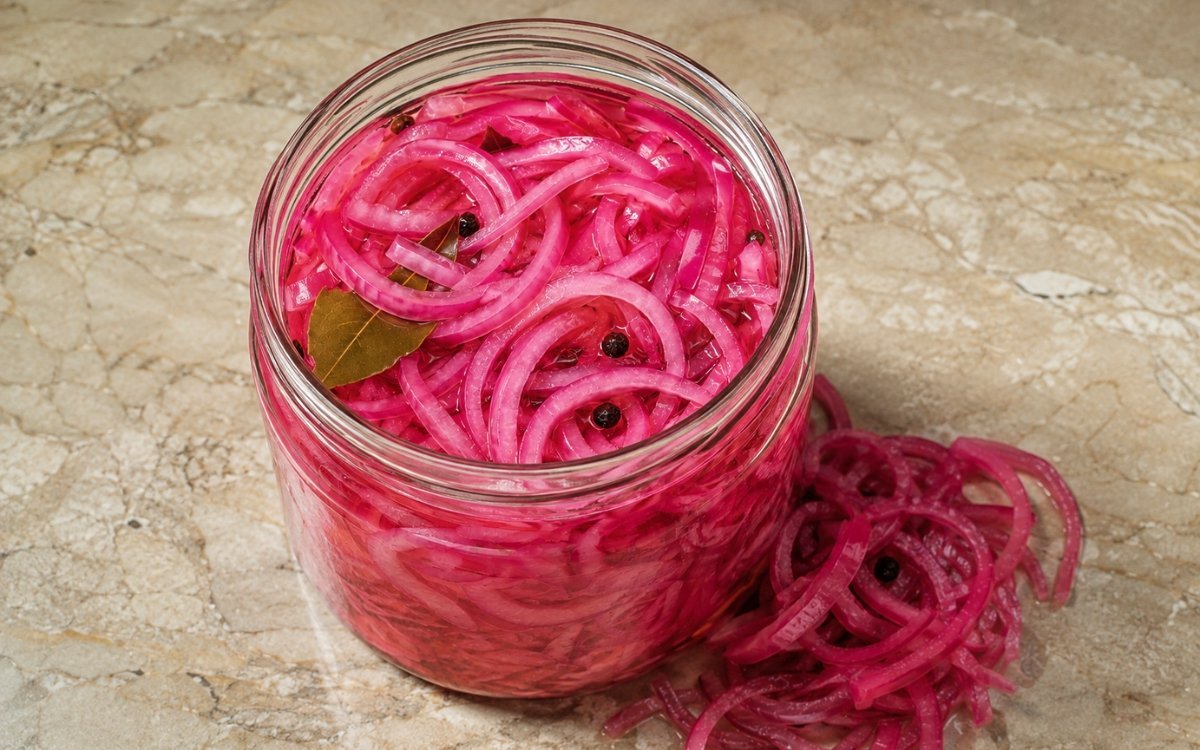
Ingredients
Method
Slice the Onions
- Peel the red onions, halve them through the root, and slice them thinly into half-moons. Try to keep the slices fairly even so they pickle at the same rate. Thin slices give the most classic texture — tender but still lightly crisp. Even slicing matters more here than it might seem for such a simple recipe — brine penetrates thin, uniform pieces at a consistent rate, while a mix of thick and thin slices in the same jar would leave some pieces properly pickled while others are either still raw-tasting or have gone limp.
Pack the Jar
- Place the sliced onions into a clean heatproof jar or container. Add the bay leaves, black peppercorns, and coriander seeds throughout the onions so the aromatics are distributed evenly. Do not pack the onions too tightly — they should have enough space for the brine to move around them. Leaving genuine space between the onion slices, rather than compressing them into the jar, lets the brine actually circulate and reach every piece — onions packed too densely would trap some slices away from full contact with the liquid.
Make the Brine
- In a small saucepan or bowl, combine the vinegar, hot water, sugar, salt, and lime juice. Stir until the sugar and salt are fully dissolved. If using a saucepan, warm the mixture gently just until everything dissolves — do not boil aggressively. The brine should taste bright, balanced, and slightly sharp, with enough salt and sugar to round it out rather than taste harsh. Fully dissolving the sugar and salt into the liquid before it ever touches the onion is what ensures that seasoning distributes evenly through every slice — any undissolved granules left in the brine would settle unevenly rather than flavouring the pickle consistently.
Pour and Press Down
- Pour the hot brine over the onions in the jar. Use a spoon to gently press the onions down so they are fully submerged. Make sure the bay leaves and spices are tucked into the liquid as well. Let the jar sit uncovered at room temperature for 20–30 minutes to begin softening and taking on colour. After a short rest, the onions should already begin turning vivid pink and slightly softening while still keeping some crunch. Fully submerging every slice, rather than leaving some peeking above the liquid's surface, is what ensures the whole batch pickles evenly — any exposed portion left above the brine simply doesn't get the same contact time and would lag behind the rest in both colour and flavour.
Cool and Chill
- Once the onions have cooled, cover the jar and refrigerate. They are good after about 1 hour, but best after 4–12 hours, when the flavour settles and the colour deepens fully. Serve chilled or cool. This extended resting period in the refrigerator gives the brine's flavours — vinegar, lime, sugar, salt, and the aromatic bay, peppercorn, and coriander — real time to fully permeate every layer of the onion rather than sitting only on the surface, which is exactly why the flavour and colour continue developing well beyond that first hour.
Notes
Slicing the onions thin and genuinely even deserves more attention than its simplicity might suggest, since it's the detail most directly responsible for whether the finished batch pickles consistently. Thin, uniform slices allow the brine to penetrate at the same rate throughout, producing onions that all reach the same texture together. A batch with a mix of thicker and thinner pieces will inevitably pickle unevenly, with the thinner slices going soft while thicker ones are still noticeably firmer and less flavoured.
Fully dissolving the sugar and salt into the brine before it ever meets the onion is worth treating as a genuine requirement rather than an assumed given. Any granules left undissolved in the liquid settle unevenly once poured over the onions, meaning some slices end up more seasoned than others purely by chance of where those granules happened to land — a fully dissolved brine avoids that inconsistency entirely.
The brine's temperature at the moment of pouring functions as a genuinely useful, adjustable control on the finished onion's texture. Hot brine poured immediately softens the onion more aggressively and quickly; letting the brine cool slightly before pouring produces a crunchier result. This is a real, practical lever worth understanding and using deliberately depending on which texture is preferred for a given use.
The extended refrigeration window — best between 4 and 12 hours, though usable after just one — reflects how flavour genuinely continues developing over that longer resting period. The brine needs real time to fully permeate every layer of each onion slice, not just its exposed surface, which is why the colour and flavour both continue deepening well past that first hour, even though the onions are technically ready to eat sooner.