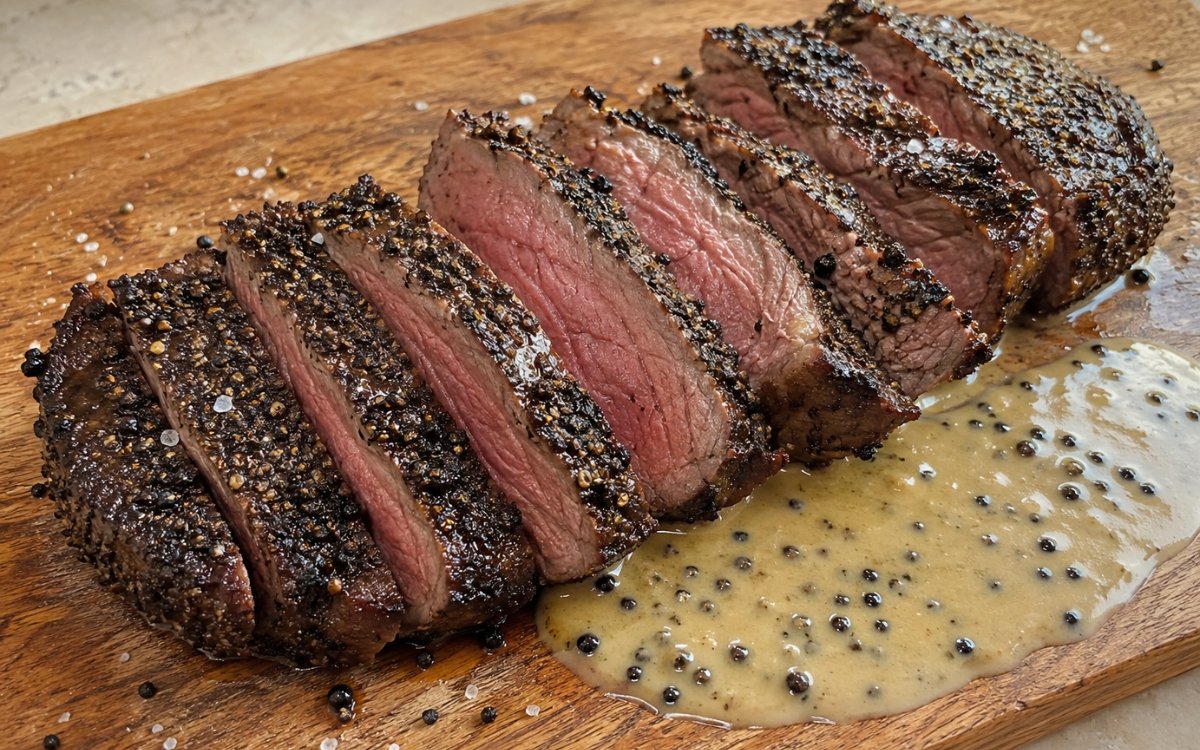
Ingredients
Method
Temper and Dry the Meat
- Remove the steaks from the refrigerator 30 minutes before cooking and leave them uncovered on a tray. This step equalises the internal temperature of the meat, reducing the gradient between the cold centre and warm exterior. Without tempering, the outer layers overcook before the centre reaches proper doneness. Pat the steaks completely dry on all surfaces using paper towels. This is not optional — it is foundational. Surface moisture must evaporate before the temperature can rise above 100°C. If water remains, the steak steams instead of sears, and the peppercorn crust will not adhere properly. A wet steak cannot form a crust — it is physically impossible.
Crush the Peppercorns Properly
- Place the whole peppercorns in a mortar and pestle or under a heavy pan and crush them coarsely. The correct texture is irregular — large fragments, cracked halves, and smaller shards. Do not grind into powder. This step defines the entire dish. Coarse peppercorns behave differently under heat: they toast gradually and release aromatic oils in stages, creating layered heat instead of uniform bitterness. Fine pepper burns quickly and produces an acrid, flat flavour. The goal is controlled release, not immediate intensity.
Season First, Then Apply the Pepper
- Season the steaks generously with salt on all sides and press it into the meat. Allow it to sit briefly, then press the crushed peppercorns firmly onto the surface. This order matters. Salt penetrates and enhances the meat internally, while pepper must remain external to form a crust. Applying pepper too early or too loosely leads to poor adhesion and uneven flavour. There is also a structural issue: peppercorns create a physical barrier between meat and pan. If applied incorrectly, they reduce surface contact and weaken the sear. Some professional techniques intentionally coat only one side for this reason.
Preheat the Pan Aggressively
- Heat a heavy pan (cast iron or stainless steel) over high heat until it begins to smoke lightly. Add oil just before placing the steak. This level of heat is required for the Maillard reaction — the chemical process responsible for creating hundreds of complex flavour compounds. Without sufficient heat, you do not get a crust — you get browned meat that tastes flat.
Sear Without Movement
- Place the steaks in the pan and leave them completely undisturbed for 4 minutes. Do not touch them, press them, or adjust them. During this time, two processes happen simultaneously: the meat surface undergoes Maillard browning and the peppercorns toast and embed into the protein structure. Interrupting this stage breaks both processes. Movement destroys crust formation and prevents proper adhesion of the pepper layer.
Flip and Transition to Controlled Heat
- Flip the steaks and immediately add butter. As the butter melts and foams, tilt the pan and continuously spoon it over the meat. This is the critical transition point. The cooking method shifts from aggressive direct heat to controlled fat-mediated heat transfer. Butter reduces the effective surface temperature while still delivering energy, preventing the pepper from burning while finishing the steak. Fat also dissolves aromatic compounds from the pepper and distributes them more evenly across the surface, reducing harshness and increasing perceived depth.
Control Doneness with Precision
- Cook for another 3–4 minutes, depending on thickness. Remove the steak at 52–54°C for medium-rare. Peppercorn crusts are less forgiving than standard steaks. The spice layer continues to cook even after removal, meaning overcooking affects both meat texture and flavour quality. Precision is not optional here — it is required.
Build the Pan Sauce (Optional but Strategic)
- Remove the steaks and add brandy to the hot pan, scraping up the fond. The fond is concentrated flavour created during searing and must be incorporated into the sauce. Allow the alcohol to reduce for 60–90 seconds. This burns off harsh volatile compounds while concentrating sweetness. Then add cream and simmer gently until the sauce thickens and coats the back of a spoon. Heat control is critical here — boiling cream causes separation. The sauce should reduce slowly, not aggressively.
Rest and Slice
- Rest the steaks for 5 minutes before slicing against the grain. During cooking, muscle fibers contract and push moisture inward. Resting allows those juices to redistribute throughout the structure. Cutting immediately results in moisture loss and a visibly dry steak.
Notes
Coarse peppercorn texture is the single most consequential decision in this recipe. The irregular fragments, cracked halves, and shards toast gradually and release their aromatic oils in stages under heat, producing layered heat rather than uniform bitterness — finely ground pepper, by contrast, burns almost immediately and produces a flat, acric result no technique afterward can correct.
The order of salt then pepper is deliberate and structural. Salt is meant to penetrate into the meat; pepper is meant to stay on the surface as a crust. Reversing or rushing that order — applying pepper too early or too loosely — produces poor adhesion and uneven flavour distribution across the finished steak.
Doneness precision matters more here than with an unseasoned steak, since the peppercorn crust continues cooking even after the steak is removed from the pan. Pulling the steak at 52–54°C for medium-rare, rather than waiting for a higher final temperature, accounts for that carryover cooking specifically in the crusted layer.