Ingredients
Method
Prepare the Sausage
- Remove the sausage from its casing if needed. Break it into rough irregular pieces by hand instead of mincing it too finely. The sausage should cook into uneven crumbles — some small, some larger. Uniform tiny mince looks boring and eats flat. Irregular pieces give better texture. Breaking the sausage apart unevenly by hand, rather than mincing it into a uniform texture, produces a mix of larger pieces that develop a real seared crust and smaller ones that crisp through more fully — that textural variety is part of what makes the finished ragù interesting bite to bite, rather than a uniform, mince-like sauce.
Brown the Sausage
- Place a large sauté pan over medium-high heat. Add a little olive oil only if the sausage is lean. Add the sausage and spread it into the pan. Let it sear undisturbed for 2–3 minutes before breaking it up. Continue cooking until the sausage is browned, lightly crisp in places, and the fat has rendered into the pan. This stage makes or kills the dish. Pale steamed sausage is trash here. You need browned edges and rendered fat because that is the foundation of the sauce. Letting the sausage sit in genuine contact with the hot pan before disturbing it is what allows real browning to develop — sausage broken up and stirred from the moment it hits the pan releases moisture too quickly and simmers rather than searing, producing pale crumbles with none of the rendered fat this whole sauce depends on.
Build the Ragù Base
- Lower the heat to medium. Add the finely diced shallots to the sausage and fat. Cook for 3–4 minutes until softened and translucent. Add the grated garlic and black pepper. Cook for 30–45 seconds until fragrant. If using white wine, pour it in and scrape the bottom of the pan. Simmer until mostly reduced. The shallots should soften into the fat, not brown aggressively. The garlic should smell sweet and fragrant, not burnt. Deglazing with white wine at this stage, scraping up the browned fond left behind by the sausage, carries that concentrated flavour directly into the sauce base rather than leaving it stuck to the pan.
Cook the Pasta
- Bring a large pot of salted water to a boil. Cook the pappardelle until just shy of al dente. Before draining, reserve at least 400ml of the pasta water. The pasta water is not optional. It carries starch, and that starch is what helps the sausage fat and Parmigiano turn into a sauce instead of greasy pasta with cheese clumps. Pulling the pasta while still just shy of al dente matters because it will continue cooking briefly once tossed into the hot pan with the sausage and pasta water — finishing it in the sauce rather than fully in the boiling water is what lets the noodles actively absorb some of that sauce rather than simply being coated by it afterward.
Emulsify the Sauce
- Transfer the pappardelle directly into the pan with the sausage. Add about 200ml reserved pasta water and toss over medium-low heat until the noodles start absorbing the sauce. Remove the pan from the heat. Add the finely grated Parmigiano-Reggiano gradually, tossing constantly. Add more pasta water as needed until the sauce turns creamy and glossy. Add the butter only if the sauce needs extra shine and body. Fold in the parsley off heat. The sauce should coat the pappardelle in a pale glossy layer and cling to the ribbons. It should not be watery at the bottom of the pan, and it should not split into oil and cheese. Add the Parmigiano off heat. If the pan is too hot, the cheese can seize and turn grainy. Removing the pan from direct heat before the cheese goes in protects the emulsion at its most vulnerable point — Parmigiano's proteins can seize and separate from their fat under too much direct heat, and tossing it in gradually while off the flame lets residual warmth melt it smoothly instead.
Finish and Serve
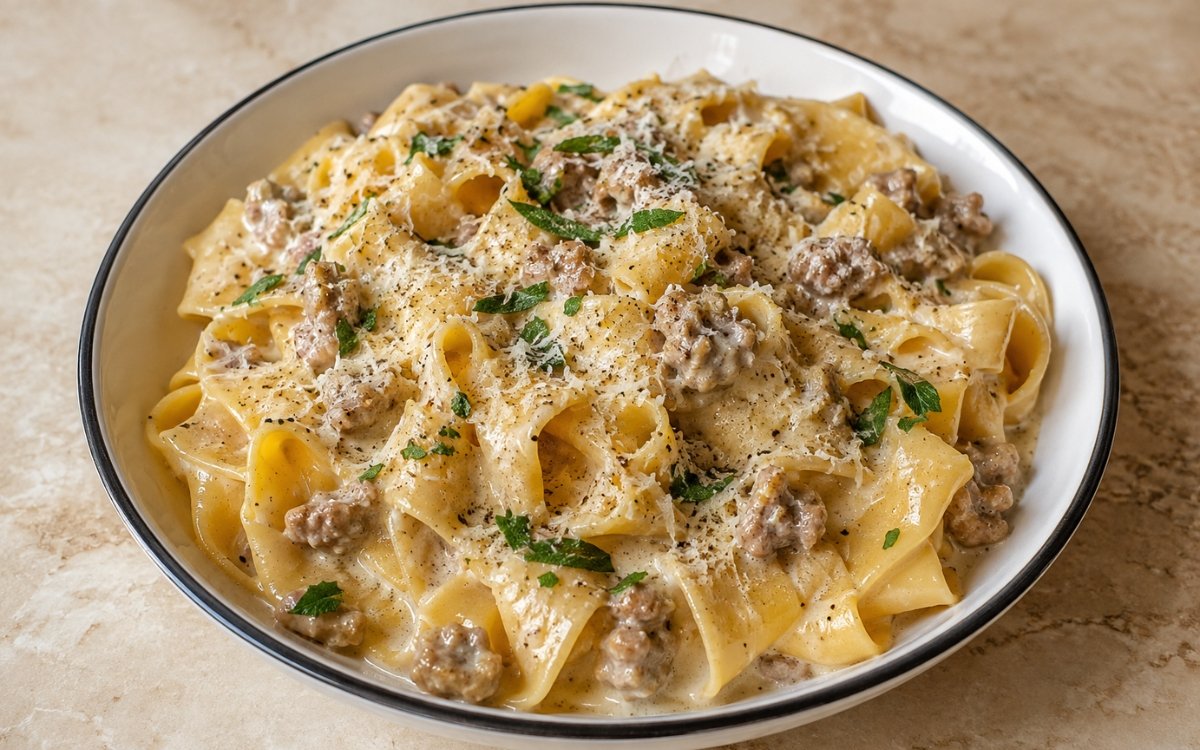
- Taste and adjust with fine sea salt only if needed, since sausage and Parmigiano are already salty. Serve immediately in warm bowls with more finely grated Parmigiano-Reggiano, cracked black pepper, and a little extra parsley. The finished pasta should look creamy, pale, rich, and heavily coated, with browned sausage pieces visible throughout the wide ribbons.
Notes
Searing the sausage thoroughly before it's broken apart is worth understanding as the true foundation of this entire dish, not simply an early cooking step. Every part of the sauce that follows — the fat the shallots soften into, the fond the wine deglazes, the base the pasta water and cheese ultimately emulsify with — traces back to how well the sausage was browned in this first stage. Pale, steamed sausage crumbles leave behind considerably less rendered fat and no real fond, and the resulting sauce tastes noticeably flatter no matter how carefully the later steps are executed.
The starchy pasta water is doing genuine structural work in this recipe rather than simply thinning the sauce. Sausage fat and finely grated Parmigiano don't naturally want to combine into a smooth, cohesive sauce on their own — left to themselves, they tend to separate into oil and clumped cheese. The starch suspended in properly reserved pasta water is what bridges that gap, allowing the fat and cheese to emulsify into something that clings to the pasta rather than pooling separately at the bottom of the pan.
Adding the Parmigiano off the heat, in stages while tossing continuously, is a technique worth treating as non-negotiable rather than a minor preference. Cheese proteins are genuinely sensitive to direct heat, and adding a large amount all at once into a still-hot pan risks the cheese seizing into grainy strands rather than melting smoothly into the sauce. Working gradually, off the flame, lets residual heat do the melting at a pace the cheese can actually follow.
This dish's specific vulnerability to sitting is worth taking seriously, since a cheese-and-starch emulsion like this one continues thickening as it cools. Pasta that looked perfectly glossy and creamy the moment it left the pan can turn noticeably heavier and stickier within just a few minutes on the table — this is a dish built for immediate serving rather than one with much tolerance for delay between finishing and eating.